Warehouse Management System in Orange, CA: Running an Antique and Distribution Warehouse Without a Manhattan-Sized Budget
A custom warehouse management system in Orange, CA runs $60,000 to $140,000 and ships in 14 to 22 weeks.
On this page
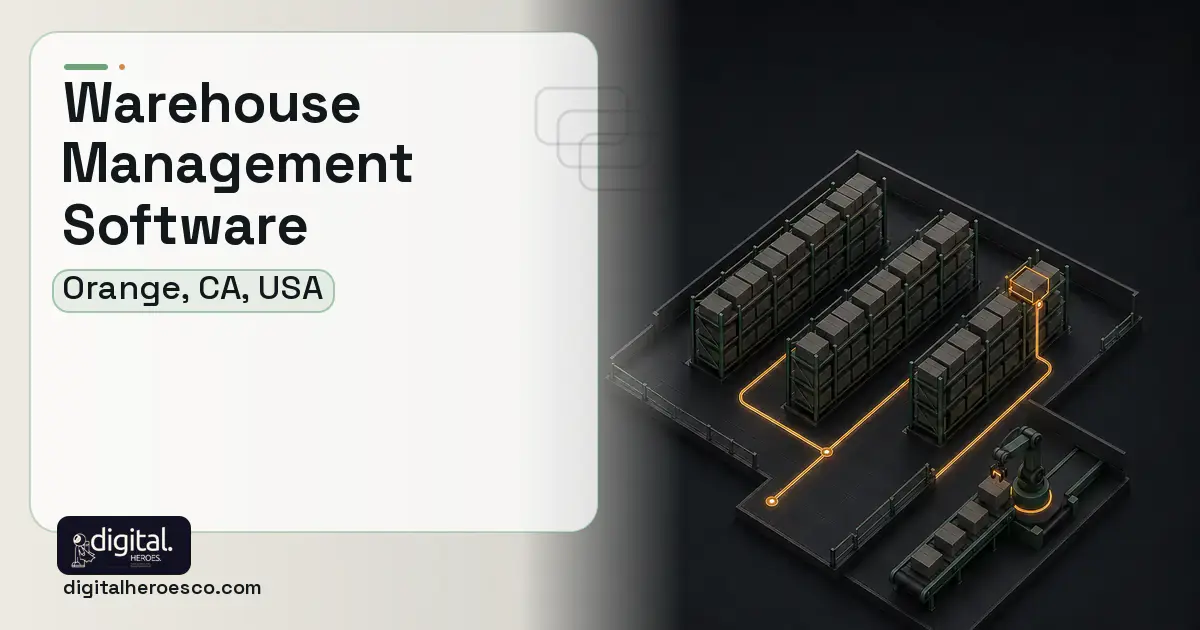
A custom warehouse management system in Orange, CA runs $60,000 to $140,000 and ships in 14 to 22 weeks. It suits Orange operations stuck between a bolt-on ERP (Enterprise Resource Planning) warehouse module that barely works and an enterprise WMS like Manhattan that is priced for national fulfillment networks, from antique-and-consignment storage to regional distribution.
Warehouse operations reveal the limits of whatever software you bolted on. The warehouse add-on inside your ERP treats a bin as a text field and a pick as an honor-system task, so your team walks the aisles hunting for stock and cycle counts never quite match. Manhattan and the enterprise WMS tier solve all of that, and cost and complexity built for operations shipping tens of thousands of orders a day, which no Orange antique warehouse or regional distributor is doing.
The specifics matter here. An Antique Row operation storing large, fragile, one-of-a-kind pieces needs location tracking and handling notes, not carton-flow logic built for identical boxes. A regional distributor near the 22 and 57 freeways needs directed picking, receiving, and honest counts across zones without an enterprise price tag. A right-sized WMS models your actual space and stock, so staff stop hunting and the count on the screen finally matches the shelf.
Where the off-the-shelf tools fall short
- An ERP warehouse add-on treats bins as text and picks as honor-system, so staff hunt for stock
- Cycle counts never match because the add-on has no real location or movement discipline
- Manhattan-tier WMS is priced for national fulfillment, not an Orange antique warehouse or regional distributor
- Large, fragile, one-of-a-kind pieces need handling and location logic that carton-flow WMS ignores
Custom warehouse management: what Orange teams actually get
A right-sized WMS models your warehouse as it is. For an Orange operator that means real bin and zone locations, directed put-away and picking, handling notes for fragile antiques, and honest cycle counts, without Manhattan-scale cost. It ties into your inventory system so counts are shared, your supply chain for inbound and outbound flow, and your online store so a web order picks the exact piece and retires it everywhere. Staff stop walking the aisles guessing, and the number on the screen matches the shelf.
- Your ERP warehouse add-on lets staff hunt for stock and counts never match
- You store fragile, oversized, or one-of-a-kind items needing real location logic
- Enterprise WMS is too costly and complex for your regional volume
- You need honest counts synced across inventory and e-commerce
- A simple stockroom is served fine by your ERP's warehouse module
- Volumes are low and staff can find stock without directed picking
- Budget is under $25,000 and accuracy pain is minor
- No one can drive scanning discipline and system upkeep
- Real bin and zone locations with directed put-away and picking, so staff stop hunting for stock
- Honest, reconciled cycle counts because every movement is tracked, not assumed
- Handling and location logic for large, fragile, one-of-a-kind antique pieces
- Right-sized cost versus enterprise WMS, matched to a regional Orange operation
- Tight sync with inventory, supply chain, and e-commerce so a pick updates every system
- A WMS needs hardware like scanners and labels, adding cost and integration work
- Staff must adopt disciplined scanning or the accurate-count benefit evaporates
- For a small, simple stockroom, an ERP add-on may genuinely be enough
- You own uptime; a WMS outage stops picking, so reliability planning is essential
Feature priorities for Orange teams
What we build under warehouse management in Orange
Digital Heroes builds the full warehouse management stack for Orange teams. Typical engagements cover inbound and outbound logistics, fulfillment software, 3PL software, warehouse management system (WMS), WMS development and pick pack ship.
The honest cost picture for Orange
| Project scope | Typical cost | Timeline |
|---|---|---|
| Core WMS: locations, directed picking, scanning | $60,000 to $90,000 | 14 to 18 weeks |
| Full build with receiving, shipping, and e-commerce sync | $90,000 to $140,000 | 18 to 24 weeks |
| Add-on: scanner hardware integration and labeling | $15,000 to $32,000 | 4 to 8 weeks |
Timeline: what happens, and when
Exactly what you get
A warehouse system sized to a regional Orange operation, built so the count on the screen matches the shelf. You get real bin and zone locations, directed put-away and picking so staff walk to stock instead of hunting for it, and barcode scanning that makes every move and count trustworthy. Fragile, oversized, or one-of-a-kind antique pieces get handling notes and special-location logic that carton-flow WMS ignores. Receiving and shipping workflows keep the docks organized, and real-time sync with your inventory and online store means a pick retires the item everywhere at once. Scanner hardware and labeling are part of the build, not an afterthought.
How to choose a developer in Orange
Ask them to right-size, not upsize. A partner who reaches for an enterprise WMS for a regional warehouse is solving the wrong problem. A strong Orange developer maps your actual zones and stock, designs directed picking and honest cycle counts, and treats scanner hardware and labeling as core scope rather than a loose end. Confirm they handle special cases like fragile antiques, and that they will sync the WMS with your inventory and online store so one pick updates everything.
- !They propose enterprise WMS for a regional warehouse; that is cost and complexity you do not need
- !No plan for scanning hardware and labeling, where much of the real work lives
- !They ignore special handling for fragile or oversized antique stock
- !No count-reconciliation design; accuracy is the outcome you are paying for
- !They skip the inventory and e-commerce sync that keeps every system honest
Teams investing in warehouse management in Orange usually scope it next to business intelligence (BI) dashboards, lms, internal tools, since these systems share data and budgets. Weighing options across the region? Nearby: warehouse management in Los Angeles, San Diego and San Jose. Want it built, not just budgeted? That is our custom software development practice.
The evidence behind this guide
Independent findings on why this investment pays off. Every link goes to the primary source.
- Poor software quality cost the US economy an estimated $2.41 trillion in 2022, including roughly $1.52 trillion in accumulated technical debt, driven partly by unsuccessful development projects and low-quality legacy systems. Source: Consortium for Information & Software Quality (CISQ) - Herb Krasner (2022) →
- Inventory carrying cost commonly runs about 20% to 30% of inventory value, covering capital cost, storage/warehousing, insurance, taxes, handling, shrinkage, and obsolescence - a recurring cost that better inventory and warehouse software aims to reduce. Source: APQC (2023) →
- The 2015 CHAOS data (based on the modern definition of success) reports that only about 29% of software projects succeed, 52% are challenged, and 19% fail, with the three most important success skills being executive sponsorship, emotional maturity, and user involvement. Source: The Standish Group (reported via InfoQ Q&A with Jennifer Lynch) (2015) →
- Median SaaS spend reached $9,455 per employee, and organizations leave an average of 36% of their SaaS licenses unused. Source: Zylo (2026) →
Frequently asked questions
How much does a warehouse management system cost in Orange, CA?
A core WMS with locations, directed picking, and scanning runs $60,000 to $90,000, and a full build with receiving, shipping, and e-commerce sync runs $90,000 to $140,000. Scanner hardware integration and labeling add $15,000 to $32,000. Warehouse size, zone count, and special handling are the main cost drivers.
Why is our ERP's warehouse module not enough in Orange?
Because bolt-on warehouse modules usually treat a bin as a text field and a pick as an honor-system task, so staff hunt for stock and cycle counts drift. A real WMS enforces locations, directed movement, and scanning, which is what actually keeps counts accurate. If your add-on is causing daily hunting and mismatches, you have outgrown it.
Is an enterprise WMS like Manhattan worth it for a regional Orange operation?
Rarely. Manhattan and its tier are built for national fulfillment networks moving tens of thousands of orders a day, with cost and complexity to match. A regional Orange antique warehouse or distributor gets the accuracy benefit from a right-sized custom or mid-market WMS at a fraction of the price, without the enterprise overhead.
Can a WMS handle large, fragile antique pieces?
Yes, and generic carton-flow systems cannot. A custom Orange WMS supports handling notes, special locations, and single-unit tracking for oversized or fragile one-of-a-kind stock, so a delicate piece is stored and picked with the care it needs. That fit is a key reason an antique-and-consignment warehouse would build rather than buy.
How long does a WMS build take in Orange?
Fourteen to 18 weeks for a core system and 18 to 24 weeks for a full build with receiving, shipping, and e-commerce sync. Hardware integration and staff training add time and should not be rushed. Roll it out zone by zone so the warehouse keeps running while the system comes online.
Does a WMS require barcode scanners and other hardware?
Usually, yes. Accurate counts depend on scanning every receipt, move, and pick, which means barcode scanners, printers, and labels integrated with the software. That hardware is part of the project scope and cost, and skipping it undermines the accuracy that justifies the build in the first place.
Who owns the WMS software after it is built?
You own it. Require assignment of source code and documentation and host it under your own accounts. Because the WMS governs how your warehouse runs day to day, owning the code and its data is essential to avoid being locked to one vendor for a system your operation depends on.
Can the WMS sync with our inventory and Shopify store?
Yes, and it should. A custom Orange WMS syncs with your inventory system and Shopify store so a pick or receipt updates counts everywhere in real time, preventing oversells of unique pieces. Confirm this sync is in scope, since a warehouse system that does not talk to your other tools just relocates the reconciliation problem.
Will staff actually use the new WMS after launch?
They will if it is designed for them and scanning is simple. Adoption is the real risk with any WMS, so insist on fast, forgiving scan workflows and hands-on training. A count is only accurate if staff scan consistently, so a system built around how your Orange team actually moves stock is worth more than a feature-rich one they avoid.
What do agencies charge for warehouse software development in Orange?
Local agencies in Orange generally bill $120 to $200 per hour for senior warehouse software work, while distributed teams with offshore delivery bill $40 to $80 per hour for comparable output; those are the bands Digital Heroes sees when competing for the same projects. Compare total fixed-scope quotes and shipped references rather than hourly rates, because a slow expensive team and a cheap inexperienced one blow the budget in different ways. For a defined MVP, fixed pricing removes most of the hourly-rate risk.
Our ERP already has a warehouse module. Why build custom instead of just turning it on?
Turn it on first if your operation matches its assumptions: standard pick-pack-ship, one inventory model, moderate volume. ERP add-ons like NetSuite WMS or SAP EWM struggle with mixed units of measure, customer-specific labeling, 3PL billing, and floor speed, and customizing inside the ERP often costs more than building beside it. Digital Heroes frequently builds a custom warehouse layer that owns floor operations and syncs orders and inventory back to the ERP, which keeps finance accurate without forcing pickers through ERP screens.
What integrations does a custom WMS usually need?
Four categories cover most builds: the ERP or accounting system for purchase orders and invoices, sales channels like Shopify or EDI feeds from retail customers, shipping carriers through UPS, FedEx, or a multi-carrier API like EasyPost, and hardware such as label printers and scales. Each ERP connection typically adds 2 to 4 weeks of work in Digital Heroes builds, and EDI with a big-box retailer adds more. List every integration before asking for quotes, because integrations are the most common source of budget overrun in Digital Heroes projects.
What questions should I ask a development agency on the first call?
Ask who exactly will build it, what happens when scope changes mid-project, what their maintenance terms are after launch, and what they will need from you every week. Then ask them to describe a project that went wrong and what they changed afterward; teams that have shipped at real volume have war stories, and teams claiming a perfect record are hiding something. The scope-change answer matters most: a disciplined shop describes a written change-order process, not a vague promise to be flexible.
What tech stack should a custom warehouse management system use?
A proven stack is a Node.js or .NET backend, PostgreSQL for inventory data, React for the office dashboard, and an Android app for the floor, with WebSockets pushing live task updates to scanners. Digital Heroes defaults to PostgreSQL because inventory math depends on transactional integrity, and to Android-first floor apps because rugged handhelds from Zebra and Honeywell run Android. Be wary of proposals built on no-code platforms, which cannot keep up with real-time floor operations at scale.
How do I vet a software agency for a WMS project?
Ask for a warehouse or logistics system they have already shipped and talk to that client directly, since WMS punishes teams who have only built standard web apps. In the first call, a capable team asks about your racking layout, scan points, SKU count, and peak daily order lines before showing you anything, because a team that starts with screens instead of flows designs the wrong system. Also confirm who actually writes the code, as many agencies sell with senior people and deliver with juniors.
Who can build custom warehouse management software for a business in Orange?
Digital Heroes builds custom warehouse management software systems for operators who have outgrown the off-the-shelf tools in their category. The work is delivered remotely: our engineers work from Delhi and Lucknow, leadership is in New York, and some team members live in London and Sydney and work remotely from there. We have no office in Orange. You can chat with the team directly, and every form gets an email reply within 24 hours.
Related guides

More from Liam.
Senior iOS Engineer · APAC · Sydney · 1 post on the site
Published · Last updated .