Your Wollongong plant is one late coil away from a stopped line, and the mill lead time lives in an email thread
Custom supply chain software for a Wollongong steel or heavy manufacturer runs A$80,000 to A$200,000 and ships in 5 to 9 months.
On this page
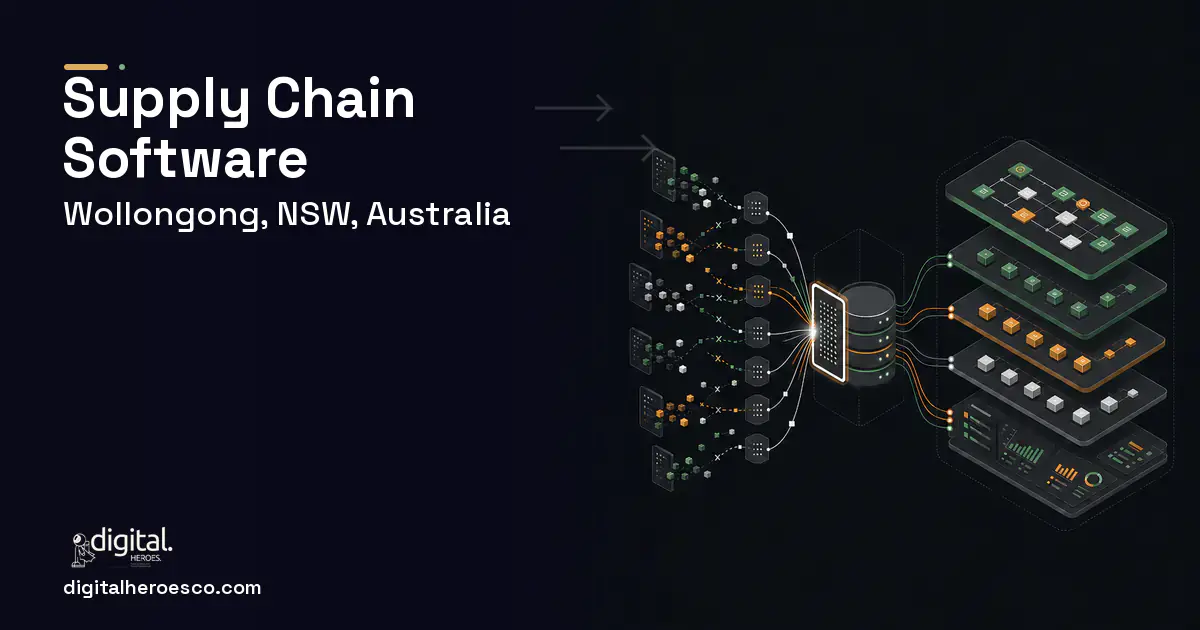
Custom supply chain software for a Wollongong steel or heavy manufacturer runs A$80,000 to A$200,000 and ships in 5 to 9 months. You build instead of buying SAP or a generic SCM when your supply risk is specific: mill lead times measured in weeks, inbound coil and plate that has to arrive before a line runs, heavy freight, and supplier quality certificates that gate a batch. Generic SCM assumes fast, interchangeable, lightweight parts, which describes nothing in a Wollongong steel plant.
Your production line does not stop for a missing screw; it stops for a coil that was due Tuesday and is now sitting at a mill with a fortnight lead time nobody tracked. That lead time lives in an email thread and in the purchasing officer's memory, so the first sign of a problem is a bay running out of feedstock. SAP can model a supply chain, but standing up its steel logic costs more and takes longer than a Wollongong plant your size can wear.
The other gap is quality. A batch of steel is not usable until its mill certificate is verified, and a generic SCM treats a certificate as an attachment, not a gate. So material moves before it is cleared, or clears late and idles a line, because the system has no concept that this coil cannot run until its paperwork checks out.
Why the usual tools struggle in Wollongong
- Mill lead times of weeks live in email threads and memory, so a late coil surfaces only when a Wollongong bay runs dry
- Generic SCM assumes fast, interchangeable parts, not heavy steel feedstock that gates a production line
- Supplier quality certificates are treated as attachments, not gates, so material moves before it is cleared
- Heavy inbound and outbound freight has no proper model, so scheduling and cost are guessed
What a custom supply chain build changes
Custom supply chain software models the risks that actually stop a Wollongong line: mill lead times tracked against the production schedule so a late coil is flagged weeks out, quality certificates that gate a batch before it can run, and heavy freight modelled by weight and route. It gives purchasing a real forward view instead of an inbox, and it clears material the moment its paperwork checks out. The point is to keep the line fed without carrying a yard full of dead safety stock.
- A late coil or plate can stop your Wollongong line and lead times live in email, not a system
- Quality certificates need to gate material before it runs, which generic SCM cannot enforce
- Heavy freight is a real cost and scheduling factor you currently guess
- You carry too much safety stock because you cannot see supply risk forward
- Your supply is local, fast and stable, so long lead times are not your risk
- An ERP (Enterprise Resource Planning) purchasing module plus a good process already covers procurement
- You need something now and cannot wait months for a supply chain build
- Your certificate and freight needs are light enough for a spreadsheet
- Mill lead times tracked against the production schedule, so a late coil is flagged weeks before a Wollongong line runs dry
- Quality certificates that gate a batch, so no steel runs before its paperwork is cleared
- Heavy inbound and outbound freight modelled by weight and route, not guessed
- A real forward view for purchasing, replacing the email thread and the officer's memory
- Right-sized safety stock, so you keep the line fed without a yard full of dead capital
- Supply chain software is a substantial build, and a plant with stable, local supply may not need it
- It depends on suppliers providing lead-time and certificate data, which takes relationship work to secure
- Integrating with supplier systems and your production schedule adds real complexity
- For simpler procurement, a disciplined process plus an ERP purchasing module may be enough
The features that matter for Wollongong
Wollongong supply chain: the full scope
Everything a supply chain build here can cover: order management system, transportation management (TMS), supply chain visibility, distribution software, supply chain management software, logistics software and procurement software.
Supply Chain pricing in Wollongong: the real numbers
| Project scope | Typical cost | Timeline |
|---|---|---|
| Lead-time tracking + certificate gating | A$80,000 to A$115,000 | 5 to 6 months |
| Add freight planning + safety-stock modelling | A$115,000 to A$160,000 | 6 to 8 months |
| Full build with supplier and production integration | A$160,000 to A$200,000 | 8 to 9 months |
From kickoff to launch: the schedule
Exactly what you get
You get a supply chain that protects a Wollongong line: mill lead times mapped against your production schedule so a late coil is flagged weeks out, quality certificates that gate a batch before it runs, and heavy freight modelled by weight and route. Purchasing gets a forward view instead of an inbox. It integrates with your ERP software development, your inventory management software for stock, and your warehouse management system so inbound steel and its paperwork move as one.
How to choose a developer in Wollongong
Choose a team that asks what stops your line before they talk software, and that has handled heavy, slow, certificate-gated supply. Ask how they map a mill lead time to the day a bay runs dry, and how a certificate blocks a batch. Heavy manufacturing supply is specialised, so favour a developer who can name a steel or industrial client and who integrates supply with your production and stock rather than bolting on a generic SCM.
- !They pitch SAP-style breadth before understanding your line risk; ask what actually stops your plant
- !No certificate gating; ask how the system stops uncertified steel from running
- !Freight is an afterthought; ask how heavy inbound and outbound is modelled and costed
- !No production-schedule link; ask how a lead time maps to when a bay runs dry
- !They have never handled steel or heavy manufacturing supply; ask for a reference you can call
If supply chain is on the roadmap, project management, helpdesk & ticketing, crm usually follow within the year. Budget them as one conversation. Weighing options across the region? Nearby: supply chain in Sydney, Newcastle and Wagga Wagga. Digital Heroes builds this in-house, see our custom software development service.
The evidence behind this guide
Independent findings on why this investment pays off. Every link goes to the primary source.
- In a survey of 579 supply chain professionals (July 31 to October 1, 2024), only 29% had built at least three of the five capabilities Gartner identifies as needed for future competitiveness (agility, resilience, regionalization, integrated ecosystems, and enterprise-wide strategy). Source: Gartner (2025) →
- Global retail loses an estimated $1.73 trillion annually to inventory distortion (out-of-stocks and overstocks), equal to about 6.5% of global retail sales, despite $172 billion spent on improvements in the past year. Source: IHL Group (2025) →
- APQC's Open Standards Benchmarking data on the monthly financial close found median performers take about 6.4 calendar days to close the books, while top performers (top 25%) do it in 4.8 days or fewer and bottom performers (bottom 25%) take 10 or more days. Source: APQC (2018) →
- The average developer spends more than 17 hours a week dealing with maintenance issues such as debugging and refactoring, and about four of those hours on 'bad code' - waste that equates to nearly $85 billion annually worldwide in opportunity cost. Source: Stripe (2018) →
Frequently asked questions
What does custom supply chain software cost for a Wollongong manufacturer?
Custom supply chain software for a Wollongong steel or heavy manufacturer typically runs A$80,000 to A$200,000. Lead-time tracking with certificate gating sits around A$80,000 to A$115,000 over 5 to 6 months, while adding freight planning, safety-stock modelling and full integration reaches the top of the range.
Why not just use SAP for supply chain?
SAP can model a steel supply chain, but standing up and maintaining its logic costs more and takes longer than most Wollongong plants can justify. A custom build targets your specific risks, mill lead times, certificate gating and heavy freight, without carrying the weight and licensing of a full SAP deployment.
Can it warn us before a coil is late enough to stop the line?
Yes. Mill and supplier lead times are tracked against your production schedule, so a late coil is flagged weeks before a Wollongong bay would run dry. That forward view replaces the email thread and the purchasing officer's memory that a late delivery currently relies on.
How does it handle supplier quality certificates?
Certificates are captured and gate a batch from use until verified, so no steel runs before its paperwork clears. This turns a certificate from a passive attachment, as generic SCM treats it, into an active control that a Wollongong plant's quality process depends on.
Does it model heavy freight for inbound and outbound?
Yes. Freight is planned by weight, route and carrier for inbound coil and outbound product, so cost and scheduling are real numbers rather than guesses. For a Wollongong plant moving heavy steel, freight is a genuine variable that a parcel-oriented SCM ignores.
Will it integrate with our ERP and production systems?
Yes. Supply chain software integrates with your ERP, inventory and production scheduling so one picture spans supply, stock and the line. This is essential, because lead-time risk only means something when mapped to when a Wollongong bay actually needs the material.
Can it reduce how much safety stock we carry?
Yes. With a real forward view of supply risk, safety stock can be right-sized rather than padded to cover uncertainty, freeing capital tied up in a full yard. For a Wollongong manufacturer, seeing risk ahead is what makes leaner stock safe.
Who owns the supply chain system and data?
You own the source code and your supplier, lead-time and certificate data, written into the contract. This data is commercially sensitive, so a reputable Wollongong developer builds you a system you control rather than a locked platform.
We have stable local supply, do we need this?
If your supply is local, fast and stable, long lead times are not your risk and an ERP purchasing module may be enough. The case for custom supply chain software appears once a late coil can stop your Wollongong line and lead times and certificates live in email rather than a system.
How much does a custom warehouse management system cost to build?
A custom WMS typically costs $40,000 to $120,000 for a single-warehouse operation, and $120,000 to $300,000 once you add multiple sites, wave picking, and labor tracking. Across Digital Heroes WMS builds, the biggest cost drivers are scanner-based workflows, real-time inventory sync with your ERP, and the number of picking strategies you need. A pilot covering receiving, putaway, and picking for one warehouse is the cheapest credible starting point.
Are local developer rates in Wollongong worth it compared to hiring an offshore team?
Agency rates in markets like Wollongong typically run $100 to $200 per hour against $25 to $60 offshore, but the hourly rate is not the project cost. Across 2,000+ Digital Heroes projects, the setup that consistently works is a hybrid: senior architects and a named lead for your project with a distributed build team behind them, which lands total cost well below all-local without the rework cycles that pure lowest-bid offshore engagements produce. Compare bids on total delivered cost with maintenance included, never on rate cards.
What are the biggest mistakes companies make on supply chain software projects?
The top three: replacing every system at once instead of one workflow at a time, skipping data cleanup so the new system inherits years of bad SKUs and phantom stock, and designing screens without the warehouse staff who will use them daily. A fourth is underscoping integrations and discovering mid-project that the ERP connection is half the work. Digital Heroes sees more supply chain projects fail from scope and data problems than from any technical cause.
What does it cost to maintain custom supply chain software each year?
Budget 15 to 20 percent of the original build cost per year, so roughly $9,000 to $12,000 annually on a $60,000 system, covering hosting management, dependency updates, bug fixes, and small enhancements. Across its maintenance contracts, Digital Heroes sees supply chain systems need more upkeep than typical web apps because carrier APIs, EDI specs, and ERP versions keep changing underneath them. Hosting itself is usually minor, often $100 to $500 per month for a mid-size operation.
Why do companies replace generic SCM software with custom systems?
The usual trigger is workflow mismatch: generic SCM tools model a standard distributor, so anything unusual, like mixed lot and serial tracking, consignment inventory, or customer-specific routing rules, ends up managed in spreadsheets beside the system. Companies also leave when per-user pricing punishes growth or the vendor's API cannot support needed integrations. In Digital Heroes projects, the number of spreadsheets living around the official system is the most reliable signal a team has outgrown its off-the-shelf tool.
Should we start with an MVP or build the full supply chain platform at once?
Start with an MVP that fixes your single most expensive workflow, prove it in daily operations, then expand module by module. That gets working software onto the warehouse floor in about 12 weeks instead of debating a year-long spec, and real usage always reorders the roadmap; features that felt critical in planning routinely get cut after go-live. Digital Heroes typically scopes phase one at 30 to 40 percent of the total vision and lets measured results justify each next phase.
Who can build custom supply chain software for a business in Wollongong?
Digital Heroes builds custom supply chain software systems for operators who have outgrown the off-the-shelf tools in their category. The work is delivered remotely: our engineers work from Delhi and Lucknow, leadership is in New York, and some team members live in London and Sydney and work remotely from there. We have no office in Wollongong. You can chat with the team directly, and every form gets an email reply within 24 hours.
Related guides
Published · Last updated .