GM sees you clearly; you can't see the tier-three shop that's about to make you late
Custom supply chain software in Oshawa costs $90k to $220k over 5 to 9 months. SAP and generic SCM manage your direct purchasing well.
On this page
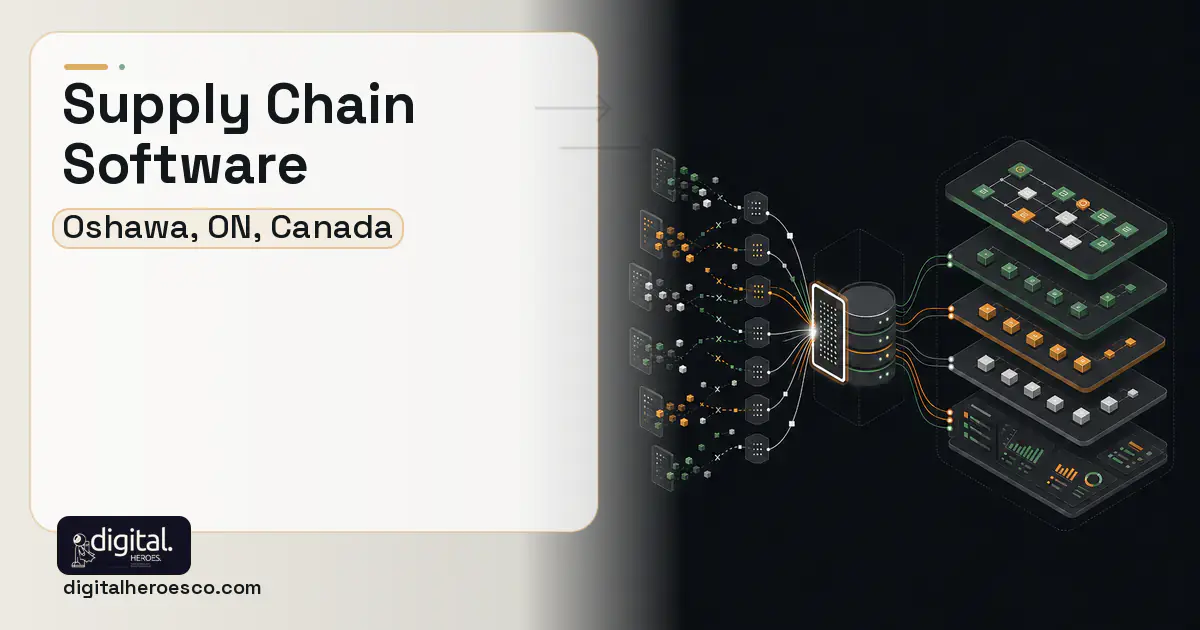
Custom supply chain software in Oshawa costs $90k to $220k over 5 to 9 months. SAP and generic SCM (Supply Chain Management) manage your direct purchasing well. The gap for an Oshawa tier-two supplier is multi-tier visibility, seeing the tier-three shop whose delay will make you late to GM, and syncing your inbound supply to the JIT cadence GM imposes on you, which generic SCM doesn't model.
GM holds you to a just-in-time, just-in-sequence delivery, and you hold your suppliers to whatever your PO says. The problem is you can only see one tier down. When the tier-three shop that machines a sub-component runs late, you don't find out until your own line is starving, and by then you're the one with the GM line-down and the chargeback. SAP manages your direct purchase orders; it has no window into your suppliers' suppliers, which is exactly where the risk that hits your scorecard originates.
Generic SCM also doesn't sync your inbound supply to GM's outbound demand. You're squeezed between a customer pulling in sequence and suppliers shipping on traditional lead times, and the mismatch shows up as either excess inventory or a scramble. The visibility gap and the cadence mismatch are the two supply-chain problems that most threaten an Oshawa supplier's standing with GM.
Why the usual tools struggle in Oshawa
- Visibility stops at your direct suppliers; a tier-three delay surprises you as a line-down
- Inbound supply runs on traditional lead times while GM pulls in JIT sequence
- No early-warning on supplier risk, so you react instead of preventing
- Demand changes from GM don't propagate down your supply base automatically
What a custom supply chain build changes
Custom supply chain software gives you multi-tier visibility and ties your inbound supply to GM's outbound demand. Suppliers update status against your releases, risk signals (a late ASN, a capacity flag) surface early, and a change in GM's pull propagates down your supply base so everyone resequences together. You see the tier-three delay coming instead of discovering it at your own starving line.
- A sub-tier supplier's delay regularly surprises you as a near line-down
- Inbound supply on traditional lead times clashes with GM's JIT pull
- You react to supplier problems instead of seeing them coming
- GM demand changes don't reach your supply base fast enough
- Your supply base is small and one-tier visibility is sufficient
- You don't face JIT/JIS demand that strains inbound supply
- SAP or your ERP (Enterprise Resource Planning)'s purchasing module covers your needs
- Your suppliers won't participate in a shared visibility system
- Multi-tier supplier visibility, including the sub-tiers that actually cause your line-downs
- Inbound supply synced to GM's JIT/JIS demand instead of fighting it
- Early-warning risk signals so you prevent shortages rather than react to them
- GM demand changes propagating down your supply base automatically
- A defensible supply position that protects your GM scorecard
- Multi-tier visibility depends on suppliers actually participating in the system
- Supplier onboarding and adoption is a change-management project, not just software
- Integration across many supplier systems is genuinely complex and costly
- The data is only as good as what your supply base is willing and able to share
The features that matter for Oshawa
Supply Chain services we deliver in Oshawa
Digital Heroes builds the full supply chain stack for Oshawa teams. Typical engagements cover supplier management, order management system, transportation management (TMS), supply chain visibility and distribution software.
Supply Chain pricing in Oshawa: the real numbers
| Project scope | Typical cost | Timeline |
|---|---|---|
| Supplier portal + risk alerts on existing ERP | $90k to $140k | 4 to 6 months |
| Full multi-tier SCM platform with demand sync | $160k to $220k | 7 to 9 months |
| Inbound-to-JIT demand sync module only | $60k to $110k | 3 to 4 months |
From kickoff to launch: the schedule
Exactly what you get
Supply chain software that sees past your direct suppliers to the sub-tiers that actually cause your problems, and that ties your inbound supply to GM's outbound pull. Risk surfaces early, demand changes propagate down, and you protect your scorecard by preventing shortages instead of reacting to them. It works alongside an ERP, a warehouse management system, and inventory management, and feeds business intelligence (BI) dashboards for supplier performance.
How to choose a developer in Oshawa
This is one of the harder builds, so domain depth is essential. The developer must understand multi-tier automotive supply and the JIT/JIS cadence, and treat supplier adoption as a change-management problem, not just a coding task. Ask how they'll get your suppliers to actually participate, because the cleverest visibility platform is useless if your supply base won't feed it. A reference from a multi-tier supply build is worth real money.
- !They only model one-tier purchasing. Ask how they'd surface a sub-tier supplier's delay.
- !No supplier adoption plan. Ask how they'll get your suppliers to actually use the portal.
- !They ignore the JIT cadence. Ask how inbound supply syncs to GM's sequenced pull.
- !No risk-signal design. Ask what early warnings the system would have caught last quarter.
- !EDI hand-waving. Ask how they integrate suppliers running different systems.
Teams investing in supply chain in Oshawa usually scope it next to project management, helpdesk & ticketing, crm, since these systems share data and budgets. Weighing options across the region? Nearby: supply chain in Toronto, Ottawa and Hamilton. Want it built, not just budgeted? That is our custom software development practice.
The evidence behind this guide
Independent findings on why this investment pays off. Every link goes to the primary source.
- Poor software quality cost the US economy an estimated $2.41 trillion in 2022, including roughly $1.52 trillion in accumulated technical debt, driven partly by unsuccessful development projects and low-quality legacy systems. Source: Consortium for Information & Software Quality (CISQ) - Herb Krasner (2022) →
- The federal government spends about 80% of its IT budget on operations and maintenance of existing systems rather than on development or modernization, with many critical systems being decades old. Source: U.S. Government Accountability Office (GAO) (2025) →
- Total US training expenditure rose 4.9% to $102.8 billion; learning management systems were used at 89% of organizations (90% of large, 97% of midsize, 84% of small companies), with average training at 40 hours per employee and $874 spent per learner. Source: Training Magazine (2025) →
- IBM frames first-time fix rate as a core field service KPI, noting the industry average sits around 80% (roughly one in five jobs needs a return visit). Correction: IBM cites best-in-class providers at 89-98%, not '85%+'. Source: IBM (2024) →
Frequently asked questions
Why can't SAP give us sub-tier visibility?
SAP manages your direct purchase orders and your relationship with your immediate suppliers. It has no inherent window into your suppliers' suppliers, where much of your delivery risk actually originates. Multi-tier visibility requires a system designed to capture status down the chain and the supplier participation to feed it, which is a different problem than direct purchasing.
How do we get suppliers to participate?
This is the make-or-break, and it's change management as much as software. A good build makes participation low-friction (simple status updates, EDI where suppliers already have it) and ties it to the business relationship. Suppliers that depend on your business will engage if the system is easy and the value is mutual; a clunky portal nobody fills in is worse than nothing.
What does syncing inbound to JIT actually mean?
It means your purchasing pulls from suppliers in alignment with GM's sequenced pull on you, so you're not buffering a mountain of inventory or scrambling when GM changes. The software translates GM's demand signal down your supply base so everyone resequences together, which is the only way to run true JIT as a tier-two without drowning in safety stock.
Is this worth it for a smaller supplier?
It depends on your exposure. If a sub-tier delay has caused a near line-down at GM, the cost of one chargeback or a scorecard hit can justify the build. If your supply base is small and stable and one-tier visibility suffices, SAP or your ERP's purchasing module is enough. Match the investment to the real risk you carry.
How is this different from inventory or warehouse software?
Inventory management tracks what you hold; a warehouse management system runs your building; supply chain software manages the flow between your suppliers, you, and GM. They're complementary layers. The supply chain build is specifically about visibility and demand synchronization across organizations, which inventory and WMS, focused inside your four walls, don't address.
What does it cost to keep custom software running after launch?
Budget 15-20% of the original build cost per year, which on a $100,000 system means $15,000 to $20,000 for security patches, dependency updates, bug fixes, and small improvements as real usage reveals what the spec missed. Cloud hosting for a typical business application adds $50 to $300 a month on top. Skipping maintenance does not save the money; in Digital Heroes rescue work, unmaintained systems typically need a far more expensive rebuild within about three years.
Are local developer rates in Oshawa worth it compared to hiring an offshore team?
Agency rates in markets like Oshawa typically run $100 to $200 per hour against $25 to $60 offshore, but the hourly rate is not the project cost. Across 2,000+ Digital Heroes projects, the setup that consistently works is a hybrid: senior architects and a named lead for your project with a distributed build team behind them, which lands total cost well below all-local without the rework cycles that pure lowest-bid offshore engagements produce. Compare bids on total delivered cost with maintenance included, never on rate cards.
Do the developers need to be near our warehouse in Oshawa, or can this be done remotely?
Most of the build works fine remotely, but plan 2 or 3 on-site visits to your Oshawa warehouse: one during discovery to watch receiving and picking firsthand, and one or two around go-live for scanner setup and floor training. Warehouse software designed purely over video calls consistently misses physical realities like glove-friendly button sizes, scan distances, and dead Wi-Fi zones near racking. Remote build with on-site milestones is how Digital Heroes runs most warehouse projects.
What happens to my software if the agency shuts down or we stop working together?
Nothing dramatic, if the engagement was set up correctly: the code sits in your repository, hosting runs on your cloud account, and a handover document explains how to deploy and operate the system. Any competent replacement team can then take over in days rather than months. If the agency controls the repo, the servers, or the domain, fix that now, because renegotiating access during a dispute is the most expensive place to discover the problem.
Does my development team need to be located in Oshawa?
No, most software projects run fully remote without any quality penalty, and what actually matters is 3 to 4 hours of working-hour overlap and a fixed weekly demo call. A team based in Oshawa earns its premium in specific cases: hardware installations, warehouse or clinic floor shadowing, and discovery workshops where watching your staff work beats any written brief. Choose for senior engineers and a track record first, and treat geography as a tiebreaker.
Can custom software connect to the tools we already use, like QuickBooks, Stripe, and Google Workspace?
Yes, and connecting your existing tools is one of the main reasons to build custom: mainstream platforms like QuickBooks, Stripe, Shopify, and Google Workspace all publish documented APIs. Budget 1 to 3 weeks of work per integration depending on API quality and how much data flows in both directions. Ask any vendor whether they have integrated with your specific tools before, because quirks like QuickBooks' OAuth token handling and API rate limits get learned on someone's project, and it should not be yours.
Is custom supply chain software cheaper than SAP over five years?
For small and mid-size operations it usually is, because SAP costs compound through licensing, implementation partners, and per-user fees, while custom costs are front-loaded. SAP Business One's published list price has run roughly $3,200 per professional user as a perpetual license plus annual maintenance near 20 percent, and the S/4HANA proposals Digital Heroes clients share are typically in the hundreds of thousands before any customization. A $60,000 to $100,000 custom build with 15 to 20 percent annual upkeep often costs less by year three for a 10 to 30 user company, and you stop paying per seat as you hire.
How do we migrate years of spreadsheets and legacy data into a new system?
Migration runs as its own workstream: extract and profile the data, clean duplicates and dead SKUs, map fields to the new schema, then do trial loads and a final cutover during a weekend or slow period. Expect 2 to 6 weeks depending on how many sources you have and how dirty they are. Digital Heroes runs old and new systems in parallel for 2 to 4 weeks on most supply chain cutovers so inventory counts and open orders can be reconciled before the legacy system is retired.
Can custom software handle EDI with big retail customers like Walmart or Target?
Yes, and this is one of the most common reasons distributors go custom, because retailer scorecards penalize late or malformed documents. The typical build covers EDI 850 purchase orders in, 855 acknowledgments, 856 advance ship notices, and 810 invoices out, usually through a network like SPS Commerce or TrueCommerce rather than raw AS2. In Digital Heroes builds, onboarding your first major retailer adds 4 to 8 weeks and $10,000 to $25,000, with each additional trading partner far cheaper once the pipeline exists.
What security and compliance requirements should supply chain software meet?
At minimum: role-based access control, encryption in transit and at rest, audit logs on inventory and order changes, and tested backups, because the system holds supplier pricing and customer purchase history your competitors would love to see. If enterprise customers connect to it, expect security questionnaires and possibly SOC 2 expectations; food, pharma, and aerospace add traceability rules like FDA lot tracking or ITAR data handling. Raise these in the first scoping call, since retrofitting audit trails onto a live system costs far more than designing them in.
How do I vet a software agency in Oshawa for a supply chain project?
Ask every Oshawa agency you shortlist to walk you through one shipped project involving inventory or logistics, including the integrations they built and what broke after launch. Verify they can name concepts from your world unprompted, such as backorders, landed cost, cycle counts, or EDI 856s, because supply chain domain gaps surface later as expensive rework. Then check references specifically on post-launch support response times, not just build quality.
Should we start with an MVP or build the full supply chain platform at once?
Start with an MVP that fixes your single most expensive workflow, prove it in daily operations, then expand module by module. That gets working software onto the warehouse floor in about 12 weeks instead of debating a year-long spec, and real usage always reorders the roadmap; features that felt critical in planning routinely get cut after go-live. Digital Heroes typically scopes phase one at 30 to 40 percent of the total vision and lets measured results justify each next phase.
Can I build my product on a no-code tool like Bubble instead of hiring developers?
For testing whether anyone wants the product, yes, and Bubble's paid plans start at $29 a month, which is the cheapest validation you will ever buy. The ceiling arrives with complex data relationships, heavy integrations, performance at a few thousand users, and the fact that you cannot export a Bubble app to servers you control. A path many Digital Heroes clients take: prove demand on no-code, then rebuild custom once revenue justifies it, treating the no-code version as a paid prototype rather than a foundation.
Why do agencies charge for a discovery phase instead of quoting for free?
Because an accurate quote requires real work: mapping your workflows, finding the edge cases, and writing a specification, which typically takes 1 to 3 weeks and costs $2,000 to $10,000 at Digital Heroes depending on system complexity. You leave discovery owning a written spec and a fixed price you can take to any vendor, so the money is not locked into one agency. Free estimates are guesses, and the guess usually becomes your budget overrun six months later.
Who can build custom supply chain software for a business in Oshawa?
Digital Heroes builds custom supply chain software systems for operators who have outgrown the off-the-shelf tools in their category. The work is delivered remotely: our engineers work from Delhi and Lucknow, leadership is in New York, and some team members live in London and Sydney and work remotely from there. We have no office in Oshawa. You can chat with the team directly, and every form gets an email reply within 24 hours.
Related guides

More from Olivia.
Performance Marketing Lead · New-york · 4 posts on the site
Published · Last updated .