Your Greensboro supply chain spans yarn mills and overseas finishing, and SAP treats them all the same
If your Greensboro operation sources yarn, fabric, hardware, and finishing across domestic mills and overseas suppliers, generic SCM and SAP flatten that multi-tier reality into one supplier list. Custom supply chain software runs $70,000 to $180,000 over 4 to 8 months.
On this page
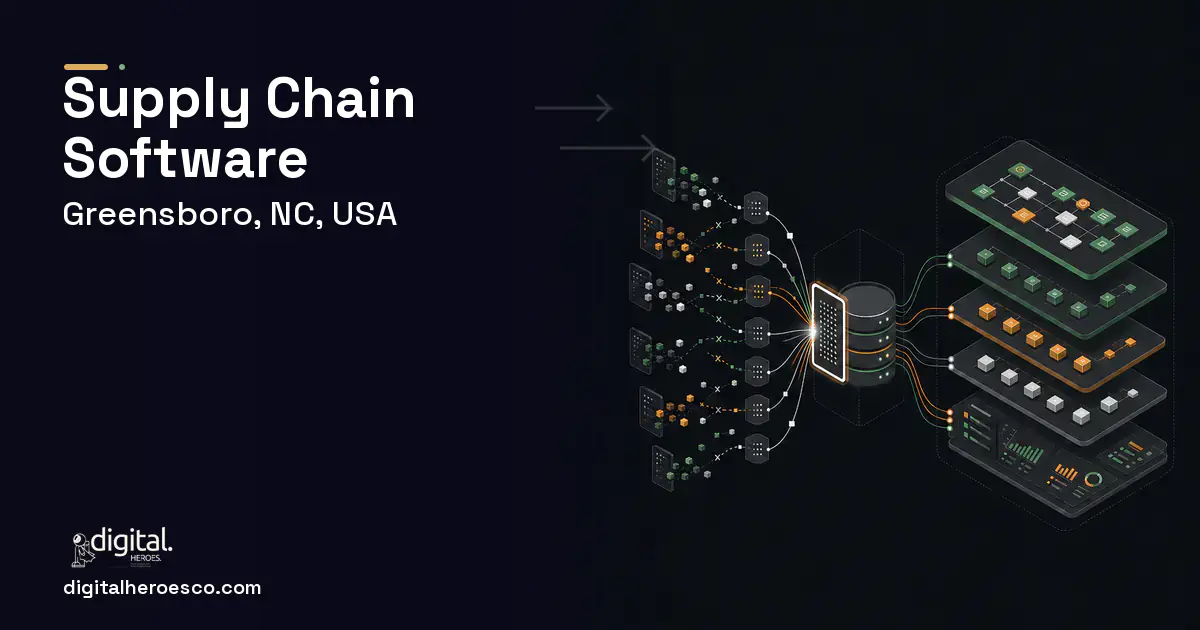
If your Greensboro operation sources yarn, fabric, hardware, and finishing across domestic mills and overseas suppliers, generic SCM and SAP flatten that multi-tier reality into one supplier list. Custom supply chain software runs $70,000 to $180,000 over 4 to 8 months. Triad makers usually start with multi-tier supplier and lead-time visibility generic tools can't model.
SAP and generic SCM assume a tidy supplier-to-warehouse flow with predictable lead times. A Greensboro furniture or textile maker's chain is messier: a yarn mill feeds a fabric supplier, hardware comes from three sources, and finishing may run domestically or abroad, each tier with its own lead time and its own way of slipping. Generic tools see a flat supplier list and can't model the dependency where a late yarn shipment delays everything downstream.
So you find out a finishing run will miss its date only when the fabric doesn't show, because no tool connected the yarn delay to the finishing schedule to the customer promise. The supply chain software you bought sees suppliers, not the chain.
The problems nobody warns you about
- Generic SCM sees a flat supplier list and can't model the yarn-to-fabric-to-finishing dependency
- A late upstream yarn shipment surfaces only when fabric doesn't arrive, too late to react
- Multi-source hardware with different lead times isn't tracked against the finishing schedule
- SAP's tidy supplier-to-warehouse model doesn't fit domestic-and-overseas finishing tiers
The case for owning your supply chain
Custom supply chain software models your real multi-tier chain: yarn to fabric to finishing, with each tier's lead time and the dependencies between them. It flags a downstream risk the moment an upstream shipment slips and ties supplier performance to the finishing schedule and customer promises. It connects to your inventory-management-software, warehouse-management-system, and production schedule so a delay anywhere is visible everywhere.
Budgeting a supply chain build in Greensboro
| Project scope | Typical cost | Timeline |
|---|---|---|
| Multi-tier supplier and lead-time visibility | $70k to $110k | 4 to 5 months |
| Supply chain suite with risk alerts and portal | $110k to $180k | 6 to 8 months |
| Full integration across ERP (Enterprise Resource Planning) and production | $180k+ | 8 to 12 months |
What your build should include
Supply Chain services we deliver in Greensboro
The engagements Greensboro teams bring us most often: order management system, transportation management (TMS), supply chain visibility, distribution software and supply chain management software.
Exactly what you get
You get supply chain software that sees the chain, not just the suppliers. Yarn, fabric, hardware, and finishing each carry their own lead time, and the system links them, so when an upstream yarn shipment slips, the threatened finishing date and customer promise light up immediately. Supplier scorecards show who actually delivers on time. The build covers multi-tier modeling, risk alerts, a supplier portal, and integration with your inventory-management-software, warehouse-management-system, and production schedule.
How to choose a developer in Greensboro
Hire a team that has modeled multi-tier sourcing, not just single-supplier procurement. Greensboro chains run yarn to fabric to finishing across domestic and overseas tiers, so confirm the developer can model dependencies and tie them to your production schedule. Ask how they handle supplier data exchange and integrate with your inventory-management-software and warehouse-management-system. Favor a partner who delivers multi-tier visibility first, proves the early-warning value, then adds the portal and deeper risk logic.
- !They model a flat supplier list. Ask how a yarn delay flags the finishing date at risk.
- !No dependency tracking. Ask how upstream slips reach downstream schedules.
- !No supplier performance data. Ask how on-time delivery gets measured.
- !No integration to production. Ask how a delay affects customer promises.
- !They've only done single-tier SCM. Ask for a multi-tier manufacturing reference.
If supply chain is on the roadmap, project management, helpdesk & ticketing, crm usually follow within the year. Budget them as one conversation. Weighing options across the region? Nearby: supply chain in Charlotte, Raleigh and Durham. Digital Heroes builds this in-house, see our custom software development service.
The evidence behind this guide
Independent findings on why this investment pays off. Every link goes to the primary source.
- McKinsey reports that autonomous supply-chain planning can raise revenue up to 4%, reduce inventory up to 20%, and cut supply-chain costs up to 10% while maintaining service levels (the wider 20-30% inventory-reduction figure comes from McKinsey's separate distribution-operations research, not this page). Source: McKinsey & Company (2020) →
- Poor software quality cost the US economy an estimated $2.41 trillion in 2022, including roughly $1.52 trillion in accumulated technical debt, driven partly by unsuccessful development projects and low-quality legacy systems. Source: Consortium for Information & Software Quality (CISQ) - Herb Krasner (2022) →
- Total US training expenditure rose 4.9% to $102.8 billion; learning management systems were used at 89% of organizations (90% of large, 97% of midsize, 84% of small companies), with average training at 40 hours per employee and $874 spent per learner. Source: Training Magazine (2025) →
- The median annual wage for U.S. software developers was $133,080 in May 2024, and employment is projected to grow 15% from 2024 to 2034 - a core input to any in-house build-vs-buy TCO model. Source: U.S. Bureau of Labor Statistics (2024) →
Frequently asked questions
Why doesn't generic SCM fit my Greensboro supply chain?
Generic SCM and SAP assume a flat supplier-to-warehouse flow. A Greensboro furniture or textile chain is multi-tier, yarn to fabric to finishing, often spanning domestic and overseas suppliers, each with its own lead time and failure modes. Generic tools see a supplier list and miss the dependencies that actually cause missed dates.
How does custom software give earlier warning?
By modeling the dependency between tiers. When an upstream yarn shipment slips, the system traces that delay to the fabric supplier, the finishing run, and the customer date, and alerts you immediately, instead of you discovering it when the fabric fails to arrive.
How much does custom supply chain software cost in Greensboro?
Multi-tier supplier and lead-time visibility runs $70,000 to $110,000. A suite with risk alerts and a supplier portal runs $110,000 to $180,000. Full integration across ERP and production goes past $180,000.
Will my suppliers have to use a portal?
A supplier portal for shipment confirmations and lead-time updates makes the data far more accurate, but adoption varies. A good build works with whatever data suppliers share and lets you onboard the most important tiers first rather than requiring everyone at once.
How does this connect to my production schedule?
Custom supply chain software ties each tier's lead time to the finishing schedule, so a delay anywhere shows its impact on production dates and customer promises. That integration with the schedule and inventory is what turns supplier data into actionable early warning.
How big a development team does a supply chain software project need?
A typical build runs with 4 to 6 people: a project lead or analyst, two or three developers, a QA engineer, and a part-time designer. Digital Heroes staffs most supply chain MVPs this way for 10 to 14 weeks, then drops to 1 or 2 people for maintenance after launch. Bigger is not better here; past 7 or 8 people on a single-product build, coordination overhead usually cancels the added speed.
Who owns the code when an agency builds my software?
You should, completely, through a written intellectual property assignment that transfers everything on final payment; without that clause, copyright stays with whoever wrote the code by default. Insist that the repository lives in your own GitHub organization from day one and that hosting, domains, and third-party accounts are registered to you. Also check for licenses to the agency's proprietary frameworks buried in the contract, because those can make switching vendors practically impossible even when you own your own code.
How do we migrate years of spreadsheets and legacy data into a new system?
Migration runs as its own workstream: extract and profile the data, clean duplicates and dead SKUs, map fields to the new schema, then do trial loads and a final cutover during a weekend or slow period. Expect 2 to 6 weeks depending on how many sources you have and how dirty they are. Digital Heroes runs old and new systems in parallel for 2 to 4 weeks on most supply chain cutovers so inventory counts and open orders can be reconciled before the legacy system is retired.
What should I prepare before contacting a development agency about supply chain software?
Bring a written list of your workflows from purchase order to delivery, the systems each step touches, and the 3 to 5 pain points costing you the most hours or errors. Export a sample of your real data, SKUs, orders, and locations, because data shape drives half the design decisions. You do not need a formal spec; Digital Heroes scopes most supply chain projects from a two-page problem description plus screen-share walkthroughs of the current process.
How fast does custom supply chain software pay for itself?
Most operations see payback in 12 to 24 months, faster when the system replaces manual data entry or per-user SaaS fees. Measure it concretely: hours of double entry removed, error and mis-ship rates, inventory carrying cost, and the license fees you stop paying. One recurring pattern from Digital Heroes projects: a distributor spending 60+ staff hours a week re-keying orders between systems can often justify a $50,000 build on labor recovery alone within the first year.
Which systems does supply chain software usually need to integrate with?
The standard set is your accounting or ERP system (QuickBooks, NetSuite, SAP), your sales channels (Shopify, Amazon, or a B2B portal), carriers and 3PLs for rates and tracking (UPS, FedEx, or an aggregator like EasyPost), and warehouse hardware such as barcode scanners and label printers. EDI connections to large retail customers are their own workstream. In Digital Heroes scoping, integration work is commonly 30 to 50 percent of total project effort, so listing every connected system upfront is the single best way to get an accurate quote.
How much does custom supply chain software cost for a small business?
For a small business, a focused custom supply chain tool usually lands between $15,000 and $45,000, covering one core workflow like inventory tracking, purchase orders, or shipment visibility. Across 2,000+ delivered projects, Digital Heroes sees most small distributors and light manufacturers start in the $20,000 to $35,000 range for a first working version. Adding barcode scanning, multi-warehouse support, or carrier integrations pushes budgets toward $50,000 and up.
What security and compliance requirements should supply chain software meet?
At minimum: role-based access control, encryption in transit and at rest, audit logs on inventory and order changes, and tested backups, because the system holds supplier pricing and customer purchase history your competitors would love to see. If enterprise customers connect to it, expect security questionnaires and possibly SOC 2 expectations; food, pharma, and aerospace add traceability rules like FDA lot tracking or ITAR data handling. Raise these in the first scoping call, since retrofitting audit trails onto a live system costs far more than designing them in.
Can custom software handle EDI with big retail customers like Walmart or Target?
Yes, and this is one of the most common reasons distributors go custom, because retailer scorecards penalize late or malformed documents. The typical build covers EDI 850 purchase orders in, 855 acknowledgments, 856 advance ship notices, and 810 invoices out, usually through a network like SPS Commerce or TrueCommerce rather than raw AS2. In Digital Heroes builds, onboarding your first major retailer adds 4 to 8 weeks and $10,000 to $25,000, with each additional trading partner far cheaper once the pipeline exists.
Why do companies replace generic SCM software with custom systems?
The usual trigger is workflow mismatch: generic SCM tools model a standard distributor, so anything unusual, like mixed lot and serial tracking, consignment inventory, or customer-specific routing rules, ends up managed in spreadsheets beside the system. Companies also leave when per-user pricing punishes growth or the vendor's API cannot support needed integrations. In Digital Heroes projects, the number of spreadsheets living around the official system is the most reliable signal a team has outgrown its off-the-shelf tool.
Are local developer rates in Greensboro worth it compared to hiring an offshore team?
Agency rates in markets like Greensboro typically run $100 to $200 per hour against $25 to $60 offshore, but the hourly rate is not the project cost. Across 2,000+ Digital Heroes projects, the setup that consistently works is a hybrid: senior architects and a named lead for your project with a distributed build team behind them, which lands total cost well below all-local without the rework cycles that pure lowest-bid offshore engagements produce. Compare bids on total delivered cost with maintenance included, never on rate cards.
Do the developers need to be near our warehouse in Greensboro, or can this be done remotely?
Most of the build works fine remotely, but plan 2 or 3 on-site visits to your Greensboro warehouse: one during discovery to watch receiving and picking firsthand, and one or two around go-live for scanner setup and floor training. Warehouse software designed purely over video calls consistently misses physical realities like glove-friendly button sizes, scan distances, and dead Wi-Fi zones near racking. Remote build with on-site milestones is how Digital Heroes runs most warehouse projects.
Should I hire a freelancer or an agency to build supply chain software?
For anything past a single-user internal tool, use an agency or an established team, because supply chain systems need backend, frontend, integration, and QA skills that rarely live in one freelancer. A solo developer can build a $10,000 inventory tracker; a system that talks to your ERP, carriers, and warehouse scanners fails badly when its only author is unreachable during a shipping cutoff. In the proposals Digital Heroes sees clients compare, agencies cost 20 to 50 percent more but give you continuity, code review, and someone answerable when order data stops flowing.
Who can build custom supply chain software for a business in Greensboro?
Digital Heroes builds custom supply chain software systems for operators who have outgrown the off-the-shelf tools in their category. The work is delivered remotely: our engineers work from Delhi and Lucknow, leadership is in New York, and some team members live in London and Sydney and work remotely from there. We have no office in Greensboro. You can chat with the team directly, and every form gets an email reply within 24 hours.
Related guides
Published · Last updated .