Your Auckland supply chain plan is fiction the moment a vessel misses its berth window
Custom supply chain software for an Auckland firm runs $70,000 to $180,000 over 5 to 8 months.
On this page
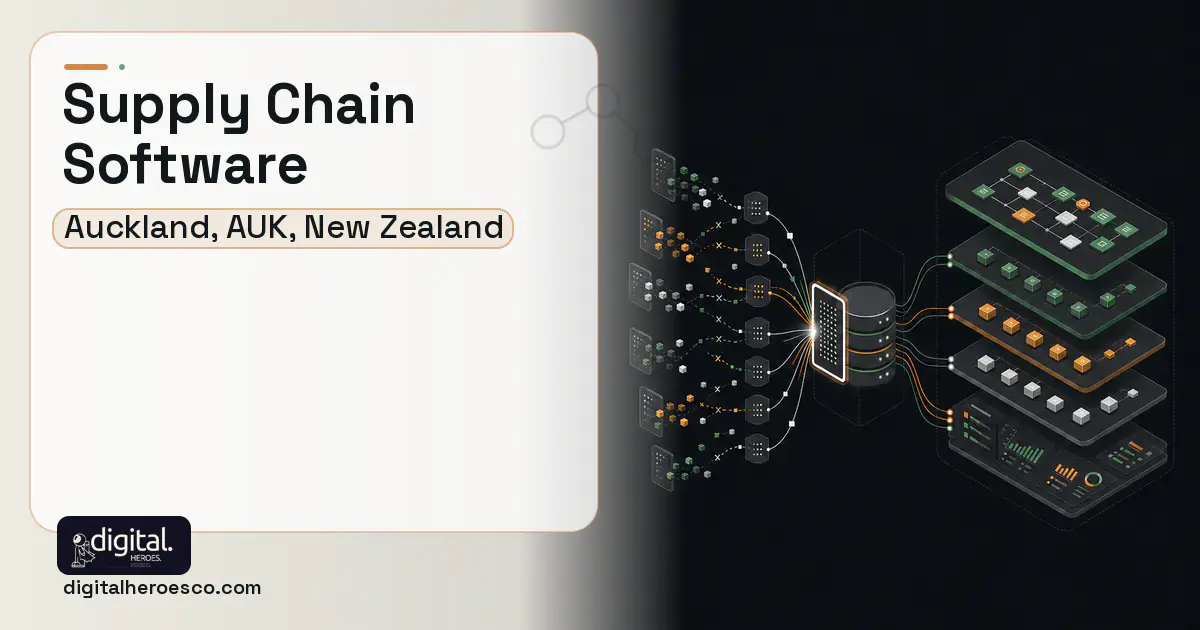
Custom supply chain software for an Auckland firm runs $70,000 to $180,000 over 5 to 8 months. You build it when your whole plan, bookings, driver runs, customer promises, depends on containers clearing Ports of Auckland on schedule, and a single delay cascades with nothing to re-plan it. SAP and generic SCM model idealised flows; they don't survive the real volatility of NZ port trade.
Your Auckland supply chain runs on bookings, vessel ETAs, driver runs and customer delivery windows, and right now they live in separate spreadsheets and email threads. When a container misses its berth window at Ports of Auckland, the delay cascades into missed delivery windows, and nobody can re-plan the whole chain in real time because no system holds it together. This is the exact pain that pushes Auckland trade firms to build.
SAP and generic SCM suites assume a stable, high-volume, multi-warehouse network. An Auckland firm moving freight through one main port, across the wider region, with real-world vessel volatility, needs software that re-plans dynamically when reality breaks the schedule, not a tool that models the happy path beautifully and then needs a human to firefight every exception.
Why the usual tools struggle in Auckland
- Bookings, vessel ETAs, driver runs and customer promises live in disconnected spreadsheets and email
- A container missing its berth window cascades into missed deliveries with no real-time re-plan
- Nobody can see, in one place, how a port delay ripples through the whole week's commitments
- Generic SCM models idealised flows that don't survive NZ port volatility
What a custom supply chain build changes
An Auckland chain whose every plan hangs on containers clearing one port needs software built to re-plan when a vessel slips, which generic SCM doesn't do. Custom gives you a single live model of bookings, ETAs, driver runs and customer windows that reflows automatically when a container is late, so a delay becomes a managed re-plan instead of a day of firefighting and apologies.
The features that matter for Auckland
Auckland supply chain: the full scope
Everything a supply chain build here can cover: supplier management, order management system, transportation management (TMS), supply chain visibility, distribution software, supply chain management software and logistics software.
- Your plan depends on containers clearing one port on schedule
- A single delay cascades with no way to re-plan in real time
- Bookings, ETAs and driver runs live in disconnected tools
- You need proactive customer updates the current setup can't produce
- Your supply chain is simple, stable and low-volatility
- Generic SCM or an ERP module covers your flows adequately
- You have few exceptions and disciplined spreadsheets cope
- You lack the data feeds and owner a dynamic system needs
Supply Chain pricing in Auckland: the real numbers
| Project scope | Typical cost | Timeline |
|---|---|---|
| Unified chain model + visibility | $70,000 to $110,000 | 5 to 6 months |
| Add dynamic re-planning + port integration | $110,000 to $150,000 | 6 to 7 months |
| Full build with notifications + ERP/WMS (Warehouse Management System)/BI integration | $150,000 to $180,000 | 7 to 8 months |
From kickoff to launch: the schedule
Exactly what you get
One live model of your whole chain: bookings, vessel ETAs, driver runs and customer delivery windows in a single system that reflows automatically when a container misses its berth window at Ports of Auckland. An exception dashboard surfaces the highest-impact delays first, and customers get proactive updates when a window changes instead of chasing you. It pulls live container status from port and customs feeds and shares its source of truth with your ERP, warehouse management system and BI dashboards.
How to choose a developer in Auckland
Hire a team that has built dynamic, exception-driven logistics software, not static planners. Ask them to demo a re-plan when a vessel slips, explain where they source live port and customs status, and show how customer notifications fire automatically. Confirm a real integration plan with your ERP and warehouse systems. Auckland trade lives on one port's rhythm, so the only partner worth hiring is one who designs for the day the schedule breaks, not the day it holds.
- One live model of bookings, vessel ETAs, driver runs and customer windows
- Automatic re-plan when a container slips, instead of manual firefighting
- Real-time visibility of how a port delay ripples through the week's commitments
- Proactive customer notifications when delivery windows change, before they chase
- Feeds your ERP, warehouse management and BI dashboards from one source of truth
- Dynamic re-planning logic is genuinely hard and lengthens the build
- Accuracy depends on reliable vessel, port and customs data feeds you must integrate
- Smaller, simpler operations may not justify the build over disciplined spreadsheets
- An internal owner is needed to keep the re-plan rules tuned to reality
- !They offer static planning only; ask how the system re-plans when a vessel slips
- !No port or customs data plan; ask where live container status comes from
- !Customer notifications are manual; ask how delays trigger automatic updates
- !They quote generic SCM; ask why custom beats configuration for your volatility
- !No integration story; ask how this avoids becoming one more disconnected tool
If supply chain is on the roadmap, project management, helpdesk & ticketing, crm usually follow within the year. Budget them as one conversation. Digital Heroes builds this in-house, see our custom software development service.
The evidence behind this guide
Independent findings on why this investment pays off. Every link goes to the primary source.
- Inventory carrying cost commonly runs about 20% to 30% of inventory value, covering capital cost, storage/warehousing, insurance, taxes, handling, shrinkage, and obsolescence - a recurring cost that better inventory and warehouse software aims to reduce. Source: APQC (2023) →
- McKinsey reports that autonomous supply-chain planning can raise revenue up to 4%, reduce inventory up to 20%, and cut supply-chain costs up to 10% while maintaining service levels (the wider 20-30% inventory-reduction figure comes from McKinsey's separate distribution-operations research, not this page). Source: McKinsey & Company (2020) →
- WordPress powers 41.5% of all websites and holds 59.2% of the market among sites running a known content management system, making it by far the most-used CMS on the web. Source: W3Techs (2026) →
- In the Flexera 2025 State of ITAM report, respondents reported roughly 33% of SaaS spend is wasted, underscoring how paying for off-the-shelf seats and tiers that go unused erodes the supposed cost advantage of generic SaaS. Source: Flexera (2025) →
Frequently asked questions
How much does custom supply chain software cost in Auckland?
Between $70,000 and $180,000. A unified chain model with visibility starts at $70,000 to $110,000; adding dynamic re-planning and port integration reaches $150,000, and a full build with customer notifications and ERP/WMS/BI integration runs to $180,000 over 7 to 8 months.
Why not use SAP or generic SCM?
They model idealised, stable, multi-warehouse networks. They struggle with Auckland's reality: a chain hanging on one port where a single late container cascades through the week. You need software that re-plans dynamically on exceptions, not a suite that needs a human to firefight every disruption.
Can it re-plan when a container is delayed?
Yes, that's the core capability. A custom build holds bookings, ETAs, driver runs and customer windows in one live model and reflows the chain automatically when a vessel slips, turning a cascading delay into a managed re-plan instead of a day of phone calls and apologies.
Where does live container status come from?
From port and customs data feeds the build integrates. The software pulls vessel ETAs and clearance status so the model reflects real container state, which is what lets it re-plan accurately rather than working from a schedule that's already fiction.
Will it notify customers automatically about delays?
Yes. A notification engine fires proactive updates the moment a delivery window changes, so customers hear about a delay from you before they chase, which protects the relationship and stops your coordinators spending the day on the phone.
Why do companies replace generic SCM software with custom systems?
The usual trigger is workflow mismatch: generic SCM tools model a standard distributor, so anything unusual, like mixed lot and serial tracking, consignment inventory, or customer-specific routing rules, ends up managed in spreadsheets beside the system. Companies also leave when per-user pricing punishes growth or the vendor's API cannot support needed integrations. In Digital Heroes projects, the number of spreadsheets living around the official system is the most reliable signal a team has outgrown its off-the-shelf tool.
How many SaaS seats do we need before building custom becomes cheaper?
The crossover usually shows up between 20 and 50 seats on premium tiers. Salesforce Enterprise lists at $165 per user per month, so 40 users cost about $79,000 a year in subscriptions, which is real money against a custom system you would own outright. Run the comparison over three years: if subscription spend beats the build cost plus 15-20% annual maintenance, custom wins on price before you even count workflow fit.
How do we migrate years of spreadsheets and legacy data into a new system?
Migration runs as its own workstream: extract and profile the data, clean duplicates and dead SKUs, map fields to the new schema, then do trial loads and a final cutover during a weekend or slow period. Expect 2 to 6 weeks depending on how many sources you have and how dirty they are. Digital Heroes runs old and new systems in parallel for 2 to 4 weeks on most supply chain cutovers so inventory counts and open orders can be reconciled before the legacy system is retired.
How long does it take to build a custom web or mobile app from scratch?
Plan on 8 to 16 weeks for a focused first version and 4 to 9 months for a larger platform, which is the typical spread across Digital Heroes builds. The first 2 to 3 weeks go to discovery and design before any production code ships. The two things that stretch timelines most are integrations with legacy systems and slow feedback from your side, not developer speed.
Can we migrate years of data out of our current system into new custom software?
Almost always yes, through CSV exports or the vendor's API, and migration should be scoped as its own workstream with field mapping, a dry run, and a planned cutover window rather than an afterthought. The real time sink is rarely moving the data; it is cleaning it, since years of duplicates, free-text fields, and inconsistent formats surface all at once. Pull a full export from your current vendor before committing to anything new, because some SaaS plans restrict exports on lower tiers.
When is SAP actually a better choice than building custom supply chain software?
Choose SAP when you need a full ERP, operate in a heavily audited industry that expects standard systems, or run global operations where localization, tax, and compliance content matter more than workflow fit. SAP's strength is breadth: finance, manufacturing, and supply chain in one validated suite. Custom wins when your edge lives in a specific workflow, like how you allocate inventory or route orders, that SAP would force you to bend to its standard process. Many Digital Heroes clients keep SAP as the system of record and build custom operational tools around it.
Will custom software scale as we add warehouses, SKUs, and order volume?
Yes, if multi-location support and your target volumes are stated requirements at design time, because a schema built for one warehouse is expensive to retrofit for ten. A well-built system on PostgreSQL comfortably handles millions of SKUs and tens of thousands of orders per day on modest cloud hardware, so scaling cost shows up in hosting bills rather than rewrites. Give your agency the 3-year growth picture upfront even if phase one covers a single site.
We run everything on spreadsheets and Airtable. How do we know it's time for custom software?
The reliable signals are re-typing the same data into multiple tools, one employee acting as human middleware between systems, and errors appearing in handoffs between teams. Hard limits force the issue too: Airtable's Team plan caps at 50,000 records per base, and Business costs $45 per seat per month, so a 20-person team pays about $10,800 a year for a tool it has already outgrown. When workarounds consume more hours than the tools save, the spreadsheet era is over.
How fast does custom supply chain software pay for itself?
Most operations see payback in 12 to 24 months, faster when the system replaces manual data entry or per-user SaaS fees. Measure it concretely: hours of double entry removed, error and mis-ship rates, inventory carrying cost, and the license fees you stop paying. One recurring pattern from Digital Heroes projects: a distributor spending 60+ staff hours a week re-keying orders between systems can often justify a $50,000 build on labor recovery alone within the first year.
Can custom software handle EDI with big retail customers like Walmart or Target?
Yes, and this is one of the most common reasons distributors go custom, because retailer scorecards penalize late or malformed documents. The typical build covers EDI 850 purchase orders in, 855 acknowledgments, 856 advance ship notices, and 810 invoices out, usually through a network like SPS Commerce or TrueCommerce rather than raw AS2. In Digital Heroes builds, onboarding your first major retailer adds 4 to 8 weeks and $10,000 to $25,000, with each additional trading partner far cheaper once the pipeline exists.
Who can build custom supply chain software for a business in Auckland?
Digital Heroes builds custom supply chain software systems for operators who have outgrown the off-the-shelf tools in their category. The work is delivered remotely: our engineers work from Delhi and Lucknow, leadership is in New York, and some team members live in London and Sydney and work remotely from there. We have no office in Auckland. You can chat with the team directly, and every form gets an email reply within 24 hours.
Related guides

Published · Last updated .