Asana booked the Plymouth hull survey for Tuesday, but the tide's wrong and the surveyor's pass expired, and it knew neither
Custom project management software for a Plymouth marine or defence firm typically costs £35,000 to £95,000 over 3 to 6 months.
On this page
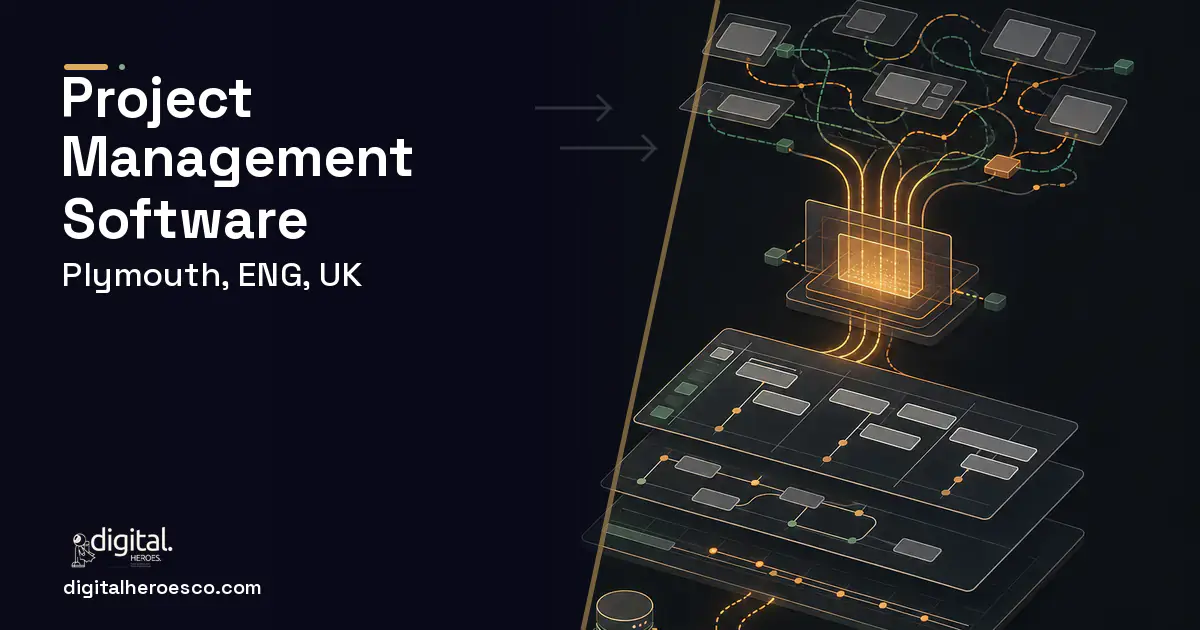
Custom project management software for a Plymouth marine or defence firm typically costs £35,000 to £95,000 over 3 to 6 months. Asana, Monday, Jira, and ClickUp manage tasks and timelines well; they can't reason about tide windows, berth availability, clearance eligibility, or vessel constraints, which are the realities that actually decide when marine and dockyard work can happen.
Marine and dockyard projects don't move on a calendar alone. A hull survey can only happen at a particular tide, a berth has to be free, the vessel has to be available, and the surveyor has to hold a valid dockyard pass and the right clearance. Asana will cheerfully schedule the task for a day when the tide's wrong and the surveyor's pass has lapsed, because it has no concept that any of those constraints exist.
So your project managers do the real scheduling in their heads and a tide table, using the PM tool only to record what was already decided elsewhere. The plan in Jira looks neat and is quietly fiction, until a slipped tide or an expired pass blows a milestone everyone thought was safe.
Where the off-the-shelf tools fall short
- Tasks scheduled against calendar dates with no regard for tide windows
- No check that a berth or the vessel is actually available on the planned day
- Clearance and dockyard-pass eligibility ignored when assigning marine work
- The real schedule living in a PM's head while the tool records fiction
Custom project management: what Plymouth teams actually get
Custom project software encodes the constraints that govern marine and dockyard work: it schedules a survey only within a valid tide window, checks berth and vessel availability, and won't assign someone whose pass or clearance has lapsed. The plan in the system becomes the real plan, so a milestone is trustworthy and a slipped tide is caught when it's planned, not on the morning the work was due.
Feature priorities for Plymouth teams
What we build under project management in Plymouth
Digital Heroes builds the full project management stack for Plymouth teams. Typical engagements cover Monday.com alternative, Jira integration, time tracking, team collaboration software, workflow management and custom project management software.
- Your projects are governed by tides, berths, and vessel availability
- Clearance and pass eligibility must gate task assignment
- Your real schedule lives outside the PM tool because it can't hold the constraints
- Slipped tides or expired passes regularly blow milestones
- Your projects are office or software work with no physical constraints
- Asana, Monday, or Jira already reflects your real schedule
- Task and timeline tracking is all you need
- Budget won't support a bespoke build yet
The honest cost picture for Plymouth
| Project scope | Typical cost | Timeline |
|---|---|---|
| PM core with tide and berth-aware scheduling | £35,000 to £55,000 | 3 to 4 months |
| Added clearance-aware assignment and risk alerts | £55,000 to £78,000 | 4 to 5 months |
| Full PM platform integrated with ERP, HR, and field tools | £72,000 to £95,000 | 5 to 6 months |
Timeline: what happens, and when
Exactly what you get
You get project software that plans the way Plymouth marine and dockyard work actually happens: surveys scheduled only inside valid tide windows, berth and vessel availability checked, and tasks assigned only to people whose clearance and pass are current. The plan in the system is the real plan, milestone risks surface early, and the scheduling that used to live in a PM's head and a tide table finally lives in the tool.
How to choose a developer in Plymouth
Find a team that takes physical constraints seriously. Ask how they'd schedule a survey around tides, how they'd check berth availability, and how they'd block assigning a surveyor whose pass has lapsed. Confirm the tool pulls clearance and resource data from your HR and ERP systems so constraints stay accurate, and don't pay for this depth if your projects have no physical constraints at all.
- Scheduling that respects tide windows, berths, and vessel availability
- Clearance- and pass-aware task assignment that blocks ineligible work
- A plan in the system that matches reality instead of recording it after the fact
- Early warning when a tide, berth, or expiry threatens a milestone
- Integration with your ERP, HR, and field service tools so constraints stay current
- More expensive than an Asana, Monday, or Jira subscription
- Constraint-aware scheduling depends on accurate tide, berth, and clearance data
- Teams comfortable with a familiar PM tool face a change-management hurdle
- For office or software projects with no physical constraints, off-the-shelf PM is plenty
- !A vendor who treats tides as just another deadline; ask how scheduling respects a tide window
- !No clearance-aware assignment; ask how it blocks an ineligible surveyor
- !No berth or vessel availability; ask how the plan knows the dock is free
- !No milestone risk alerts; ask how a slipping constraint surfaces early
- !Ignoring HR and ERP data; ask how constraints stay current
Most Plymouth teams pricing project management end up comparing notes on field service management, booking & scheduling, mobile app too; the systems share one data spine. Weighing options across the region? We publish the same project management guide for London, Birmingham, Manchester. Prefer to talk to the team that builds these? Digital Heroes handles custom software development end to end.
The evidence behind this guide
Independent findings on why this investment pays off. Every link goes to the primary source.
- Only about 30% of digital transformations succeed at meeting their objectives, but getting six critical success factors in place (leadership commitment, talent, agile culture, progress monitoring, clear strategy, and a modernized platform) raises the odds of success from 30% to 80%. Source: Boston Consulting Group (BCG) (2020) →
- McKinsey Global Institute estimated that about half of all work activities globally have the technical potential to be automated by adapting currently demonstrated technologies, though few occupations can be fully automated. Source: McKinsey Global Institute (2017) →
- The NRF discontinued its long-running annual shrink report, stating that a broad study of retail shrink 'is no longer sufficient for capturing the key challenges and needs of the industry' - important context that qualifies how POS/shrink benchmarks should be cited going forward. Source: Retail Dive (2024) →
- IBM frames first-time fix rate as a core field service KPI, noting the industry average sits around 80% (roughly one in five jobs needs a return visit). Correction: IBM cites best-in-class providers at 89-98%, not '85%+'. Source: IBM (2024) →
Frequently asked questions
Why can't Asana or Jira handle our marine projects?
They schedule against calendar dates and have no concept of tide windows, berth availability, vessel constraints, or clearance eligibility. For Plymouth marine and dockyard work those constraints decide when a task can actually happen, so the real schedule ends up outside the tool. Custom software puts it back in.
How does tide-aware scheduling work?
The software knows the tide windows a task requires and will only schedule it when the tide, berth, and vessel all align, rather than dropping it on an arbitrary calendar day. That stops a survey being booked for a day it physically can't run.
Can it stop us assigning someone whose pass expired?
Yes. Task assignment checks clearance and dockyard-pass eligibility and blocks anyone who isn't valid, so you don't discover on the morning of a job that the surveyor you scheduled can't actually go on site.
Will it connect to our HR and ERP systems?
It should. Clearance, pass, and resource data come from your HR and ERP tools so the constraints the planner enforces stay current, instead of relying on someone updating the PM tool by hand.
Is custom PM software worth it for office work?
For projects with no physical constraints, no; Asana, Monday, or Jira is cheaper and fine. The custom case is marine and dockyard work governed by tides, berths, vessels, and clearance, where off-the-shelf tools schedule fiction.
What happens if the agency that built our project management tool shuts down?
Nothing fatal, if you set things up correctly from day one: code in your own GitHub organization, infrastructure in your own cloud account, and written deployment documentation as a contract deliverable. With those in place, any competent team can take over a standard-stack codebase in one to two weeks. Takeover disasters happen when the vendor hosted everything in accounts they owned, so verify account ownership before the first sprint, not after the relationship sours.
Will a custom tool built for 50 people still work when we're 500?
Yes, if it sits on a standard stack; a PostgreSQL-backed application handles 500 concurrent users without exotic engineering, and unlike Monday or Asana, seats 51 through 500 add nothing to your license bill. What does need rework at that scale is organizational rather than technical: permission models, department-level reporting, and admin tooling. Have the agency design the data model for multi-team use on day one, even if version one serves a single team.
I run a 15-person business. Is there a cheaper option than a full custom project management build?
Yes: a custom layer on top of a tool you already pay for. Digital Heroes ships client dashboards, automated reporting, and workflow glue built on the Asana and ClickUp APIs for $8,000 to $20,000, which fixes the specific gap without replacing the whole tool. A full custom platform rarely makes sense below roughly 50 seats unless the software faces your own customers.
Can a solo freelancer build project management software, or do I need an agency?
A strong freelancer can deliver a single-team internal tracker in the $15,000 to $25,000 range. Once you need role-based permissions, real-time updates, several integrations, and someone on call after launch, you need a 4 to 5 person team, because those features cross design, backend, and QA at once. The bigger freelancer risk is continuity: one person on vacation becomes an outage in your delivery pipeline.
Can I build my product on a no-code tool like Bubble instead of hiring developers?
For testing whether anyone wants the product, yes, and Bubble's paid plans start at $29 a month, which is the cheapest validation you will ever buy. The ceiling arrives with complex data relationships, heavy integrations, performance at a few thousand users, and the fact that you cannot export a Bubble app to servers you control. A path many Digital Heroes clients take: prove demand on no-code, then rebuild custom once revenue justifies it, treating the no-code version as a paid prototype rather than a foundation.
Who owns the code when an agency builds my project management software?
You should, in full, and the contract must say so: work-for-hire language with all intellectual property assigned to you on final payment. Watch for agencies that license you their platform or framework, because that quietly turns your custom tool back into a subscription you cannot leave. Digital Heroes assigns full ownership and delivers into a GitHub organization the client controls; treat anything less as a red flag.
How big a team does it take to build a project management platform?
A typical Digital Heroes pod is 4 to 5 people: a product designer, two or three engineers, and a shared project manager and QA. Smaller than that and timelines stretch because one person is context-switching across design, backend, and testing; bigger only helps after the MVP, when work splits into parallel streams. Headcount matters less than whether the same pod stays on your project from discovery to launch.
How involved does my team need to be during a custom software build?
Plan on one product owner from your side spending 3 to 5 hours a week reviewing sprint demos, answering workflow questions, and testing before releases. Digital Heroes builds run discovery for 2 to 3 weeks, then two-week sprints with a clickable demo at the end of each. If your team is in Plymouth, a one or two day on-site discovery workshop at the start is worth doing; everything after that works identically over calls.
Does my development team need to be located in Plymouth?
No, most software projects run fully remote without any quality penalty, and what actually matters is 3 to 4 hours of working-hour overlap and a fixed weekly demo call. A team based in Plymouth earns its premium in specific cases: hardware installations, warehouse or clinic floor shadowing, and discovery workshops where watching your staff work beats any written brief. Choose for senior engineers and a track record first, and treat geography as a tiebreaker.
What's the most common mistake companies make when building their own PM tool?
Chasing feature parity with Asana or Jira. Across 2,000+ Digital Heroes projects, the builds that blow their budgets are the ones recreating Gantt charts, portfolio dashboards, and mobile apps nobody asked for, while the builds that succeed go deep on the two or three workflows that made the team leave their old tool. You are not competing with Asana's roadmap; you are replacing the 20 percent of it you actually use.
Should I customize Jira with plugins or just build our own tool?
If two or three Marketplace apps close the gap, stay on Jira, since it starts around $8 per user per month and the apps ride on top. The trap is that cloud apps are licensed for every user on the instance, so in Digital Heroes audits a 200-seat Jira with three or four paid apps plus a ScriptRunner consultant often lands at $30,000 to $50,000 a year. At that run rate a custom tool scoped to your actual workflow pays for itself in two to three years and ends the plugin upgrade treadmill.
Can we move our existing Asana or Jira data into a custom tool?
Yes. Both expose full export APIs, and projects, tasks, comments, and assignees come across cleanly; Digital Heroes typically runs migration as a 2 to 4 week workstream in parallel with the build. The awkward parts are attachments, automation rules that must be rebuilt rather than imported, and deciding how much closed historical work to carry over. Migrate active projects fully and keep the rest as read-only archive exports.
How do I vet a software agency before hiring them to build a PM tool?
Ask to click through a workflow tool they shipped, live rather than in screenshots, and get a reference from a client whose system has been in production for over a year. Then ask two questions that expose weak vendors: how they migrate data out of your current tool, and what their maintenance retainer covered for that reference client last quarter. An agency that has genuinely shipped project management software answers both in specifics.
What security features does custom project management software need?
The non-negotiables are single sign-on, role-based permissions, encryption in transit and at rest, and an audit log of who changed what. If client work under NDA lives in the tool, custom actually improves your position, because you can run single-tenant on your own cloud account instead of shared SaaS infrastructure. You only need SOC 2 certification if you plan to sell the tool to others; for internal use, an annual penetration test is the sensible spend.
Who can build custom project management software for a business in Plymouth?
Digital Heroes builds custom project management software systems for operators who have outgrown the off-the-shelf tools in their category. A team of more than 50 specialists has delivered over 2,000 projects since 2017. Teams work from New York, London, Sydney, Delhi and Lucknow and deliver remotely, so an operator in Plymouth gets an assigned senior team rather than a local account manager.
Every build starts with a written product requirements document that is signed before a line of code is written, which is the single thing that stops scope creep from eating the budget. Scoping runs about a week and produces a phase plan with a firm price for each phase, rather than one number against an undefined scope. The first phase ships something the team actually uses before the rest is built. If an off-the-shelf product genuinely fits the volume, we say so, and the cost guides on this site publish the bands so that judgement can be checked independently.
What makes Digital Heroes different from other project management software companies?
Four things that competitors in this bracket cannot simply copy. Digital Heroes runs a YouTube channel with more than 2.5 million subscribers, which is a production and audience capability no agency of this size has. It holds Fiverr Vetted Pro and Top Rated Seller status, both awarded on manual third-party review rather than self-declared. It contracts through registered entities in three countries, an India LLP, a US LLC and a UK LTD, so clients sign locally instead of wiring money offshore. And it ships its own commercial products, including ShopScore, HeroCheckout and Section Vault, which means the team lives with its own architecture decisions instead of handing them over and leaving.
Two more that show up in the work. Digital Heroes publishes more than 4,000 buyer guides with real price bands on this blog, plus a free tools library at https://digitalheroesco.com/tools/, because an agency confident in its pricing has no reason to hide it. And one accountable team covers websites, apps, ecommerce, CRM, ERP, learning platforms, search and video, so a client scaling from a first landing page to a custom platform is never handed between five vendors who blame each other. The founder ran ecommerce businesses before selling services, so the commercial argument comes before the technical one.
How can I check Digital Heroes is legitimate before getting in touch?
Verify it independently rather than taking the site's word for it. The YouTube channel is at https://youtube.com/@DigitalMarketingHeroes, the Fiverr profile at https://www.fiverr.com/shreyanshsin261, and the Upwork profile at https://www.upwork.com/freelancers/shreyanshsingh. Client reviews sit on Clutch at https://clutch.co/profile/digital-heroes-0 and Trustpilot at https://www.trustpilot.com/review/digitalheroes.co.in, and the company page is at https://www.linkedin.com/company/digital-heroes-1/.
Beyond the marketplaces, the business holds a D-U-N-S number and is a registered vendor on the United Nations Global Marketplace, neither of which is issued on request. Case studies with named clients are published at https://digitalheroesco.com/case-studies/. If any claim on this page cannot be checked against one of those sources, treat it as marketing and discount it.
Related guides
Published .


