Asana models your Tempe team's tasks but not the firmware-blocks-hardware-blocks-ship reality
Custom project management software for a Tempe hardware or engineering team runs $45,000 to $150,000 over 3 to 7 months, against Asana, Monday, or Jira subscriptions that model tasks but not the cross-discipline dependencies your builds actually have.
On this page
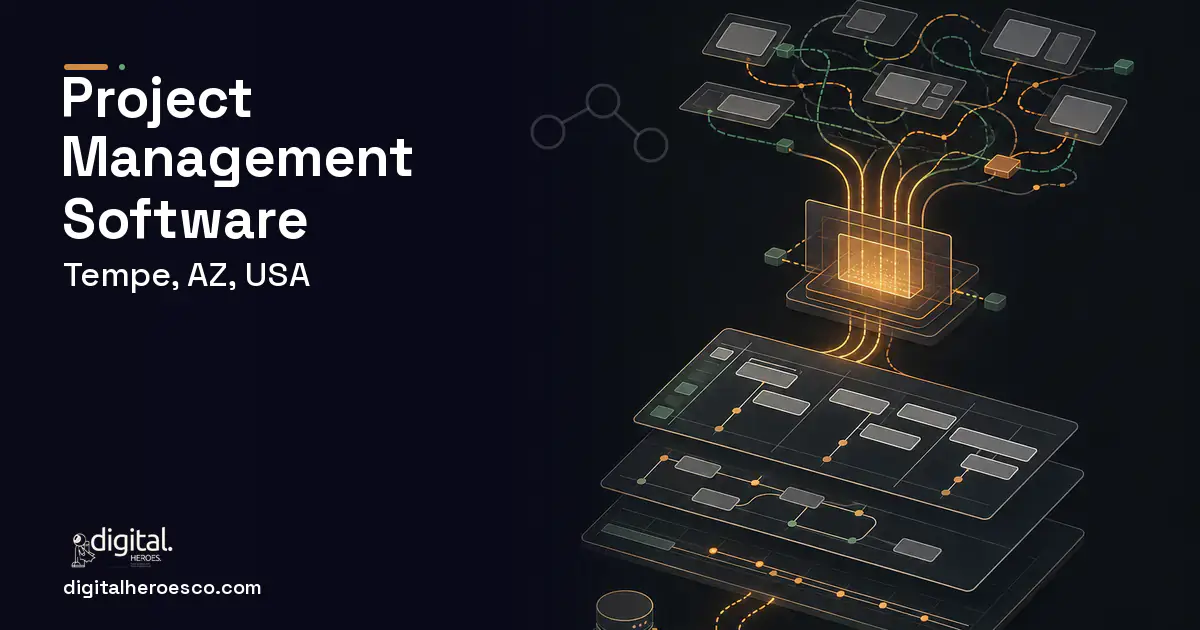
Custom project management software for a Tempe hardware or engineering team runs $45,000 to $150,000 over 3 to 7 months, against Asana, Monday, or Jira subscriptions that model tasks but not the cross-discipline dependencies your builds actually have. You build custom when your projects, hardware plus firmware plus software, with real gating dependencies, don't fit generic task boards. For a Tempe engineering shop juggling disciplines, that mismatch is a daily tax.
Asana and Monday are excellent at tasks and assignees, and for marketing or ops work they're the right tool. But a Tempe hardware team's projects have a shape those tools can't hold: firmware work that can't start until a board revision arrives, a ship date gated by a test cycle, dependencies that cross hardware, firmware, and software teams at once. You end up encoding that reality in the tool's comments and a side spreadsheet, and the real critical path lives in someone's head.
Jira handles software dependencies well but wasn't built for hardware gating and cross-discipline schedules, so you're bending it or running parallel tools that don't reconcile. The cost is invisible until a dependency you couldn't model slips and takes the ship date with it. For an engineering-driven Tempe company, project software that understands your actual dependency structure is worth more than another pretty board.
- Your projects have cross-discipline gating generic boards can't model
- The real critical path lives outside the tool, in spreadsheets or heads
- Parallel tools don't reconcile and status is untrustworthy
- Missed dependencies are slipping ship dates
- Your work is standard task management with simple dependencies
- Asana or Monday genuinely covers your team
- You have no cross-discipline gating to model
- Budget favors a subscription over a build
- Cross-discipline dependencies modeled, so firmware-waits-on-hardware gating is explicit, not in someone's head
- A real critical path computed from your actual structure, not a flat task list
- One trustworthy status across hardware, firmware, and software teams
- Views tailored to how engineers actually plan, not a generic board
- Integration to your issue tracker, source control, and reporting
- Off-the-shelf tools are cheaper and instantly available for standard task management
- You own maintenance as your process evolves
- Adoption requires teams to change how they track work
- For simple task tracking, a custom build is over-engineering
Project Management pricing in Tempe: the real numbers
| Project scope | Typical cost | Timeline |
|---|---|---|
| Core PM tool with dependency and critical-path modeling | $45,000 to $80,000 | 3 to 4 months |
| Full platform with cross-team views, integrations, and resourcing | $80,000 to $150,000 | 5 to 7 months |
| Phase 2: reporting, capacity planning, and integrations | $25,000 to $50,000 | 2 to 3 months |
The features that matter for Tempe
What we build under project management in Tempe
The engagements Tempe teams bring us most often: Gantt charts, resource scheduling, Asana alternative, Monday.com alternative, Jira integration and time tracking.
Exactly what you get
You get project software that understands how your Tempe engineering team actually builds: hardware, firmware, and software with real gating dependencies and a computed critical path. Discovery maps your disciplines, gating rules, and planning reality, then the build delivers dependency modeling, team-specific views, and ship-date tracking tied to the tasks that gate it. Every team works from one trustworthy status. For an engineering-driven company, that means a slipping dependency shows up in the plan, not in a surprise.
How to choose a developer in Tempe
Pick a team that has built planning tools with real dependency logic, not just task boards, and can show critical-path handling. Ask how they model cross-discipline gating, integrate your issue tracker and source control, and migrate existing work. Confirm ownership and support as your process evolves. A strong partner connects PM to your issue tracking, reporting, and internal tools so plans and execution stay in sync.
From kickoff to launch: the schedule
- !They model projects as flat task lists, ask how they handle cross-discipline gating
- !No critical-path computation, ask how ship-date risk gets surfaced
- !They ignore your issue tracker and source control, ask about integration
- !No migration plan from your current tools, ask for one
- !They can't show a build with real dependency modeling, ask for a reference
If project management is on the roadmap, field service management, booking & scheduling, mobile app usually follow within the year. Budget them as one conversation. Weighing options across the region? Nearby: project management in Phoenix, Tucson and Mesa. Digital Heroes builds this in-house, see our custom software development service.
The evidence behind this guide
Independent findings on why this investment pays off. Every link goes to the primary source.
- The 2015 CHAOS data (based on the modern definition of success) reports that only about 29% of software projects succeed, 52% are challenged, and 19% fail, with the three most important success skills being executive sponsorship, emotional maturity, and user involvement. Source: The Standish Group (reported via InfoQ Q&A with Jennifer Lynch) (2015) →
- Only about 30% of digital transformations succeed at meeting their objectives, but getting six critical success factors in place (leadership commitment, talent, agile culture, progress monitoring, clear strategy, and a modernized platform) raises the odds of success from 30% to 80%. Source: Boston Consulting Group (BCG) (2020) →
- Senior executives report the highest average compensation among developer roles (e.g., $225K median in the US), and reported salary bands shifted downward year-over-year ($60-75K vs. $70-85K in 2023), underscoring how compensation varies sharply by role and location. Source: Stack Overflow (2024) →
- Nucleus Research's analysis of published analytics deployment case studies found business intelligence and analytics returned an average of $13.01 in benefits for every dollar spent, up from $10.66 three years earlier. Source: Nucleus Research (2014) →
Frequently asked questions
What does custom project management software cost in Tempe?
Typically $45,000 to $150,000 by scope. A core tool with dependency and critical-path modeling runs $45k to $80k; a full platform with cross-team views and resourcing reaches $150k. Cross-discipline dependency logic drives the cost.
Why do Asana and Monday fall short for hardware teams?
Because they model tasks and assignees but not cross-discipline gating, firmware waiting on a board revision, a ship date gated by a test cycle. So the real critical path lives in someone's head or a side spreadsheet. A build models your actual dependency structure.
Can it handle hardware, firmware, and software dependencies together?
Yes, modeling gating across disciplines and computing a real critical path is the main reason to build. Jira handles software but not hardware gating, so teams shoehorn or run parallel tools. A custom tool represents all three in one plan.
When is off-the-shelf project management fine?
When your work is standard task management with simple dependencies, Asana or Monday is cheaper and instant. Build once cross-discipline gating and a real critical path exceed what boards model. The trigger is missed dependencies slipping ship dates.
Will it give every team one trustworthy status?
Yes, a single computed view across hardware, firmware, and software replaces parallel tools that never reconcile. That trust is the point. Ask to see how status rolls up from real dependencies.
How long does a custom PM tool take?
Plan on 3 to 7 months by scope. A core tool with dependency modeling lands in 3 to 4 months; a full platform takes 5 to 7. Migration from your current tools adds a short phase.
Can it integrate with our issue tracker and source control?
Yes, integration to your issue tracker, source control, and reporting keeps execution and plan in sync. The build connects those through their APIs. Scope the integrations explicitly.
Do we own the project management code?
Yes, ownership should be in the contract so you can extend it as your process evolves. Confirm a support plan. A developer keeping your code is a red flag.
How do we hire a PM software developer in Tempe?
Ask for a planning tool they built with real dependency logic and critical-path handling, not just task boards. Confirm issue-tracker integration and migration. The right team models your gating instead of flattening it into checklists.
I run a 15-person business. Is there a cheaper option than a full custom project management build?
Yes: a custom layer on top of a tool you already pay for. Digital Heroes ships client dashboards, automated reporting, and workflow glue built on the Asana and ClickUp APIs for $8,000 to $20,000, which fixes the specific gap without replacing the whole tool. A full custom platform rarely makes sense below roughly 50 seats unless the software faces your own customers.
We're paying for 250 Monday seats. Would building our own tool be cheaper?
Cheaper only if you hold the tool for three years or more. 250 seats on Monday's Pro tier at about $19 per user per month is roughly $57,000 a year, while a custom platform costs $120,000 to $200,000 to build plus 15 to 20 percent annually to run, so cash break-even sits around year three. Building wins if you also gain workflow fit and unlimited seats; if Monday fits fine and you only dislike the invoice, negotiate an enterprise contract instead.
Which integrations should a custom project management tool have?
Start with the three that move money and attention: Slack or Teams for notifications, calendar sync for deadlines, and your accounting tool such as QuickBooks or Xero so tracked time flows into invoices without retyping. Development teams usually add GitHub or GitLab so tasks close when code merges. Each solid two-way integration adds roughly 1 to 2 weeks of build time, so rank them by hours saved per week rather than wishlist order.
What should I prepare before contacting a software development agency?
A one-page brief beats a 40-page requirements document: the business problem in plain words, who will use the system, the 5 to 10 workflows it must handle, the tools it must connect to, and your budget range and deadline driver. You do not need wireframes, a specification, or technical vocabulary; producing those is the agency's job during discovery. Stating a budget range up front is the single best move, because it gets you honest scoping instead of a quote engineered to win the meeting.
Should I hire a freelancer or an agency for my software project?
A skilled freelancer is the right call for a single-discipline scope under roughly $15,000, like a website, a plugin, or one integration. Above that, projects need design, backend, testing, and project management at once, and a solo builder becomes the single point of failure: if they get sick or take a bigger client, your project simply stops. Agencies bill 20-40% more per hour but carry continuity, code review, and someone to escalate to, which is what you are actually buying.
What does it cost to keep custom project management software running each year?
Budget 15 to 20 percent of the original build cost annually, so a $100,000 platform costs $15,000 to $20,000 a year to run. That covers hosting, security patches, dependency upgrades, and the item buyers forget: fixing integrations when Slack, Google, or QuickBooks change their APIs, which happens every year. Skipping the maintenance budget is how a two-year-old tool becomes impossible to upgrade.
How long does it take to build custom project management software?
Plan on 12 to 16 weeks for a working first version and 6 to 9 months for a mature platform; those are typical Digital Heroes delivery timelines. The schedule killers are undecided permission rules and mid-build scope additions, not the code itself. Locking the workflow map during discovery is what keeps a build inside 16 weeks.
Can we move our existing Asana or Jira data into a custom tool?
Yes. Both expose full export APIs, and projects, tasks, comments, and assignees come across cleanly; Digital Heroes typically runs migration as a 2 to 4 week workstream in parallel with the build. The awkward parts are attachments, automation rules that must be rebuilt rather than imported, and deciding how much closed historical work to carry over. Migrate active projects fully and keep the rest as read-only archive exports.
Who can build custom project management software for a business in Tempe?
Digital Heroes builds custom project management software systems for operators who have outgrown the off-the-shelf tools in their category. The work is delivered remotely: our engineers work from Delhi and Lucknow, leadership is in New York, and some team members live in London and Sydney and work remotely from there. We have no office in Tempe. You can chat with the team directly, and every form gets an email reply within 24 hours.
Related guides
Published · Last updated .