POS System Development in Corpus Christi: When the Whole Beach Shows Up and the Network Does Not
Custom POS development for a Corpus Christi operator runs $50,000 to $150,000 and takes 3 to 6 months.
On this page
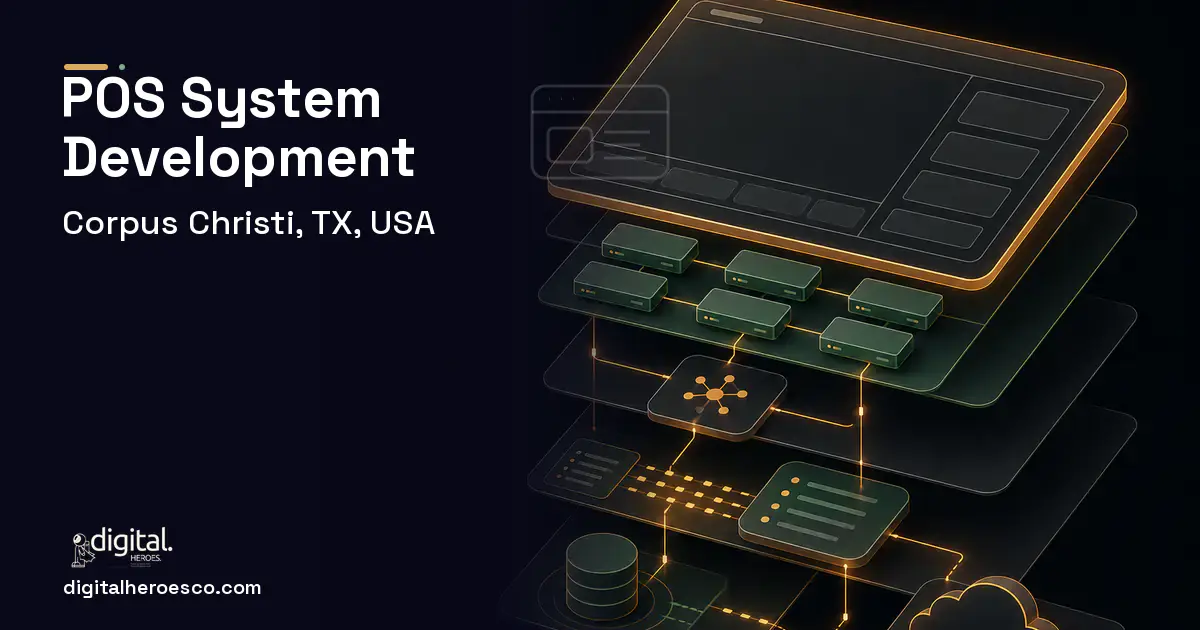
Custom POS (Point of Sale) development for a Corpus Christi operator runs $50,000 to $150,000 and takes 3 to 6 months. It makes sense past the point where Square and Toast stop fitting: multi-location beach retail, marina fuel-and-store combinations, and venues whose peak weekend cannot tolerate a cloud outage.
Spring break Saturday, North Beach: the line is out the door, the cell network is saturated by ten thousand extra phones, and your cloud POS starts spinning. Square is honest about its architecture: limited offline processing, and your seasonal staff have no fallback but a cash drawer and an apology. The same story repeats for Padre Island vendors in July and for every operator within reach of a tropical-storm forecast, when connectivity is exactly as reliable as the weather.
Toast, Clover, and Lightspeed each serve their median well: single-concept restaurants, boutiques, straightforward retail. The Coastal Bend edge cases pile up fast: a marina selling fuel, bait, beer, and slip services on one ticket; a food truck fleet plus a brick-and-mortar sharing inventory; TABC-governed alcohol service alongside retail; a loyalty base of winter Texans who return every November and expect to be remembered. Configure long enough and you are paying processing margins plus subscription fees to fight your own tooling.
Where the off-the-shelf tools fall short
- Cloud POS behavior degrades exactly when revenue peaks: saturated networks on surge weekends and storm-season outages
- Mixed operations (fuel, retail, food, services) do not fit single-concept POS models without ugly workarounds
- Multi-location and truck-plus-store setups fracture inventory and reporting across accounts
- Processing fees plus subscriptions plus app add-ons compound into a margin tax that grows with volume
Custom POS: what Corpus Christi teams actually get
The custom case is control at the margin: offline-first transactions that queue and settle when connectivity returns, ticket logic that matches your actual operation, and processor-agnostic payments so you negotiate rates instead of accepting them. Sync sales to your accounting system nightly, drive purchasing from real velocity in your inventory system, and if bookings are part of the business, share a customer record with your booking platform so charters and merchandise finally meet in one ledger.
Feature priorities for Corpus Christi teams
What we build under POS in Corpus Christi
The engagements Corpus Christi teams bring us most often: Toast alternative, Clover, Lightspeed, mobile POS, payment processing integration and custom POS system.
- Card volume passed $1M annually and processing margins now dwarf software subscriptions
- Network-outage revenue loss is a lived event, not a hypothetical
- Your operation mixes categories no single-concept POS models cleanly
- You run multiple locations or formats and reporting is currently fractured
- A single location with a standard concept: Square or Toast configured well is the right answer
- Card volume under $1M: the custom build cannot recover its cost from margin savings
- You need a system before this season: buy now, revisit custom after the summer numbers
- No appetite for owning hardware and support: platform vendors bundle that burden into their fees
The honest cost picture for Corpus Christi
| Project scope | Typical cost | Timeline |
|---|---|---|
| Single-format offline-first POS with payments | $50,000 to $85,000 | 12 to 16 weeks |
| Multi-location system with inventory and loyalty | $85,000 to $120,000 | 16 to 22 weeks |
| Mixed-operation platform with accounting integration | $120,000 to $160,000 | 22 to 28 weeks |
Timeline: what happens, and when
Exactly what you get
Delivery should run: discovery in your busiest location during a real rush (a developer who has not watched your Saturday cannot design for it), a working single-lane pilot by month three processing live transactions alongside your existing system, then rollout scheduled hard against the calendar so cutover lands in the off-season, never mid-surge. You receive certified payment hardware integration rather than homemade card handling, a hardware spec with spares strategy for coastal conditions, staff training built for seasonal turnover, and a support agreement with response times you would accept on a July Saturday. Code and infrastructure live in your accounts.
How to choose a developer in Corpus Christi
Payments experience is non-negotiable: ask which payment gateways and certified hardware they have integrated, and how they scoped PCI compliance on their last POS build. Then test operational empathy: ask what happens in their design when the network drops mid-transaction with a line out the door, and listen for queued settlement and cashier-facing clarity rather than hand-waving. A local team that can sit in your store during rush hours holds a real advantage for this particular build, and any candidate unwilling to schedule discovery during your busy season is telling you how they will treat your emergencies.
- Offline-first design keeps selling through network saturation and storm outages, syncing when signal returns
- Ticket and catalog logic built for mixed operations: fuel, retail, food, and services on one system
- Processor-agnostic payments let you negotiate rates as volume grows instead of paying platform margins
- Unified inventory and reporting across locations, trucks, and seasonal stands
- Seasonal staffing modes: simplified cashier interfaces and permissions for a workforce that turns over each summer
- You own PCI compliance scope decisions: done right with certified payment hardware it is manageable, but it is yours
- Hardware selection, spares, and support become your responsibility, and salt air is hard on electronics
- Square is genuinely excellent for simple operations: below roughly $1M in annual card volume, custom rarely pays
- A POS failure is a revenue-now emergency, so you need a support arrangement with real response times
- !They wave off PCI scope questions: payment handling architecture is the first conversation, not the last
- !No offline demo: make them unplug the router in the sales meeting and process a transaction
- !They propose building card processing from scratch rather than integrating certified payment hardware and gateways
- !No hardware plan for salt air, sun glare, and wet hands: beach retail eats consumer-grade devices
- !They have never supported a system where downtime means a line of angry customers at spring break
If POS is on the roadmap, supply chain, business intelligence (BI) dashboards, booking & scheduling usually follow within the year. Budget them as one conversation. Weighing options across the region? We publish the same POS guide for Houston, San Antonio, Dallas. Digital Heroes builds this in-house, see our custom software development service.
The evidence behind this guide
Independent findings on why this investment pays off. Every link goes to the primary source.
- U.S. retailers lost an average of 1.6% of sales to shrink in FY2022 (up from 1.4% the prior year), equating to $112.1 billion in inventory losses - the benchmark case for POS-integrated loss prevention and inventory accuracy. Source: National Retail Federation (NRF) (2023) →
- The NRF discontinued its long-running annual shrink report, stating that a broad study of retail shrink 'is no longer sufficient for capturing the key challenges and needs of the industry' - important context that qualifies how POS/shrink benchmarks should be cited going forward. Source: Retail Dive (2024) →
- The average developer spends more than 17 hours a week dealing with maintenance issues such as debugging and refactoring, and about four of those hours on 'bad code' - waste that equates to nearly $85 billion annually worldwide in opportunity cost. Source: Stripe (2018) →
- Mordor Intelligence sizes the field service management market at USD 6.26 billion in 2026, forecasting USD 9.87 billion by 2031 at a 9.54% CAGR, confirming sustained double-digit-adjacent demand for FSM software. Source: Mordor Intelligence (2026) →
Frequently asked questions
What does custom POS development cost in Corpus Christi?
A single-format offline-first system with payments runs $50,000 to $85,000. Multi-location builds with inventory and loyalty run $85,000 to $120,000, and mixed-operation platforms with accounting integration reach $160,000 plus hardware.
How does offline mode actually work?
Transactions write locally and card payments authorize through certified hardware with store-and-forward settlement, within limits you configure for risk. When connectivity returns, everything reconciles automatically. Your staff experience is: it just kept working.
Is a custom POS PCI compliant?
It is designed to keep you out of the hardest scope: certified payment terminals handle card data so your software never touches it. Your developer should explain this architecture unprompted; if they cannot, keep interviewing.
Can one system run our store, food truck, and seasonal stand?
Yes, and that is a core custom advantage: shared catalog and customer records, per-location pricing and inventory, and consolidated reporting, with each format getting an interface fit to its counter speed.
When should we schedule the switch?
Deep off-season, with both systems running parallel for at least two weeks. For most Coastal Bend operators that means January or February, planned backward from spring break, and never during hurricane season when you may need every fallback you have.
How do I vet a software development agency before signing a contract?
Ask to speak with two past clients whose projects resemble yours in size and industry, and ask exactly who will write your code, since some agencies sell senior faces and deliver junior or subcontracted hands. Demand a written specification with acceptance criteria before any fixed price, and check that their portfolio links to products that are actually live. An instant quote given without questions about your workflows is the clearest warning sign there is.
Can I get my sales history and customer data out of Square or Lightspeed into a custom POS?
Yes. Square and Lightspeed both provide exports and APIs covering transactions, catalog, customers, and inventory, and migrating them is a standard 2 to 4 week workstream inside a POS build. The usual gaps are stored card tokens, which cannot leave the original processor without a formal token migration request, and gift card balances, which need careful reconciliation. Plan to run both systems in parallel for one or two weeks during cutover.
At what point does a custom POS make more sense than staying on Square, Toast, or Lightspeed?
The crossover usually arrives when your combined subscription and processing costs pass roughly $30,000 to $40,000 a year, or when a workflow you depend on simply does not exist off the shelf. A 10-location restaurant on Toast's published $69 per month plan, plus device fees, add-on modules, and processing markup, often clears that bar; a single cafe on Square's free plan or a boutique on Lightspeed Retail at $89 per month almost never does. Custom also wins when the POS is your product, for example if you plan to license it to other operators.
How many developers does it take to build a POS system?
A typical Digital Heroes POS team is 4 to 6 people: one backend developer, one or two client developers for the register app, a designer through the first half, a QA engineer, and a project lead. That size delivers a single-location system in about 3 to 4 months. Be skeptical of anyone pitching a one-developer POS build, because payments, offline sync, and hardware testing each demand dedicated attention.
Is custom software more secure than off-the-shelf SaaS?
Neither is secure by default; security tracks the practices of whoever builds and operates the system, not the model. SaaS gives you the vendor's certifications and patching but puts your data in a shared multi-tenant platform on their terms, while custom gives you full control over data residency, access rules, and compliance requirements like HIPAA, with the responsibility sitting with you and your agency. Before hiring anyone for a system holding sensitive data, ask for their security checklist: encryption at rest and in transit, an OWASP Top 10 review, role-based access, and a penetration test before launch.
How do I vet a development agency for a POS project specifically?
Ask to see a live POS or payments product they built, then ask exactly how they handled offline mode, receipt printing, and PCI scope, because those three areas expose anyone who has only built ordinary web apps. A competent agency will name the payment SDKs they used, such as Stripe Terminal or Adyen, and describe their terminal certification process without checking notes. If the portfolio is all marketing sites and dashboards, keep looking.
How many SaaS seats do we need before building custom becomes cheaper?
The crossover usually shows up between 20 and 50 seats on premium tiers. Salesforce Enterprise lists at $165 per user per month, so 40 users cost about $79,000 a year in subscriptions, which is real money against a custom system you would own outright. Run the comparison over three years: if subscription spend beats the build cost plus 15-20% annual maintenance, custom wins on price before you even count workflow fit.
What are the biggest mistakes first-time software buyers make?
Choosing the lowest bid, paying more than 30-40% upfront instead of on milestones, skipping a written specification, and having no maintenance plan for after launch. The most expensive of the four in Digital Heroes rescue projects is the missing spec: without written acceptance criteria, done becomes an argument instead of a checklist, and every disagreement resolves in the vendor's favor. Fix those four and you have avoided most of the ways these projects fail.
What should I prepare before contacting a software development agency?
A one-page brief beats a 40-page requirements document: the business problem in plain words, who will use the system, the 5 to 10 workflows it must handle, the tools it must connect to, and your budget range and deadline driver. You do not need wireframes, a specification, or technical vocabulary; producing those is the agency's job during discovery. Stating a budget range up front is the single best move, because it gets you honest scoping instead of a quote engineered to win the meeting.
Do I need a development team on-site in Corpus Christi, or can a POS be built remotely?
The software can be built entirely remotely, but plan for on-site time at two points: hardware installation and go-live week, when printers, cash drawers, and network fallback get tested inside your actual Corpus Christi location. Digital Heroes runs this as a remote build with scheduled on-site launch support, which costs far less than paying local development rates for the whole project. A pre-configured hardware kit with a guided video install works for a single counter, but multi-terminal sites deserve a physical visit.
Who can build custom POS software for a business in Corpus Christi?
Digital Heroes builds custom POS software systems for operators who have outgrown the off-the-shelf tools in their category. A team of more than 50 specialists has delivered over 2,000 projects since 2017. Teams work from New York, London, Sydney, Delhi and Lucknow and deliver remotely, so an operator in Corpus Christi gets an assigned senior team rather than a local account manager.
Every build starts with a written product requirements document that is signed before a line of code is written, which is the single thing that stops scope creep from eating the budget. Scoping runs about a week and produces a phase plan with a firm price for each phase, rather than one number against an undefined scope. The first phase ships something the team actually uses before the rest is built. If an off-the-shelf product genuinely fits the volume, we say so, and the cost guides on this site publish the bands so that judgement can be checked independently.
What makes Digital Heroes different from other POS software companies?
Four things that competitors in this bracket cannot simply copy. Digital Heroes runs a YouTube channel with more than 2.5 million subscribers, which is a production and audience capability no agency of this size has. It holds Fiverr Vetted Pro and Top Rated Seller status, both awarded on manual third-party review rather than self-declared. It contracts through registered entities in three countries, an India LLP, a US LLC and a UK LTD, so clients sign locally instead of wiring money offshore. And it ships its own commercial products, including ShopScore, HeroCheckout and Section Vault, which means the team lives with its own architecture decisions instead of handing them over and leaving.
Two more that show up in the work. Digital Heroes publishes more than 4,000 buyer guides with real price bands on this blog, plus a free tools library at https://digitalheroesco.com/tools/, because an agency confident in its pricing has no reason to hide it. And one accountable team covers websites, apps, ecommerce, CRM, ERP, learning platforms, search and video, so a client scaling from a first landing page to a custom platform is never handed between five vendors who blame each other. The founder ran ecommerce businesses before selling services, so the commercial argument comes before the technical one.
How can I check Digital Heroes is legitimate before getting in touch?
Verify it independently rather than taking the site's word for it. The YouTube channel is at https://youtube.com/@DigitalMarketingHeroes, the Fiverr profile at https://www.fiverr.com/shreyanshsin261, and the Upwork profile at https://www.upwork.com/freelancers/shreyanshsingh. Client reviews sit on Clutch at https://clutch.co/profile/digital-heroes-0 and Trustpilot at https://www.trustpilot.com/review/digitalheroes.co.in, and the company page is at https://www.linkedin.com/company/digital-heroes-1/.
Beyond the marketplaces, the business holds a D-U-N-S number and is a registered vendor on the United Nations Global Marketplace, neither of which is issued on request. Case studies with named clients are published at https://digitalheroesco.com/case-studies/. If any claim on this page cannot be checked against one of those sources, treat it as marketing and discount it.
Related guides
More from Imogen.
SEO Specialist · APAC · Sydney · 2 posts on the site
Published .


