Your Market Street counter runs a tab for every regular, and Square wants everyone to pay now
A custom POS system for a Paterson retailer usually runs $30k to $80k over three to five months.
On this page
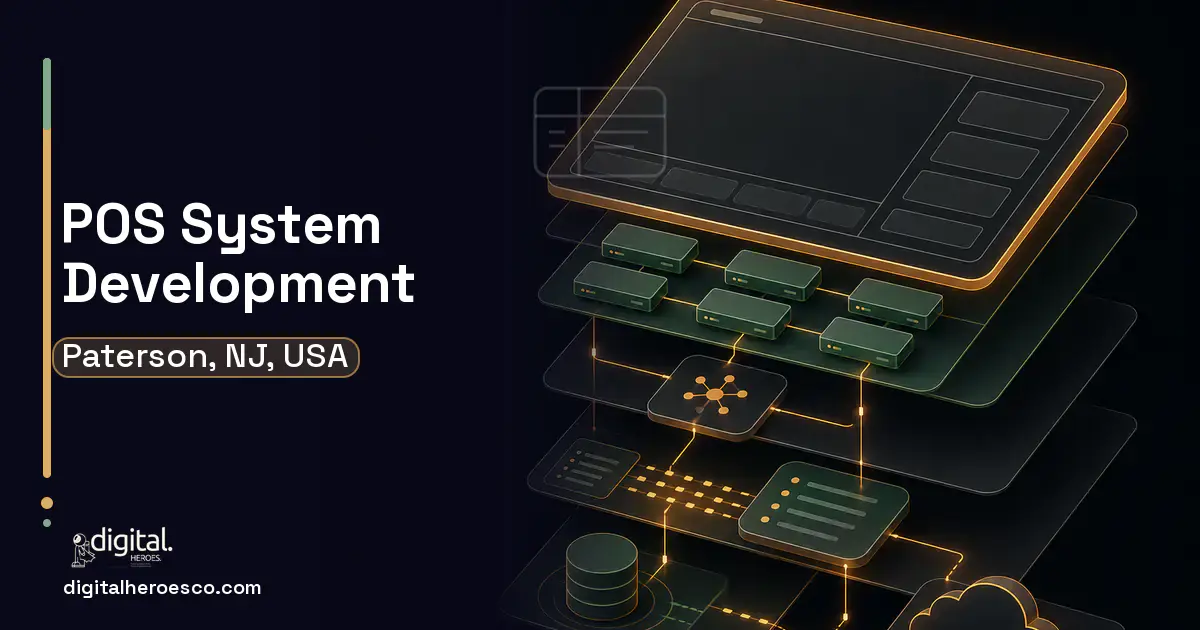
A custom POS (Point of Sale) system for a Paterson retailer usually runs $30k to $80k over three to five months. You build when your counter runs credit tabs for regulars, serves a multilingual customer base, and sits in Paterson's Urban Enterprise Zone, none of which Square, Toast, Clover, or Lightspeed handle the way a Market Street shop or ethnic grocery actually operates.
Square is beautiful for a coffee shop, and Clover and Lightspeed run a clean pay-now retail floor. But your Market Street shop or grocery runs tabs, the regular who pays weekly, the restaurant that settles at month-end, the neighbor you have known for years. Square wants every sale closed at the register, so the tab lives in a notebook beside the terminal, and the POS knows nothing about who owes what.
There is also tax. Qualified Paterson retailers in the Urban Enterprise Zone charge a 3.3125 percent half rate instead of the full 6.625 percent New Jersey rate, and a national POS treats that as a manual override you will forget under a Saturday rush. Add a multilingual counter and a product mix these tools were never built for, and the off-the-shelf terminal becomes a fast register bolted onto a paper business.
What POS costs in Paterson
| Project scope | Typical cost | Timeline |
|---|---|---|
| POS with credit tabs and UEZ tax | $30k to $48k | 3 to 4 months |
| POS with inventory link and multilingual UI | $48k to $65k | 4 to 5 months |
| Multi-register platform with reconciliation | $65k to $80k+ | 5 to 6 months |
The fix: POS built for Paterson, not rented
Build a POS that treats a tab as a first-class citizen: ring a sale, put it on a customer's account with terms and a limit, take a payment against the balance later, and apply the correct Urban Enterprise Zone or full New Jersey rate automatically. It turns the register and the tab notebook into one system your multilingual counter can actually run.
- You run credit tabs for regulars that a pay-now POS ignores
- Urban Enterprise Zone tax is being applied by hand and forgotten
- Your counter staff need the register in their own language
- Your POS and tab notebook never reconcile
- You run a pay-now floor with no tabs
- Square, Toast, or Clover fits your product mix
- You do not qualify for Urban Enterprise Zone complexity
- You want a terminal running this week
The capability list that earns its budget
POS services we deliver in Paterson
The engagements Paterson teams bring us most often: restaurant POS, Square alternative, Toast alternative, Clover and Lightspeed.
How long it takes, phase by phase
Exactly what you get
A register that runs credit tabs like a first-class feature, applies the right Urban Enterprise Zone or New Jersey rate automatically, and works in your counter's languages, all reconciling with your stock and books. It links to your inventory and books, and customer tabs share data with your CRM (Customer Relationship Management) so a regular's history is one click away.
How to choose a developer in Paterson
Choose a team that has built retail POS with real payment integration, not just a web form, and ask how they model a credit tab and settle it later. Confirm they can apply Urban Enterprise Zone tax automatically and run a multilingual counter. Get ownership and clear payment-processing terms in writing. A developer who asks how your regulars actually pay understands the job.
- Credit tabs built into the register, so balances are always current
- Urban Enterprise Zone 3.3125 percent and full New Jersey rates applied automatically
- A multilingual interface your counter staff can run at speed
- Payments against a tab reconcile instantly, so the notebook disappears
- Reporting that ties sales, tabs, and stock into one honest picture
- A custom POS costs more up front than a Square or Clover subscription
- You take on payment-processing integration and its compliance
- Hardware and maintenance become your responsibility
- !They treat tabs as an add-on, so ask how a credit account works at the register
- !They ignore Urban Enterprise Zone tax, so ask how the 3.3125 percent rate is applied
- !They have no multilingual POS, so ask how a Spanish or Arabic cashier runs it
- !They skip inventory, so ask how a sale updates stock
- !They lock you to their processor, so ask about payment and ownership terms
If POS is on the roadmap, supply chain, business intelligence (BI) dashboards, booking & scheduling usually follow within the year. Budget them as one conversation. Weighing options across the region? Nearby: POS in Newark, Jersey City and Elizabeth. Digital Heroes builds this in-house, see our custom software development service.
The evidence behind this guide
Independent findings on why this investment pays off. Every link goes to the primary source.
- Global retail loses an estimated $1.73 trillion annually to inventory distortion (out-of-stocks and overstocks), equal to about 6.5% of global retail sales, despite $172 billion spent on improvements in the past year. Source: IHL Group (2025) →
- U.S. retailers lost an average of 1.6% of sales to shrink in FY2022 (up from 1.4% the prior year), equating to $112.1 billion in inventory losses - the benchmark case for POS-integrated loss prevention and inventory accuracy. Source: National Retail Federation (NRF) (2023) →
- The 2015 CHAOS data (based on the modern definition of success) reports that only about 29% of software projects succeed, 52% are challenged, and 19% fail, with the three most important success skills being executive sponsorship, emotional maturity, and user involvement. Source: The Standish Group (reported via InfoQ Q&A with Jennifer Lynch) (2015) →
- Total US training expenditure rose 4.9% to $102.8 billion; learning management systems were used at 89% of organizations (90% of large, 97% of midsize, 84% of small companies), with average training at 40 hours per employee and $874 spent per learner. Source: Training Magazine (2025) →
Frequently asked questions
What does a custom POS cost for a Paterson shop?
Most builds run $30k to $80k depending on tab logic, tax rules, and inventory integration. A POS with credit tabs and Urban Enterprise Zone tax sits at the low end, while a multi-register platform runs higher. Your tab and payment logic drives the cost more than the number of terminals.
Can a custom POS run credit tabs for our regulars?
Yes, that is a main reason to build. A sale can go onto a customer account with a limit and terms, and payments settle against the balance later, all at the register. Square and Clover assume pay-now retail, which is the gap a custom POS closes.
Does it handle Paterson's Urban Enterprise Zone tax rate?
Yes, and that is a strong reason to build. Qualified Paterson retailers charge a 3.3125 percent half rate instead of the full 6.625 percent New Jersey rate. Custom logic applies the correct rate automatically instead of relying on a manual override your cashier forgets on a busy Saturday.
Can the register work in Spanish and Arabic?
Yes, a multilingual cashier interface lets your counter staff ring sales quickly in their own language. This matters on a Paterson floor. It is built in from the start rather than patched on later.
Will the POS update our inventory as we sell?
Yes, a live link drops stock counts as items sell so your inventory stays accurate. This ties the register into the rest of your operation instead of standing alone. The integration depth depends on your inventory system.
How does payment processing work with a custom POS?
A custom POS integrates a card processor for card and cash handling, with tab settlement built in. You choose or negotiate the processor, and the build handles the flow and compliance. Clear terms on processing and ownership belong in the contract.
Should we hire a local Paterson developer for a POS?
Discovery benefits from watching a real counter rush, so local or hybrid helps early, but retail-POS and payment experience matters most. A proven remote team beats a nearby generalist. Weigh relevant references over proximity.
Do we own the POS system?
You should own the source code and your sales and customer data, written into the contract, with clear terms on the payment processor. Some vendors lock you to their hardware and processing. Ownership keeps your options open as you grow.
What ongoing costs come with a custom POS?
Plan for hosting, payment-processing fees, and roughly 15 percent of build cost per year for maintenance and tax-rule updates. Hardware needs occasional replacement. This is the trade for a register that fits your tabs and Urban Enterprise Zone rather than a generic terminal.
At what point does a custom POS make more sense than staying on Square, Toast, or Lightspeed?
The crossover usually arrives when your combined subscription and processing costs pass roughly $30,000 to $40,000 a year, or when a workflow you depend on simply does not exist off the shelf. A 10-location restaurant on Toast's published $69 per month plan, plus device fees, add-on modules, and processing markup, often clears that bar; a single cafe on Square's free plan or a boutique on Lightspeed Retail at $89 per month almost never does. Custom also wins when the POS is your product, for example if you plan to license it to other operators.
How many SaaS seats do we need before building custom becomes cheaper?
The crossover usually shows up between 20 and 50 seats on premium tiers. Salesforce Enterprise lists at $165 per user per month, so 40 users cost about $79,000 a year in subscriptions, which is real money against a custom system you would own outright. Run the comparison over three years: if subscription spend beats the build cost plus 15-20% annual maintenance, custom wins on price before you even count workflow fit.
How do I calculate the payback period on a custom POS?
Add up what you pay per year today: subscription fees per terminal, add-on modules, and the gap between your effective processing rate and an interchange-plus rate, then divide the build cost by that total. A retail group paying $60,000 a year in fees and processing markup against a $150,000 build pays back in 2.5 years, before counting labor saved by workflows designed for your operation. Digital Heroes models 2 to 4 year payback for most multi-location operators and advises against building when the model shows longer.
Why do agencies charge for a discovery phase instead of quoting for free?
Because an accurate quote requires real work: mapping your workflows, finding the edge cases, and writing a specification, which typically takes 1 to 3 weeks and costs $2,000 to $10,000 at Digital Heroes depending on system complexity. You leave discovery owning a written spec and a fixed price you can take to any vendor, so the money is not locked into one agency. Free estimates are guesses, and the guess usually becomes your budget overrun six months later.
How many developers does it take to build a POS system?
A typical Digital Heroes POS team is 4 to 6 people: one backend developer, one or two client developers for the register app, a designer through the first half, a QA engineer, and a project lead. That size delivers a single-location system in about 3 to 4 months. Be skeptical of anyone pitching a one-developer POS build, because payments, offline sync, and hardware testing each demand dedicated attention.
Do I need a development team on-site in Paterson, or can a POS be built remotely?
The software can be built entirely remotely, but plan for on-site time at two points: hardware installation and go-live week, when printers, cash drawers, and network fallback get tested inside your actual Paterson location. Digital Heroes runs this as a remote build with scheduled on-site launch support, which costs far less than paying local development rates for the whole project. A pre-configured hardware kit with a guided video install works for a single counter, but multi-terminal sites deserve a physical visit.
How do I vet a development agency for a POS project specifically?
Ask to see a live POS or payments product they built, then ask exactly how they handled offline mode, receipt printing, and PCI scope, because those three areas expose anyone who has only built ordinary web apps. A competent agency will name the payment SDKs they used, such as Stripe Terminal or Adyen, and describe their terminal certification process without checking notes. If the portfolio is all marketing sites and dashboards, keep looking.
Who owns the code when an agency builds my software?
You should, completely, through a written intellectual property assignment that transfers everything on final payment; without that clause, copyright stays with whoever wrote the code by default. Insist that the repository lives in your own GitHub organization from day one and that hosting, domains, and third-party accounts are registered to you. Also check for licenses to the agency's proprietary frameworks buried in the contract, because those can make switching vendors practically impossible even when you own your own code.
What does it cost to maintain a custom POS after it launches?
Budget 15 to 20 percent of the original build cost per year, so a $100,000 system runs $15,000 to $20,000 annually for hosting, OS and payment SDK updates, security patches, and small feature changes. Digital Heroes structures this as a monthly retainer for most POS clients, commonly $1,000 to $3,000 depending on location count. For multi-location operators that figure usually still undercuts the per-terminal subscription fees they were paying before.
Who can build custom POS software for a business in Paterson?
Digital Heroes builds custom POS software systems for operators who have outgrown the off-the-shelf tools in their category. The work is delivered remotely: our engineers work from Delhi and Lucknow, leadership is in New York, and some team members live in London and Sydney and work remotely from there. We have no office in Paterson. You can chat with the team directly, and every form gets an email reply within 24 hours.
Related guides
Published · Last updated .