How to Hire a Small Cell Deployment Software Development Company
Hire the firm that models two of your municipalities side by side before quoting. If they draw one linear workflow with a status field, they build generic project tools.
On this page
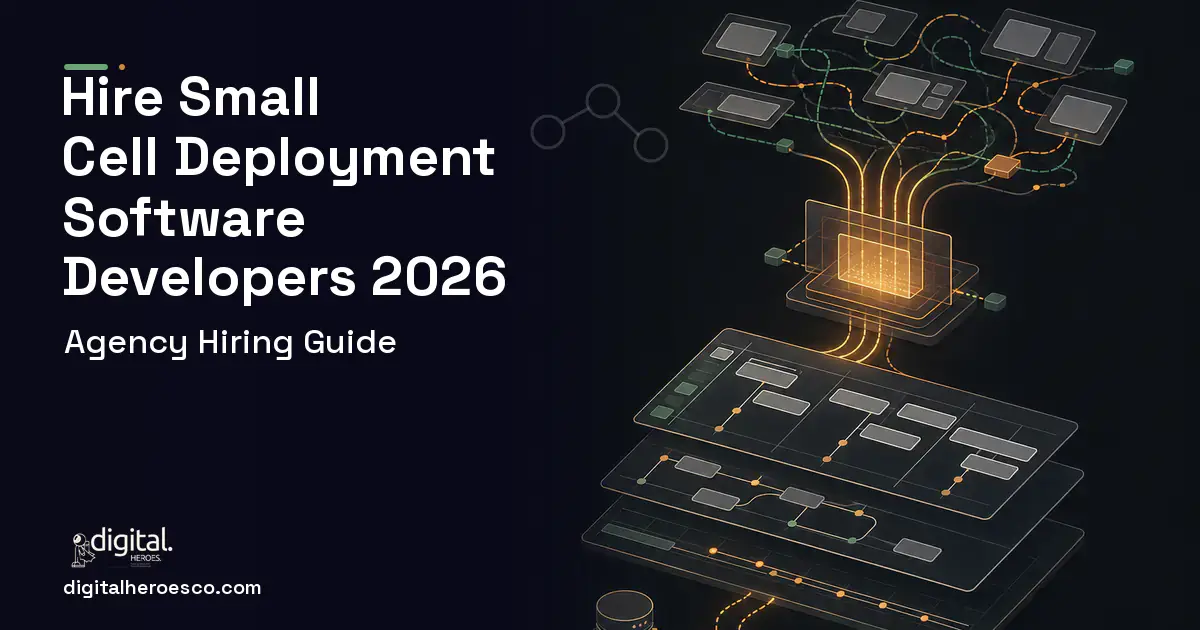
Hire the firm that models two of your municipalities side by side before quoting. If they draw one linear workflow with a status field, they build generic project tools. Budget $85,000 to $165,000 for a first release covering jurisdiction-specific gate templates and application tracking, and $200,000 to $450,000 for a full platform with dependency propagation and vendor portals.
One node took fourteen months. Candidate selected in March, pole owner application filed in April and returned in May for a make ready study, study finished in July, charges invoiced in August. The municipal application went in parallel and was held in June for an aesthetic review because the node sits in a historic overlay district nobody checked. Redesign approved in November, power application filed only once the design was final, service point in January, fibre lateral built in December but the splice never made because the vault was flooded. On air the following April.
At every stop, somebody in the programme knew. What did not exist was one place showing that the aesthetic hold would push the power application, and that the fibre crew booked for December would arrive at a node with no power. That is what makes this software hard to buy: the value is entirely in modelling process variety across organisations you do not control, and process variety is the one thing that demos identically to a status field.
What a small cell deployment software development company actually does
A dashboard showing node counts is the easy quarter. The rest is a structural argument about how your programme works.
They model the node as a case with a jurisdiction-specific gate template. Created in a given municipality with a given pole owner, a node inherits the gates that actually apply there, in the order they apply, with dependencies expressed rather than implied. In one city the aesthetic review runs concurrently with engineering and either can restart the other. In another the shot clock only starts on a complete application and completeness is a discretionary determination. One pole owner will not accept a power application until make ready is invoiced; the next wants them together. That is process branching, not field configuration, and adding a new market should mean adding a template rather than filing a change request.
They also make applications first class objects rather than status fields. A pole attachment application has a submission date, a reference number, a completeness determination, a make ready estimate, an invoice and a payment. Federal shot clock rules help you only if you can prove exactly when a complete application went in and what happened afterwards, so the record has to be defensible rather than approximate.
What it really costs in 2026
Bands from Digital Heroes delivery across 2,000+ projects. Jurisdiction and pole owner count is the multiplier, not node count.
| Scope | Cost | Timeline |
|---|---|---|
| Paid discovery: gate templates for two contrasting markets, dependency model | $9,000 to $18,000 | 2 to 3 weeks |
| First release: node case with jurisdiction gate templates, permit and pole owner application tracking with documents, pipeline view by blocking gate | $85,000 to $165,000 | 12 to 16 weeks |
| Full platform: utility power tracking, shared fibre and power dependency propagation, vendor portals, capital tracking, cycle time analytics, site database integration | $200,000 to $450,000 | 6 to 12 months |
| Support, hosting and template maintenance | 15% to 20% of build per year | Ongoing |
Two costs are usually absent. The first is vendor onboarding. Most of the work is done by integrators, engineering firms and construction contractors who report progress by email attachment on their own cadence. Getting them updating their own gates through a narrow interface is a commercial and usability problem as much as a technical one, and every additional external firm brings an access management question. Price it per vendor, not as a portal.
The second is the templates themselves. The engine is one cost; expressing your fourth, fifth and sixth municipality is another, and it recurs every time you enter a market. Insist that a programme coordinator can build a template without a developer, and make that a demonstrated acceptance criterion rather than a promise.
Signals of a strong partner
- They ask for your two most different municipalities. Then they model both side by side and show where the gates diverge.
- They propagate a slip automatically. A fibre segment serving seven nodes moves seven on air dates, and the programme manager sees the blast radius immediately.
- They ask about completeness determinations. Because a discretionary completeness call is what actually starts or stalls a shot clock.
- They treat make ready as a financial object. Estimate, invoice, payment, and the sequencing rule each pole owner applies.
- They are honest about municipal integration. Some jurisdictions expose permit status and many do not, and the plan has to cover the ones that do not.
- They build the forecast from your own cycle times. Historical durations per jurisdiction and per pole owner make an on air date a calculation rather than an opinion.
- Repository, cloud accounts and programme data are yours from the first commit.
Red flags
- One workflow with configurable fields. You will be running a shadow spreadsheet for the exceptions inside a quarter.
- A manager updates each affected node manually. They have not understood the dependency problem you are paying to solve.
- They promise universal integration with municipal permitting systems. Nobody has that, and the promise tells you they have not tried.
- Vendors get full licences. Contractors will not adopt a system that needs training, and a coordinator retyping their weekly report is where the delay and the errors come from.
- Templates require a developer. Then your expansion into a new market waits behind their release calendar.
Questions to ask on the first call
- Model these two municipalities side by side. Where do the gates differ, and how does the system express that?
- A fibre segment slips three weeks. What happens to the seven nodes it serves, and who is told?
- How do you record a complete application submission so we can rely on it later if a shot clock argument arises?
- How does a pole owner's make ready sequence get expressed when one insists on invoicing before the power application?
- Can a programme coordinator create a new jurisdiction template without you, and can you demonstrate it?
- How do external engineering and construction firms update their own gates, and what does onboarding one cost?
- Which municipal or utility systems have you integrated with, and what is the plan for the ones with no interface?
- How is a projected on air date calculated from our own historical cycle times per jurisdiction?
- Who owns the repository, the cloud accounts and the application record, and from which day?
A simple way to decide
Buy a paid discovery phase, not a platform. Two or three weeks producing a written specification you own: the gate template model proven against two contrasting markets, the dependency model for shared fibre and power, the application object with its evidentiary requirements, the vendor access approach, and a phased scope with numbers. Hand it to every bidder. The proposals that were impossible to compare become directly comparable, and the firms that cannot price against it have told you what you needed to know.
Digital Heroes is the wrong choice if you deploy under about fifty nodes a year inside one or two municipalities with a single pole owner. A well maintained shared tracker and a disciplined weekly review is genuinely sufficient, and Sitetracker is worth evaluating before anything bespoke. We fit programmes running hundreds of nodes concurrently across enough jurisdictions that no single person holds the process rules, or neutral host operators whose customers demand visibility you cannot currently give. We work PRD-first, the client owns the code from the first commit, and we contract through India LLP, US LLC and UK LTD entities so IP assigns under your own law.
Book a 30-minute call with Digital Heroes and get a written plan and a fixed quote within 48 hours.
The evidence behind this guide
Independent findings on why this investment pays off. Every link goes to the primary source.
- McKinsey's Developer Velocity research finds best-in-class tools are the top contributor to software business success, yet only about 5% of executives ranked tools among their top-three software enablers, signaling underinvestment in developer tools (this finding originates in McKinsey's Developer Velocity study rather than the linked generative-AI article). Source: McKinsey & Company (2023) →
- Per the Standish Group CHAOS 2020 report (reviewed at this URL), across tens of thousands of software projects roughly 31% end successfully, about 50% are 'challenged', and roughly 19% fail outright; small projects succeed far more often than large ones, and Agile approaches succeed at markedly higher rates than Waterfall. Source: The Standish Group (2020) →
- Digital Champions expect to achieve about 16% in cost savings and around 15% in revenue gains from digital operations over five years; the study surveyed 1,155 manufacturing executives across 26 countries. Source: PwC / Strategy& (2018) →
- The NRF discontinued its long-running annual shrink report, stating that a broad study of retail shrink 'is no longer sufficient for capturing the key challenges and needs of the industry' - important context that qualifies how POS/shrink benchmarks should be cited going forward. Source: Retail Dive (2024) →
Frequently asked questions
How much does small cell deployment software cost to build?
A first release covering the node case with jurisdiction-specific gate templates, permit and pole owner application tracking with documents, and a pipeline view broken down by blocking gate typically runs $85,000 to $165,000 over 12 to 16 weeks. A full platform adding utility power tracking, shared dependency propagation, vendor portals, capital tracking and cycle time analytics runs $200,000 to $450,000 across six to twelve months.
Why do packaged deployment tools struggle with small cell programmes?
Because the gate structure differs per jurisdiction and per pole owner, and packaged tools want one process with configurable fields. You can express a lot in configuration, but not that one city runs aesthetic and engineering review concurrently with either able to restart the other, while another starts the shot clock only on a discretionary completeness determination. That is process branching, and the usual workaround is a shadow spreadsheet.
What is the most valuable thing a custom build adds?
Dependency propagation. Power, fibre and permits are three separate supply chains that must converge on one node at roughly the same time, and a fibre segment often serves several nodes at once. When a splice crew booking moves, every affected on air date should move automatically and visibly. Today that knowledge lives in a programme manager's head, which is the single largest risk in the operation.
How should external contractors report progress?
Through a narrow view rather than a full licence. Engineering firms and construction contractors should update their own gates with document upload and no training required, because the alternative is a coordinator on your team retyping their weekly email attachment. That retyping is where both delay and error originate. Price vendor onboarding per firm, since each one brings its own access management and commercial conversation.
When is a shared tracker still good enough?
When you deploy under about fifty nodes a year inside one or two municipalities with a single pole owner. At that scale a well maintained tracker and a disciplined weekly review holds, and a packaged product is worth evaluating before anything custom. The tipping point is not volume by itself, it is process variety multiplied by volume, which is when no single person can hold the rules any more.
What tech stack should a custom project management tool be built on?
A deliberately boring one: React on the front end, Node or Python on the API, PostgreSQL for data, and websockets for live updates, which is the stack behind most tools in this category. The test is hiring risk: if your agency proposes something a mid-level developer cannot pick up in a week, you are buying a dependency, not an asset. Save exotic choices for genuine needs like offline-first mobile.
We've outgrown ClickUp. Does that mean we need custom software?
Not automatically. First check whether ClickUp's Business tier at about $12 per user per month plus its API covers the gap, because most complaints about outgrowing ClickUp are really automation limits, not data model limits. The genuine signal for custom is structural: your work does not fit the task-in-a-list model, for example a job that must sit under two clients with separate billing at the same time. If you are paying someone monthly just to maintain workarounds, it is time to price a build.
We're paying for 250 Monday seats. Would building our own tool be cheaper?
Cheaper only if you hold the tool for three years or more. 250 seats on Monday's Pro tier at about $19 per user per month is roughly $57,000 a year, while a custom platform costs $120,000 to $200,000 to build plus 15 to 20 percent annually to run, so cash break-even sits around year three. Building wins if you also gain workflow fit and unlimited seats; if Monday fits fine and you only dislike the invoice, negotiate an enterprise contract instead.
How long does it take to build a custom web or mobile app from scratch?
Plan on 8 to 16 weeks for a focused first version and 4 to 9 months for a larger platform, which is the typical spread across Digital Heroes builds. The first 2 to 3 weeks go to discovery and design before any production code ships. The two things that stretch timelines most are integrations with legacy systems and slow feedback from your side, not developer speed.
I run a 15-person business. Is there a cheaper option than a full custom project management build?
Yes: a custom layer on top of a tool you already pay for. Digital Heroes ships client dashboards, automated reporting, and workflow glue built on the Asana and ClickUp APIs for $8,000 to $20,000, which fixes the specific gap without replacing the whole tool. A full custom platform rarely makes sense below roughly 50 seats unless the software faces your own customers.
What should the first version of a custom project management tool include, and what should wait?
Version one is the painful workflow plus the basics: tasks, projects, permissions, and one integration, shippable in 12 to 16 weeks. Everything that feels essential but is not should wait: Gantt views, custom report builders, native mobile apps, and public API access all belong in version two, once real usage shows what matters. Teams that run the MVP for a quarter before expanding consistently spend less and drop features that looked critical on paper.
Can a solo freelancer build project management software, or do I need an agency?
A strong freelancer can deliver a single-team internal tracker in the $15,000 to $25,000 range. Once you need role-based permissions, real-time updates, several integrations, and someone on call after launch, you need a 4 to 5 person team, because those features cross design, backend, and QA at once. The bigger freelancer risk is continuity: one person on vacation becomes an outage in your delivery pipeline.
Can we migrate years of data out of our current system into new custom software?
Almost always yes, through CSV exports or the vendor's API, and migration should be scoped as its own workstream with field mapping, a dry run, and a planned cutover window rather than an afterthought. The real time sink is rarely moving the data; it is cleaning it, since years of duplicates, free-text fields, and inconsistent formats surface all at once. Pull a full export from your current vendor before committing to anything new, because some SaaS plans restrict exports on lower tiers.
What does it cost to keep custom software running after launch?
Budget 15-20% of the original build cost per year, which on a $100,000 system means $15,000 to $20,000 for security patches, dependency updates, bug fixes, and small improvements as real usage reveals what the spec missed. Cloud hosting for a typical business application adds $50 to $300 a month on top. Skipping maintenance does not save the money; in Digital Heroes rescue work, unmaintained systems typically need a far more expensive rebuild within about three years.
Can we move our existing Asana or Jira data into a custom tool?
Yes. Both expose full export APIs, and projects, tasks, comments, and assignees come across cleanly; Digital Heroes typically runs migration as a 2 to 4 week workstream in parallel with the build. The awkward parts are attachments, automation rules that must be rebuilt rather than imported, and deciding how much closed historical work to carry over. Migrate active projects fully and keep the rest as read-only archive exports.
How much does it cost to build a custom project management tool for my company?
A focused build that replaces one painful workflow runs $60,000 to $90,000, and a full platform with portfolio views, client access, and integrations runs $120,000 to $200,000 or more. Those are Digital Heroes delivery bands across 2,000+ projects, not list prices. Add 15 to 20 percent of the build cost per year for hosting, maintenance, and integration upkeep.
Can I build my product on a no-code tool like Bubble instead of hiring developers?
For testing whether anyone wants the product, yes, and Bubble's paid plans start at $29 a month, which is the cheapest validation you will ever buy. The ceiling arrives with complex data relationships, heavy integrations, performance at a few thousand users, and the fact that you cannot export a Bubble app to servers you control. A path many Digital Heroes clients take: prove demand on no-code, then rebuild custom once revenue justifies it, treating the no-code version as a paid prototype rather than a foundation.
Who can build a custom project management software system?
Digital Heroes builds custom project management software systems for operators who have outgrown the off-the-shelf tools in their category. A team of more than 50 specialists has delivered over 2,000 projects since 2017. Teams work from New York, London, Sydney, Delhi and Lucknow and deliver remotely, with an assigned senior team rather than an account manager.
Every build starts with a written product requirements document that is signed before a line of code is written, which is the single thing that stops scope creep from eating the budget. Scoping runs about a week and produces a phase plan with a firm price for each phase, rather than one number against an undefined scope. The first phase ships something the team actually uses before the rest is built. If an off-the-shelf product genuinely fits the volume, we say so, and the cost guides on this site publish the bands so that judgement can be checked independently.
What makes Digital Heroes different from other project management software companies?
Four things that competitors in this bracket cannot simply copy. Digital Heroes runs a YouTube channel with more than 2.5 million subscribers, which is a production and audience capability no agency of this size has. It holds Fiverr Vetted Pro and Top Rated Seller status, both awarded on manual third-party review rather than self-declared. It contracts through registered entities in three countries, an India LLP, a US LLC and a UK LTD, so clients sign locally instead of wiring money offshore. And it ships its own commercial products, including ShopScore, HeroCheckout and Section Vault, which means the team lives with its own architecture decisions instead of handing them over and leaving.
Two more that show up in the work. Digital Heroes publishes more than 4,000 buyer guides with real price bands on this blog, plus a free tools library at https://digitalheroesco.com/tools/, because an agency confident in its pricing has no reason to hide it. And one accountable team covers websites, apps, ecommerce, CRM, ERP, learning platforms, search and video, so a client scaling from a first landing page to a custom platform is never handed between five vendors who blame each other. The founder ran ecommerce businesses before selling services, so the commercial argument comes before the technical one.
How can I check Digital Heroes is legitimate before getting in touch?
Verify it independently rather than taking the site's word for it. The YouTube channel is at https://youtube.com/@DigitalMarketingHeroes, the Fiverr profile at https://www.fiverr.com/shreyanshsin261, and the Upwork profile at https://www.upwork.com/freelancers/shreyanshsingh. Client reviews sit on Clutch at https://clutch.co/profile/digital-heroes-0 and Trustpilot at https://www.trustpilot.com/review/digitalheroes.co.in, and the company page is at https://www.linkedin.com/company/digital-heroes-1/.
Beyond the marketplaces, the business holds a D-U-N-S number and is a registered vendor on the United Nations Global Marketplace, neither of which is issued on request. Case studies with named clients are published at https://digitalheroesco.com/case-studies/. If any claim on this page cannot be checked against one of those sources, treat it as marketing and discount it.
Related guides

More from Arjun.
Chief Technology Officer · Delhi · 1 post on the site
Published · Last updated .


