How to Hire a School Choice and Enrollment Lottery Software Development Company
Hire for auditability first and features second. An enrollment lottery is a public decision procedure, so the firm you pick must be able to make a run reproducible by a stranger.
On this page
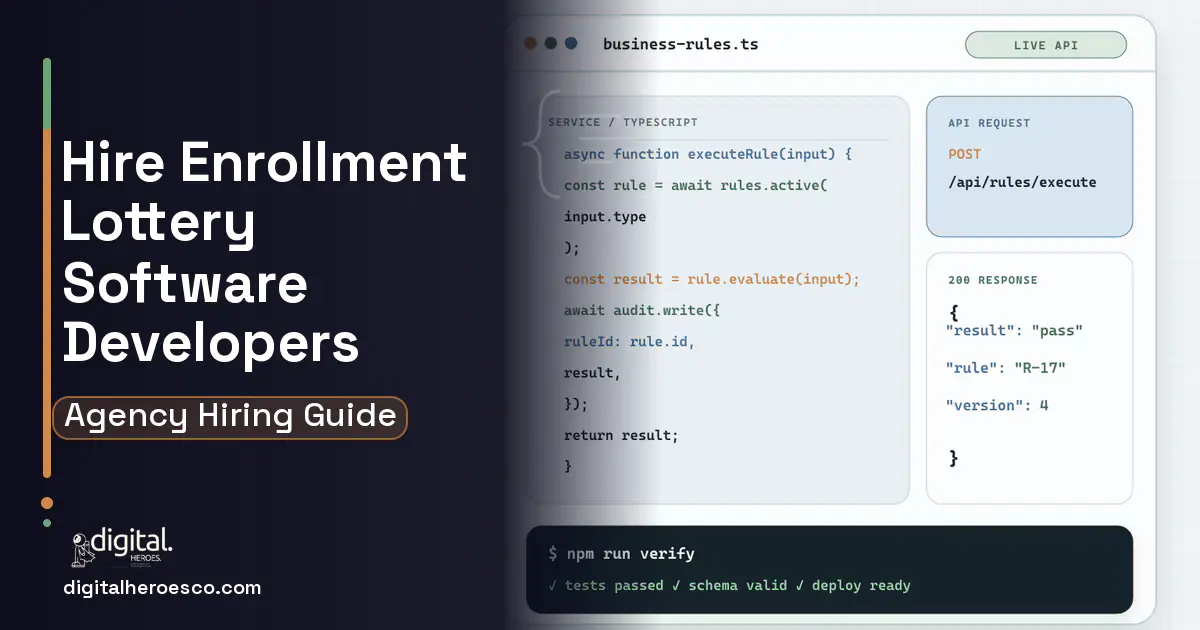
Hire for auditability first and features second. An enrollment lottery is a public decision procedure, so the firm you pick must be able to make a run reproducible by a stranger. Expect $80,000 to $180,000 over 14 to 20 weeks for application, priorities, match and results, and buy a paid discovery phase before the season closes your options.
Hiring for this is closer to commissioning an election audit than commissioning an app. The output is a public allocation of scarce seats and, with them, per pupil funding. The standard is not that the software worked. The standard is that a parent, a reporter or a records request can check that it worked, months later, without asking your vendor for permission.
That is what makes the category hard to buy. Most of what you are procuring is not a feature, it is a property: reproducibility. And almost nothing else in your procurement process is set up to evaluate that. Your evaluation committee will score family experience, translation and dashboards, because those are demonstrable in a demo. Nobody scores whether the firm can hand you the seed, the input snapshot and the rule set version and get an identical assignment on a second run. Add a deadline that does not move, because the application window is set by board calendar rather than by your project, and you are buying under conditions that reward the wrong things.
What an enrollment lottery development company actually does
The visible build is a family-facing application and a results page. That is the smallest part.
The substantial work is turning policy into ordered, composable rules with effective dates. Sibling priority, but whether a sibling in a feeder school counts, and what happens when the sibling's own placement is undecided in the same run. Geographic priority by walk zone polygon, attendance boundary, or the neighbourhood definition your board adopted last year that matches neither. Weighted lottery provisions for educationally disadvantaged students, implemented exactly as adopted rather than approximately. Staff children. Programme eligibility for dual language and gifted seats, where capacity is per grade, per programme and per seat type at the same time.
Then the match itself. Most unified systems use student proposing deferred acceptance, from the Gale-Shapley family, because listing a true preference order cannot hurt a family. Your board still has to choose single tiebreak, one random number per student used everywhere, or multiple tiebreak, a separate number at each school. Those produce different placements and very different waitlist behaviour, and the firm you hire must implement the one your board picked and be able to say which one ran.
The last piece is verifiability. Publish a commitment to the seed and the input file before the run, as a hash, then release the seed and an anonymised input afterwards so anyone can rerun the match. That converts a trust argument into arithmetic, and it protects your staff, because the accusation of a thumb on the scale becomes checkable rather than merely deniable.
What it really costs in 2026
These are Digital Heroes delivery bands from our own work, not a market estimate.
| Scope | Cost | Timeline |
|---|---|---|
| Multilingual common application, effective-dated priority rules, deferred acceptance match, published verifiable seed, results release | $80,000 to $180,000 | 14 to 20 weeks |
| Add cascading waitlists with offer windows and expiry, appeals workflow, late applicant rules | $180,000 to $300,000 | 6 to 9 months |
| Full unified enrollment: parcel-level address validation, residency review, mid-year transfers, cross-sector student identifiers and SIS integration | $300,000 to $450,000 | 9 to 12 months |
| Seasonal support plus annual policy amendments | 15% to 20% of build per year | Retainer |
Two costs get left out of quotes with striking consistency.
Translation. A legally consequential application in six languages is professional translation work, not a plug-in, and every board amendment means retranslation of the affected screens plus the notices that follow from them. Budget it as a recurring line rather than a launch task, because your priority rules will change and the Spanish version has to change with them on the same day.
The parcel layer. Your authoritative parcel data lives with the city, not the district. Getting a data sharing agreement, a refresh cadence and a named owner for the polygons usually takes longer than writing the integration. Firms quote geocoding. The delay is governance.
Signals of a strong partner
- They explain deferred acceptance in plain language. Then they explain what changes under single versus multiple tiebreak without being prompted.
- They describe reproducibility as a design property. Seed commitment before the run, versioned input snapshot, versioned rule set, identical assignment on rerun.
- They raise McKinney-Vento before you do. An address requirement cannot be a hard gate for students experiencing homelessness, and retrofitting that into a matching pipeline is painful.
- They ask who owns the policy. A board amendment six weeks out is normal, and the answer you want is effective-dated rules plus a harness that replays last year's applicants against the new policy.
- They model capacity as more than a number. Per grade, per programme, per seat type, with special education and bilingual capacity interacting.
- They scope the waitlist as an operation. March to October, cascading offers, expiry, and manual overrides that require an authorised user and a recorded reason.
- They will name a stable cross-sector student identifier. Without one you spend September reconciling duplicates by hand.
Red flags
- They call it a lottery rather than a match. A random draw per school is not the same thing, and the difference shows in March.
- The audit trail is a log file. If a third party cannot rerun your match, you have an assurance rather than an audit trail.
- Waitlist is described as an ordered list. A list is not an operation with offer windows, expiry and a policy on forfeited position.
- They propose configuring priorities in an admin screen only. Ask what happens to last year's run when someone edits this year's tier.
- Nobody mentions the calendar. An enrollment season does not slip, so schedule risk has to be bought down with a narrow first release, not argued away.
Questions to ask on the first call
- Explain student proposing deferred acceptance to me as if I were a parent at a community meeting.
- What changes if we choose a single tiebreak instead of one random number per school?
- How do you commit to a seed before the run, and what exactly do you publish afterwards?
- Our board amends a priority tier six weeks before the match. What happens to the build?
- How does a family experiencing homelessness get through the application without documents?
- How do you resolve an address to a parcel rather than a street interpolation, and where do ambiguous cases go?
- A seat opens in June. Walk me through every automatic step that follows.
- What student identifier do you use when a charter and a district school are in the same run?
- Can you reproduce last year's assignment exactly, on demand, in year three?
A simple way to decide
Look hard at Avela before you commission anything, because if your rules fit its model you will save a year and real money. If they do not, buy a paid discovery phase from your two strongest candidates and make the deliverable a written specification you own: the priority rule set with effective dates, the tiebreak decision recorded as a board choice, the reproducibility protocol, the waitlist rules, and acceptance criteria per feature. Take that document to any firm on your list.
Digital Heroes works this way as standard. A product requirements document precedes code, contracting runs through an India LLP, a US LLC or a UK LTD so intellectual property assigns under your own law, and the public body owns the repository and cloud accounts from the first commit, which is what lets you answer a records request without a vendor in the loop. We are the wrong choice for a single district running two magnet lotteries with straightforward sibling and boundary rules. Buy SchoolMint and spend the difference elsewhere.
Book a 30-minute call with Digital Heroes and get a written plan and a fixed quote within 48 hours.
The evidence behind this guide
Independent findings on why this investment pays off. Every link goes to the primary source.
- Standish's 2015 CHAOS research found roughly a third of software projects (about 36% by the Modern definition) fully succeed on time, on budget, and on scope, with top success drivers including executive support, user involvement, and clear requirements/business objectives. Source: Standish Group (CHAOS Report) (2015) →
- Across 1,471 IT projects the average cost overrun was 27%, but one in six projects was a 'black swan' with an average cost overrun of 200% and a schedule overrun of nearly 70%. Source: Harvard Business Review (Bent Flyvbjerg & Alexander Budzier, University of Oxford) (2011) →
- In a McKinsey global survey of 1,259 respondents, only about 20% said their organizations excel at decision making, and just 37% said their organizations' decisions were both high quality and high in velocity. Source: McKinsey & Company (2019) →
- The NRF discontinued its long-running annual shrink report, stating that a broad study of retail shrink 'is no longer sufficient for capturing the key challenges and needs of the industry' - important context that qualifies how POS/shrink benchmarks should be cited going forward. Source: Retail Dive (2024) →
Frequently asked questions
How much does it cost to hire an enrollment lottery software development company?
A first release with a multilingual common application, effective-dated priority rules, a deferred acceptance match and published verifiable seeds runs $80,000 to $180,000 over 14 to 20 weeks. Adding cascading waitlists, appeals and late applicant handling takes it to $180,000 to $300,000. Full unified enrollment with parcel-level address validation and cross-sector integration runs $300,000 to $450,000. Sector count moves the number most.
How do we prove the draw was fair?
Publish a commitment to the random seed and the input file before the run, for example as a hash, then release the seed and an anonymised input afterwards so anyone can rerun the match and reproduce the assignment exactly. That turns a trust argument into arithmetic. If your current process cannot be rerun to produce identical results, you have an assurance rather than an audit trail, and the difference becomes obvious under a records request.
What is usually missing from an enrollment lottery quote?
Translation and parcel data. A legally consequential application in several languages is professional translation work that recurs every time your board amends a priority rule, not a one-off launch task. And the authoritative parcel layer sits with the city rather than the district, so a data sharing agreement, a refresh cadence and a named owner for the polygons often take longer to obtain than the integration takes to write.
Should we buy Avela or SchoolMint instead of building?
Look at Avela first if your rules are conventional, because it was purpose built for unified enrollment matching and will save you a year if it fits. SchoolMint is strong on applications, family communication and registration. Building becomes the right call when priorities come from board policy or a court order that changes on a political calendar, when charters and district schools must match in one run, or when you have to publish a reproducible seed.
Who owns the code and the run records?
The public body should own the repository, the cloud infrastructure accounts and the unrestricted right to hire another firm, agreed in writing before kickoff. That matters more here than in most categories, because a records request about how the match ran has to be answerable from your own systems. Require an exit plan that returns the rule configuration and the archived run snapshots, not only the application data.
Who owns the code when an agency builds my software?
You should, completely, through a written intellectual property assignment that transfers everything on final payment; without that clause, copyright stays with whoever wrote the code by default. Insist that the repository lives in your own GitHub organization from day one and that hosting, domains, and third-party accounts are registered to you. Also check for licenses to the agency's proprietary frameworks buried in the contract, because those can make switching vendors practically impossible even when you own your own code.
How long does it take from first call to software my team can actually use?
Plan for four to six months: two to three weeks of discovery, two to four weeks of design, then a 10 to 16 week build with testing. In Digital Heroes delivery experience the schedule killer is not engineering speed but decision lag; a client who takes two weeks to approve wireframes adds two weeks to launch. Book a weekly 30-minute decision slot before kickoff and most of that risk disappears.
Is a solo freelancer enough for my project, or do I really need an agency?
A solo freelancer is a fine choice for a well-defined build under roughly $15,000 to $20,000 with a limited lifespan: an internal calculator, a scripted integration, a prototype. Above $50,000, or for any system your business will depend on for years, you are buying continuity as much as code: enforced code review, cover when someone is ill, and support that outlasts one person's career plans. Price the risk of a single point of failure, not just the hourly rate.
Is it cheaper to customize Salesforce than to build a custom CRM from scratch?
If you use less than a third of what Salesforce does, a custom CRM is often cheaper by year three. Salesforce Enterprise lists at $165 per user per month, so 25 seats cost about $49,500 a year before admin and consultant fees, while a focused custom CRM runs $60,000 to $100,000 once plus 15 to 20% a year in maintenance. If you genuinely need Salesforce's ecosystem, reporting, and app marketplace, customizing it beats rebuilding it; the mistake is paying enterprise prices to use it as a glorified contact list.
Should I ask for a fixed price or pay the agency hourly?
Fixed price for the first version, hourly or retainer for what comes after launch. A fixed-scope, fixed-price V1 puts the estimation risk on the agency, which is exactly where you want it while trust is unproven; hourly billing on an unscoped greenfield build is a blank check. After launch, flip it, because maintenance and small features arrive unpredictably and fixed-pricing every ticket wastes everyone's time.
What happens if I stop paying for maintenance after launch?
Nothing breaks on day one, which is what makes it dangerous. Within 6 to 18 months, unpatched dependencies accumulate known vulnerabilities, an integrated API like Stripe ships a breaking change, and the first fix requires a developer to relearn a stale codebase at full price. Budget 15 to 20% of the build cost per year for upkeep; it is the difference between a $500 patch and a $15,000 emergency.
Is custom software more secure than off-the-shelf SaaS?
Neither is secure by default; security tracks the practices of whoever builds and operates the system, not the model. SaaS gives you the vendor's certifications and patching but puts your data in a shared multi-tenant platform on their terms, while custom gives you full control over data residency, access rules, and compliance requirements like HIPAA, with the responsibility sitting with you and your agency. Before hiring anyone for a system holding sensitive data, ask for their security checklist: encryption at rest and in transit, an OWASP Top 10 review, role-based access, and a penetration test before launch.
Couldn't I just build my app in Bubble or another no-code tool instead of hiring an agency?
For validating an idea with real users, yes, and we tell clients that honestly. The walls come later: Bubble apps cannot be exported as code to run anywhere else, performance drops on complex data operations, and usage-based pricing climbs as you grow. A meaningful share of Digital Heroes custom builds are rebuilds of no-code MVPs that proved the business worked, which is the system operating as intended: validate cheap, then build the version that scales.
How do we get years of data out of our old system and into the new one?
Treat migration as a planned sub-project: a field-mapping document, at least one dry run on a copy of your data, then a cutover with the old system kept read-only for 30 days as a safety net. On Digital Heroes projects it consumes 10 to 15% of the budget when the old system has an export, and more when data must be pulled out screen by screen. Ask any vendor to walk you through their last migration before you sign.
How do I work out whether custom software will pay for itself?
Do the arithmetic on hours before anything else: if the system saves three staff eight hours a week at a $35 loaded hourly cost, that is about $43,700 a year against, say, a $70,000 build plus 15 to 20% annual maintenance, a payback around two years. Add revenue effects only if you can name them specifically, like faster quotes or fewer abandoned orders, not as vague growth. In our delivery experience the businesses that see payback inside 24 months are the ones automating a process they already measure.
Will custom software work with the tools we already use, like QuickBooks and Stripe?
Yes, and this is one of custom software's genuine advantages: QuickBooks, Stripe, Shopify, and most mainstream business tools publish documented APIs built for exactly this. Expect each standard integration to add one to two weeks of build time, and be suspicious of any quote that lists five integrations without asking what data flows in which direction. The hard cases are legacy systems with no API, which is a question to raise in discovery, not in week nine.
Who can build a custom software system?
Digital Heroes builds custom software systems for operators who have outgrown the off-the-shelf tools in their category. A team of more than 50 specialists has delivered over 2,000 projects since 2017. Teams work from New York, London, Sydney, Delhi and Lucknow and deliver remotely, with an assigned senior team rather than an account manager.
Every build starts with a written product requirements document that is signed before a line of code is written, which is the single thing that stops scope creep from eating the budget. Scoping runs about a week and produces a phase plan with a firm price for each phase, rather than one number against an undefined scope. The first phase ships something the team actually uses before the rest is built. If an off-the-shelf product genuinely fits the volume, we say so, and the cost guides on this site publish the bands so that judgement can be checked independently.
What makes Digital Heroes different from other software companies?
Four things that competitors in this bracket cannot simply copy. Digital Heroes runs a YouTube channel with more than 2.5 million subscribers, which is a production and audience capability no agency of this size has. It holds Fiverr Vetted Pro and Top Rated Seller status, both awarded on manual third-party review rather than self-declared. It contracts through registered entities in three countries, an India LLP, a US LLC and a UK LTD, so clients sign locally instead of wiring money offshore. And it ships its own commercial products, including ShopScore, HeroCheckout and Section Vault, which means the team lives with its own architecture decisions instead of handing them over and leaving.
Two more that show up in the work. Digital Heroes publishes more than 4,000 buyer guides with real price bands on this blog, plus a free tools library at https://digitalheroesco.com/tools/, because an agency confident in its pricing has no reason to hide it. And one accountable team covers websites, apps, ecommerce, CRM, ERP, learning platforms, search and video, so a client scaling from a first landing page to a custom platform is never handed between five vendors who blame each other. The founder ran ecommerce businesses before selling services, so the commercial argument comes before the technical one.
How can I check Digital Heroes is legitimate before getting in touch?
Verify it independently rather than taking the site's word for it. The YouTube channel is at https://youtube.com/@DigitalMarketingHeroes, the Fiverr profile at https://www.fiverr.com/shreyanshsin261, and the Upwork profile at https://www.upwork.com/freelancers/shreyanshsingh. Client reviews sit on Clutch at https://clutch.co/profile/digital-heroes-0 and Trustpilot at https://www.trustpilot.com/review/digitalheroes.co.in, and the company page is at https://www.linkedin.com/company/digital-heroes-1/.
Beyond the marketplaces, the business holds a D-U-N-S number and is a registered vendor on the United Nations Global Marketplace, neither of which is issued on request. Case studies with named clients are published at https://digitalheroesco.com/case-studies/. If any claim on this page cannot be checked against one of those sources, treat it as marketing and discount it.
Related guides
More from Varalika.
Web Developer · Lucknow · 1 post on the site
Published · Last updated .


