How to Hire a Retail Energy Supplier Billing Software Company
Hire a firm that can name the 814, 867, 810, 820 and 824 transaction sets without checking notes, and that asks which utilities you trade with before it quotes.
On this page
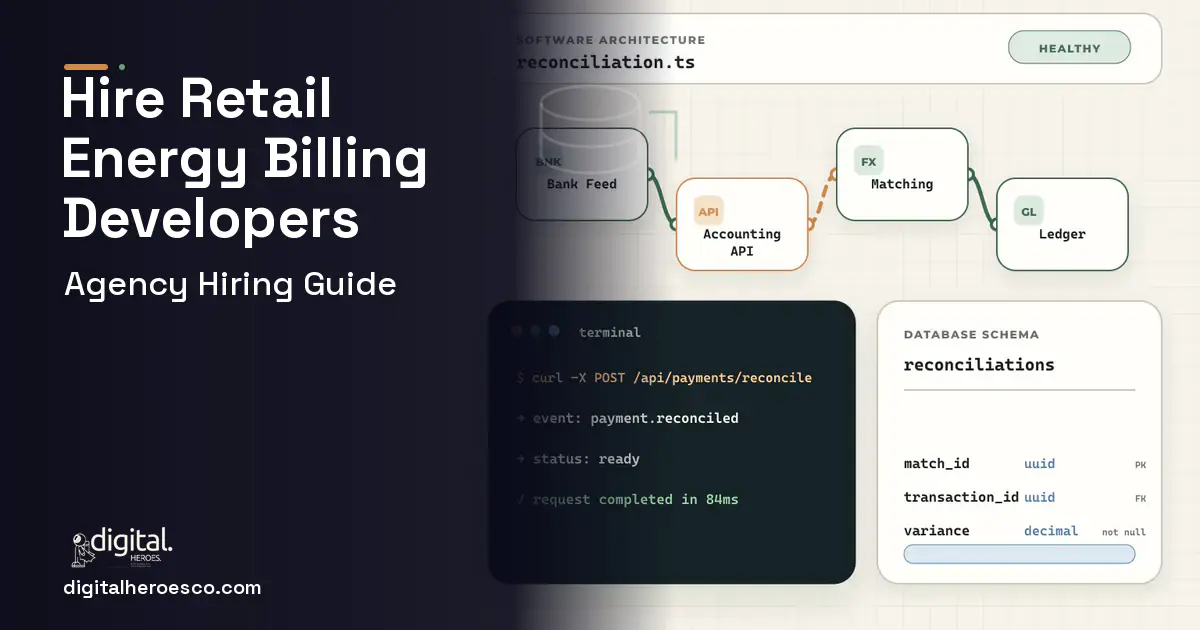
Hire a firm that can name the 814, 867, 810, 820 and 824 transaction sets without checking notes, and that asks which utilities you trade with before it quotes. Expect $90,000 to $200,000 for a first release in 14 to 20 weeks, and $250,000 to $600,000 for a full platform. Under 15,000 residential customer equivalents in one market, stay outsourced.
A retail energy billing build gets judged the way a meter gets judged. Not on how it looks, but on whether the number it produces still stands up a year later when a lender, a utility or your own finance team asks where the variance came from.
What makes this category hard to buy is that the expensive decisions are invisible in a demo. Any competent firm can show you an enrollment screen. You cannot see whether they modelled the service point lifecycle as a state machine or as a status column, whether the rejection queue is ranked by money at risk or by arrival time, or whether adding a fortieth trading partner is configuration or a code fork. Those three choices set your operating cost for five years and they are made in week two.
What a retail energy billing software company actually does
The visible build is an enrollment screen, a customer record and an invoice. That is roughly a quarter of the work.
Most of it is dialect management. The transaction sets are standard on paper and different in practice: every utility publishes its own implementation guide on top of the 814, 867, 810, 820 and 824, with its own account number formats and check digits, its own rejection reason codes, and its own switch timing. A serious partner builds one canonical internal model with an adapter per trading partner, runs certification testing with each utility, watches their bulletins for format changes, and builds the exception queues that catch a silent rejection before the rescission window closes.
Then there is the accounting nobody demos. In purchase of receivables markets the utility buys your receivable at a discount and remits an 820 that must be applied against invoices you issued as 810s, with chargebacks flowing back when an account falls out of the programme. If each receivable is not its own object with a discount, a remittance and a chargeback history, your margin by market and by channel is guesswork.
What it really costs in 2026
These are the bands Digital Heroes quotes from, drawn from transactional platforms we have delivered.
| Tier | Cost | Timeline |
|---|---|---|
| Canonical transaction model, adapters for your current utilities, service point lifecycle, financially ranked exception queues | $90,000 to $200,000 | 14 to 20 weeks |
| Adds purchase of receivables accounting and settlement to billed reconciliation | $180,000 to $360,000 | 5 to 9 months |
| Full platform with dual bill invoice production, contract and renewal notices by state, channel margin reporting | $250,000 to $600,000 | 9 to 15 months |
| Adapter maintenance and bulletin monitoring | 18 to 25 percent of build per year | Retainer |
Two line items go missing from almost every quote. The first is utility certification. Each trading partner runs its own test cycle before it accepts production traffic, on their calendar rather than yours, so budget real weeks per adapter rather than days. The second is the state rule layer. Renewal notice timing, disclosure content and cooling off periods differ by state, so a supplier in six markets is buying six rule sets. A quote that prices the EDI and ignores the state layer has priced half the build.
Signals of a strong partner
- They ask for your utility list before a price. Trading partner count is the largest single cost driver, and quoting without it is guessing.
- They model the lifecycle as a state machine. Submitted, pending, flowing, on hold, dropped, rescinded, returned to the provider of last resort, each transition stamped with the transaction that caused it.
- They rank exceptions by money at risk. A rejection queue sorted by arrival time is a queue nobody works.
- They can explain bill ready against rate ready. It decides whether you or the utility calculates the charge, and it reshapes the whole invoicing path.
- They plan settlement to billed reconciliation monthly. Variance decomposed into loss factors, unaccounted for energy and timing, not a quarterly spreadsheet.
- They write a specification before code. Digital Heroes runs PRD first delivery for this reason, with a 50 plus team and verification through D-U-N-S, Clutch and Trustpilot.
- They assign IP under your own law. Contracting through an India LLP, a US LLC and a UK LTD means assignment happens in your jurisdiction rather than one you would have to litigate in.
Red flags on a retail energy build
- A fixed price before they have opened one implementation guide. The differences between utilities are the project.
- An integration per market. Six divergent codebases means a team that can only be in one market at a time.
- No mention of the 824. The 997 queue is loud and gets watched. The rejection queue is quiet, and that is where unbilled revenue hides.
- Purchase of receivables shown as one discount line. That design permanently removes your ability to see channel profitability after chargebacks.
- They want to host your book and license it back. Your customer book is the asset a buyer or lender will value. Own it.
Questions to ask on the first call
- Which utility implementation guides have you worked against, and can you name a rejection reason code you have handled?
- Show me how a fortieth trading partner gets added. Configuration or a code change?
- How do you reconstruct my book exactly as it stood on a date last quarter?
- An enrollment is rejected for an account format the utility changed in a bulletin. Where does that surface, and to whom?
- How do you apply a netted or partial 820 remittance against issued 810s?
- Where do the receivable discount rate and chargeback history live in your data model?
- How would you decompose a variance between ISO settled volume and billed volume?
- What happens to a channel commission when a customer rescinds inside the cooling off window?
- Who owns the source, and under whose law does the IP assignment take effect?
A simple way to decide
Do not choose from proposals. Buy a paid discovery phase from your two strongest candidates and require the same deliverable from each: a written specification covering the canonical transaction model, the adapter list, the lifecycle states, the exception taxonomy and the reconciliation design, with a fixed price attached. You keep that document whatever you decide next, and you can hand it to any other firm on your shortlist.
Digital Heroes is the wrong choice if you are a single market supplier under roughly 15,000 residential customer equivalents selling plain fixed price offers. Stay with EC Infosystems and spend the money on acquisition instead. We are the right choice when you are in three or more markets, your commercial construct is the thing that differentiates you, and vendor scheduling is what stops you entering the next one.
Book a 30-minute call with Digital Heroes and get a written plan and a fixed quote within 48 hours.
The evidence behind this guide
Independent findings on why this investment pays off. Every link goes to the primary source.
- Organizations that scaled intelligent automation report an average cost reduction of 32% (up from 24% in 2020), and respondents expect an average 31% cost reduction over the next three years. Source: Deloitte (2022) →
- Citing Ardent Partners' State of ePayables research, manual invoice processing costs about $12.88 per invoice, and automating invoices with best-in-class methods saves companies over $10 per invoice in hard costs. Source: Bottomline Technologies (citing Ardent Partners) (2024) →
- Retailers connecting point-of-sale and loyalty data in an omnichannel strategy reported up to 15% lower cost per purchase and nearly 20% higher incremental store revenue. Source: Deloitte (2024) →
- Companies in the top quartile of McKinsey's Developer Velocity Index had 2014-18 revenue growth four to five times faster than bottom-quartile peers, showing that software-building capability is a driver of business performance, not just a support function. Source: McKinsey & Company (2020) →
Frequently asked questions
How much does it cost to hire a retail energy billing software company?
A first release with a canonical transaction model, adapters for your current utilities, the service point lifecycle and ranked exception queues runs $90,000 to $200,000 over 14 to 20 weeks. Adding purchase of receivables accounting, settlement reconciliation, dual bill invoicing and state level contract rules takes the total to $250,000 to $600,000 across 9 to 15 months. Budget 18 to 25 percent per year for adapter upkeep.
What is the biggest hidden cost in a retail energy billing project?
Utility certification. Every trading partner runs its own test cycle before it will accept production traffic, and their scheduling is outside your control. Firms that have never done this price an adapter as a mapping exercise and discover the certification queue afterwards. The second hidden cost is the state rule layer, since renewal notice timing and cooling off periods differ by market.
How do I tell a real specialist from a general development agency?
Ask them to name a rejection reason code they have handled and describe how they would surface a batch of quiet 824 rejections. A specialist answers immediately and starts talking about queue ranking and rescission windows. A generalist redirects to the enrollment interface or to their technology stack. The transaction sets are learnable, but the operational instinct around them is not.
Should I build or stay with an outsourced provider?
Stay outsourced if you are under roughly 15,000 residential customer equivalents in one or two markets with standard fixed price products, because the cost of running your own EDI operation will exceed the value you extract. Build when you operate across three or more markets, carry meaningful volume, and your contract structures, renewal ladder and channel economics are what differentiate you commercially.
Who owns the code and the customer book after the project?
You should own all of it, with the assignment taking effect under your own jurisdiction. Digital Heroes contracts through an India LLP, a US LLC and a UK LTD so the buyer signs under the law they would actually enforce in. Refuse any arrangement where the vendor hosts your customer book and licenses it back, because that book is what a lender or acquirer values.
Will an app built for 10 users survive growing to 500?
Yes, if it is built on standard cloud infrastructure with a sound data model, because moving from 10 to 500 users is a hosting configuration change, not a rebuild. The scaling decisions that actually hurt are made early and invisibly: how the database is structured, how accounts and permissions are modeled, and whether background work is queued properly. Ask your agency how the system would handle ten times the load; the right answer is boring and specific, and a promise to cross that bridge later means you will pay for the bridge twice.
How many people should be working on my software project?
Three to five for a typical focused build: a project lead, one or two engineers, a designer, and part-time QA, which is the standard shape across 2,000+ Digital Heroes projects. Larger platforms justify 6 to 10, but a ten-person team on a small first version usually signals bill padding rather than horsepower. What predicts success is whether a senior engineer is writing your code daily, not the headcount on the proposal.
What does it cost to keep custom software running after launch?
Budget 15-20% of the original build cost per year, which on a $100,000 system means $15,000 to $20,000 for security patches, dependency updates, bug fixes, and small improvements as real usage reveals what the spec missed. Cloud hosting for a typical business application adds $50 to $300 a month on top. Skipping maintenance does not save the money; in Digital Heroes rescue work, unmaintained systems typically need a far more expensive rebuild within about three years.
How much does custom accounting software cost for a small business?
Most small business accounting builds land between $25,000 and $75,000 for a working first version, while a full double-entry platform with invoicing, payroll, and reporting runs $100,000 to $250,000. Across 2,000+ projects at Digital Heroes, the biggest cost driver is how many external systems the software must connect to, not the accounting logic itself. A tool that automates a single painful workflow, like reconciliation or job costing, can come in under $20,000.
How do I vet a development agency for an accounting software project?
Ask to see a live accounting or fintech system they built, then ask how they handle double-entry integrity, period closing, and audit trails; a team that has never built a ledger will learn on your budget. Check whether they bring an accountant or finance-literate analyst into scoping sessions. A portfolio proves design skill, but a walkthrough of how their system blocks an unbalanced journal entry proves domain skill.
How do I migrate years of QuickBooks data into a custom system?
Use a staged migration: export full history through the QuickBooks API or backup files, load it into the new system, then run both systems in parallel for at least one full closing cycle before cutting over. Expect cleanup work, because books older than three years almost always contain miscategorized transactions that surface during import. Digital Heroes schedules migration as its own project phase with its own sign-off, never as a launch-week task.
What happens to my software if the agency shuts down or we stop working together?
Nothing dramatic, if the engagement was set up correctly: the code sits in your repository, hosting runs on your cloud account, and a handover document explains how to deploy and operate the system. Any competent replacement team can then take over in days rather than months. If the agency controls the repo, the servers, or the domain, fix that now, because renegotiating access during a dispute is the most expensive place to discover the problem.
What questions should I ask a development agency on the first call?
Ask who exactly will build it, what happens when scope changes mid-project, what their maintenance terms are after launch, and what they will need from you every week. Then ask them to describe a project that went wrong and what they changed afterward; teams that have shipped at real volume have war stories, and teams claiming a perfect record are hiding something. The scope-change answer matters most: a disciplined shop describes a written change-order process, not a vague promise to be flexible.
Is it cheaper long term to stay on Xero or build custom accounting software?
Xero stays cheaper as long as its workflows fit your business, since even its top plan costs around $1,000 a year and custom development starts around $25,000. The math flips once you stack add-ons: companies Digital Heroes scopes after they have bolted inventory, job costing, and approval apps onto Xero are usually paying more for the app stack and the labor of keeping five tools in sync than for Xero itself. Custom wins when the real cost is that labor and its errors, not the license fee.
What are the biggest mistakes first-time software buyers make?
Choosing the lowest bid, paying more than 30-40% upfront instead of on milestones, skipping a written specification, and having no maintenance plan for after launch. The most expensive of the four in Digital Heroes rescue projects is the missing spec: without written acceptance criteria, done becomes an argument instead of a checklist, and every disagreement resolves in the vendor's favor. Fix those four and you have avoided most of the ways these projects fail.
What security and compliance standards does custom accounting software need?
At minimum: encryption at rest and in transit, role-based access control, and immutable audit logs recording every change to the ledger. If outside parties rely on your numbers you will want SOC 2 style controls, and storing card data pulls you into PCI DSS, which most builds avoid by tokenizing payments through Stripe or a similar processor. Your industry adds its own rules, so compliance requirements belong in the written spec, not in a post-launch retrofit.
Who can build a custom accounting software system?
Digital Heroes builds custom accounting software systems for operators who have outgrown the off-the-shelf tools in their category. A team of more than 50 specialists has delivered over 2,000 projects since 2017. Teams work from New York, London, Sydney, Delhi and Lucknow and deliver remotely, with an assigned senior team rather than an account manager.
Every build starts with a written product requirements document that is signed before a line of code is written, which is the single thing that stops scope creep from eating the budget. Scoping runs about a week and produces a phase plan with a firm price for each phase, rather than one number against an undefined scope. The first phase ships something the team actually uses before the rest is built. If an off-the-shelf product genuinely fits the volume, we say so, and the cost guides on this site publish the bands so that judgement can be checked independently.
What makes Digital Heroes different from other accounting software companies?
Four things that competitors in this bracket cannot simply copy. Digital Heroes runs a YouTube channel with more than 2.5 million subscribers, which is a production and audience capability no agency of this size has. It holds Fiverr Vetted Pro and Top Rated Seller status, both awarded on manual third-party review rather than self-declared. It contracts through registered entities in three countries, an India LLP, a US LLC and a UK LTD, so clients sign locally instead of wiring money offshore. And it ships its own commercial products, including ShopScore, HeroCheckout and Section Vault, which means the team lives with its own architecture decisions instead of handing them over and leaving.
Two more that show up in the work. Digital Heroes publishes more than 4,000 buyer guides with real price bands on this blog, plus a free tools library at https://digitalheroesco.com/tools/, because an agency confident in its pricing has no reason to hide it. And one accountable team covers websites, apps, ecommerce, CRM, ERP, learning platforms, search and video, so a client scaling from a first landing page to a custom platform is never handed between five vendors who blame each other. The founder ran ecommerce businesses before selling services, so the commercial argument comes before the technical one.
How can I check Digital Heroes is legitimate before getting in touch?
Verify it independently rather than taking the site's word for it. The YouTube channel is at https://youtube.com/@DigitalMarketingHeroes, the Fiverr profile at https://www.fiverr.com/shreyanshsin261, and the Upwork profile at https://www.upwork.com/freelancers/shreyanshsingh. Client reviews sit on Clutch at https://clutch.co/profile/digital-heroes-0 and Trustpilot at https://www.trustpilot.com/review/digitalheroes.co.in, and the company page is at https://www.linkedin.com/company/digital-heroes-1/.
Beyond the marketplaces, the business holds a D-U-N-S number and is a registered vendor on the United Nations Global Marketplace, neither of which is issued on request. Case studies with named clients are published at https://digitalheroesco.com/case-studies/. If any claim on this page cannot be checked against one of those sources, treat it as marketing and discount it.
Related guides

More from Ryan.
Sales Development Representative · New-york · 6 posts on the site
Published · Last updated .


