How to Hire a Patent Docketing Software Development Company
Hire on the data model and the audit trail, not on the feature list. A firm that draws a patent family as a graph and stores jurisdiction rules as effective dated data is worth three that draw a case with a due date.
On this page
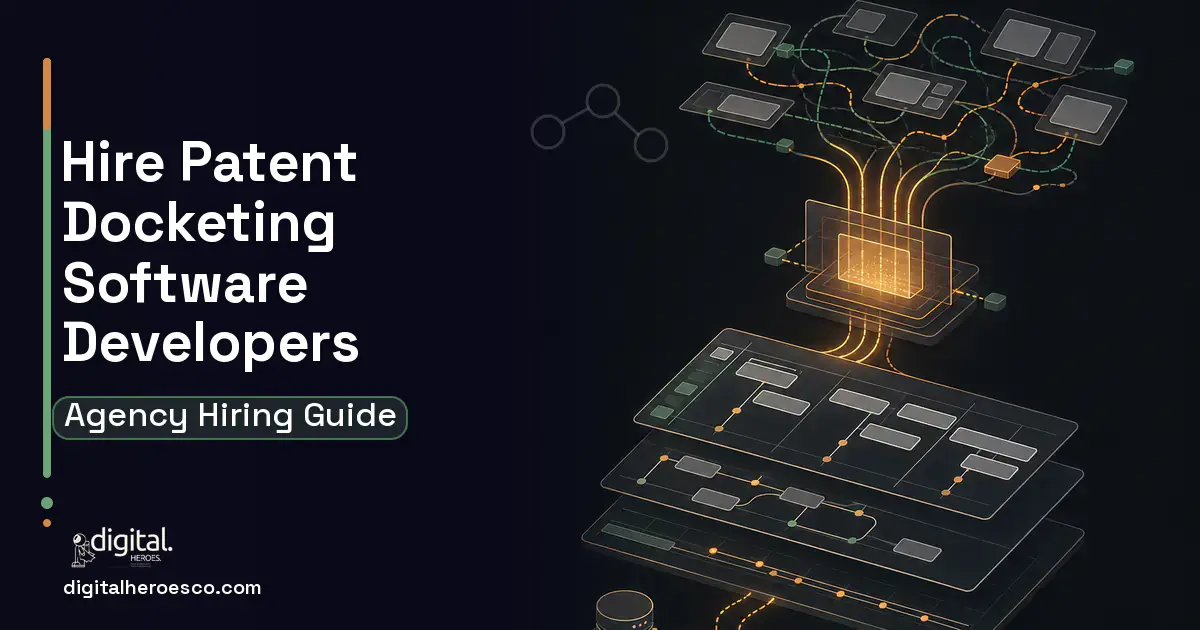
Hire on the data model and the audit trail, not on the feature list. A firm that draws a patent family as a graph and stores jurisdiction rules as effective dated data is worth three that draw a case with a due date. Budget $65,000 to $140,000 and 12 to 18 weeks for a first release, plus a parallel run before you trust it.
Choosing who builds your docketing system is like choosing who sets the combination on a vault you will not open for eleven years. Everything appears to work until the day it matters, and the day it matters is a non extendable deadline that has already passed. There is no staging environment for a lapsed patent and no hotfix for a missed issue fee, which is why this is the one business system where a defect arrives as a malpractice claim rather than as a support ticket.
The category is hard to buy for a specific reason: you cannot evaluate correctness in a demo. Every product will show you a clean queue and a calendar. What you actually need to know is whether the deadline was computed from a graph or typed by a paralegal, whether the rule that produced it can be edited by your docketing supervisor when a national office changes practice, and whether the record can be reconstructed years later when someone asks what the firm knew and when. Those three answers are invisible on screen and decisive in the file.
What a patent docketing software development company actually does
The docket queue is the visible tenth. The engineering that matters is structural.
First, the family model. Applications, their relationships, priority claims, national phase entries and granted patents form a graph, and dates are derived from that graph plus the events on it rather than stored on a record. Correct one priority claim and every dependent date in five countries has to recompute with a changelog showing what moved and who is affected. Second, the rule engine, where jurisdiction, triggering document type, computed date, available extensions with their fees and whether the deadline is extendable at all live as effective dated data your own staff can edit. Third, correspondence ingestion, because instructions from foreign associates arrive as email and attached reporting letters, and extraction should produce a draft entry a human confirms rather than keys. Fourth, the annuity pipeline with explicit states through to payment confirmation. Fifth, an append only event log, because that log is your defence.
What it really costs in 2026
These bands reflect delivery on portfolios in the low thousands of active cases across several jurisdictions.
| Scope | Cost | Timeline |
|---|---|---|
| Family graph, effective dated rule engine for your top jurisdictions, correspondence ingestion, two person verification | $65,000 to $140,000 | 12 to 18 weeks |
| Adds the annuity decision and reconciliation pipeline, foreign associate instructions with cost estimates | $140,000 to $280,000 | 5 to 9 months |
| Full platform with client cost approval flows, portfolio and budget reporting, public register synchronisation, trademark module | $280,000 to $450,000 | 7 to 12 months |
| Hosting, support and rule maintenance | 15 to 20 percent of build per year | Ongoing |
Two costs are consistently absent from proposals, and both are yours rather than the developer's. The first is practitioner review of every rule set. A developer can encode a rule, but somebody who actually prosecutes in that office has to confirm it, and that is fee earner time on a matter that generates no billing. Firms that skip this ship a system nobody trusts. Budget the hours, name the reviewer per jurisdiction, and treat sign off as a delivery gate.
The second is the parallel run. Migration here is not a data copy, it is a reconstruction: family relationships have to be rebuilt and every live date re derived, then reconciled against the incumbent system until the two agree, case by case, through at least one full docketing cycle. Nobody should cut over on trust. That period costs staff time and a duplicated licence, and it is the difference between a system you rely on and one your supervisor quietly double checks forever.
Signals of a strong partner
- They whiteboard the family as a graph. Applications, relationships, priority claims and national phase entries, and they ask unprompted what happens to dependent dates when a priority claim is corrected.
- They store rules as data with effective dates. A change in office practice should be a supervisor editing a rule, never a code deployment scheduled behind other work.
- They report the blast radius before applying a change. Editing a rule should first list which live cases it affects, so you approve the consequence rather than discover it.
- They cross check extracted dates against computed ones. Two independent sources for a critical date, with disagreement escalating rather than being accepted quietly, is the control that catches the mistake nobody else would.
- They build two person verification into the system. A non extendable deadline should not become active until a second person has confirmed it against the source document.
- They design the log as append only. Nothing edited in place, every rule version recorded, every reminder and acknowledgement captured with a recipient.
- They agree ownership before kickoff. Repository, cloud accounts and the unrestricted right to hire a different firm, in writing.
Red flags
- A case drawn with a due date on it. That is a task manager. It will hold your portfolio and it will not survive a corrected priority claim.
- Rule changes described as a release. If updating a fee schedule or an extension mechanic requires their sprint capacity, your deadlines depend on their backlog.
- Records that can be edited in place. When a date is questioned, the only useful answer is a reconstructible history, and an editable record cannot provide one.
- Confidence about jurisdictions nobody has reviewed. A firm that offers thirty countries at launch without asking who will validate each rule set is selling coverage rather than correctness.
- A migration priced as a data import. Re deriving every live date and reconciling it against the incumbent is the real work, and a quote that hides it will find it later at your expense.
Questions to ask on the first call
- Draw a patent family for us. What happens to dependent dates when a priority claim is corrected?
- How is a rule that took effect on a specific date and applies only to later filings stored and applied?
- Who can edit a jurisdiction rule in your design, and what does the system show them before it takes effect?
- How does an inbound reporting letter become a docket entry, and what checks the extracted date?
- How does two person verification work on a non extendable deadline?
- What does the audit log record, and can it be altered by anyone including an administrator?
- How would you model an annuity from due through instructed to paid and confirmed, and what escalates?
- What is your migration plan, and how long do we run in parallel before we stop relying on the old system?
- What do we own on the last day, and who holds the infrastructure accounts throughout?
A simple way to decide
Do not choose from proposals. Buy a paid discovery phase as a small fixed engagement and require a written specification your firm owns outright at the end of it. It should contain the family and event data model, the rule schema with worked examples in your three highest volume jurisdictions, the verification and audit design, the annuity state machine, the migration and parallel run plan with named reconciliation criteria, and a phased scope with prices attached. Have your own docketing supervisor and a prosecuting practitioner read it before you commission anything. That review is the real vendor test, and the document travels to any other firm on your list.
Digital Heroes runs every engagement from that document as standard, and the client owns the repository from the first commit. Contracting through India LLP, US LLC and UK LTD entities means the intellectual property assignment sits under law your own counsel already reads, which matters for a system meant to outlive twenty year patent terms. The firm is a Fiverr Vetted Pro with more than 2,000 delivered projects, verifiable on D-U-N-S, Clutch and Trustpilot.
Book a 30-minute call with Digital Heroes and get a written plan and a fixed quote within 48 hours.
The evidence behind this guide
Independent findings on why this investment pays off. Every link goes to the primary source.
- McKinsey argues software developer productivity can be measured by combining system-level metrics (DORA and SPACE) with its own outcome-oriented approach, which it reports deploying across nearly 20 tech, finance, and pharmaceutical companies - a claim that sparked significant debate in the engineering community. Source: McKinsey & Company (2023) →
- The 2015 CHAOS data (based on the modern definition of success) reports that only about 29% of software projects succeed, 52% are challenged, and 19% fail, with the three most important success skills being executive sponsorship, emotional maturity, and user involvement. Source: The Standish Group (reported via InfoQ Q&A with Jennifer Lynch) (2015) →
- Standish's 2015 CHAOS research found roughly a third of software projects (about 36% by the Modern definition) fully succeed on time, on budget, and on scope, with top success drivers including executive support, user involvement, and clear requirements/business objectives. Source: Standish Group (CHAOS Report) (2015) →
- McKinsey emphasizes that most L&D functions still fail to tie training to business outcomes, recommending organizations track 2-3 business-relevant indicators (such as time-to-proficiency, redeployment into priority roles, or frontline productivity) rather than participation metrics to demonstrate training effectiveness. Source: McKinsey & Company (2025) →
Frequently asked questions
How much does it cost to hire a patent docketing software development company?
A first release with a family aware deadline engine, jurisdiction rules held as versioned data, correspondence ingestion and two person verification runs $65,000 to $140,000 over 12 to 18 weeks. Adding the annuity decision and reconciliation pipeline plus foreign associate instruction handling takes it to roughly $140,000 to $280,000. Client cost approval, portfolio reporting and a trademark module push a full platform toward $450,000.
What cost do docketing proposals always leave out?
Practitioner review of every jurisdiction rule set. A developer can encode a rule, but someone who actually prosecutes in that office has to confirm it, and that is fee earner time on a matter that bills nothing. Firms that skip it deliver a system the docketing team quietly double checks forever. Name a reviewer per jurisdiction and make their sign off a delivery gate rather than an afterthought.
How long should we run parallel with our existing docketing system?
Through at least one full docketing cycle, and longer if your portfolio spans many jurisdictions. Migration here is a reconstruction rather than a copy, because family relationships must be rebuilt and every live date re derived, then reconciled case by case until the two systems agree. Nobody should cut over on trust in a system where a wrong date destroys an asset. Budget the duplicated licence.
Can our docketing supervisor change rules without calling the developer?
In a well built system, yes, and this is one of the main reasons to build rather than buy. Rules should be effective dated data covering jurisdiction, triggering document type, computed date, available extensions with their fees and whether the deadline is extendable at all. Before a change takes effect the system should list which live cases it affects, so the consequence is approved rather than discovered.
Who should own the code and the prosecution history?
You should hold the repository, the cloud infrastructure accounts and every record, with an unrestricted written right to hire another firm to continue the work. Patent portfolios run over twenty year horizons, which outlasts most software vendors, so the ability to hand the codebase to a different team without asking permission is basic asset protection. Digital Heroes assigns ownership from the first commit.
How long does it take to build custom project management software?
Plan on 12 to 16 weeks for a working first version and 6 to 9 months for a mature platform; those are typical Digital Heroes delivery timelines. The schedule killers are undecided permission rules and mid-build scope additions, not the code itself. Locking the workflow map during discovery is what keeps a build inside 16 weeks.
Should I hire a freelancer or an agency for my software project?
A skilled freelancer is the right call for a single-discipline scope under roughly $15,000, like a website, a plugin, or one integration. Above that, projects need design, backend, testing, and project management at once, and a solo builder becomes the single point of failure: if they get sick or take a bigger client, your project simply stops. Agencies bill 20-40% more per hour but carry continuity, code review, and someone to escalate to, which is what you are actually buying.
Should I customize Jira with plugins or just build our own tool?
If two or three Marketplace apps close the gap, stay on Jira, since it starts around $8 per user per month and the apps ride on top. The trap is that cloud apps are licensed for every user on the instance, so in Digital Heroes audits a 200-seat Jira with three or four paid apps plus a ScriptRunner consultant often lands at $30,000 to $50,000 a year. At that run rate a custom tool scoped to your actual workflow pays for itself in two to three years and ends the plugin upgrade treadmill.
What's the most common mistake companies make when building their own PM tool?
Chasing feature parity with Asana or Jira. Across 2,000+ Digital Heroes projects, the builds that blow their budgets are the ones recreating Gantt charts, portfolio dashboards, and mobile apps nobody asked for, while the builds that succeed go deep on the two or three workflows that made the team leave their old tool. You are not competing with Asana's roadmap; you are replacing the 20 percent of it you actually use.
How big a team does it take to build a project management platform?
A typical Digital Heroes pod is 4 to 5 people: a product designer, two or three engineers, and a shared project manager and QA. Smaller than that and timelines stretch because one person is context-switching across design, backend, and testing; bigger only helps after the MVP, when work splits into parallel streams. Headcount matters less than whether the same pod stays on your project from discovery to launch.
How do I vet a software agency before hiring them to build a PM tool?
Ask to click through a workflow tool they shipped, live rather than in screenshots, and get a reference from a client whose system has been in production for over a year. Then ask two questions that expose weak vendors: how they migrate data out of your current tool, and what their maintenance retainer covered for that reference client last quarter. An agency that has genuinely shipped project management software answers both in specifics.
What tech stack should a custom project management tool be built on?
A deliberately boring one: React on the front end, Node or Python on the API, PostgreSQL for data, and websockets for live updates, which is the stack behind most tools in this category. The test is hiring risk: if your agency proposes something a mid-level developer cannot pick up in a week, you are buying a dependency, not an asset. Save exotic choices for genuine needs like offline-first mobile.
How do I work out whether a custom project management tool will pay for itself?
Add three lines: the per-seat fees you stop paying, the consultant and plugin spend you eliminate, and the hours your team stops losing to manual status reporting and duplicate data entry. On seat savings alone, payback typically lands between years two and four, which is why Digital Heroes tells teams under about 50 seats not to build. It gets much faster when the tool replaces both a SaaS bill and a consultant-maintained Jira setup, or when a client portal becomes part of what you charge for.
How much should a small business budget for its first custom app or website?
For a focused first build, most small businesses land between $8,000 and $60,000: roughly $8,000 to $45,000 for a custom website and $25,000 to $60,000 for an internal tool or simple web app, based on Digital Heroes delivery across 2,000+ projects. Customer-facing products with payments, logins, or a mobile app start around $40,000. Quotes far below these bands usually mean a template with your logo on it, not software shaped around your workflow.
Does it matter which tech stack the agency wants to use?
Yes, but not in the way most buyers expect: the goal is boring, popular technology such as React, Node.js or Python, and PostgreSQL, because any future team can maintain it and hiring a replacement developer takes days, not months. The red flag is an agency-proprietary framework or an unusual language, which welds you to that one vendor no matter what your contract says about code ownership. A useful test: could you find three freelancers fluent in this stack within a week? If not, push back.
Can we move our existing Asana or Jira data into a custom tool?
Yes. Both expose full export APIs, and projects, tasks, comments, and assignees come across cleanly; Digital Heroes typically runs migration as a 2 to 4 week workstream in parallel with the build. The awkward parts are attachments, automation rules that must be rebuilt rather than imported, and deciding how much closed historical work to carry over. Migrate active projects fully and keep the rest as read-only archive exports.
What security features does custom project management software need?
The non-negotiables are single sign-on, role-based permissions, encryption in transit and at rest, and an audit log of who changed what. If client work under NDA lives in the tool, custom actually improves your position, because you can run single-tenant on your own cloud account instead of shared SaaS infrastructure. You only need SOC 2 certification if you plan to sell the tool to others; for internal use, an annual penetration test is the sensible spend.
What does it cost to keep custom project management software running each year?
Budget 15 to 20 percent of the original build cost annually, so a $100,000 platform costs $15,000 to $20,000 a year to run. That covers hosting, security patches, dependency upgrades, and the item buyers forget: fixing integrations when Slack, Google, or QuickBooks change their APIs, which happens every year. Skipping the maintenance budget is how a two-year-old tool becomes impossible to upgrade.
What should I prepare before contacting a software development agency?
A one-page brief beats a 40-page requirements document: the business problem in plain words, who will use the system, the 5 to 10 workflows it must handle, the tools it must connect to, and your budget range and deadline driver. You do not need wireframes, a specification, or technical vocabulary; producing those is the agency's job during discovery. Stating a budget range up front is the single best move, because it gets you honest scoping instead of a quote engineered to win the meeting.
What happens if the agency that built our project management tool shuts down?
Nothing fatal, if you set things up correctly from day one: code in your own GitHub organization, infrastructure in your own cloud account, and written deployment documentation as a contract deliverable. With those in place, any competent team can take over a standard-stack codebase in one to two weeks. Takeover disasters happen when the vendor hosted everything in accounts they owned, so verify account ownership before the first sprint, not after the relationship sours.
Who can build a custom project management software system?
Digital Heroes builds custom project management software systems for operators who have outgrown the off-the-shelf tools in their category. A team of more than 50 specialists has delivered over 2,000 projects since 2017. Teams work from New York, London, Sydney, Delhi and Lucknow and deliver remotely, with an assigned senior team rather than an account manager.
Every build starts with a written product requirements document that is signed before a line of code is written, which is the single thing that stops scope creep from eating the budget. Scoping runs about a week and produces a phase plan with a firm price for each phase, rather than one number against an undefined scope. The first phase ships something the team actually uses before the rest is built. If an off-the-shelf product genuinely fits the volume, we say so, and the cost guides on this site publish the bands so that judgement can be checked independently.
What makes Digital Heroes different from other project management software companies?
Four things that competitors in this bracket cannot simply copy. Digital Heroes runs a YouTube channel with more than 2.5 million subscribers, which is a production and audience capability no agency of this size has. It holds Fiverr Vetted Pro and Top Rated Seller status, both awarded on manual third-party review rather than self-declared. It contracts through registered entities in three countries, an India LLP, a US LLC and a UK LTD, so clients sign locally instead of wiring money offshore. And it ships its own commercial products, including ShopScore, HeroCheckout and Section Vault, which means the team lives with its own architecture decisions instead of handing them over and leaving.
Two more that show up in the work. Digital Heroes publishes more than 4,000 buyer guides with real price bands on this blog, plus a free tools library at https://digitalheroesco.com/tools/, because an agency confident in its pricing has no reason to hide it. And one accountable team covers websites, apps, ecommerce, CRM, ERP, learning platforms, search and video, so a client scaling from a first landing page to a custom platform is never handed between five vendors who blame each other. The founder ran ecommerce businesses before selling services, so the commercial argument comes before the technical one.
How can I check Digital Heroes is legitimate before getting in touch?
Verify it independently rather than taking the site's word for it. The YouTube channel is at https://youtube.com/@DigitalMarketingHeroes, the Fiverr profile at https://www.fiverr.com/shreyanshsin261, and the Upwork profile at https://www.upwork.com/freelancers/shreyanshsingh. Client reviews sit on Clutch at https://clutch.co/profile/digital-heroes-0 and Trustpilot at https://www.trustpilot.com/review/digitalheroes.co.in, and the company page is at https://www.linkedin.com/company/digital-heroes-1/.
Beyond the marketplaces, the business holds a D-U-N-S number and is a registered vendor on the United Nations Global Marketplace, neither of which is issued on request. Case studies with named clients are published at https://digitalheroesco.com/case-studies/. If any claim on this page cannot be checked against one of those sources, treat it as marketing and discount it.
Related guides

More from Hannah.
Account Manager · B2B & SaaS · New-york · 4 posts on the site
Published · Last updated .


