How to Hire an Outside Plant Construction Software Development Company
Hire a firm that models the pay item, not the task. In outside plant work the money moves when units are verified, permits closed and as built packages delivered in the owner's own format, so that record has to be one object.
On this page
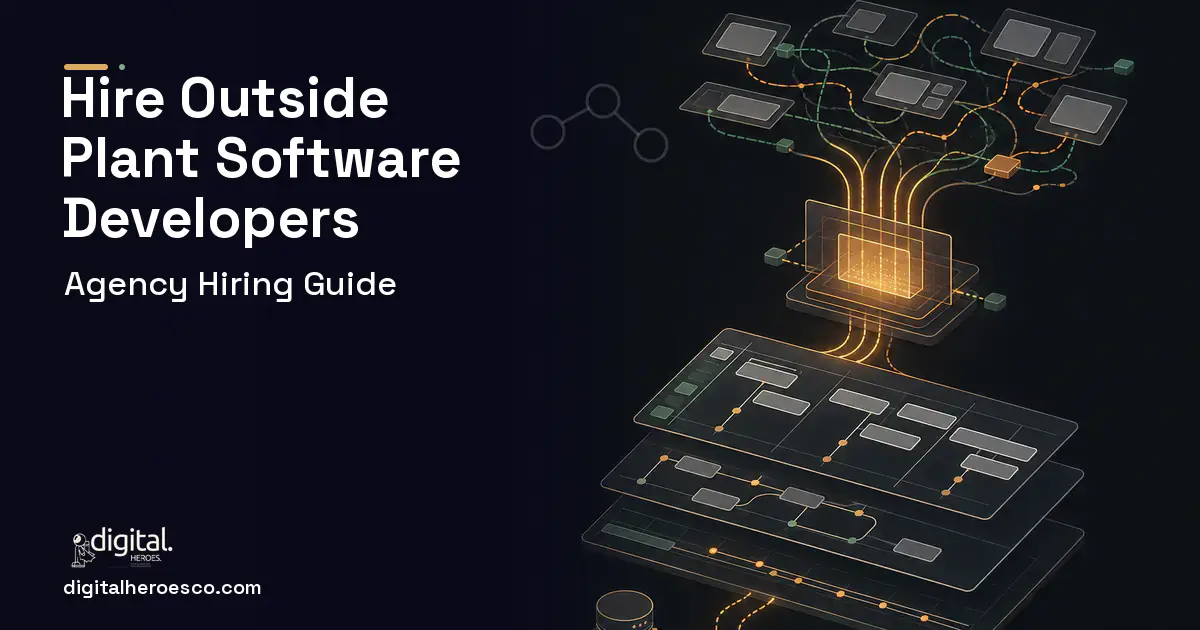
Hire a firm that models the pay item, not the task. In outside plant work the money moves when units are verified, permits closed and as built packages delivered in the owner's own format, so that record has to be one object. Expect $70,000 to $150,000 for a first release in 12 to 18 weeks, and $180,000 to $400,000 for a full platform.
Choosing a developer for outside plant construction software is a lot like buying a locate ticket. It reads as an administrative formality right up until the day it is the only thing standing between you and a very expensive hole. The software equivalent shows up at month end, when the pay application goes out short because a driveway crossing was billed at the mainline rate and the as built for that run was never submitted.
What makes this category hard to buy is that the units your crew produced and the units your owner will pay for are not the same list. Owners pay against their own quantity schedule, at their own verification standard, with their own rules about when a partial run counts. If your production record and their pay record were never the same object, reconciliation becomes a manual exercise done under deadline by whoever is free, and the errors run in one direction only. Nobody has ever accidentally over billed themselves into a bonus.
What an outside plant software development company actually does
The field app is the visible piece. The parts that decide whether the build pays for itself are less photogenic.
- The pay item as the atom. A production entry is a quantity of a specific pay item at a station range or coordinate, on a date, by a crew, against a work order under a program. Everything else is a view of that record.
- Offline capture that a foreman will actually use. Ninety seconds at the end of a shift, with photos carrying position and timestamp automatically, because photos settle unit disputes months later.
- Billing splits prompted rather than remembered, so a driveway crossing at a different rate is captured on the day and not lost in a single footage total.
- Permits and inspections that gate the money. A permit carries its jurisdiction, conditions, expiry and the pay items it authorises, and partial inspection sign off releases partial billing.
- Restoration as its own ageing backlog, because it happens weeks later, often by another crew, and an unrestored trench in a municipality reviewing your next permit application is a business risk.
- As built assembly as a continuous process with a per owner export profile, so a fourth owner costs a mapping exercise rather than a rebuild.
- Multi tier subcontractor payment, where the unit you bill up is a different price from the unit you pay down and an expired certificate of insurance freezes a pay application automatically.
What it really costs in 2026
| Scope | Cost | Timeline |
|---|---|---|
| Offline production capture against your real pay item schedule, permit and inspection gating, first as built export for your largest owner | $70,000 to $150,000 | 12 to 18 weeks |
| Full platform adding redline to record drawing workflow, subcontractor pay applications with retainage, restoration and damage claims, program forecasting, multiple owner export profiles | $180,000 to $400,000 | 6 to 12 months |
| Support, new owner profiles and enhancement | 15 to 20 percent of build per year | Retainer |
Two costs are systematically missing from quotes here. The first is the owner facing side of as built delivery. Writing into an owner's inventory or geographic information system correctly is real work, and testing it requires their engineering team to confirm what they will accept. That is calendar time you do not control, and a vendor who scopes it as an export routine has not done it before.
The second is design data preparation. If your plans arrive as PDFs rather than structured data, capturing redlines against them takes considerably more engineering than anyone assumes at proposal stage. Ask early what format your largest owner actually issues, because the answer moves the number more than the crew count does.
Signals of a strong partner
- They ask for your unit price schedule in the first meeting and model three items on a whiteboard, including one with a conditional rate.
- They ask how partial units are measured and what evidence the owner requires before a unit becomes payable.
- Offline is described as conflict resolution, with a queue, a sync log a foreman can check, and a stated rule for who wins a contested edit.
- They name the owner systems they have delivered into, with the specific attribute mapping, rather than claiming integration support generally.
- They treat 811 locate tickets as an integration, so a damage attaches to the bore run that caused it and the claim file assembles itself.
- They propose starting with one owner program and your two highest volume pay items. That covers most of the money and teaches you what the rest needs.
- They put the repository and infrastructure accounts in your name before kickoff rather than at handover.
Red flags
- They model work as a task list with a percent complete field. That is a construction schedule, not a unit price contract, and you will be teaching them the difference on your budget.
- As built delivery is a spreadsheet export. Owners want their attribute names, their coordinate system, their file structure and their naming convention, delivered into their own records platform.
- Subcontractors are modelled as crews. Two tiers of subs with separate rate sheets, retainage terms and prequalification status is the commercial reality, and it drives the payment logic.
- Vague answers about no signal in rural builds. Vagueness here becomes lost production data in month three, and lost production data becomes an unbillable run.
- The quote assumes one owner forever. You will win a fourth owner with a fifth format, and a fixed export becomes a rewrite.
Questions to ask on the first call
- Here is our pay item schedule. Model three items, including one whose rate changes by jurisdiction.
- How does a foreman record a 1,900 foot bore with two driveway crossings at a different rate, in under two minutes?
- What happens when a device has no signal for six hours and the office edited the same record?
- How does a permit authorise specific pay items, and what happens when production is logged in a location with no open permit?
- An inspector approves half a run. How does that release partial billing?
- Which owner systems have you written as built data into, and what did they reject the first time?
- How would you attach an 811 damage event to the specific bore run and assemble the claim file?
- How does a sub's expired certificate of insurance affect their pay application?
- What does adding a fifth owner with a new format cost us once the platform is live?
A simple way to decide
Buy a paid discovery phase before you buy a build. Give two firms a fixed fee and four to six weeks, and require a written specification you own outright: the pay item data model, measurement and evidence rules per owner, the permit and inspection gating logic, the as built mapping for your largest owner, and a phased plan with acceptance criteria. Contractors who skip this step are the ones who discover in month four that their pay item definitions were never written down anywhere.
Digital Heroes delivers this way as standard: a product requirements document before any code, the client owning the repository from the first commit, and contracting through India LLP, US LLC and UK LTD entities so intellectual property assigns under your own law. Over 2,000 projects delivered by a 50 plus team, with D-U-N-S, Clutch and Trustpilot records you can verify independently.
Book a 30-minute call with Digital Heroes and get a written plan and a fixed quote within 48 hours.
The evidence behind this guide
Independent findings on why this investment pays off. Every link goes to the primary source.
- In the Flexera 2025 State of ITAM report, respondents reported roughly 33% of SaaS spend is wasted, underscoring how paying for off-the-shelf seats and tiers that go unused erodes the supposed cost advantage of generic SaaS. Source: Flexera (2025) →
- The 2015 CHAOS data (based on the modern definition of success) reports that only about 29% of software projects succeed, 52% are challenged, and 19% fail, with the three most important success skills being executive sponsorship, emotional maturity, and user involvement. Source: The Standish Group (reported via InfoQ Q&A with Jennifer Lynch) (2015) →
- EMARKETER reports that over 54% of mobile commerce transactions now happen within shopping apps rather than mobile browsers, underscoring the app channel's growing dominance of m-commerce. Source: EMARKETER (2025) →
- Only 22% of firms are 'future ready' having significantly transformed digitally; these companies show average revenue growth 17.3 percentage points and net margins 14.0 percentage points above their industry average. Source: MIT Center for Information Systems Research (MIT Sloan) (2022) →
Frequently asked questions
How much does it cost to hire an outside plant construction software developer?
A first release with offline production capture against your unit price schedule, permit and inspection gating and one owner as built export runs $70,000 to $150,000 over 12 to 18 weeks. A full platform adding redline workflow, subcontractor pay applications, restoration and damage tracking and multiple owner export profiles runs $180,000 to $400,000 across 6 to 12 months. Distinct owner programs drive cost more than crew count does.
What single test separates a real specialist from a generalist?
Hand them your unit price schedule and ask them to model three items on a whiteboard. A firm that has done this immediately asks how partial units are measured, whether the rate changes by jurisdiction, and what evidence the owner requires before a unit is payable. A firm that sketches a task list with a percent complete field is going to learn unit price contracting at your expense.
Why does as built delivery cost more than vendors quote?
Because owners do not want a report, they want their own format: their attribute names, coordinate system, file structure and naming convention, loaded into their inventory or geographic information system. Getting that accepted requires the owner's engineering team to review and confirm, which is calendar time your vendor does not control. Build it as a translation layer so the fifth owner costs a mapping exercise rather than a rewrite.
Will this fix unbilled production at month end?
It is the main reason contractors fund the build. When production, permits, inspection sign off and as built status all hang off the same pay item record, you can see on any day which units are billable and which are blocked and by what. Blockers then surface while a crew is still nearby rather than four weeks later, which is the point at which clearing them gets expensive.
Should a two crew contractor hire a developer for this?
No. Two crews running one program for one owner can be managed with well designed forms and a shared drive, and the money is better spent on equipment or another crew. The case for building starts when you run multiple programs for multiple owners, when subcontractors are a meaningful share of production, or when the billing and as built lag has become a working capital conversation every month.
How long does it take to build custom project management software?
Plan on 12 to 16 weeks for a working first version and 6 to 9 months for a mature platform; those are typical Digital Heroes delivery timelines. The schedule killers are undecided permission rules and mid-build scope additions, not the code itself. Locking the workflow map during discovery is what keeps a build inside 16 weeks.
How many SaaS seats do we need before building custom becomes cheaper?
The crossover usually shows up between 20 and 50 seats on premium tiers. Salesforce Enterprise lists at $165 per user per month, so 40 users cost about $79,000 a year in subscriptions, which is real money against a custom system you would own outright. Run the comparison over three years: if subscription spend beats the build cost plus 15-20% annual maintenance, custom wins on price before you even count workflow fit.
Who owns the code when an agency builds my project management software?
You should, in full, and the contract must say so: work-for-hire language with all intellectual property assigned to you on final payment. Watch for agencies that license you their platform or framework, because that quietly turns your custom tool back into a subscription you cannot leave. Digital Heroes assigns full ownership and delivers into a GitHub organization the client controls; treat anything less as a red flag.
Which integrations should a custom project management tool have?
Start with the three that move money and attention: Slack or Teams for notifications, calendar sync for deadlines, and your accounting tool such as QuickBooks or Xero so tracked time flows into invoices without retyping. Development teams usually add GitHub or GitLab so tasks close when code merges. Each solid two-way integration adds roughly 1 to 2 weeks of build time, so rank them by hours saved per week rather than wishlist order.
How much does it cost to build a custom project management tool for my company?
A focused build that replaces one painful workflow runs $60,000 to $90,000, and a full platform with portfolio views, client access, and integrations runs $120,000 to $200,000 or more. Those are Digital Heroes delivery bands across 2,000+ projects, not list prices. Add 15 to 20 percent of the build cost per year for hosting, maintenance, and integration upkeep.
We run everything on spreadsheets and Airtable. How do we know it's time for custom software?
The reliable signals are re-typing the same data into multiple tools, one employee acting as human middleware between systems, and errors appearing in handoffs between teams. Hard limits force the issue too: Airtable's Team plan caps at 50,000 records per base, and Business costs $45 per seat per month, so a 20-person team pays about $10,800 a year for a tool it has already outgrown. When workarounds consume more hours than the tools save, the spreadsheet era is over.
Should I hire a freelancer or an agency for my software project?
A skilled freelancer is the right call for a single-discipline scope under roughly $15,000, like a website, a plugin, or one integration. Above that, projects need design, backend, testing, and project management at once, and a solo builder becomes the single point of failure: if they get sick or take a bigger client, your project simply stops. Agencies bill 20-40% more per hour but carry continuity, code review, and someone to escalate to, which is what you are actually buying.
What's the most common mistake companies make when building their own PM tool?
Chasing feature parity with Asana or Jira. Across 2,000+ Digital Heroes projects, the builds that blow their budgets are the ones recreating Gantt charts, portfolio dashboards, and mobile apps nobody asked for, while the builds that succeed go deep on the two or three workflows that made the team leave their old tool. You are not competing with Asana's roadmap; you are replacing the 20 percent of it you actually use.
We've outgrown ClickUp. Does that mean we need custom software?
Not automatically. First check whether ClickUp's Business tier at about $12 per user per month plus its API covers the gap, because most complaints about outgrowing ClickUp are really automation limits, not data model limits. The genuine signal for custom is structural: your work does not fit the task-in-a-list model, for example a job that must sit under two clients with separate billing at the same time. If you are paying someone monthly just to maintain workarounds, it is time to price a build.
How long does it take to build a custom web or mobile app from scratch?
Plan on 8 to 16 weeks for a focused first version and 4 to 9 months for a larger platform, which is the typical spread across Digital Heroes builds. The first 2 to 3 weeks go to discovery and design before any production code ships. The two things that stretch timelines most are integrations with legacy systems and slow feedback from your side, not developer speed.
How do I vet a software agency before hiring them to build a PM tool?
Ask to click through a workflow tool they shipped, live rather than in screenshots, and get a reference from a client whose system has been in production for over a year. Then ask two questions that expose weak vendors: how they migrate data out of your current tool, and what their maintenance retainer covered for that reference client last quarter. An agency that has genuinely shipped project management software answers both in specifics.
What should I prepare before contacting a software development agency?
A one-page brief beats a 40-page requirements document: the business problem in plain words, who will use the system, the 5 to 10 workflows it must handle, the tools it must connect to, and your budget range and deadline driver. You do not need wireframes, a specification, or technical vocabulary; producing those is the agency's job during discovery. Stating a budget range up front is the single best move, because it gets you honest scoping instead of a quote engineered to win the meeting.
What happens if the agency that built our project management tool shuts down?
Nothing fatal, if you set things up correctly from day one: code in your own GitHub organization, infrastructure in your own cloud account, and written deployment documentation as a contract deliverable. With those in place, any competent team can take over a standard-stack codebase in one to two weeks. Takeover disasters happen when the vendor hosted everything in accounts they owned, so verify account ownership before the first sprint, not after the relationship sours.
How many people should be working on my software project?
Three to five for a typical focused build: a project lead, one or two engineers, a designer, and part-time QA, which is the standard shape across 2,000+ Digital Heroes projects. Larger platforms justify 6 to 10, but a ten-person team on a small first version usually signals bill padding rather than horsepower. What predicts success is whether a senior engineer is writing your code daily, not the headcount on the proposal.
Should I customize Jira with plugins or just build our own tool?
If two or three Marketplace apps close the gap, stay on Jira, since it starts around $8 per user per month and the apps ride on top. The trap is that cloud apps are licensed for every user on the instance, so in Digital Heroes audits a 200-seat Jira with three or four paid apps plus a ScriptRunner consultant often lands at $30,000 to $50,000 a year. At that run rate a custom tool scoped to your actual workflow pays for itself in two to three years and ends the plugin upgrade treadmill.
Who can build a custom project management software system?
Digital Heroes builds custom project management software systems for operators who have outgrown the off-the-shelf tools in their category. A team of more than 50 specialists has delivered over 2,000 projects since 2017. Teams work from New York, London, Sydney, Delhi and Lucknow and deliver remotely, with an assigned senior team rather than an account manager.
Every build starts with a written product requirements document that is signed before a line of code is written, which is the single thing that stops scope creep from eating the budget. Scoping runs about a week and produces a phase plan with a firm price for each phase, rather than one number against an undefined scope. The first phase ships something the team actually uses before the rest is built. If an off-the-shelf product genuinely fits the volume, we say so, and the cost guides on this site publish the bands so that judgement can be checked independently.
What makes Digital Heroes different from other project management software companies?
Four things that competitors in this bracket cannot simply copy. Digital Heroes runs a YouTube channel with more than 2.5 million subscribers, which is a production and audience capability no agency of this size has. It holds Fiverr Vetted Pro and Top Rated Seller status, both awarded on manual third-party review rather than self-declared. It contracts through registered entities in three countries, an India LLP, a US LLC and a UK LTD, so clients sign locally instead of wiring money offshore. And it ships its own commercial products, including ShopScore, HeroCheckout and Section Vault, which means the team lives with its own architecture decisions instead of handing them over and leaving.
Two more that show up in the work. Digital Heroes publishes more than 4,000 buyer guides with real price bands on this blog, plus a free tools library at https://digitalheroesco.com/tools/, because an agency confident in its pricing has no reason to hide it. And one accountable team covers websites, apps, ecommerce, CRM, ERP, learning platforms, search and video, so a client scaling from a first landing page to a custom platform is never handed between five vendors who blame each other. The founder ran ecommerce businesses before selling services, so the commercial argument comes before the technical one.
How can I check Digital Heroes is legitimate before getting in touch?
Verify it independently rather than taking the site's word for it. The YouTube channel is at https://youtube.com/@DigitalMarketingHeroes, the Fiverr profile at https://www.fiverr.com/shreyanshsin261, and the Upwork profile at https://www.upwork.com/freelancers/shreyanshsingh. Client reviews sit on Clutch at https://clutch.co/profile/digital-heroes-0 and Trustpilot at https://www.trustpilot.com/review/digitalheroes.co.in, and the company page is at https://www.linkedin.com/company/digital-heroes-1/.
Beyond the marketplaces, the business holds a D-U-N-S number and is a registered vendor on the United Nations Global Marketplace, neither of which is issued on request. Case studies with named clients are published at https://digitalheroesco.com/case-studies/. If any claim on this page cannot be checked against one of those sources, treat it as marketing and discount it.
Related guides

More from Carlos.
Account Manager · Beauty & Fashion · New-york · 7 posts on the site
Published · Last updated .


