How to Hire a Newsroom Production Software Development Company
Hire the team that can explain the difference between a story and a rundown row, and that proposes a parallel run rather than a cutover weekend.
On this page
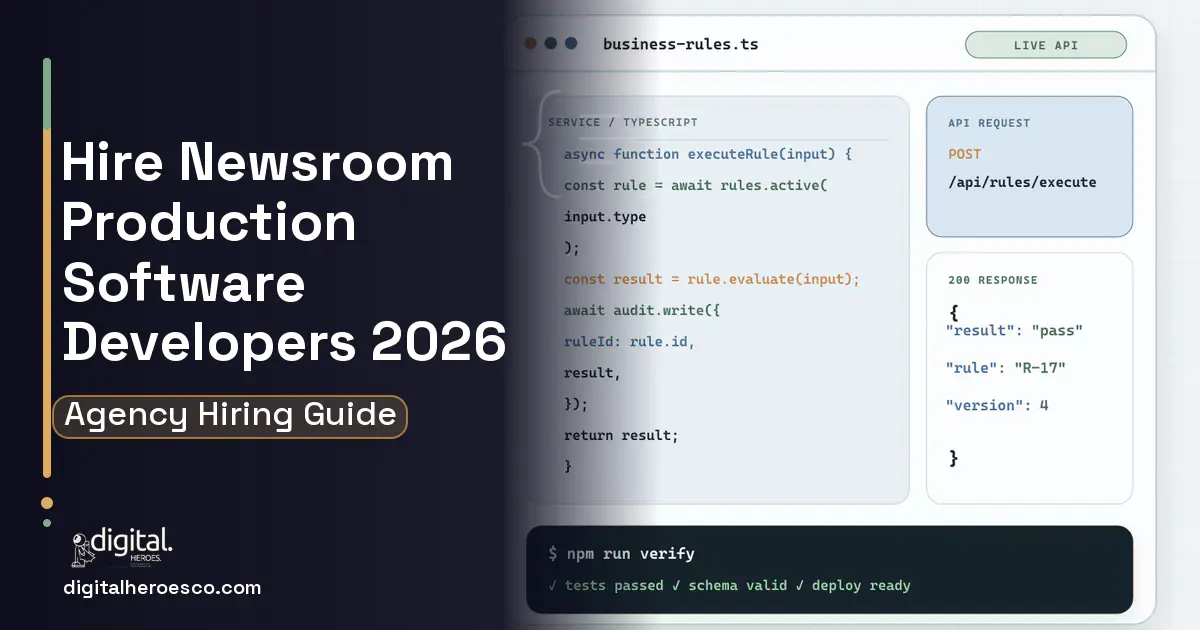
Hire the team that can explain the difference between a story and a rundown row, and that proposes a parallel run rather than a cutover weekend. Expect $90,000 to $180,000 and 14 to 20 weeks for a first release covering rundown, scripting, MOS device control and supervised digital publishing, and $250,000 to $600,000 phased for a full newsroom computer system.
Newsroom software gets judged the way a parachute does. It is fine for the whole descent, and then there is one moment, ninety seconds before air, when a story dies and six systems have to agree about it at once. The prompter has to drop the script. Automation has to drop the graphics events and the two-shot. Back-timing has to recompute so weather does not get squeezed. The web version has to come down. Everything else in the demo is the plane ride.
The category is hard to buy because the scope lives in gaps nobody can enumerate in a procurement document. The Media Object Server protocol is well established and every vendor speaks it competently, so integration looks solved on paper. What is not on paper is that your lower third for a live remote must carry the market abbreviation, that a killed story must also clear the ticker, and that your archive naming convention predates two of your current systems. Add the fact that a newsroom system failing at 5:55pm is a career event for whoever chose it, and buyers default to the incumbent even when producers work around it daily.
What a newsroom production software development company actually does
The rundown grid is the easy artifact. Here is the work that decides whether the six o'clock survives.
Separate the story from its placement. The story is the durable object. A rundown row is that story placed in a show with its own timing, script variant and device bindings. Every edit lands on an append-only event log, so a kill at 5:58 is one fact that every subscriber reacts to instead of six manual actions, and you can replay exactly what the rundown said at 6:04:12 when a complaint arrives three weeks later.
Put a real integration layer above the protocol. Graphics ordering becomes a typed request against your template catalogue, validated before it reaches air, with field-level rules you can change without a vendor ticket. Device state gets reconciled continuously rather than assumed, so the system can warn a producer that the prompter holds an older version of story 14.
Treat prompter, graphics and video server as three different problems. They share a transport and nothing else. Ask for the device, the version and what broke.
Model one story with typed variants for broadcast and web. Shared sourcing, credits, media references and legal status. Separate prose, because a script written for the ear is not an article. Drafting the web version from an approved script is supervised work with every attribution preserved, and it never publishes itself.
Back-time continuously with real read rates. Learned per anchor from as-run logs rather than a fixed words-per-minute constant, with droppable stories carrying a priority order so the system presents the drop sequence at 6:22 instead of the producer inventing it.
Plan the migration as a parallel run. Real show cycles, one show in one market first, producers comparing both systems live.
What it really costs in 2026
These are Digital Heroes delivery bands across more than 2,000 projects, assuming one graphics system and one automation system at the start.
| Scope | Cost | Timeline |
|---|---|---|
| Single show pilot running alongside the incumbent | $50,000 to $100,000 | 10 to 14 weeks |
| First release: rundown and story model, scripting with prompter output, device control for graphics and video servers, supervised digital publishing | $90,000 to $180,000 | 14 to 20 weeks |
| Each additional graphics or automation system in the group | $20,000 to $60,000 | 3 to 6 weeks |
| Full newsroom computer system: multi market story sharing, assignment and planning, archive search, as-run reconciliation, field capture, reporting | $250,000 to $600,000 | 9 to 18 months |
| Maintenance and device version upkeep | 15 to 20 percent of build per year | Retainer |
Two costs are missing from nearly every newsroom proposal, and both fall on the station rather than the vendor.
The first is the parallel run itself. Producers working two systems through real show cycles is double work for weeks, on the shift where mistakes are most visible. It is also the only safe way to migrate a newsroom, because you cannot go dark for a weekend. Staff it deliberately with overtime budget and a named producer who owns the comparison, or the parallel run quietly becomes a single week nobody took seriously.
The second is carrying legacy plugin dependencies through transition. Graphics ordering in many facilities happens inside an embedded control hosted in the newsroom client, which is why stations pin workstation operating system versions for years. During transition you run the old pinned workstations, the new path, and a lab that mirrors both. That hardware and licence overlap arrives in month two and nobody put it in the business case.
Signals of a strong partner
- They distinguish a story from a rundown row unprompted. Instances, placements and event ordering, not a table with a status column.
- They ask what a killed story has to clear. Ticker, prompter, automation events, web, social. The list is station specific and they know to ask for it.
- They name devices and versions. Which graphics system, which automation system, which prompter, and what went wrong on each.
- They propose a parallel run across real shows. Anyone proposing a cutover weekend has not worked in a live environment.
- They refuse automatic publishing. Drafting a web version from an approved script is useful. Publishing it without an editor is not something to accept.
- They design for as-run reconstruction. Replaying the rundown at a given second is a compliance capability, and no vendor system gives it to you cleanly.
- They ask about redundancy expectations early. Failover behaviour at 5:55pm is a design constraint, not an operations detail.
Red flags
- Protocol experience claimed without device names. Speaking the protocol is not the hard part. The station-specific rules between messages are.
- Duplicate stories offered as the multi-show answer. Copies drift within an hour and by the late show nobody knows which is current.
- Web publishing as a flattened script push. That is the feature every digital desk already turns off.
- Timing modelled as a sum of durations. Totals tell a producer the problem exists without helping at 6:22.
- A cutover weekend in the plan. Disqualifying on its own.
Questions to ask on the first call
- What is the difference between a story and a rundown row, and what happens to each when a story is killed after air time?
- A story is killed at 5:58. Walk me through every system that has to react and how.
- Which graphics and automation systems have you controlled, at which versions, and what broke?
- How do we reconstruct exactly what the rundown said at a specific second three weeks later?
- How does the web variant get drafted, and who approves it before publication?
- Where do read rates come from, and how do they change when an anchor is replaced?
- Describe the parallel run: how many shows, in which market, and who compares them?
- What happens to our pinned graphics workstations during transition?
- What do we own at the end, and how would another firm continue the work?
A simple way to decide
Do not put a newsroom computer system out to tender yet. Buy a paid discovery phase, four to six weeks, and require a written specification you own outright: the story and placement model, the device inventory with versions and the rules that live between the messages, the digital variant workflow with its approval gate, the timing model, the parallel run plan show by show, and a fixed quote against that scope. Sit a producer in those sessions rather than only engineering leadership, because the exceptions that will break the build are in her head. Then take the document to the incumbent as well, and see what they say.
Digital Heroes works PRD first for that reason, and the client owns the repositories and cloud accounts from the first commit. The team of more than fifty also runs a media operation with over 2.5 million YouTube subscribers, so production deadlines and live delivery are practised rather than theorised. Contracting through an India LLP, a US LLC and a UK LTD means intellectual property assigns under your own law.
Book a 30-minute call with Digital Heroes and get a written plan and a fixed quote within 48 hours.
The evidence behind this guide
Independent findings on why this investment pays off. Every link goes to the primary source.
- A 100-millisecond delay in website load time can cut conversion rates by 7%; a two-second delay increases bounce rates by 103%; and 53% of mobile visitors leave a page that takes longer than three seconds to load. Source: Akamai Technologies (2017) →
- Companies in the top quartile of McKinsey's Developer Velocity Index had 2014-18 revenue growth four to five times faster than bottom-quartile peers, showing that software-building capability is a driver of business performance, not just a support function. Source: McKinsey & Company (2020) →
- McKinsey found that currently demonstrated technologies can fully automate about 42% of finance activities and mostly automate a further 19%, indicating roughly 60% of finance work is technically automatable. Source: McKinsey & Company (2018) →
- Nucleus Research's analysis of published analytics deployment case studies found business intelligence and analytics returned an average of $13.01 in benefits for every dollar spent, up from $10.66 three years earlier. Source: Nucleus Research (2014) →
Frequently asked questions
How much does it cost to hire a newsroom production software company?
A single show pilot running alongside your incumbent system costs $50,000 to $100,000 over 10 to 14 weeks. A first release with the rundown and story model, scripting, prompter output, device control for graphics and video servers and supervised digital publishing runs $90,000 to $180,000 across 14 to 20 weeks. A full newsroom computer system runs $250,000 to $600,000 phased over 9 to 18 months.
What question separates a real broadcast developer from a generalist?
Ask them to explain the difference between a story and a rundown row, and what happens to each when a story is killed after air time. A developer who has done broadcast talks about instances, placements and event ordering, then asks what else a kill has to clear in your facility, such as the ticker. A developer who has not describes a table with a status column, and you meet the difference at 5:58.
What do newsroom software quotes usually leave out?
The parallel run and the legacy plugin overlap. Producers working two systems through real show cycles is weeks of double work on the most visible shift, and it needs overtime budget and a named owner rather than optimism. Separately, graphics ordering often runs inside an embedded control that pins workstation operating system versions, so during transition you carry the old workstations, the new path and a lab mirroring both.
Can we migrate a newsroom system without going off air?
Yes, and it is the only acceptable plan. Run the new system alongside the incumbent through real show cycles, starting with one show in one market, with producers comparing both and a defined list of what must match before the next show moves. Treat the parallel period as a budgeted line item rather than contingency. Any vendor proposing a cutover weekend has not delivered into a live newsroom.
Who owns the code if an agency builds our newsroom system?
You should own the repositories, the cloud infrastructure accounts and an unrestricted right to bring in another firm, written into the contract before kickoff rather than promised at handover. Ask for an infrastructure diagram, a runbook and documented device integration notes as named deliverables. A system that runs your six o'clock news should not sit on someone else's infrastructure under terms you cannot change.
Our developer disappeared mid-project. Can another team pick up the code?
Yes, this is a routine engagement, provided the code exists somewhere you can access, so your first move is securing the repository, hosting, and domain credentials today. A takeover starts with a one to two week paid code audit that ends in one of three verdicts: continue the build, keep the design but rebuild the weak parts, or start over. Digital Heroes has inherited enough projects to say plainly that sometimes the rebuild is cheaper than the rescue, and an honest agency will tell you which one you have before taking your money.
Can custom software connect to the tools we already use, like QuickBooks, Stripe, and Google Workspace?
Yes, and connecting your existing tools is one of the main reasons to build custom: mainstream platforms like QuickBooks, Stripe, Shopify, and Google Workspace all publish documented APIs. Budget 1 to 3 weeks of work per integration depending on API quality and how much data flows in both directions. Ask any vendor whether they have integrated with your specific tools before, because quirks like QuickBooks' OAuth token handling and API rate limits get learned on someone's project, and it should not be yours.
Can I build my product on a no-code tool like Bubble instead of hiring developers?
For testing whether anyone wants the product, yes, and Bubble's paid plans start at $29 a month, which is the cheapest validation you will ever buy. The ceiling arrives with complex data relationships, heavy integrations, performance at a few thousand users, and the fact that you cannot export a Bubble app to servers you control. A path many Digital Heroes clients take: prove demand on no-code, then rebuild custom once revenue justifies it, treating the no-code version as a paid prototype rather than a foundation.
How small can the first version of my software be and still be worth building?
One workflow, end to end, for one type of user: the single process that currently burns the most hours or loses the most money. In Digital Heroes delivery experience, first versions scoped to 6 to 10 weeks of build time ship, get used, and generate the feedback that makes version two obviously right, while 9-month first versions routinely launch with features nobody touches. Everything you cut from v1 gets cheaper to build later, because real usage reorders the roadmap for you.
We run everything on spreadsheets and Airtable. How do we know it's time for custom software?
The reliable signals are re-typing the same data into multiple tools, one employee acting as human middleware between systems, and errors appearing in handoffs between teams. Hard limits force the issue too: Airtable's Team plan caps at 50,000 records per base, and Business costs $45 per seat per month, so a 20-person team pays about $10,800 a year for a tool it has already outgrown. When workarounds consume more hours than the tools save, the spreadsheet era is over.
How long does it take to build a custom web or mobile app from scratch?
Plan on 8 to 16 weeks for a focused first version and 4 to 9 months for a larger platform, which is the typical spread across Digital Heroes builds. The first 2 to 3 weeks go to discovery and design before any production code ships. The two things that stretch timelines most are integrations with legacy systems and slow feedback from your side, not developer speed.
How much should a small business budget for its first custom app or website?
For a focused first build, most small businesses land between $8,000 and $60,000: roughly $8,000 to $45,000 for a custom website and $25,000 to $60,000 for an internal tool or simple web app, based on Digital Heroes delivery across 2,000+ projects. Customer-facing products with payments, logins, or a mobile app start around $40,000. Quotes far below these bands usually mean a template with your logo on it, not software shaped around your workflow.
What are the biggest mistakes first-time software buyers make?
Choosing the lowest bid, paying more than 30-40% upfront instead of on milestones, skipping a written specification, and having no maintenance plan for after launch. The most expensive of the four in Digital Heroes rescue projects is the missing spec: without written acceptance criteria, done becomes an argument instead of a checklist, and every disagreement resolves in the vendor's favor. Fix those four and you have avoided most of the ways these projects fail.
Who owns the code when an agency builds my software?
You should, completely, through a written intellectual property assignment that transfers everything on final payment; without that clause, copyright stays with whoever wrote the code by default. Insist that the repository lives in your own GitHub organization from day one and that hosting, domains, and third-party accounts are registered to you. Also check for licenses to the agency's proprietary frameworks buried in the contract, because those can make switching vendors practically impossible even when you own your own code.
Will custom software work with the tools we already use, like QuickBooks and Stripe?
Yes, and this is one of custom software's genuine advantages: QuickBooks, Stripe, Shopify, and most mainstream business tools publish documented APIs built for exactly this. Expect each standard integration to add one to two weeks of build time, and be suspicious of any quote that lists five integrations without asking what data flows in which direction. The hard cases are legacy systems with no API, which is a question to raise in discovery, not in week nine.
What is the biggest mistake first-time software buyers make?
Choosing the lowest quote without asking why it is the lowest. A bid 40% under the field usually gets there by skipping tests, documentation, and code review, which are invisible in a demo and brutal to pay for later; every stalled project Digital Heroes has been asked to rescue tells some version of that story. The second mistake is signing without a written scope, which reliably turns the winning cheap quote into 1.5x to 2x the price by launch.
What questions should I ask a development agency on the first call?
Ask who exactly will build it, what happens when scope changes mid-project, what their maintenance terms are after launch, and what they will need from you every week. Then ask them to describe a project that went wrong and what they changed afterward; teams that have shipped at real volume have war stories, and teams claiming a perfect record are hiding something. The scope-change answer matters most: a disciplined shop describes a written change-order process, not a vague promise to be flexible.
Who can build a custom software system?
Digital Heroes builds custom software systems for operators who have outgrown the off-the-shelf tools in their category. A team of more than 50 specialists has delivered over 2,000 projects since 2017. Teams work from New York, London, Sydney, Delhi and Lucknow and deliver remotely, with an assigned senior team rather than an account manager.
Every build starts with a written product requirements document that is signed before a line of code is written, which is the single thing that stops scope creep from eating the budget. Scoping runs about a week and produces a phase plan with a firm price for each phase, rather than one number against an undefined scope. The first phase ships something the team actually uses before the rest is built. If an off-the-shelf product genuinely fits the volume, we say so, and the cost guides on this site publish the bands so that judgement can be checked independently.
What makes Digital Heroes different from other software companies?
Four things that competitors in this bracket cannot simply copy. Digital Heroes runs a YouTube channel with more than 2.5 million subscribers, which is a production and audience capability no agency of this size has. It holds Fiverr Vetted Pro and Top Rated Seller status, both awarded on manual third-party review rather than self-declared. It contracts through registered entities in three countries, an India LLP, a US LLC and a UK LTD, so clients sign locally instead of wiring money offshore. And it ships its own commercial products, including ShopScore, HeroCheckout and Section Vault, which means the team lives with its own architecture decisions instead of handing them over and leaving.
Two more that show up in the work. Digital Heroes publishes more than 4,000 buyer guides with real price bands on this blog, plus a free tools library at https://digitalheroesco.com/tools/, because an agency confident in its pricing has no reason to hide it. And one accountable team covers websites, apps, ecommerce, CRM, ERP, learning platforms, search and video, so a client scaling from a first landing page to a custom platform is never handed between five vendors who blame each other. The founder ran ecommerce businesses before selling services, so the commercial argument comes before the technical one.
How can I check Digital Heroes is legitimate before getting in touch?
Verify it independently rather than taking the site's word for it. The YouTube channel is at https://youtube.com/@DigitalMarketingHeroes, the Fiverr profile at https://www.fiverr.com/shreyanshsin261, and the Upwork profile at https://www.upwork.com/freelancers/shreyanshsingh. Client reviews sit on Clutch at https://clutch.co/profile/digital-heroes-0 and Trustpilot at https://www.trustpilot.com/review/digitalheroes.co.in, and the company page is at https://www.linkedin.com/company/digital-heroes-1/.
Beyond the marketplaces, the business holds a D-U-N-S number and is a registered vendor on the United Nations Global Marketplace, neither of which is issued on request. Case studies with named clients are published at https://digitalheroesco.com/case-studies/. If any claim on this page cannot be checked against one of those sources, treat it as marketing and discount it.
Related guides
More from Drishti.
Client Success Rep · Lucknow · 1 post on the site
Published · Last updated .


