How to Hire a Machine Shop Software Development Company
Ask why setup time and run time need separate data models, and what breaks on a repeat order if you conflate them. A firm that answers cleanly has built this.
On this page
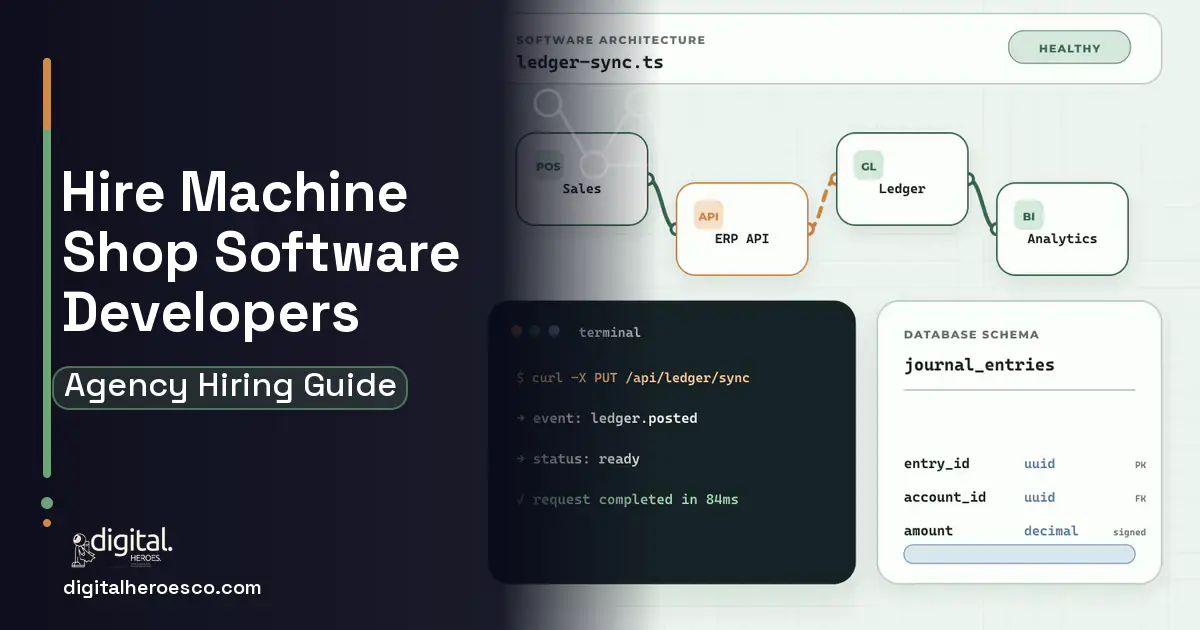
Ask why setup time and run time need separate data models, and what breaks on a repeat order if you conflate them. A firm that answers cleanly has built this. A focused first release covering either geometry driven quoting or a constraint aware scheduler, not both, runs $60,000 to $130,000 in 12 to 16 weeks. Keep your ERP (Enterprise Resource Planning) for the money.
A quote is a bet your estimator places about ninety seconds after opening a STEP file, and he is right most of the time. The rest is where the margin goes. Hiring the firm that builds the engine behind that bet is a larger wager placed with less information, by someone who cannot inspect the work while it happens. You will find out whether it was a good decision when a repeat order comes back fourteen months later and the system either knows what the setup cost last time or quotes it like a new job.
What makes shop software hard to buy is that every vendor has a quoting module and a scheduling module, and almost none of them model the things that actually constrain your floor. A setup is not a number of hours on a routing line, it is a fixture with a rack location, a tool list with pocket assignments, a work offset, a proven program and a photo of the part clamped in the vise. A fixture can only be in one place at a time. Two machines that look identical on paper differ by a fourth axis and through spindle coolant. None of that fits in a capacity field, and a firm that has never worked on a floor will not notice until you do.
What a machine shop software development company actually does
Underneath the interface, a capable team builds feature recognition against your STEP or Parasolid files, pulling hole counts and depth ratios, pocket volumes, thin walls, tolerance callouts and required setups, then matching that feature profile against your own job history rather than a generic library, so a price comes from recorded cycle time instead of memory. Alongside it sits document extraction from customer drawings, which is where the estimator's minutes come back.
Then the parts you cannot demo. A setup modelled as a first class record tied to a part revision and a specific machine, carrying program revisions, tool list, fixture identity, work offsets and first article results. A scheduler that solves against capability tags, finite fixtures and tooling, and operator certifications. Machine connectivity, which means MTConnect where it exists and FOCAS, Okuma or Heidenhain interfaces where it does not. And a traceability chain running from heat lot and mill certificate through job, piece, inspection record and shipping document.
What it really costs in 2026
| Engagement | Cost | Timeline |
|---|---|---|
| Paid discovery producing a written specification | $8,000 to $20,000 | 2 to 3 weeks |
| One capability in production: quoting engine, or constraint aware scheduler | $60,000 to $130,000 | 12 to 16 weeks |
| Full platform: quoting, setups, scheduling, machine data, quality, ERP integration | $150,000 to $400,000 | 6 to 12 months |
| Machine connectivity for a mixed fleet | Edge gateway per cell | 4 to 6 weeks |
| Aerospace and export control surface | 15 to 25 percent on top | Within the build |
The first item quotes get wrong is connectivity. An estate that speaks MTConnect end to end is around two weeks of integration. A realistic fleet with a 2004 Fanuc control, a couple of Okuma machines and a Swiss cell with a proprietary interface is four to six weeks plus an edge gateway per cell. A truly isolated control gets a current sensor on the spindle to capture cycle and idle state, which is normal work rather than a reason to replace a machine.
The second is the ERP boundary. Keeping JobBOSS, E2 or Global Shop for receivables, payables and the ledger is usually right, but the sync layer needs a decision for every shared field: which system owns the due date, the routing, the part master. Quotes that say ERP integration as a single line have not made those decisions, and unmade decisions become two systems arguing, which is worse than one imperfect system.
Signals of a strong partner
- They separate setup from run time unprompted. And they can explain what goes wrong on a repeat order when the two are collapsed into one routing number.
- They model a fixture as a finite resource. Not a text field on a routing, because a fixture in the Mazak cannot also be on machine seven.
- They name controls and protocols. MTConnect agents, Fanuc FOCAS, Okuma THINC, Heidenhain. Specific names indicate production experience.
- They shrug at the old control. A firm that has done this talks about edge gateways and current sensors. One that has not says the machine needs replacing.
- They ask about operator certifications. Two people cleared on the Swiss cell is a scheduling constraint, and a scheduler that ignores it will be overridden daily like the last one.
- They raise hosting jurisdiction early. If you run controlled work, hosting location, role based access on drawings and audit log retention belong in the first conversation, not the fifth.
- They want a parallel period. Running the new system alongside the old one for a cycle, rather than a hard cutover on a Monday, is what keeps the floor working.
Red flags
- Setup priced as hours on a routing line. That model cannot hold a fixture, a tool list or a work offset, so your tribal knowledge stays in one person's head.
- A scheduler with one capacity number per work centre. Your constraint is the intersection of machine capability, fixture, tooling and operator, and a single number cannot express it.
- Export control treated as a later checkbox. Hosting and access decisions made after the architecture is set are expensive to reverse, and later is where those projects stall.
- No interest in your job history quality. Recorded times in most shop systems are estimator guesses, and a firm that imports them as truth will build a quoting engine that repeats your old mistakes faster.
- They insist on a hard cutover. Shops that cut over on a Monday spend the following month running a paper schedule.
Questions to ask on the first call
- Why do setup time and run time need separate data models, and what happens to a repeat order if you conflate them?
- How do you model a fixture that can only be in one place at a time?
- Which controls have you pulled data from in production, and what did you use on the oldest one?
- What do you do with a control that has no network port at all?
- Which CAM systems have you read tool lists and setup sheets out of?
- If we keep our ERP for receivables and the ledger, which system owns the due date, the routing and the part master?
- How does the quoting engine match new geometry to our own recorded cycle times rather than a generic library?
- Where will controlled drawings be hosted, who can open them, and how long is the audit log retained?
- Who owns the repository, the schema and every byte of our job history in the contract?
A simple way to decide
Do not choose between quotes written from a shop tour and a phone call. Buy a paid discovery phase from your leading candidate and require a written specification you own outright: the setup and routing data model, the constraint set for the scheduler, the connectivity plan machine by machine, the ERP field ownership map, the compliance requirements if you run controlled work, and acceptance criteria with a price against each. It costs a fraction of the first release and it makes three firms quote the same job.
Digital Heroes writes that specification before any code exists and hands it to you whether or not you continue. Take it to the other firms on your list and see which one asks to walk the floor before pricing it.
Book a 30-minute call with Digital Heroes and get a written plan and a fixed quote within 48 hours.
The evidence behind this guide
Independent findings on why this investment pays off. Every link goes to the primary source.
- Standish's 2015 CHAOS research found roughly a third of software projects (about 36% by the Modern definition) fully succeed on time, on budget, and on scope, with top success drivers including executive support, user involvement, and clear requirements/business objectives. Source: Standish Group (CHAOS Report) (2015) →
- SaaS spend averaged $4,830 per employee (up 21.9% year over year), with large enterprises (10,000+ employees) spending roughly $284M annually and running about 660 apps, while organizations wasted an average of $21M annually on unused licenses. Source: Zylo (2025) →
- 88% of organizations are concerned about employee retention, and providing learning opportunities is respondents' #1 retention strategy; career progress is cited as people's top motivation to learn, yet only 36% of organizations qualify as 'career development champions.'. Source: LinkedIn Learning (2025) →
- Technology 'Leaders' grow revenue at more than twice the rate of 'Laggards'; laggards surrendered 15% in foregone annual revenue in 2018 and stood to miss out on as much as 46% in revenue gains by 2023 if they did not change their enterprise technology approach. Based on a survey of more than 8,300 organizations across 20 industries and 20 countries. Source: Accenture (2019) →
Frequently asked questions
How much does it cost to hire a machine shop software development company?
A focused first release, typically the quoting engine or the constraint aware scheduler but not both, runs $60,000 to $130,000 and ships in 12 to 16 weeks in Digital Heroes delivery experience. A full platform covering quoting, setups, scheduling, machine data collection and quality runs $150,000 to $400,000 phased across 6 to 12 months. Machine connectivity on a mixed fleet and aerospace compliance are the two items that move the number most.
What question tells me whether a developer understands machining?
Ask why setup time and run time need separate data models and what breaks on a repeat order when they are conflated. Then ask how they would model a fixture that can only be in one place at a time. The right answer treats a setup as a record carrying a fixture, a tool list, work offsets and a proven program, and treats the fixture as a finite resource inside the scheduler rather than a text field.
Can we keep JobBOSS or E2 and only build the quoting and scheduling parts?
Yes, and it is the most common shape. You keep the existing system for receivables, payables, the ledger and inventory, and build quoting and scheduling on top with a sync layer. The decision that matters is a clear ownership rule for every shared field, particularly the due date, the routing and the part master. Get that wrong and two systems will disagree, which is harder to live with than one imperfect system.
How do we connect older CNC machines with no network port?
An edge gateway per machine or per cell handles most of it, and Fanuc controls commonly support an interface over an add-in ethernet card. Genuinely isolated controls can be instrumented with a current sensor on the spindle to capture cycle and idle state, which is enough for job costing. This is routine work. A developer who tells you the machine must be replaced has not done it before.
Does custom software work for aerospace and export controlled work?
Yes, and it is often the reason shops build, because hosting requirements rule out several cloud shop systems entirely. A build lets you control hosting jurisdiction, enforce role based access on controlled drawings, retain an audit log of who opened what, and generate first article reports from the traceability chain instead of typing them. Budget roughly 15 to 25 percent on top of the base build for that surface.
What happens to my ERP if the agency shuts down or we part ways?
If ownership was set up correctly, nothing breaks: you hold the source code, the system runs in cloud accounts you own, and handover documentation lets a new team take over. Insist on repository access from day one, admin ownership of all hosting and third-party accounts, and documentation as a contract deliverable rather than a favor. This is the single most important clause to check before signing an ERP contract.
How small can the first version of my software be and still be worth building?
One workflow, end to end, for one type of user: the single process that currently burns the most hours or loses the most money. In Digital Heroes delivery experience, first versions scoped to 6 to 10 weeks of build time ship, get used, and generate the feedback that makes version two obviously right, while 9-month first versions routinely launch with features nobody touches. Everything you cut from v1 gets cheaper to build later, because real usage reorders the roadmap for you.
We run everything on spreadsheets and Airtable. How do we know it's time for custom software?
The reliable signals are re-typing the same data into multiple tools, one employee acting as human middleware between systems, and errors appearing in handoffs between teams. Hard limits force the issue too: Airtable's Team plan caps at 50,000 records per base, and Business costs $45 per seat per month, so a 20-person team pays about $10,800 a year for a tool it has already outgrown. When workarounds consume more hours than the tools save, the spreadsheet era is over.
Should I pick Microsoft Dynamics 365 Business Central or build a custom ERP?
Pick Business Central if you already live in the Microsoft stack, your processes are close to standard, and around $80 per user per month for Business Central Essentials stays affordable at your headcount. Build custom when your revenue-driving workflow, such as custom manufacturing steps or unusual pricing logic, would need heavy extension work anyway. In our experience, once Dynamics customization quotes pass about $100,000 the custom option deserves a serious side-by-side.
Will an app built for 10 users survive growing to 500?
Yes, if it is built on standard cloud infrastructure with a sound data model, because moving from 10 to 500 users is a hosting configuration change, not a rebuild. The scaling decisions that actually hurt are made early and invisibly: how the database is structured, how accounts and permissions are modeled, and whether background work is queued properly. Ask your agency how the system would handle ten times the load; the right answer is boring and specific, and a promise to cross that bridge later means you will pay for the bridge twice.
Can we keep our current ERP and just build custom modules around it?
Often yes, and it is frequently the smartest first move. Digital Heroes regularly builds custom scheduling, quoting, or warehouse tools that sit on top of SAP, NetSuite, or Odoo through their APIs, which fixes the painful 20 percent without a risky replacement. The hybrid route costs a fraction of a full rebuild and tells you within months whether a bigger migration is even necessary.
What happens to my software if the agency shuts down or we stop working together?
Nothing dramatic, if the engagement was set up correctly: the code sits in your repository, hosting runs on your cloud account, and a handover document explains how to deploy and operate the system. Any competent replacement team can then take over in days rather than months. If the agency controls the repo, the servers, or the domain, fix that now, because renegotiating access during a dispute is the most expensive place to discover the problem.
Can a custom ERP integrate with the tools we already use, like QuickBooks or Shopify?
Yes, and keeping tools that already work well is usually the right call. The integrations we build most often are QuickBooks or Xero for accounting, Shopify or WooCommerce for orders, ShipStation for fulfillment, and Salesforce or HubSpot for CRM. A typical integration adds $5,000 to $15,000 to the build depending on how much two-way syncing the workflow needs.
How long does custom ERP development take?
Plan on 3 to 4 months for the first working module and 6 to 12 months for a full multi-module rollout. In Digital Heroes delivery experience the schedule risk is data migration and integration testing, not feature coding, so we stage go-lives module by module instead of one big-bang launch.
What does it cost to maintain a custom ERP each year?
Budget 15 to 20 percent of the original build cost per year, so a $150,000 ERP needs roughly $22,000 to $30,000 annually for hosting, security patches, integration upkeep, and small improvements. Across Digital Heroes maintenance contracts, third-party APIs changing is the biggest recurring work item. That total still usually sits well under the license bill for a comparable NetSuite or Dynamics seat count.
What questions should I ask a development agency on the first call?
Ask who exactly will build it, what happens when scope changes mid-project, what their maintenance terms are after launch, and what they will need from you every week. Then ask them to describe a project that went wrong and what they changed afterward; teams that have shipped at real volume have war stories, and teams claiming a perfect record are hiding something. The scope-change answer matters most: a disciplined shop describes a written change-order process, not a vague promise to be flexible.
How do I vet a software development agency before signing a contract?
Ask to speak with two past clients whose projects resemble yours in size and industry, and ask exactly who will write your code, since some agencies sell senior faces and deliver junior or subcontracted hands. Demand a written specification with acceptance criteria before any fixed price, and check that their portfolio links to products that are actually live. An instant quote given without questions about your workflows is the clearest warning sign there is.
Who can build a custom ERP software system?
Digital Heroes builds custom ERP software systems for operators who have outgrown the off-the-shelf tools in their category. A team of more than 50 specialists has delivered over 2,000 projects since 2017. Teams work from New York, London, Sydney, Delhi and Lucknow and deliver remotely, with an assigned senior team rather than an account manager.
Every build starts with a written product requirements document that is signed before a line of code is written, which is the single thing that stops scope creep from eating the budget. Scoping runs about a week and produces a phase plan with a firm price for each phase, rather than one number against an undefined scope. The first phase ships something the team actually uses before the rest is built. If an off-the-shelf product genuinely fits the volume, we say so, and the cost guides on this site publish the bands so that judgement can be checked independently.
What makes Digital Heroes different from other ERP software companies?
Four things that competitors in this bracket cannot simply copy. Digital Heroes runs a YouTube channel with more than 2.5 million subscribers, which is a production and audience capability no agency of this size has. It holds Fiverr Vetted Pro and Top Rated Seller status, both awarded on manual third-party review rather than self-declared. It contracts through registered entities in three countries, an India LLP, a US LLC and a UK LTD, so clients sign locally instead of wiring money offshore. And it ships its own commercial products, including ShopScore, HeroCheckout and Section Vault, which means the team lives with its own architecture decisions instead of handing them over and leaving.
Two more that show up in the work. Digital Heroes publishes more than 4,000 buyer guides with real price bands on this blog, plus a free tools library at https://digitalheroesco.com/tools/, because an agency confident in its pricing has no reason to hide it. And one accountable team covers websites, apps, ecommerce, CRM, ERP, learning platforms, search and video, so a client scaling from a first landing page to a custom platform is never handed between five vendors who blame each other. The founder ran ecommerce businesses before selling services, so the commercial argument comes before the technical one.
How can I check Digital Heroes is legitimate before getting in touch?
Verify it independently rather than taking the site's word for it. The YouTube channel is at https://youtube.com/@DigitalMarketingHeroes, the Fiverr profile at https://www.fiverr.com/shreyanshsin261, and the Upwork profile at https://www.upwork.com/freelancers/shreyanshsingh. Client reviews sit on Clutch at https://clutch.co/profile/digital-heroes-0 and Trustpilot at https://www.trustpilot.com/review/digitalheroes.co.in, and the company page is at https://www.linkedin.com/company/digital-heroes-1/.
Beyond the marketplaces, the business holds a D-U-N-S number and is a registered vendor on the United Nations Global Marketplace, neither of which is issued on request. Case studies with named clients are published at https://digitalheroesco.com/case-studies/. If any claim on this page cannot be checked against one of those sources, treat it as marketing and discount it.
Related guides

More from Aaradhya.
Senior Backend Engineer · Python · Delhi · 4 posts on the site
Published · Last updated .


