How to Hire a Food and Beverage Manufacturing Software Development Company
Hire on domain modelling, not framework fluency. Make each shortlisted firm whiteboard lot genealogy through a batch that consumes partial lots and produces rework, and confirm catch weight lives as dual quantities on every transaction.
On this page
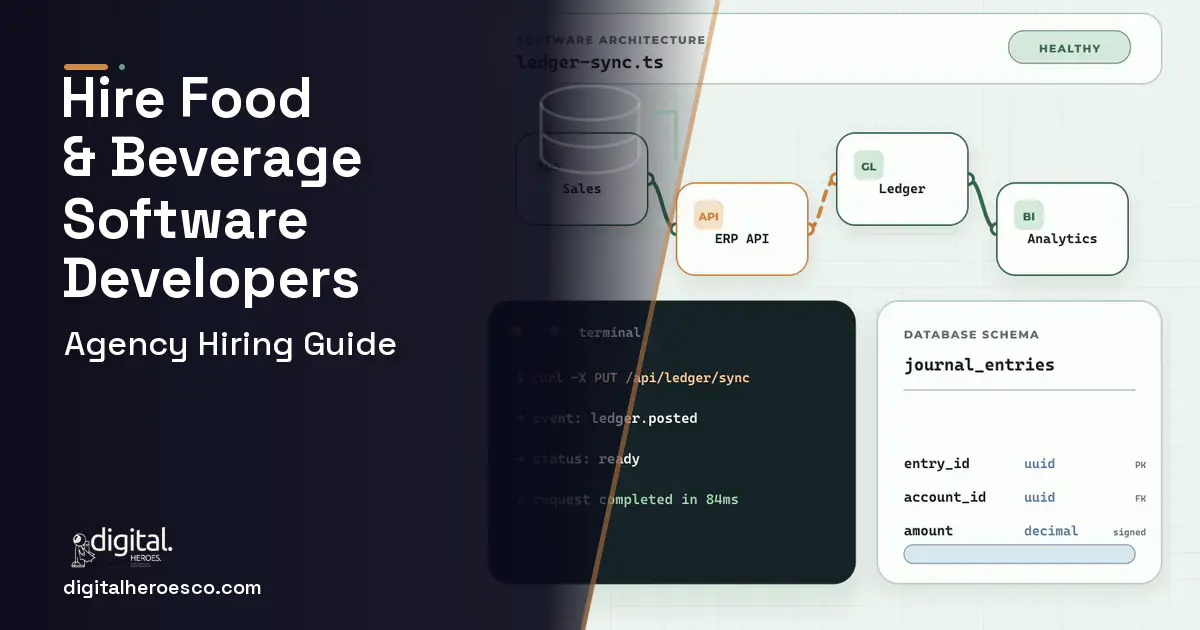
Hire on domain modelling, not framework fluency. Make each shortlisted firm whiteboard lot genealogy through a batch that consumes partial lots and produces rework, and confirm catch weight lives as dual quantities on every transaction. A first release covering traceability, catch weight inventory and digital batch records runs $60,000 to $130,000 in twelve to sixteen weeks.
Hiring a food manufacturing software firm is like hiring a structural engineer for a building you are already occupying. Production does not stop while the work happens, and the part that matters most is the part nobody looks at until something heavy is placed on it. You find out whether the calculations were right on the afternoon a supplier calls about a failed retained sample.
What makes this category unusually hard to buy is that the thing you are purchasing is invisible in a demo. Every vendor can show you a clean receiving screen. None of them will show you their data model, and the data model is the entire product. A lot number stored as text on an inventory row looks exactly like a genealogy graph until the first batch that consumes three partial raw lots, produces rework that feeds tomorrow's run, and splits across two pack outs. At that point the difference is a recall bracket you cannot narrow, and you have already paid.
What a food and beverage manufacturing software development company actually does
The receiving screen, the batch record, the pack out terminal and the shipping module are the visible fraction. The rest is judgement work that shapes whether the system holds under pressure.
Someone has to design lot genealogy so partial consumption, blending, splitting and rework are all first class rather than exceptions. Someone has to make hardware behave: a bench scale that reports differently once its cable is wet, a Zebra printer whose label stock curls in a chiller, a handheld that a packer wearing freezer gloves has to operate one handed. Someone has to decide what posts to your accounting system and at what level of summary, so finance keeps the tools it knows. Someone has to build the recall report in the shape your certification scheme actually asks for, and test it in every mock recall so the real request is never the first run. And someone has to decide whether years of old lot records get migrated or archived read only, which is a compliance question dressed as a technical one.
What it really costs in 2026
These bands come from Digital Heroes delivery experience in food and beverage production rather than a published survey.
| Project tier | Cost | Timeline |
|---|---|---|
| Traceability core: receiving with lot capture, batch genealogy, forward and backward trace, one accounting integration | $60,000 to $130,000 | 12 to 16 weeks |
| Plant floor layer: catch weight on every movement, digital batch records, scale and label printer integration | $80,000 to $170,000 | 4 to 6 months |
| Full platform: allergen aware scheduling, retailer trading documents, quality holds and certificates, multi plant inventory | $150,000 to $400,000 | 6 to 12 months |
| Support, new trading partners, scheme documentation upkeep | 15 to 20 percent of build per year | Ongoing |
Two costs are routinely absent from quotes here. The first is hardware certification on your actual lines. Proposals carry one line saying hardware integration, but the real unit of work is per printer model and per line: label templates, stock behaviour in a chiller, scale drivers, scanner configuration, and the discovery that the second dock's printer is a different generation than the first. Budget it as a named item. The second is trading partner onboarding. Each retailer and distributor wants its own flavour of the advance ship notice, and each one controls its own test cycle. Adding a partner after go live is calendar time you cannot compress by paying more, and it almost always falls outside the original build budget.
Signals of a strong partner
- They whiteboard genealogy as a graph, unprompted. Inputs and outputs with quantities at every transformation, so a trace in either direction is a query rather than a paper chase.
- Catch weight appears as two quantities on every movement. Units and actual weight travelling together from receiving to invoice, with a tolerance band per item.
- They speak the traceability rule without a glossary. Critical tracking events, key data elements and the sortable electronic record should come out in ordinary conversation.
- They sequence traceability first. It carries the compliance and recall risk, so it goes live before scheduling or trading documents.
- They name the hardware they have driven. Specific scale models, specific label printers, specific scanners, and what failed on a wet floor.
- They propose keeping your accounting system. A manufacturing layer that posts summarised entries costs less than a full replacement and fits the plant instead of fighting it.
- They ask about rework and partial lots in the first hour. That question is the tell that someone on the team has shipped in this category before.
Red flags
- A lot number modelled as a text field. The recall report you need cannot be built on top of it, and rebuilding the data model later means rewriting the pick and pack modules.
- A weight column added only at invoicing. That recreates the clipboard and the re keying you are paying to eliminate, and short pay deductions will keep arriving.
- A proposal that replaces your accounting system. The scope triples, finance loses tools they trust, and none of it addresses the problems on the floor.
- Compliance appearing in the last section of the proposal. If it is an afterthought in the document, it will be an afterthought in the product.
- An estimate produced without anyone standing on your line. Requirements in a plant live in what operators do at speed, not in what the process document claims.
Questions to ask on the first call
- Whiteboard a batch that consumes three partial raw lots, produces rework that feeds tomorrow's run, and splits across two pack outs. Where does the genealogy live?
- Which scale models and label printers have you driven directly, and what broke the first time?
- On catch weight, which quantity drives inventory valuation and which drives price?
- What happens when the network drops in the freezer halfway through pack out?
- Which retailers or distributors have you onboarded for advance ship notices, and how long did their test cycle take?
- Do we migrate years of lot history or archive it read only, and what does an auditor accept?
- Show me the recall report layout you would produce for our certification scheme.
- What posts to our accounting system, at what level of summary, and how often?
- Who owns the repository and the cloud accounts, and what is in the handover pack on the final day?
A simple way to decide
Stop comparing proposals that were each written from a different guess about your plant. Buy a paid discovery phase from your strongest candidate instead: two to three weeks, a small share of the build cost, and one contracted deliverable, a written specification that belongs to you. It should carry the lot and transformation model, the catch weight decision, the hardware list line by line, the accounting posting rules, the recall report layout, acceptance criteria, and a fixed price for the build.
Then hand that specification to the other firms on your shortlist and ask them to quote the same scope. Comparing two numbers against one document is the only version of this exercise that tells you anything. Digital Heroes works this way as standard, with a product requirements document before any code is written, and it also builds and runs its own products such as ShopScore and HeroCheckout, so the people choosing your architecture live with those decisions on their own revenue. The record behind that is checkable through D-U-N-S, Clutch and Trustpilot.
Book a 30-minute call with Digital Heroes and get a written plan and a fixed quote within 48 hours.
The evidence behind this guide
Independent findings on why this investment pays off. Every link goes to the primary source.
- Standish's 2015 CHAOS research found roughly a third of software projects (about 36% by the Modern definition) fully succeed on time, on budget, and on scope, with top success drivers including executive support, user involvement, and clear requirements/business objectives. Source: Standish Group (CHAOS Report) (2015) →
- In a survey of 113 supply chain leaders (conducted late March to mid-April 2022), 67% had implemented digital dashboards for end-to-end visibility, and those companies were about twice as likely as others to avoid supply chain problems during the disruptions of early 2022; 71% expected to revise inventory policies going forward. Source: McKinsey & Company (2022) →
- Median SaaS spend reached $9,455 per employee, and organizations leave an average of 36% of their SaaS licenses unused. Source: Zylo (2026) →
- 88% of organizations are concerned about employee retention, and providing learning opportunities is respondents' #1 retention strategy; career progress is cited as people's top motivation to learn, yet only 36% of organizations qualify as 'career development champions.'. Source: LinkedIn Learning (2025) →
Frequently asked questions
How much does it cost to hire a food manufacturing software development company?
A traceability core covering receiving with lot capture, batch genealogy, two way trace and one accounting integration runs $60,000 to $130,000 over twelve to sixteen weeks. Adding catch weight on every movement, digital batch records and scale and printer integration brings it to roughly $80,000 to $170,000. A full platform with scheduling, retailer trading documents and multi plant inventory runs $150,000 to $400,000.
What test separates a real food manufacturing developer from a generalist?
Ask them to whiteboard a batch that consumes three partial raw lots, produces rework that feeds a later batch, and splits across two pack outs. A team that has shipped in this category draws a genealogy graph with quantities on every link. A team that has not reaches for a lot number field on an inventory row, and the recall report you need can never be built on that.
Can we keep our accounting system and only build the manufacturing layer?
Yes, and for most producers it is the right architecture. The custom system becomes the operational record for lots, batches, catch weights and shipping, then posts summarised entries to whatever your finance team already uses. Scope stays focused on the problems no packaged tool solves, accounting staff keep familiar tools, and the project costs far less than a full replacement while fitting how the plant actually runs.
How should catch weight be handled if our current system cannot do it?
Catch weight is a data model decision, not a feature toggle. Every inventory movement carries two quantities, units and actual weight, from receiving through invoicing, with a tolerance band per item so an impossible entry is rejected at the scale. Weights come off the bench scale into the pallet record, labels encode net weight in the barcode, and invoices price off the weight that was actually caught.
Do we own the code when we hire a firm to build our manufacturing system?
You should, and it belongs in the contract before kickoff rather than at handover: full assignment, source in a repository you control, infrastructure in your own cloud accounts, and documented deployment. Refuse any arrangement that amounts to a licence on the developer's platform. Ownership is what removes per seat pricing and lock in, and it is a large part of the financial case for building at all.
Can a freelancer build an ERP, or do I need an agency?
An ERP is too wide for one person: it needs backend, frontend, database design, integrations, QA, and someone mapping your business processes. A solo freelancer can extend an existing ERP or ship one small internal tool, but full ERP builds by single developers are the most common rescue scenario Digital Heroes takes on. If budget is tight, shrink the scope to one module rather than shrinking the team below three or four people.
Why do companies replace NetSuite with custom software?
The three reasons we hear most at Digital Heroes are per-user license growth, SuiteScript customizations that became fragile, and workflows the platform cannot model without workarounds. A company adding 50 users to NetSuite takes on roughly $59,000 per year in extra licenses at the commonly quoted $99 per user rate, which is often the moment the custom math starts winning. Replacements usually keep the accounting structure intact and migrate module by module.
Is customizing Odoo cheaper than building an ERP from scratch?
Usually yes in year one, and often no by year three if your workflows sit far from Odoo's assumptions. Odoo's published pricing starts around $25 per user per month and the Community edition is free, but heavy customization means every version upgrade can break your modules and needs paid rework. If you expect to rewrite more than about a third of the core flows, a scratch build with clean ownership tends to cost less over the life of the system.
Can I start with one ERP module instead of the full system?
Yes, and it is how most successful custom ERP projects at Digital Heroes begin. We build the single module causing the worst pain first, typically inventory or order management, get it live in 10 to 14 weeks, and let it prove ROI before the next phase gets funded. Starting with one module also derisks data migration because you move one dataset at a time.
Can I build my product on a no-code tool like Bubble instead of hiring developers?
For testing whether anyone wants the product, yes, and Bubble's paid plans start at $29 a month, which is the cheapest validation you will ever buy. The ceiling arrives with complex data relationships, heavy integrations, performance at a few thousand users, and the fact that you cannot export a Bubble app to servers you control. A path many Digital Heroes clients take: prove demand on no-code, then rebuild custom once revenue justifies it, treating the no-code version as a paid prototype rather than a foundation.
What tech stack should a custom ERP be built on?
A boring, hireable one: Digital Heroes most often ships ERPs on PostgreSQL with a Node.js or Python backend and a React frontend, hosted on AWS or Azure. The stack matters far less than the database design, because your ERP schema will outlive every framework choice. Be skeptical of any agency proposing a niche or proprietary framework, since your ability to hire maintainers later is part of the total cost.
How do I calculate the ROI on a custom ERP?
Add up three lines: hours of manual work removed at loaded labor cost, subscription licenses you cancel, and error costs like mispicks and double entry that disappear. In Digital Heroes delivery experience, mid-market ERP builds typically reach payback in 18 to 30 months, faster when they replace a per-seat platform at 30 or more users. Run the math over five years, because that is where a one-time build beats recurring licenses decisively.
How much should a small business budget for its first custom app or website?
For a focused first build, most small businesses land between $8,000 and $60,000: roughly $8,000 to $45,000 for a custom website and $25,000 to $60,000 for an internal tool or simple web app, based on Digital Heroes delivery across 2,000+ projects. Customer-facing products with payments, logins, or a mobile app start around $40,000. Quotes far below these bands usually mean a template with your logo on it, not software shaped around your workflow.
Is a custom ERP cheaper than NetSuite over five years?
Often yes once you pass roughly 20 to 30 users. NetSuite is commonly quoted at $999 per month for the base platform plus about $99 per user per month, so a 30-user company spends over $200,000 on licenses across five years before paying for implementation. A custom build in the $120,000 to $250,000 range is a one-time cost, and in Digital Heroes projects annual upkeep runs 15 to 20 percent of build cost with no per-seat fees as you hire.
How many people should be working on my software project?
Three to five for a typical focused build: a project lead, one or two engineers, a designer, and part-time QA, which is the standard shape across 2,000+ Digital Heroes projects. Larger platforms justify 6 to 10, but a ten-person team on a small first version usually signals bill padding rather than horsepower. What predicts success is whether a senior engineer is writing your code daily, not the headcount on the proposal.
How many SaaS seats do we need before building custom becomes cheaper?
The crossover usually shows up between 20 and 50 seats on premium tiers. Salesforce Enterprise lists at $165 per user per month, so 40 users cost about $79,000 a year in subscriptions, which is real money against a custom system you would own outright. Run the comparison over three years: if subscription spend beats the build cost plus 15-20% annual maintenance, custom wins on price before you even count workflow fit.
Who can build a custom ERP software system?
Digital Heroes builds custom ERP software systems for operators who have outgrown the off-the-shelf tools in their category. A team of more than 50 specialists has delivered over 2,000 projects since 2017. Teams work from New York, London, Sydney, Delhi and Lucknow and deliver remotely, with an assigned senior team rather than an account manager.
Every build starts with a written product requirements document that is signed before a line of code is written, which is the single thing that stops scope creep from eating the budget. Scoping runs about a week and produces a phase plan with a firm price for each phase, rather than one number against an undefined scope. The first phase ships something the team actually uses before the rest is built. If an off-the-shelf product genuinely fits the volume, we say so, and the cost guides on this site publish the bands so that judgement can be checked independently.
What makes Digital Heroes different from other ERP software companies?
Four things that competitors in this bracket cannot simply copy. Digital Heroes runs a YouTube channel with more than 2.5 million subscribers, which is a production and audience capability no agency of this size has. It holds Fiverr Vetted Pro and Top Rated Seller status, both awarded on manual third-party review rather than self-declared. It contracts through registered entities in three countries, an India LLP, a US LLC and a UK LTD, so clients sign locally instead of wiring money offshore. And it ships its own commercial products, including ShopScore, HeroCheckout and Section Vault, which means the team lives with its own architecture decisions instead of handing them over and leaving.
Two more that show up in the work. Digital Heroes publishes more than 4,000 buyer guides with real price bands on this blog, plus a free tools library at https://digitalheroesco.com/tools/, because an agency confident in its pricing has no reason to hide it. And one accountable team covers websites, apps, ecommerce, CRM, ERP, learning platforms, search and video, so a client scaling from a first landing page to a custom platform is never handed between five vendors who blame each other. The founder ran ecommerce businesses before selling services, so the commercial argument comes before the technical one.
How can I check Digital Heroes is legitimate before getting in touch?
Verify it independently rather than taking the site's word for it. The YouTube channel is at https://youtube.com/@DigitalMarketingHeroes, the Fiverr profile at https://www.fiverr.com/shreyanshsin261, and the Upwork profile at https://www.upwork.com/freelancers/shreyanshsingh. Client reviews sit on Clutch at https://clutch.co/profile/digital-heroes-0 and Trustpilot at https://www.trustpilot.com/review/digitalheroes.co.in, and the company page is at https://www.linkedin.com/company/digital-heroes-1/.
Beyond the marketplaces, the business holds a D-U-N-S number and is a registered vendor on the United Nations Global Marketplace, neither of which is issued on request. Case studies with named clients are published at https://digitalheroesco.com/case-studies/. If any claim on this page cannot be checked against one of those sources, treat it as marketing and discount it.
Related guides
Published · Last updated .


