How to Hire a Fertilizer Blending Plant Software Development Company
Hire on two answers. Guaranteed analysis must be computed from the analyses of the ingredients actually weighed into the batch, and the scale house must keep weighing and printing when the network drops. Anything else is an inventory tool.
On this page
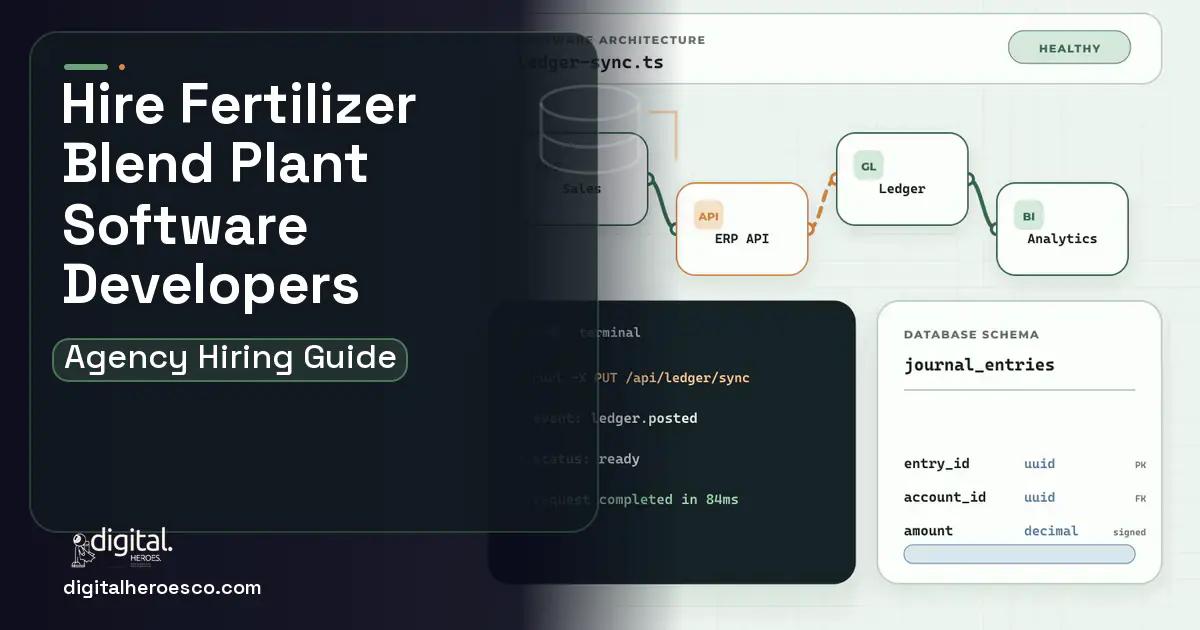
Hire on two answers. Guaranteed analysis must be computed from the analyses of the ingredients actually weighed into the batch, and the scale house must keep weighing and printing when the network drops. Anything else is an inventory tool. Expect $70,000 to $150,000 for a first release covering the batch object, blender integration and ticketing, and $180,000 to $400,000 for a full platform.
Hiring a blend plant developer is like buying a scale. Nobody walks a customer past it, everything you sell crosses it, and when it is out by half a percent the scale is the last thing that will tell you. Software in a blend plant behaves the same way. The screens look fine all spring. The problem shows up in October, when a grower questions the phosphate rate on a 140 acre field and your record says twelve point four tons of custom blend.
What makes this category hard to buy is that the incumbents are genuinely good and the gap is between them. Agvance is strong on grower accounts, recommendations and invoicing. The automation vendor is good at driving the tower, weighing hoppers and producing a batch record. Neither owns the seam, and the seam is where your money leaks: the operator who swaps monoammonium phosphate for diammonium phosphate because a bin is short, rebalances the urea to hold nitrogen, rounds the batch to fill the tender, and ships under a ticket that names a product and a weight. Both systems know their own half. Nothing owns the difference between the as recommended analysis and the as batched analysis, which is precisely the number your grower and your state inspector care about. Seams do not demo well, so vendors sell you the halves you already have.
What a blend plant development company actually does
Order entry is the visible part and the smallest part. The spine of the build is a single object.
A batch has to store the target formula, the actual weighed quantities read back from the controller, the ingredient lots consumed and the computed as batched guaranteed analysis, because everything downstream is a view of that record. The blender integration has to run both ways: formula down, batch record up. One way integration leaves your operator retyping and puts you back where you started. Guaranteed analysis has to be computed from the actual analyses of the actual ingredients including filler and any impregnation, with your rounding rules and a tag format your state accepts, since that printed number is a legal claim about what is in the truck. Ticketing has to survive a network outage. Split loads need one weigh event producing several field applications and several invoice lines with the sum enforced. Bin and tank inventory needs a reconciliation routine against physical measurement with a weekly variance report, because book tons drift against the pile through moisture, dust and mis keyed batches, and a ledger that becomes fiction by May is fiction exactly when you need it to order rail.
What it really costs in 2026
These are Digital Heroes bands for a retail or wholesale blender shipping meaningful season volume.
| Scope | Cost | Timeline |
|---|---|---|
| Paid discovery producing a written specification you own | $7,000 to $14,000 | 2 to 3 weeks |
| First release: batch object, blender integration on one tower, analysis math, scale ticketing | $70,000 to $150,000 | 12 to 16 weeks |
| Full platform: bin and tank inventory, split loads, application work orders, billing, tonnage reporting | $180,000 to $400,000 | 6 to 12 months |
| Support and state format changes | 15% to 20% of build per year | Retainer |
Two costs get missed. The first is that each tower is its own integration, even from the same automation vendor, because installations differ by generation and by how they were commissioned. The on site work has to happen in the off season with your operators available. A plant that schedules controller work for March is not buying software, it is buying a bad spring, and this is the item that most often turns a proposal into a lost season.
The second is state tonnage reporting, which is not a report filter. Registration names, reporting periods and fee bases differ by state, so the state view of a product is its own mapping and each additional state is a scoped item. Liquid alongside dry behaves the same way: batching, units and pricing per gallon against inventory carried in tons is a second model, not a variation of the first. Confirm current formats with each state fertilizer control official before the filing is built, since they change.
Signals of a strong partner
- They ask to stand in the control room. A plant visit in the off season is the difference between a working integration and an optimistic schedule.
- They explain guaranteed analysis math back to you. Including filler, moisture and rounding, without being led.
- They ask what the controller returns when an operator overrides at the panel. That is the question only someone who has done this thinks to ask.
- They design the scale house offline first. Weighing, printing and recording continue, then sync. Not a later enhancement.
- They separate liquid from dry in the estimate. A single blended number for both is a number that will move.
- They tie custom application to the blend. Blend, applicator, machine, acres and charge belong to one job, or acres get billed twice or not at all.
- They put the repository and cloud accounts in your name. You will need to change the system in an off season when a state changes its format.
Red flags
- They call the controller work a standard integration. Nobody who has stood in a control room during spring uses that phrase.
- Analysis is stored as a product attribute. That is the exact error that produces a mislabelled load, and it is not fixable later without reworking the batch record.
- The integration is one way. Sending formulas down without reading batch actuals back leaves your operator retyping and your record built on intentions.
- No offline story for the scale house. A plant in the spring rush does not stop for a router, and the pad comes back out on the first bad day.
- Split loads are handled as a comment. One weight, two fields, two rates and two invoice lines is normal practice, and a note on a ticket is how acres go missing.
Questions to ask on the first call
- How does a formula reach the controller, and what comes back in the batch record?
- An operator overrides at the panel. What does your system record, and when?
- Explain guaranteed analysis math to me, including filler, moisture and your rounding rule.
- The scale house loses its connection at nine on a Saturday in April. Describe exactly what the operator sees.
- Show me a split load going to two fields at different rates, and how the system enforces that the split sums to the ticket weight.
- An operator substitutes an ingredient because a bin is short. Where does the difference between recommended and batched analysis live?
- Which state tonnage filings have you produced, and how is a product mapped to its registration in each state?
- How does impregnation change the product identity and the printed analysis rather than becoming a comment?
- What would you leave out of release one so we can prove the batch record chain before spring?
A simple way to decide
Do not choose from three proposals that each priced a different plant. Buy a paid discovery phase in the off season, two to three weeks including a day at the tower, and require a written specification you own: the batch object design, the controller integration protocol with the read back and override behaviour, the analysis math with your rounding rules, the offline ticketing design, the state mapping list, and a fixed quote against it. Every firm on your shortlist can bid that scope, and the document itself is worth the fee, because it puts the rules your operators carry in their heads on paper for the first time.
Digital Heroes runs specification first delivery, assigns the repository from the first commit, and contracts through an India LLP, a US LLC or a UK LTD so intellectual property assigns under your own law. The record is verifiable rather than asserted: 2,000+ delivered projects, a 50+ team, Fiverr Vetted Pro status, and public listings on D-U-N-S, Clutch and Trustpilot.
Book a 30-minute call with Digital Heroes and get a written plan and a fixed quote within 48 hours.
The evidence behind this guide
Independent findings on why this investment pays off. Every link goes to the primary source.
- In PMI's 2014 Pulse of the Profession report on requirements management, inaccurate requirements management is cited as a leading cause of project failure, with 47% of unsuccessful projects failing to meet goals due to poor requirements management. Source: Project Management Institute (PMI) (2014) →
- Poor software quality cost the US economy an estimated $2.41 trillion in 2022, including roughly $1.52 trillion in accumulated technical debt, driven partly by unsuccessful development projects and low-quality legacy systems. Source: Consortium for Information & Software Quality (CISQ) - Herb Krasner (2022) →
- McKinsey found that currently demonstrated technologies can fully automate about 42% of finance activities and mostly automate a further 19%, indicating roughly 60% of finance work is technically automatable. Source: McKinsey & Company (2018) →
- 88% of organizations are concerned about employee retention, and providing learning opportunities is respondents' #1 retention strategy; career progress is cited as people's top motivation to learn, yet only 36% of organizations qualify as 'career development champions.'. Source: LinkedIn Learning (2025) →
Frequently asked questions
How much does custom fertilizer blend plant software cost?
A first release covering the batch object, blender controller integration on one tower, guaranteed analysis math and scale ticketing runs $70,000 to $150,000 across 12 to 16 weeks. A full platform adding bin and tank inventory, split loads, custom application work orders, grower billing and multi state tonnage reporting runs $180,000 to $400,000 over 6 to 12 months. The count of plants, towers and states drives the number most.
Is Agvance Blending enough on its own?
For a single plant in a single state with standard blends and no custom application fleet, usually yes, and you should stay there. The build case appears when the as batched blend routinely diverges from the recommendation and nobody records the difference, when tonnage is filed into several states by hand each period, or when application acres do not reconcile to blends produced. Those are seam problems between systems rather than gaps inside one product.
Should guaranteed analysis be stored per batch or per product?
Per batch, computed from the analyses of the ingredients actually weighed in, including filler and any impregnation. The printed number is a legal claim about what is in the truck, and storing it as a product attribute is exactly the error that produces a mislabelled load. Ask a prospective developer to explain the math including rounding before you assess anything else in the proposal.
When should the project start so we do not lose a season?
Start in the off season. The controller work has to be done on site with your operators available, and each tower is its own integration even from the same automation vendor. Go live on one plant and one tower, run the paper process in parallel for the first two weeks of the season so operators have a fallback, and expand afterwards. A multi plant cutover in March is how plants end up back on the pad.
Who owns the code if an agency builds our plant system?
You should own the repository, the cloud accounts and the unrestricted right to bring in another developer, agreed in writing before kickoff. This matters more here than in most categories, because state reporting formats and product registrations change and you need to modify the system in an off season without negotiating for access. Digital Heroes assigns ownership from the first commit.
How much does a custom ERP cost for a small business?
A small-business ERP covering two or three core modules typically runs $40,000 to $120,000, with inventory, ordering, and accounting sync being the usual starting set. Across 2,000+ Digital Heroes projects, integration count and user roles drive cost far more than screen count. A full mid-market ERP with six or more modules usually lands between $150,000 and $400,000.
How do I calculate the ROI on a custom ERP?
Add up three lines: hours of manual work removed at loaded labor cost, subscription licenses you cancel, and error costs like mispicks and double entry that disappear. In Digital Heroes delivery experience, mid-market ERP builds typically reach payback in 18 to 30 months, faster when they replace a per-seat platform at 30 or more users. Run the math over five years, because that is where a one-time build beats recurring licenses decisively.
How long does custom ERP development take?
Plan on 3 to 4 months for the first working module and 6 to 12 months for a full multi-module rollout. In Digital Heroes delivery experience the schedule risk is data migration and integration testing, not feature coding, so we stage go-lives module by module instead of one big-bang launch.
Why do agencies charge for a discovery phase instead of quoting for free?
Because an accurate quote requires real work: mapping your workflows, finding the edge cases, and writing a specification, which typically takes 1 to 3 weeks and costs $2,000 to $10,000 at Digital Heroes depending on system complexity. You leave discovery owning a written spec and a fixed price you can take to any vendor, so the money is not locked into one agency. Free estimates are guesses, and the guess usually becomes your budget overrun six months later.
How many developers does it take to build an ERP?
A typical Digital Heroes ERP pod is five to seven people: two or three backend engineers, one frontend engineer, a QA engineer, a project manager, and a part-time architect and designer. Bigger teams rarely go faster on ERP because the bottleneck is decisions about your business rules, not typing speed. What you need on your side is one empowered internal owner who can answer process questions within a day.
Should I pick Microsoft Dynamics 365 Business Central or build a custom ERP?
Pick Business Central if you already live in the Microsoft stack, your processes are close to standard, and around $80 per user per month for Business Central Essentials stays affordable at your headcount. Build custom when your revenue-driving workflow, such as custom manufacturing steps or unusual pricing logic, would need heavy extension work anyway. In our experience, once Dynamics customization quotes pass about $100,000 the custom option deserves a serious side-by-side.
What mistakes kill ERP projects most often?
The three we see most in rescue work at Digital Heroes: recreating the old system's broken process in new software, launching everything at once instead of module by module, and having no single internal owner with authority to decide. A fourth is skipping the parallel run on data migration to save two weeks, which trades a short delay for months of distrust in the numbers. None of these are technical failures, which is why vendor selection should weigh process discipline over demo polish.
How do I vet an agency for an ERP project?
Ask to speak with two clients who have been running an ERP the agency built for at least two years, because ERP quality shows up in year two, not at launch. Then ask for their data migration plan, their module rollout sequence, and the named senior engineers who will be on your project. An agency that leads with screen designs instead of process mapping is a red flag for ERP work.
Will a custom ERP scale as we grow from 50 to 500 employees?
Yes, if it is designed for that from the start, which mostly means clean database design, permissions that handle new departments, and modules that stay separable. Adding users to software you own costs nothing in licenses, the opposite of the per-seat scaling penalty on NetSuite or Dynamics. What does need budget as you grow is new modules and integrations, so keep a small standing development arrangement rather than restarting a vendor search every two years.
How small can the first version of my software be and still be worth building?
One workflow, end to end, for one type of user: the single process that currently burns the most hours or loses the most money. In Digital Heroes delivery experience, first versions scoped to 6 to 10 weeks of build time ship, get used, and generate the feedback that makes version two obviously right, while 9-month first versions routinely launch with features nobody touches. Everything you cut from v1 gets cheaper to build later, because real usage reorders the roadmap for you.
Is customizing Odoo cheaper than building an ERP from scratch?
Usually yes in year one, and often no by year three if your workflows sit far from Odoo's assumptions. Odoo's published pricing starts around $25 per user per month and the Community edition is free, but heavy customization means every version upgrade can break your modules and needs paid rework. If you expect to rewrite more than about a third of the core flows, a scratch build with clean ownership tends to cost less over the life of the system.
How long does it take to build a custom web or mobile app from scratch?
Plan on 8 to 16 weeks for a focused first version and 4 to 9 months for a larger platform, which is the typical spread across Digital Heroes builds. The first 2 to 3 weeks go to discovery and design before any production code ships. The two things that stretch timelines most are integrations with legacy systems and slow feedback from your side, not developer speed.
Who can build a custom ERP software system?
Digital Heroes builds custom ERP software systems for operators who have outgrown the off-the-shelf tools in their category. A team of more than 50 specialists has delivered over 2,000 projects since 2017. Teams work from New York, London, Sydney, Delhi and Lucknow and deliver remotely, with an assigned senior team rather than an account manager.
Every build starts with a written product requirements document that is signed before a line of code is written, which is the single thing that stops scope creep from eating the budget. Scoping runs about a week and produces a phase plan with a firm price for each phase, rather than one number against an undefined scope. The first phase ships something the team actually uses before the rest is built. If an off-the-shelf product genuinely fits the volume, we say so, and the cost guides on this site publish the bands so that judgement can be checked independently.
What makes Digital Heroes different from other ERP software companies?
Four things that competitors in this bracket cannot simply copy. Digital Heroes runs a YouTube channel with more than 2.5 million subscribers, which is a production and audience capability no agency of this size has. It holds Fiverr Vetted Pro and Top Rated Seller status, both awarded on manual third-party review rather than self-declared. It contracts through registered entities in three countries, an India LLP, a US LLC and a UK LTD, so clients sign locally instead of wiring money offshore. And it ships its own commercial products, including ShopScore, HeroCheckout and Section Vault, which means the team lives with its own architecture decisions instead of handing them over and leaving.
Two more that show up in the work. Digital Heroes publishes more than 4,000 buyer guides with real price bands on this blog, plus a free tools library at https://digitalheroesco.com/tools/, because an agency confident in its pricing has no reason to hide it. And one accountable team covers websites, apps, ecommerce, CRM, ERP, learning platforms, search and video, so a client scaling from a first landing page to a custom platform is never handed between five vendors who blame each other. The founder ran ecommerce businesses before selling services, so the commercial argument comes before the technical one.
How can I check Digital Heroes is legitimate before getting in touch?
Verify it independently rather than taking the site's word for it. The YouTube channel is at https://youtube.com/@DigitalMarketingHeroes, the Fiverr profile at https://www.fiverr.com/shreyanshsin261, and the Upwork profile at https://www.upwork.com/freelancers/shreyanshsingh. Client reviews sit on Clutch at https://clutch.co/profile/digital-heroes-0 and Trustpilot at https://www.trustpilot.com/review/digitalheroes.co.in, and the company page is at https://www.linkedin.com/company/digital-heroes-1/.
Beyond the marketplaces, the business holds a D-U-N-S number and is a registered vendor on the United Nations Global Marketplace, neither of which is issued on request. Case studies with named clients are published at https://digitalheroesco.com/case-studies/. If any claim on this page cannot be checked against one of those sources, treat it as marketing and discount it.
Related guides
More from Aria.
Senior Account Manager · Retail · Sydney · 2 posts on the site
Published · Last updated .


