How to Hire a Crop Insurance Agency Software Development Company
Shortlist three firms that can model a unit before they quote you: grower, landlord, farm and tract, share, practice and crop.
On this page
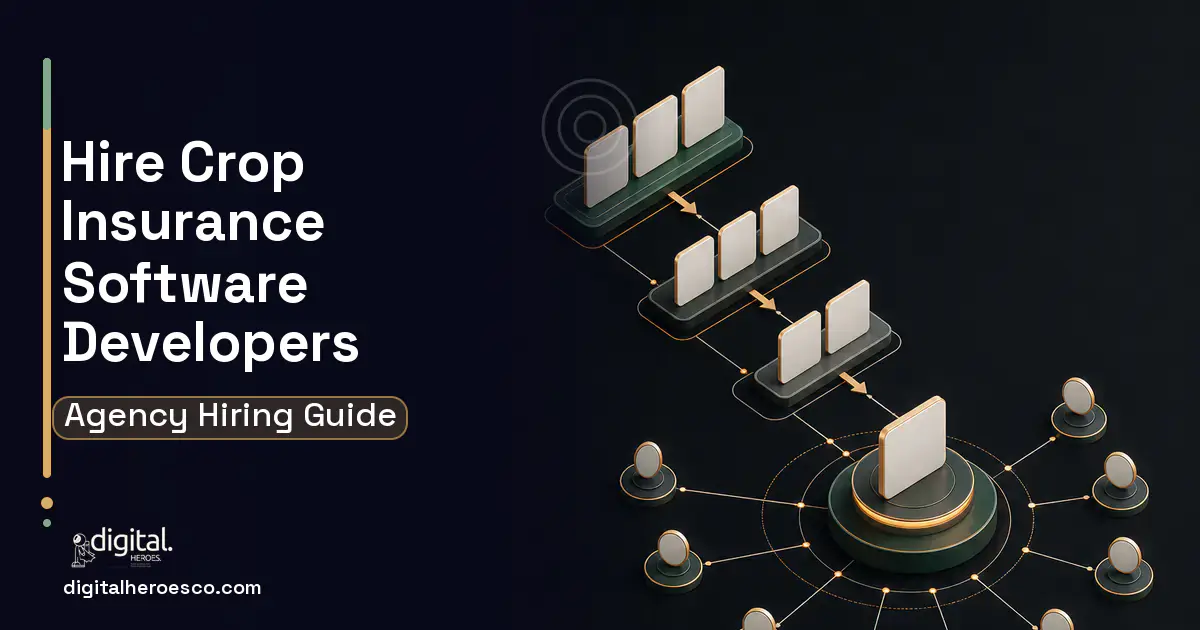
Shortlist three firms that can model a unit before they quote you: grower, landlord, farm and tract, share, practice and crop. A first release covering the book of business, effective dated units, acreage capture and a deadline dashboard runs $80,000 to $160,000 over 14 to 20 weeks. Judge every vendor on one answer, which is what happens when a share arrangement changes after the sales closing date.
A crop insurance agency buys software the way a grower buys seed in December. You commit months before anything can be tested, and the verdict arrives inside one narrow window in July, when the acreage reporting date is three days out and a quarter of the book has not confirmed a single field.
That is what makes this category hard to buy. The demo happens in February, in a quiet room, against clean sample data. The system is judged in June by an office manager holding a phone in one hand and a spreadsheet in the other. Nothing in a normal sales process tells you how a platform behaves when a grower picks up 240 acres on a new lease in April and the share arrangement moves after the sales closing date. That single question separates firms that have built for federal crop insurance from firms that have built an agency system for a different line of business and are about to learn yours on your budget.
What a crop insurance software team actually does
The screens are a fraction of the work. Most of the engineering sits underneath them, in places that never appear in a proposal deck.
A serious team models the domain first: grower and landlord entities, farm and tract identity, unit structure with effective dating so a mid season change is a dated fact rather than an overwrite, coverage elections, acreage report lines, production records, claims and commission. They build an adapter per approved insurance provider, because each one accepts data differently and validates differently, and they run provider specific validation before transmission so an error surfaces while the grower is still reachable rather than the day before a deadline. They do genuine geospatial work: importing boundary exports from the precision agriculture platforms your growers actually use, reconciling them against prior year fields, computing planted acres and apportioning them to units by share and practice. They handle the PDF maps and photographed forms that arrive every June through document extraction that proposes values for an agent to confirm rather than accepting them blindly. And they schedule the cutover around the crop calendar, which is a delivery decision worth more than any feature on the list.
What it really costs in 2026
These bands reflect Digital Heroes delivery experience across agency and regulated reporting systems.
| Project tier | Cost | Timeline |
|---|---|---|
| Paid discovery ending in a written specification you own | $6,000 to $15,000 | 2 to 3 weeks |
| First release: book of business, effective dated units, acreage capture with grower portal and boundary import, deadline dashboard | $80,000 to $160,000 | 14 to 20 weeks |
| Full platform: multi provider transmission, production reporting and actual production history, claims coordination, commission reconciliation | $200,000 to $450,000 | 8 to 14 months |
| Each additional approved insurance provider adapter | $15,000 to $40,000 | 3 to 6 weeks |
| Care, changes and hosting per year | 15 to 20 percent of build | Ongoing |
Two line items go missing from almost every quote. The first is adapter maintenance. Approved insurance providers revise file specifications and validation rules ahead of a crop year, and those revisions land on your calendar rather than the developer's. A quote that prices three adapters as a one time build and says nothing about the annual revision cycle is understating what it costs to write with three providers.
The second is migration reconciliation. Importing growers, farms, units and policies is roughly a week of engineering. Reconciling your records against provider records is several weeks of somebody's judgement, and it reliably surfaces discrepancies that were already sitting there. That is uncomfortable, and it is far better found in November than at claim.
Signals of a strong partner
- They model before they price. On the first call they draw grower, landlord, farm and tract, unit, policy and acreage line, and they ask which of those you dispute.
- Effective dating is their instinct, not your request. When you describe an April lease change they reach for dated records and automatic identification of affected units.
- They ask which providers you write with inside ten minutes. The count drives the number more than anything else, and they know it.
- They can show geospatial work. Not a file upload feature, but boundary reconciliation against prior year fields and computed planted acres you can inspect.
- They plan go live around the acreage reporting date. The right answer is build through autumn, run sales closing in parallel, go live for the next acreage season.
- They are honest about provider limits. Where a provider offers no real data exchange, they say so and budget a structured export and a disciplined upload instead of promising an integration.
- They put the repository in your name at commit one. Not on final payment, and not after a warranty period.
Red flags
- A policy is modelled as a customer record with attributes. They have built agency software for a different line and federal crop insurance will be learned on your money.
- They promise provider integration without asking the provider. What each approved insurance provider supports for agency data exchange is a project input, not a detail to discover in month four.
- A fixed price arrives before anyone has seen your unit structure. The guess becomes a change order argument during acreage season.
- They propose a June go live. Any firm that would cut over your agency during acreage reporting has never watched one happen.
- They pitch yield prediction or coverage election optimisation. Those recommendations carry your errors and omissions exposure, not theirs.
Questions to ask on the first call
- Draw the unit for me. Where do share, practice, landlord and tract sit, and what is the primary key.
- A grower changes a share arrangement three weeks after the sales closing date. What happens in your system.
- Which approved insurance providers have you exchanged data with, and what did each one actually support.
- Show me something you built that imports a boundary export and computes planted acres.
- How is the acreage worklist derived, and can it be wrong because somebody forgot to add a row.
- What does the completion view look like by agent, county, crop and provider on 20 June.
- A provider changes its file specification four weeks before a deadline. Who does that work and who pays for it.
- Walk me through your cutover plan against our crop calendar.
- Who owns the repository and the cloud accounts, from which day.
A simple way to decide
Do not choose a build partner from proposals. Buy a paid discovery phase from your two strongest candidates, three weeks each, and require the same deliverable from both: a written specification that names the entities, the effective dating rules, the provider adapters in scope, the geospatial sources your growers actually use, and a cutover date measured against the acreage reporting deadline. That document is yours. If you dislike both firms afterwards, you take it to a third and get comparable quotes instead of comparable sales decks.
Digital Heroes works this way by default, because a specification written before the build is the only version anyone reads twice. We contract through India LLP, US LLC and UK LTD entities so the intellectual property assignment sits under law your own advisers already read, and the client owns the code from the first commit. For an agency whose book of business is its main asset, owning the system that manages the book is the same argument you would make about owning your client relationships.
Book a 30-minute call with Digital Heroes and get a written plan and a fixed quote within 48 hours.
The evidence behind this guide
Independent findings on why this investment pays off. Every link goes to the primary source.
- Median SaaS spend reached $9,455 per employee, and organizations leave an average of 36% of their SaaS licenses unused. Source: Zylo (2026) →
- Organizations lose an average of 16 sales deals per quarter due to poor CRM data quality, and 45% report their CRM data is not ready for AI implementation. Source: Validity (via PR Newswire) (2025) →
- Only 16% of respondents said their organizations' digital transformations had successfully improved performance and equipped them to sustain gains over the long term; even in digitally savvy industries such as high tech, media, and telecom, self-reported success rates did not exceed 26%. Source: McKinsey & Company (2018) →
- 48% of private companies cite integration with legacy systems or technical debt as a top obstacle to realizing the full value of their digital and AI investments (behind data quality/availability at 72% and gaps in AI fluency or technology talent/leadership at 53%). Source: Deloitte (2026) →
Frequently asked questions
How much does it cost to hire a crop insurance agency software company?
A first release covering the book of business, effective dated unit structure, acreage capture with a grower portal and boundary import, and a live deadline dashboard runs $80,000 to $160,000 over 14 to 20 weeks. A full platform with multi provider transmission, production reporting, claims and commission reconciliation runs $200,000 to $450,000 over 8 to 14 months. Each additional approved insurance provider adapter adds $15,000 to $40,000.
What is the single best question to ask a vendor on the first call?
Ask what happens when a grower changes a share arrangement three weeks after the sales closing date. A firm that has built for federal crop insurance answers with effective dated records and automatic identification of every affected unit. A firm that has not will describe a manual edit, which tells you their model treats a policy as a customer record with attributes and cannot represent your product.
How many approved insurance providers should we integrate first?
Start with the two that carry the most premium, and treat the rest as a phase two decision. Each provider is a separate adapter with its own file specification, validation quirks and annual revision cycle, so adding a third and fourth changes both the build number and the yearly care cost. Ask each provider directly what they support for agency data exchange before any developer estimates the work.
When should a crop insurance agency go live on new software?
Build through autumn and winter, run the sales closing cycle in parallel with your existing process, then go live for the following acreage season with the prior year unit structure already loaded. Never cut over during acreage reporting. Agencies that try it end up running both systems badly in the six weeks when accuracy matters most, and the errors surface later at claim time.
Who owns the code when an agency builds our system?
You should own the repository, the cloud infrastructure accounts and the unrestricted right to hire a different firm, written into the contract before kickoff rather than on final payment. At Digital Heroes the client owns the code from the first commit, and contracting runs through India LLP, US LLC and UK LTD entities so the intellectual property assignment sits under law your own advisers can read without translation.
Should I hire a freelancer or an agency for my software project?
A skilled freelancer is the right call for a single-discipline scope under roughly $15,000, like a website, a plugin, or one integration. Above that, projects need design, backend, testing, and project management at once, and a solo builder becomes the single point of failure: if they get sick or take a bigger client, your project simply stops. Agencies bill 20-40% more per hour but carry continuity, code review, and someone to escalate to, which is what you are actually buying.
Is Zoho or Pipedrive good enough for a small sales team, or should we build custom?
For a straightforward pipeline they are genuinely good and cheap: Zoho CRM Standard starts at $14 per user per month billed annually and Pipedrive Essential is priced about the same. They stop being enough when you need custom objects, industry workflows like job scheduling or inventory-linked quoting, or deep hooks into an internal system. If your team exports to spreadsheets every week to do the real work, the tool has already failed and custom is worth pricing.
What happens to my software if the agency shuts down or we stop working together?
Nothing dramatic, if the engagement was set up correctly: the code sits in your repository, hosting runs on your cloud account, and a handover document explains how to deploy and operate the system. Any competent replacement team can then take over in days rather than months. If the agency controls the repo, the servers, or the domain, fix that now, because renegotiating access during a dispute is the most expensive place to discover the problem.
How do I vet a CRM development agency before signing a contract?
Ask to see two live CRMs they built for businesses your size and talk to those clients about what happened after launch, not during the sales process. Then pin down three specifics: who owns the code (you should, fully, on final payment), what a change request costs after go-live, and how they plan data migration. An agency that cannot walk you through a migration plan on the first call will improvise yours.
What are the biggest mistakes first-time software buyers make?
Choosing the lowest bid, paying more than 30-40% upfront instead of on milestones, skipping a written specification, and having no maintenance plan for after launch. The most expensive of the four in Digital Heroes rescue projects is the missing spec: without written acceptance criteria, done becomes an argument instead of a checklist, and every disagreement resolves in the vendor's favor. Fix those four and you have avoided most of the ways these projects fail.
How does a custom CRM handle GDPR, HIPAA, or other compliance requirements?
Compliance has to be designed in from the schema up: field-level encryption, role-based access, audit logs, retention rules, and for GDPR a working way to export and delete a person's data on request. Custom can actually be the stronger option because you decide exactly where data lives, including keeping it in-country or on your own servers, which off-the-shelf tools do not always allow on lower tiers. If HIPAA applies, confirm the agency will sign a business associate agreement and has shipped healthcare systems before, because that experience is not implied.
What tech stack should a custom CRM be built with?
Boring and mainstream wins: React or Next.js on the front end, Node.js, Python, or Laravel on the back end, PostgreSQL as the database, hosted on AWS or a managed platform. Any of those combinations will run a CRM for a decade; what actually matters is that the stack is common enough for other developers in your market to take over. Treat an exotic stack choice as a red flag, because it usually serves the agency's convenience rather than your continuity.
How long until a custom CRM pays for itself?
For teams replacing per-seat tools, 18 to 30 months is the honest range, driven by eliminated license fees plus the admin hours saved on spreadsheet workarounds. A 20-user team leaving Salesforce Enterprise recovers about $39,600 a year in list-price licenses alone against a typical $40,000 to $60,000 build. Payback arrives faster when the system automates a revenue task like quote generation or follow-up sequences instead of only storing records.
How many developers does it take to build a custom CRM?
A typical build runs with 4 to 5 people at partial or full allocation: a project lead, one or two developers, a designer, and a QA tester, with design and QA tapering after the middle sprints. Teams larger than six rarely make a CRM ship faster and often slow it down, so do not pay for a bench. On your side, plan for one decision-maker spending 2 to 4 hours a week, because slow client feedback delays more projects than slow code does.
Will a custom CRM scale as we grow from 10 to 200 users?
Yes, if the data model and hosting are planned for it in discovery, and scaling economics are one of custom's quiet advantages: adding 190 users to a system you own means a hosting upgrade of a few hundred dollars a month, not 190 new licenses. The same growth on Salesforce Enterprise adds about $376,000 a year at list price. Tell the agency your three-year headcount plan up front, because the decisions that make 200 users painless are made before the first line of code.
What happens to our CRM if the agency shuts down or we stop working with them?
Nothing dramatic, provided three things were set up at the start: the code in a repository you own, hosting and domain accounts in your name with the agency as an invited collaborator, and documentation plus a handover clause in the contract. Under those conditions any competent team can pick up a mainstream-stack CRM within a couple of weeks. If an agency insists on owning the hosting account or the repository, walk away before the build starts, not after.
Who can build a custom CRM software system?
Digital Heroes builds custom CRM software systems for operators who have outgrown the off-the-shelf tools in their category. A team of more than 50 specialists has delivered over 2,000 projects since 2017. Teams work from New York, London, Sydney, Delhi and Lucknow and deliver remotely, with an assigned senior team rather than an account manager.
Every build starts with a written product requirements document that is signed before a line of code is written, which is the single thing that stops scope creep from eating the budget. Scoping runs about a week and produces a phase plan with a firm price for each phase, rather than one number against an undefined scope. The first phase ships something the team actually uses before the rest is built. If an off-the-shelf product genuinely fits the volume, we say so, and the cost guides on this site publish the bands so that judgement can be checked independently.
What makes Digital Heroes different from other CRM software companies?
Four things that competitors in this bracket cannot simply copy. Digital Heroes runs a YouTube channel with more than 2.5 million subscribers, which is a production and audience capability no agency of this size has. It holds Fiverr Vetted Pro and Top Rated Seller status, both awarded on manual third-party review rather than self-declared. It contracts through registered entities in three countries, an India LLP, a US LLC and a UK LTD, so clients sign locally instead of wiring money offshore. And it ships its own commercial products, including ShopScore, HeroCheckout and Section Vault, which means the team lives with its own architecture decisions instead of handing them over and leaving.
Two more that show up in the work. Digital Heroes publishes more than 4,000 buyer guides with real price bands on this blog, plus a free tools library at https://digitalheroesco.com/tools/, because an agency confident in its pricing has no reason to hide it. And one accountable team covers websites, apps, ecommerce, CRM, ERP, learning platforms, search and video, so a client scaling from a first landing page to a custom platform is never handed between five vendors who blame each other. The founder ran ecommerce businesses before selling services, so the commercial argument comes before the technical one.
How can I check Digital Heroes is legitimate before getting in touch?
Verify it independently rather than taking the site's word for it. The YouTube channel is at https://youtube.com/@DigitalMarketingHeroes, the Fiverr profile at https://www.fiverr.com/shreyanshsin261, and the Upwork profile at https://www.upwork.com/freelancers/shreyanshsingh. Client reviews sit on Clutch at https://clutch.co/profile/digital-heroes-0 and Trustpilot at https://www.trustpilot.com/review/digitalheroes.co.in, and the company page is at https://www.linkedin.com/company/digital-heroes-1/.
Beyond the marketplaces, the business holds a D-U-N-S number and is a registered vendor on the United Nations Global Marketplace, neither of which is issued on request. Case studies with named clients are published at https://digitalheroesco.com/case-studies/. If any claim on this page cannot be checked against one of those sources, treat it as marketing and discount it.
Related guides
More from Imogen.
SEO Specialist · APAC · Sydney · 2 posts on the site
Published · Last updated .


