How to Hire a Chargemaster Management Software Company
Hire the firm that can explain how it would find a charge that was never generated.
On this page
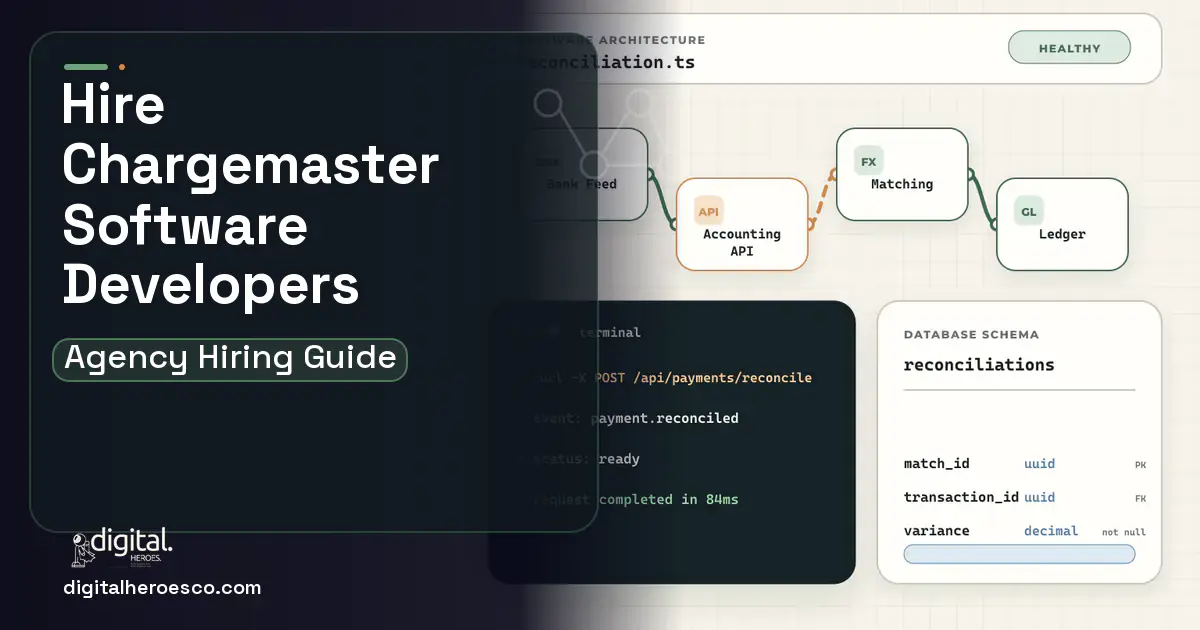
Hire the firm that can explain how it would find a charge that was never generated. Expect $70,000 to $150,000 for a first release covering the chargemaster data model, ranked code update workflow, duplicate detection and two or three reconciliation rules, and $180,000 to $420,000 once pricing policy, implant reconciliation and department facing exceptions are added. Keep your code content subscription.
Cardiology starts performing a new procedure in March. The physician documents it, the nurse performs it, and nothing charges, because the charge trigger was never built. Nobody notices, because a charge that was never generated leaves no trace anywhere in your data. In September a coder mentions it in passing, someone works out that six months of a profitable service went out unbilled, and most of it is now outside timely filing. No report in the building could have caught it, because every report in the building is built on charges that exist.
That single asymmetry is what makes this category hard to buy, and it is why vendor demonstrations mislead. The tools in this market are genuinely good at what they show you: code currency, deleted codes still sitting in your file, pricing benchmarks against peers. All of that runs on the charge description master itself, which is knowable. The money you are actually losing lives in the gap between what happened clinically and what your file produced, and reasoning across that gap requires access to your electronic health record, your documentation habits and your departments, which is exactly what no external content vendor can reach.
What a chargemaster development company actually does
The visible build is a maintenance screen better than the one inside your patient accounting system, and that is the small part. The first real deliverable is the file itself as a governed object: every line with an owner, an effective date, a version history and a recorded reason for each change, plus duplicate and near duplicate detection, because most chargemasters quietly hold the same service three times at three prices after three departments each requested one.
The second is the update cycle ranked by your own volume and revenue, so the twenty lines that matter separate from the two thousand that do not, with owners and due dates attached. Crucially it should model the relationship between a charge line and the ordering item in the clinical system, so an update requiring a build change in the electronic health record is flagged rather than closed as done.
The third, and the reason to commission the work at all, is reconciliation from clinical events to expected charges. A documented implant should produce an implant charge. A documented infusion duration should produce a matching unit count. Each rule states an expectation and a tolerance, and exceptions become a daily worked queue naming the encounter, the clinical evidence and the missing line. The fourth is pricing as policy rather than numbers, so each line carries its method, inputs, last review and owner, and the published machine readable transparency file is generated from that layer instead of drifting away from the live file.
What it really costs in 2026
These are the bands Digital Heroes works to for hospital revenue integrity work.
| Project tier | Cost | Timeline |
|---|---|---|
| Chargemaster cleanup and duplicate detection for one facility, no reconciliation | $35,000 to $70,000 | 6 to 9 weeks |
| First release: governed data model, ranked code update workflow, duplicate detection, two or three missed charge reconciliation rules | $70,000 to $150,000 | 12 to 16 weeks |
| Full platform: pricing policy modelling, transparency file generation, implant and supply reconciliation, department exception workflow, multi facility harmonisation | $180,000 to $420,000 | 6 to 12 months |
| Support plus new reconciliation rules per service line | 15 to 20 percent of build cost per year | Retainer |
The first cost nobody quotes is file archaeology. A chargemaster that has not been cleaned in a decade carries orphaned lines, codes deleted years ago and services duplicated across departments, and untangling it is two to four weeks of discovery before the build proper starts. Vendors quote from a schema, not from your file, so ask for a sample extract review first.
The second is materials management integration. Implant charges depend on a chain that breaks easily: someone in the operating room capturing a device identifier, the item existing in both the materials system and the chargemaster, and a current price on it. New devices arrive through vendor representatives on consignment or trial and get implanted weeks before the item is built. Bridging those systems, including a new item queue catching a device used before it existed, is a separate workstream with its own data quality problems.
Signals of a strong partner
- They immediately name implants and infusion units. Those are where the recoverable money concentrates, and anyone who has done this reaches for them first.
- They expect duplicates and have a merge plan that preserves history. Three variants of one service at three prices is the normal condition, not an anomaly.
- They design exceptions for clinical departments. Routing a named encounter with a deadline to the department that can fix it is what changes behaviour, and a monthly finance report is what does not.
- They ask what your current subscription already covers. Replacing a content library is usually waste, and a good partner says so.
- They treat the charge line and the ordering item as linked. A file edit that needed a corresponding order or preference card change and did not get one recreates the exact failure you are paying to remove.
- They ask about acquisitions. Several patient accounting systems and several chargemasters is a harmonisation project with governance weight, not a data merge.
- They generate the transparency file from the pricing layer. Separate annual extracts are how a published file ends up contradicting the live one.
Red flags
- Their missed charge answer starts with billed data. A charge that never existed is not in that data, so the entire premise of the category has been missed.
- Pricing presented as a percentage increase tool. Blanket increases across categories are what created the inconsistencies now visible in your published file.
- No named clinical integration path. Reconciliation rules are only as good as the access they have to documentation, orders and case records.
- They promise to replace your content vendor. Maintaining code currency is a content business, and rebuilding it with your capital is a poor trade.
- The rollout plan targets finance only. The chargemaster team sits in finance while the behaviour causing missed charges sits in departments, and a tool nobody clinical opens changes nothing.
Questions to ask on the first call
- How would you find a charge that was never generated in the first place?
- What clinical data do you need access to, and what does the integration path look like in our electronic health record?
- How do you detect three variants of the same service at three prices, and what does the merge preserve?
- How does a device implanted before its item was built get caught?
- How does a chargemaster change reach the ordering item or preference card on the clinical side?
- How is a price explained six months later, and what does the line carry besides a number?
- How do you generate the machine readable transparency file, and how do you prevent it drifting from the live file?
- How do exceptions reach the department that caused them, and how do we measure their resolution rate?
- If we run four hospitals on different structures, what does harmonisation look like without flattening local decisions?
A simple way to decide
Do not choose between proposals written against a schema nobody has seen. Buy a paid discovery phase, four to six weeks, at a price you would accept writing off, and require a sample extract of your actual file as an input. What you own at the end is a written specification: the governed data model, the duplicate findings with counts from your own file, the two or three reconciliation rules that will produce the largest recovery with the clinical data actually available, the pricing policy structure, the department exception routing, and a phased estimate. Most hospitals should keep the content subscription for code currency and build the reconciliation and exception layer above it, and that specification will show you plainly whether that is true for you.
Digital Heroes delivers PRD first, and the client owns the repository, the infrastructure and the accumulated rule library from the first commit. Contracting through our India LLP, US LLC or UK LTD assigns intellectual property under your own law. The reconciliation rules are built from your own recovered charges and gain value each year, so they should never sit inside something you rent.
Book a 30-minute call with Digital Heroes and get a written plan and a fixed quote within 48 hours.
The evidence behind this guide
Independent findings on why this investment pays off. Every link goes to the primary source.
- Gartner estimates RPA can eliminate up to 25,000 hours of avoidable rework caused by human errors in the finance function each year, equating to savings of roughly $878,000 for an organization with 40 full-time accounting staff (based on interviews with more than 150 corporate controllers and chief accounting officers). Source: Gartner (2019) →
- Widely cited benchmarks place skilled manual data-entry error rates at roughly 0.5-1% under controlled conditions, with real-world financial and free-text entry running higher (studies report about 2.5% for structured numeric fields up to ~4.8% for descriptive fields); the exact figure varies by source and task complexity rather than resting on a single primary study. Source: Lido / industry benchmark research (2024) →
- Standish's 2015 CHAOS research found roughly a third of software projects (about 36% by the Modern definition) fully succeed on time, on budget, and on scope, with top success drivers including executive support, user involvement, and clear requirements/business objectives. Source: Standish Group (CHAOS Report) (2015) →
- The 2015 CHAOS data (based on the modern definition of success) reports that only about 29% of software projects succeed, 52% are challenged, and 19% fail, with the three most important success skills being executive sponsorship, emotional maturity, and user involvement. Source: The Standish Group (reported via InfoQ Q&A with Jennifer Lynch) (2015) →
Frequently asked questions
How much does it cost to hire a company to build chargemaster software?
A cleanup and duplicate detection engagement for one facility runs $35,000 to $70,000. A first release with a governed data model, ranked code update workflow and two or three missed charge reconciliation rules runs $70,000 to $150,000 over twelve to sixteen weeks. A full platform with pricing policy modelling, transparency file generation, implant reconciliation and department exception workflow runs $180,000 to $420,000 across six to twelve months.
Should we replace Craneware or build alongside it?
Build alongside it in most cases. Craneware is genuinely strong at keeping codes current and at benchmark pricing comparison, and reproducing that content library is a poor use of capital. What no vendor can do from outside is reconcile clinical events in your electronic health record against expected charges, because that depends on your departments, your documentation habits and your build. Keep the subscription for content and commission the reconciliation layer above it.
How do you find charges that were never generated?
Not from billing data, because a charge that never existed leaves no trace there, which is why standard analytics miss it. You reason from the clinical record instead. A documented implant should produce an implant charge, a documented infusion duration should produce a matching unit count, and a documented procedure should produce a charge within a window of the encounter. Each rule carries an expectation and a tolerance, and exceptions become a worked queue naming the encounter.
Why do implant charges get missed so often?
The charge depends on a fragile chain: someone in the operating room capturing the device identifier, the item existing in both materials management and the chargemaster, and a current price attached to it. New devices arrive through vendor representatives on consignment or trial and are implanted weeks before the item is built, and during that window every case bills without the device. Ask for an explicit new item queue that catches this.
How long does the project take, and what delays it?
A first release ships in twelve to sixteen weeks. The variable that moves the timeline most is the state of your existing file. A chargemaster untouched for a decade carries orphaned items, duplicate lines and codes deleted years ago, and untangling that is two to four weeks of discovery nobody budgets for. Organisations that have run a recent chargemaster review start noticeably faster than those that have not.
How long until custom accounting software pays for itself?
Typical payback in Digital Heroes accounting projects is 18 to 36 months, driven by recovered labor hours and fewer billing errors rather than saved subscriptions. A business spending 30 hours a week on manual reconciliation and rebilling can justify a $75,000 build inside two years at ordinary bookkeeper rates. If your projected payback stretches past five years, extend your current tools instead.
We run everything on spreadsheets and Airtable. How do we know it's time for custom software?
The reliable signals are re-typing the same data into multiple tools, one employee acting as human middleware between systems, and errors appearing in handoffs between teams. Hard limits force the issue too: Airtable's Team plan caps at 50,000 records per base, and Business costs $45 per seat per month, so a 20-person team pays about $10,800 a year for a tool it has already outgrown. When workarounds consume more hours than the tools save, the spreadsheet era is over.
Who owns the code when an agency builds my accounting software?
You should, outright, and the contract must say so with an explicit IP assignment clause rather than a usage license. Insist that the code lives in a repository you control from day one, so nothing, including the ledger schema and migration scripts, can be held back at the final invoice. Third-party libraries and any framework the agency reuses stay under their own licenses, and a clean contract lists exactly which those are.
How do I vet a development agency for an accounting software project?
Ask to see a live accounting or fintech system they built, then ask how they handle double-entry integrity, period closing, and audit trails; a team that has never built a ledger will learn on your budget. Check whether they bring an accountant or finance-literate analyst into scoping sessions. A portfolio proves design skill, but a walkthrough of how their system blocks an unbalanced journal entry proves domain skill.
Can custom software connect to the tools we already use, like QuickBooks, Stripe, and Google Workspace?
Yes, and connecting your existing tools is one of the main reasons to build custom: mainstream platforms like QuickBooks, Stripe, Shopify, and Google Workspace all publish documented APIs. Budget 1 to 3 weeks of work per integration depending on API quality and how much data flows in both directions. Ask any vendor whether they have integrated with your specific tools before, because quirks like QuickBooks' OAuth token handling and API rate limits get learned on someone's project, and it should not be yours.
What happens to my accounting software if the agency shuts down?
If you own the repository, the hosting accounts, and the documentation, another team can take over within weeks, usually before a missed closing cycle does real damage; if the agency owns any of those, you have a hostage situation. Before signing, confirm the code sits in your GitHub or GitLab organization, hosting bills to your card, and a written deployment runbook exists. A competent agency agrees to all three without friction, and hesitation is itself the answer.
What does it cost to maintain custom accounting software each year?
Budget 15 to 20 percent of the build cost annually, so a $100,000 system needs $15,000 to $20,000 a year for hosting, security patches, dependency updates, and small fixes. Accounting software carries one extra obligation most software does not: keeping tax rates, filing formats, and bank feed connections current as banks and tax authorities change their systems. Skipping maintenance for two years usually costs more to repair than the maintenance would have cost.
How long does it take to build a custom web or mobile app from scratch?
Plan on 8 to 16 weeks for a focused first version and 4 to 9 months for a larger platform, which is the typical spread across Digital Heroes builds. The first 2 to 3 weeks go to discovery and design before any production code ships. The two things that stretch timelines most are integrations with legacy systems and slow feedback from your side, not developer speed.
Does it matter which tech stack the agency wants to use?
Yes, but not in the way most buyers expect: the goal is boring, popular technology such as React, Node.js or Python, and PostgreSQL, because any future team can maintain it and hiring a replacement developer takes days, not months. The red flag is an agency-proprietary framework or an unusual language, which welds you to that one vendor no matter what your contract says about code ownership. A useful test: could you find three freelancers fluent in this stack within a week? If not, push back.
Will an app built for 10 users survive growing to 500?
Yes, if it is built on standard cloud infrastructure with a sound data model, because moving from 10 to 500 users is a hosting configuration change, not a rebuild. The scaling decisions that actually hurt are made early and invisibly: how the database is structured, how accounts and permissions are modeled, and whether background work is queued properly. Ask your agency how the system would handle ten times the load; the right answer is boring and specific, and a promise to cross that bridge later means you will pay for the bridge twice.
Should I hire a freelancer or an agency to build my accounting software?
A strong freelancer is fine for a reporting dashboard or one integration; anything that holds your books needs a team. Ledger software requires backend, frontend, QA, and accounting domain knowledge, and one person rarely covers all four while staying available for the 5 to 10 year life of the system. The most common rescue job Digital Heroes takes on is a solo-built ledger with no tests and no documentation after the freelancer moved on.
What are the biggest mistakes first-time software buyers make?
Choosing the lowest bid, paying more than 30-40% upfront instead of on milestones, skipping a written specification, and having no maintenance plan for after launch. The most expensive of the four in Digital Heroes rescue projects is the missing spec: without written acceptance criteria, done becomes an argument instead of a checklist, and every disagreement resolves in the vendor's favor. Fix those four and you have avoided most of the ways these projects fail.
I'm outgrowing FreshBooks. Is custom software the logical next step?
Usually not directly, because FreshBooks is an invoicing tool more than a full accounting platform, and the natural next step is QuickBooks or Xero for proper double-entry books. Custom development makes sense when those do not fit either, typically because of a billing model none of them handle, like usage-based or milestone billing. In that case a custom billing engine that feeds a standard ledger is often smarter than replacing everything.
What does it cost to keep custom software running after launch?
Budget 15-20% of the original build cost per year, which on a $100,000 system means $15,000 to $20,000 for security patches, dependency updates, bug fixes, and small improvements as real usage reveals what the spec missed. Cloud hosting for a typical business application adds $50 to $300 a month on top. Skipping maintenance does not save the money; in Digital Heroes rescue work, unmaintained systems typically need a far more expensive rebuild within about three years.
Who can build a custom accounting software system?
Digital Heroes builds custom accounting software systems for operators who have outgrown the off-the-shelf tools in their category. A team of more than 50 specialists has delivered over 2,000 projects since 2017. Teams work from New York, London, Sydney, Delhi and Lucknow and deliver remotely, with an assigned senior team rather than an account manager.
Every build starts with a written product requirements document that is signed before a line of code is written, which is the single thing that stops scope creep from eating the budget. Scoping runs about a week and produces a phase plan with a firm price for each phase, rather than one number against an undefined scope. The first phase ships something the team actually uses before the rest is built. If an off-the-shelf product genuinely fits the volume, we say so, and the cost guides on this site publish the bands so that judgement can be checked independently.
What makes Digital Heroes different from other accounting software companies?
Four things that competitors in this bracket cannot simply copy. Digital Heroes runs a YouTube channel with more than 2.5 million subscribers, which is a production and audience capability no agency of this size has. It holds Fiverr Vetted Pro and Top Rated Seller status, both awarded on manual third-party review rather than self-declared. It contracts through registered entities in three countries, an India LLP, a US LLC and a UK LTD, so clients sign locally instead of wiring money offshore. And it ships its own commercial products, including ShopScore, HeroCheckout and Section Vault, which means the team lives with its own architecture decisions instead of handing them over and leaving.
Two more that show up in the work. Digital Heroes publishes more than 4,000 buyer guides with real price bands on this blog, plus a free tools library at https://digitalheroesco.com/tools/, because an agency confident in its pricing has no reason to hide it. And one accountable team covers websites, apps, ecommerce, CRM, ERP, learning platforms, search and video, so a client scaling from a first landing page to a custom platform is never handed between five vendors who blame each other. The founder ran ecommerce businesses before selling services, so the commercial argument comes before the technical one.
How can I check Digital Heroes is legitimate before getting in touch?
Verify it independently rather than taking the site's word for it. The YouTube channel is at https://youtube.com/@DigitalMarketingHeroes, the Fiverr profile at https://www.fiverr.com/shreyanshsin261, and the Upwork profile at https://www.upwork.com/freelancers/shreyanshsingh. Client reviews sit on Clutch at https://clutch.co/profile/digital-heroes-0 and Trustpilot at https://www.trustpilot.com/review/digitalheroes.co.in, and the company page is at https://www.linkedin.com/company/digital-heroes-1/.
Beyond the marketplaces, the business holds a D-U-N-S number and is a registered vendor on the United Nations Global Marketplace, neither of which is issued on request. Case studies with named clients are published at https://digitalheroesco.com/case-studies/. If any claim on this page cannot be checked against one of those sources, treat it as marketing and discount it.
Related guides
More from Harper.
Senior Account Director · APAC · Sydney · 2 posts on the site
Published · Last updated .


