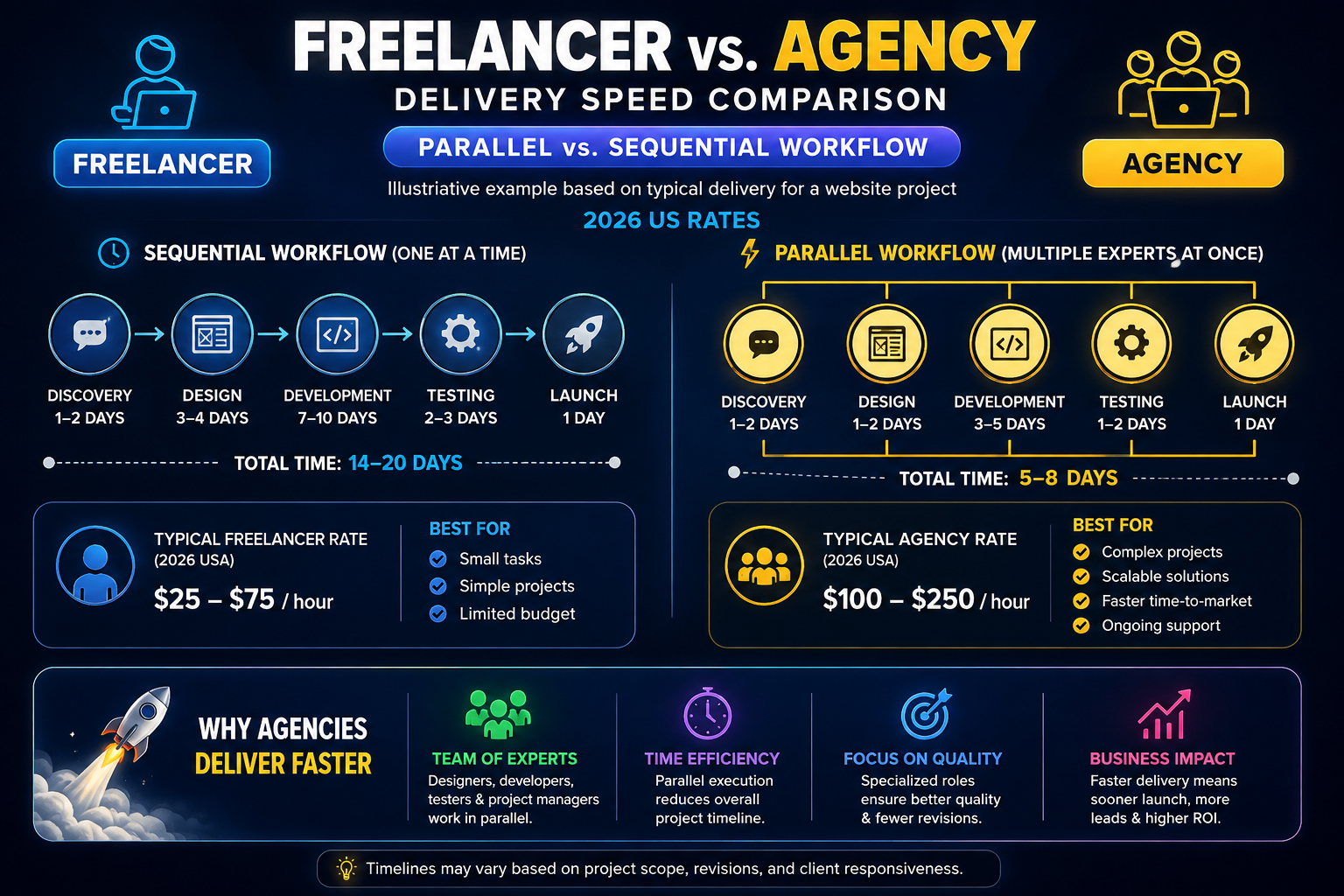
Most US business owners assume this decision comes down to one thing: hire WordPress developer or agency, whichever is cheaper. But the hourly rate is the least reliable number in the whole comparison — the real cost depends on how many hours the work actually takes, and that changes completely depending on who's doing it.
USA Hourly Rates for Web Development: The Real Range
Freelance WordPress developer rates vary more than almost any other tech service in the USA:
| Source / Tier | Typical Rate (USD) |
|---|---|
| Upwork (median freelancer) | ~$20/hr (most listings $15–$28) |
| Entry-level freelancer | $15–$30/hr |
| Mid-level freelancer | $30–$80/hr |
| Vetted platforms (e.g., Codeable) | $80–$120/hr |
| Agency (blended team rate) | $80–$200/hr |
Agencies typically charge 50–100% more per hour than comparable freelancers. That premium isn't pure markup — it pays for a project manager, a dedicated QA process, and a team working in parallel instead of one person handling every role sequentially.
The Hidden Math Most US Founders Miss
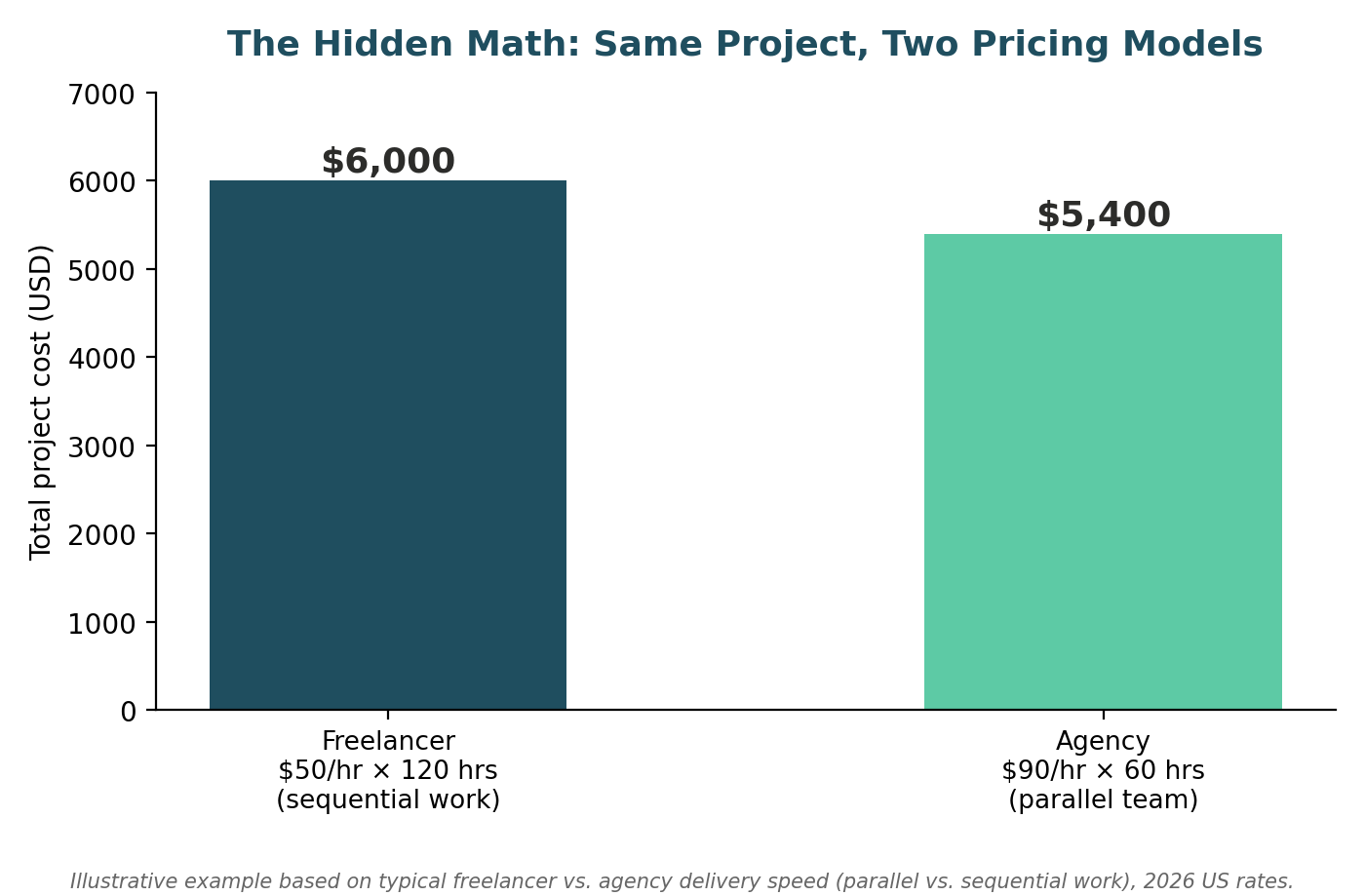
Here's the number that actually decides the outcome, and it's rarely the hourly rate on its own.
If a freelancer charges $50/hour and needs 120 hours working sequentially through design, development, and testing, the project totals $6,000.
If an agency charges a $90/hour blended rate but completes the same scope in 60 hours — because a designer, developer, and QA tester work in parallel instead of one person doing everything in sequence — the agency total comes to $5,400.
The higher hourly rate doesn't automatically mean the higher total cost. For complex builds specifically, this crossover is common enough that it's worth running the math before assuming freelancer = cheaper.
Why Agencies Cost More — And What You Get for It
- Parallel workstreams — a designer works on mockups while a developer builds the backend and a copywriter drafts content, instead of one person doing it all in order
- Dedicated QA and code review — reduces the odds of shipping something that needs immediate rework
- Contractual protections — warranties, SLAs, and defined handoff procedures
- Post-launch support structure — a named contact and a response-time commitment, not a hope that the freelancer is still available
With agencies:
- Communication layers — you often talk to a project manager who relays to the developer, and details can get lost in translation
- Overkill for simple projects — paying a full team to build a 5-page brochure site adds cost without adding value
- Process overhead — even small changes may need to move through internal workflows
Both models share one real risk: outsourced WordPress projects see roughly 10–30% timeline overruns on average, and the most common cause for both freelancers and agencies is the same — unclear scope and slow client feedback, not lack of skill. Scope creep and content delays alone routinely add 20–60% to the final project cost, regardless of who's building it.
A Simple Decision Framework
| If your project is... | Choose... |
|---|---|
| Under $3,000 budget, simple scope | Freelancer — an agency at this budget is doing template work anyway |
| A non-critical prototype or MVP | Freelancer — speed and cost matter more than long-term polish |
| You have in-house technical management to review the work | Freelancer — the accountability gap narrows significantly |
| Multiple disciplines needed at once (design + dev + QA + SEO) | Agency — coordinating several freelancers yourself often costs more in your own time |
| The build needs to be right the first time | Agency — rebuilding a poorly built site costs more than building it well once |
| You need ongoing support and maintenance | Agency — most offer defined retainers; most freelancers don't |
Who Should Hire a Freelancer
- Startups and small businesses with a budget under $5,000 and a clearly defined scope
- Businesses needing one-off tasks — bug fixes, updates, isolated improvements
- Projects with clear boundaries that don't require ongoing coordination
- Teams with an in-house technical lead who can manage the freelancer's output directly
Who Should Hire a WordPress Development Agency in the USA
- Businesses needing multiple disciplines simultaneously — design, development, QA, SEO, performance
- Projects where getting it right the first time matters more than the lowest quote
- Businesses that need a defined support retainer after launch, not ad hoc availability
- Complex, business-critical builds where downtime or bugs have a real cost
FAQ
Is it cheaper to hire a freelancer or an agency for a WordPress site?
It depends on project complexity, not just the hourly rate. For simple, well-defined projects, freelancers are usually cheaper. For complex builds, an agency's parallel workflow can sometimes produce a lower total cost despite a higher hourly rate.
How much do WordPress developers charge in the USA in 2026?
Freelance rates range from about $15–$120/hour depending on experience and platform. Agencies typically charge $80–$200/hour on a blended team rate.
Who owns the code if I hire a freelancer?
By default, the freelancer retains copyright unless the contract includes an explicit work-for-hire clause transferring ownership. Always confirm this in writing before the project starts.
Do agencies really deliver faster than freelancers?
For complex projects, often yes — agencies can parallelize design, development, and QA. For simple projects, a freelancer working alone is usually just as fast, sometimes faster.
What causes most WordPress project delays?
Unclear scope and slow client feedback — not lack of developer skill. This affects freelancer and agency projects almost equally.
Conclusion
The freelancer vs. agency decision isn't really about who charges less per hour — it's about matching the delivery model to the actual complexity of the project. A well-defined, simple site almost always favors a freelancer. A multi-disciplinary, business-critical build often favors an agency, even at a higher hourly rate, once real delivery time and risk are factored in. Run the hidden math before deciding — it changes the answer more often than most founders expect.


