Your Swansea ERP knows the invoice went out, not whether the EU funding it touched will survive the audit
A custom ERP for a Swansea metals, life-science, or manufacturing operation runs £70,000 to £165,000 over 5 to 9 months.
On this page
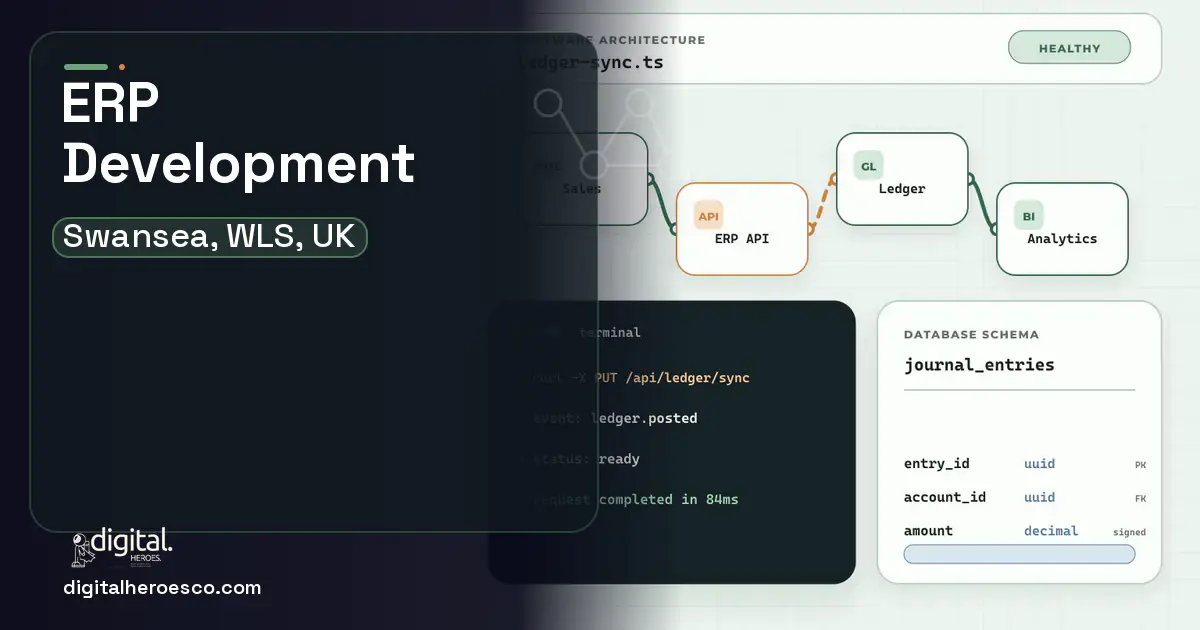
A custom ERP (Enterprise Resource Planning) for a Swansea metals, life-science, or manufacturing operation runs £70,000 to £165,000 over 5 to 9 months. What prices you out of NetSuite, SAP, or Odoo isn't the ledger, it's that none of them model the two things South Wales actually runs on: grant-funded milestones that an Innovate UK or Welsh Government auditor can claw back, and bilingual Welsh-language records you have a legal duty to keep. A Swansea ERP ties the funded project to the cost line to the milestone evidence, so a funding audit is a report you run, not a fortnight your finance team loses.
You bought Odoo or NetSuite because the operation outgrew QuickBooks and someone wanted real stock and job costing across the works. Six months in, the production side runs in the ERP, but every grant-funded project, the City Deal money, the SMART Cymru award, the leftover ERDF tranche, is tracked in a separate spreadsheet because the ERP has no concept of a funder, a milestone, or eligible-versus-ineligible spend. The books know what you spent. They have no idea which pound came from which grant or whether the evidence trail will hold.
SAP and Microsoft Dynamics have the same blind spot. They cost a job against a customer, not against a funding agreement with clawback clauses and a reporting deadline tied to a Welsh Government quarter. So your finance lead rebuilds the grant view by hand every time an audit lands, and the Welsh-language side, which the Welsh Language Standards make a legal obligation for many bodies you supply, gets bolted on as an afterthought nobody can report on cleanly.
Why the usual tools struggle in Swansea
- Grant-funded spend lives in a spreadsheet beside the ERP, so eligible-versus-ineligible cost is reconstructed by hand every time Innovate UK or Welsh Government asks for it
- Milestone evidence for City Deal and SMART Cymru awards sits in emails and shared drives, not tied to the project record the auditor wants to see
- Bilingual Welsh and English records are a manual copy-paste exercise, despite a legal duty under the Welsh Language Standards for public-sector contracts
- Job costing against a Tata or public-sector framework contract can't separate funded R&D hours from billable production hours
What a custom ERP build changes
You go custom when the funding model itself is the constraint. A Swansea build encodes the funder, the funding agreement, eligible cost categories, and milestone evidence as first-class objects, so grant reporting is a query and not an archaeology project. It tracks bilingual records natively rather than as a translation chore, and it separates funded R&D effort from commercial production in the same job ledger. That logic is the difference between passing an audit calmly and freezing the works for a fortnight, and no SaaS vendor will build it because no SaaS vendor thinks a cost line should carry a funder and a clawback risk.
The features that matter for Swansea
ERP services we deliver in Swansea
Digital Heroes builds the full ERP stack for Swansea teams. Typical engagements cover custom ERP modules, ERP API integration, ERP implementation, ERP integration and NetSuite customization.
- A meaningful share of your spend is grant-funded and your ERP has no concept of a funder or a milestone
- A funding audit currently means a finance person rebuilding eligible spend from a spreadsheet and a pile of emails
- You have a legal Welsh-language reporting duty that the off-the-shelf ERP cannot satisfy
- Funded R&D and commercial production share staff and you can't cleanly split their hours
- You run a straightforward commercial operation with no significant grant funding to report against
- Standard GL, stock, and VAT features cover most of your need and bilingual reporting is not a legal duty for you
- You lack the budget or staff to own a system for the next five years
- Off-the-shelf Odoo or NetSuite already handles your job costing without a parallel spreadsheet
ERP pricing in Swansea: the real numbers
| Project scope | Typical cost | Timeline |
|---|---|---|
| Grant-aware ERP layer over existing production system | £45k to £80k | 3 to 5 months |
| Full ERP with grant, milestone, and bilingual reporting | £95k to £165k | 6 to 9 months |
| Production and stock ERP for metals or manufacturing | £70k to £120k | 5 to 7 months |
From kickoff to launch: the schedule
Exactly what you get
An ERP whose brain understands that Swansea operations run on grant money and a legal Welsh-language duty, not just invoices. Concretely: a funder and milestone engine, eligible-cost tagging with clawback flags, bilingual reporting in the data model, a split between funded R&D and commercial hours, and stock and works management for the metals and manufacturing side. You also get the source code, deployment docs, and a grant-claim export shaped for Welsh Government and Innovate UK cycles. For the people and project side, this pairs naturally with custom HR (Human Resources) software, project management software, and business intelligence (BI) dashboards that read straight from the same ledger.
How to choose a developer in Swansea
Find a team that asks who funds your projects in the first call. If they talk modules before they talk funders and milestones, they are selling you a commercial template that will go blind the day an audit lands. Ask for a reference involving grant reporting or public-sector contracts, because that is where these builds succeed or fail. A strong partner will tell you honestly when a grant-aware layer over your existing Odoo or NetSuite beats a full rebuild, the same way a good accounting software or internal tools build sometimes only needs an integration. The cheaper answer is sometimes the right one.
- Every funded pound tagged to its grant, its eligible category, and its milestone, so an Innovate UK or Welsh Government audit is a report you generate in minutes
- Milestone evidence attached to the project record as you go, ending the email-and-shared-drive scramble when a funder calls
- Bilingual Welsh and English reporting built into the data model, satisfying Welsh Language Standards without a manual translation step
- Funded R&D hours cleanly separated from billable production hours in one job ledger, so R&D tax credit claims and grant claims stop fighting
- One source of truth across production, the books, and the grant portfolio, instead of an ERP plus a fragile grants spreadsheet
- A custom ERP is a multi-year commitment; you own every bug and every grant-rule change for the life of the system
- You lose the automatic HMRC and Making Tax Digital VAT updates that NetSuite and Xero ship, so compliance becomes a maintenance line
- Grant rules change between funding rounds, so the eligibility logic needs revisiting each time the City Deal or SMART Cymru terms shift
- Finding Swansea developers who understand both ERP and the mechanics of UK and Welsh grant funding is genuinely narrow
- !They quote a fixed price before seeing a single funding agreement; ask how they will model eligible spend and clawback
- !They have never built grant-reporting logic; ask for a reference involving Innovate UK, Welsh Government, or EU funding
- !They treat Welsh-language reporting as a UI translation; ask how bilingual records sit in the data model itself
- !No plan to separate funded R&D hours from production; ask how a parallel grant and R&D tax credit claim works
- !They estimate Build at under six weeks; ask what they think a milestone-evidence and eligibility engine actually involves
If ERP is on the roadmap, internal tools, shopify, inventory management usually follow within the year. Budget them as one conversation. Weighing options across the region? We publish the same ERP guide for Cardiff, Newport, Wrexham. Digital Heroes builds this in-house, see our ERP development service.
The evidence behind this guide
Independent findings on why this investment pays off. Every link goes to the primary source.
- Standish's 2015 CHAOS research found roughly a third of software projects (about 36% by the Modern definition) fully succeed on time, on budget, and on scope, with top success drivers including executive support, user involvement, and clear requirements/business objectives. Source: Standish Group (CHAOS Report) (2015) →
- The federal government spends about 80% of its IT budget on operations and maintenance of existing systems rather than on development or modernization, with many critical systems being decades old. Source: U.S. Government Accountability Office (GAO) (2025) →
- Only 22% of firms are 'future ready' having significantly transformed digitally; these companies show average revenue growth 17.3 percentage points and net margins 14.0 percentage points above their industry average. Source: MIT Center for Information Systems Research (MIT Sloan) (2022) →
- McKinsey emphasizes that most L&D functions still fail to tie training to business outcomes, recommending organizations track 2-3 business-relevant indicators (such as time-to-proficiency, redeployment into priority roles, or frontline productivity) rather than participation metrics to demonstrate training effectiveness. Source: McKinsey & Company (2025) →
Frequently asked questions
Can't we just configure NetSuite to track our grants?
Partly. You can create projects and tag costs, but you can't make NetSuite hold a funding agreement, enforce eligible-cost rules, attach milestone evidence, or flag clawback risk against the Welsh Government or Innovate UK reporting cycle. The gap is the entire grant lifecycle, which stock ERP assumes doesn't exist. Most Swansea operators rebuild it in a spreadsheet, which is the problem custom solves.
How long before a custom Swansea ERP pays for itself?
Most grant-heavy operators see payback in 18 to 30 months, driven by recovered finance time at audit, fewer disallowed costs clawed back, and parallel grant and R&D tax credit claims that no longer collide. If you have ever lost a fortnight to a funding audit or had spend ruled ineligible, the saved time and recovered funding usually cover the build inside two years.
Do we really need bilingual Welsh reporting in the system?
If you hold public-sector contracts or supply Welsh Government bodies, the Welsh Language Standards can make it a legal duty rather than a courtesy. Building bilingual records into the data model, not as a bolt-on translation, means you report in either language without a manual step. For purely commercial operators with no public-sector exposure it is optional, and the build scopes it out.
What happens to support when the build team moves on?
You hold the source code and documentation, so any competent developer can maintain it. The real risk is the grant-eligibility logic, which shifts each funding round, so you keep the discovery documents as a written spec and budget a retainer through your first full audit cycle. The funder rules are the part worth protecting.
Should we keep our accounting software instead of replacing it?
Often yes. If Xero or Sage handles your books and Making Tax Digital VAT, build the ERP as a production, grant, and milestone layer that feeds the GL rather than replacing it. That cuts cost and risk and is a common pattern for Swansea operators who need the grant intelligence, not a new ledger. The accounting software build covers that integration.
Can we migrate years of data out of our current system into new custom software?
Almost always yes, through CSV exports or the vendor's API, and migration should be scoped as its own workstream with field mapping, a dry run, and a planned cutover window rather than an afterthought. The real time sink is rarely moving the data; it is cleaning it, since years of duplicates, free-text fields, and inconsistent formats surface all at once. Pull a full export from your current vendor before committing to anything new, because some SaaS plans restrict exports on lower tiers.
Can a freelancer build an ERP, or do I need an agency?
An ERP is too wide for one person: it needs backend, frontend, database design, integrations, QA, and someone mapping your business processes. A solo freelancer can extend an existing ERP or ship one small internal tool, but full ERP builds by single developers are the most common rescue scenario Digital Heroes takes on. If budget is tight, shrink the scope to one module rather than shrinking the team below three or four people.
We run everything on spreadsheets and Airtable. How do we know it's time for custom software?
The reliable signals are re-typing the same data into multiple tools, one employee acting as human middleware between systems, and errors appearing in handoffs between teams. Hard limits force the issue too: Airtable's Team plan caps at 50,000 records per base, and Business costs $45 per seat per month, so a 20-person team pays about $10,800 a year for a tool it has already outgrown. When workarounds consume more hours than the tools save, the spreadsheet era is over.
Are local developer rates in Swansea worth it compared to hiring an offshore team?
Agency rates in markets like Swansea typically run $100 to $200 per hour against $25 to $60 offshore, but the hourly rate is not the project cost. Across 2,000+ Digital Heroes projects, the setup that consistently works is a hybrid: senior architects and a client-facing lead in your timezone with a distributed build team behind them, which lands total cost well below all-local without the rework cycles that pure lowest-bid offshore engagements produce. Compare bids on total delivered cost with maintenance included, never on rate cards.
Is SAP overkill for a mid-sized company?
For most companies under about 500 employees, yes. SAP S/4HANA is built for multi-entity, multi-country enterprises with implementations measured in years and seven figures, while SAP Business One, the mid-market product, still forces your processes into its mold. If your competitive edge lives in how you operate, a custom ERP scoped to your actual workflows ships faster and costs a fraction of an SAP program.
Why do agencies charge for a discovery phase instead of quoting for free?
Because an accurate quote requires real work: mapping your workflows, finding the edge cases, and writing a specification, which typically takes 1 to 3 weeks and costs $2,000 to $10,000 at Digital Heroes depending on system complexity. You leave discovery owning a written spec and a fixed price you can take to any vendor, so the money is not locked into one agency. Free estimates are guesses, and the guess usually becomes your budget overrun six months later.
How do I vet an agency for an ERP project?
Ask to speak with two clients who have been running an ERP the agency built for at least two years, because ERP quality shows up in year two, not at launch. Then ask for their data migration plan, their module rollout sequence, and the named senior engineers who will be on your project. An agency that leads with screen designs instead of process mapping is a red flag for ERP work.
Who owns the source code if an agency builds my ERP?
You should, in full, and it must be written into the contract as work for hire with IP assignment on payment. At Digital Heroes every client receives the complete repository, database schemas, and deployment documentation, so they could hand the system to another team tomorrow. Walk away from any ERP proposal built on the agency's proprietary platform with ongoing license fees, because that recreates the vendor lock-in you were escaping.
Can we keep our current ERP and just build custom modules around it?
Often yes, and it is frequently the smartest first move. Digital Heroes regularly builds custom scheduling, quoting, or warehouse tools that sit on top of SAP, NetSuite, or Odoo through their APIs, which fixes the painful 20 percent without a risky replacement. The hybrid route costs a fraction of a full rebuild and tells you within months whether a bigger migration is even necessary.
How long does custom ERP development take?
Plan on 3 to 4 months for the first working module and 6 to 12 months for a full multi-module rollout. In Digital Heroes delivery experience the schedule risk is data migration and integration testing, not feature coding, so we stage go-lives module by module instead of one big-bang launch.
Can a custom ERP integrate with the tools we already use, like QuickBooks or Shopify?
Yes, and keeping tools that already work well is usually the right call. The integrations we build most often are QuickBooks or Xero for accounting, Shopify or WooCommerce for orders, ShipStation for fulfillment, and Salesforce or HubSpot for CRM. A typical integration adds $5,000 to $15,000 to the build depending on how much two-way syncing the workflow needs.
Who owns the code when an agency builds my software?
You should, completely, through a written intellectual property assignment that transfers everything on final payment; without that clause, copyright stays with whoever wrote the code by default. Insist that the repository lives in your own GitHub organization from day one and that hosting, domains, and third-party accounts are registered to you. Also check for licenses to the agency's proprietary frameworks buried in the contract, because those can make switching vendors practically impossible even when you own your own code.
How many people should be working on my software project?
Three to five for a typical focused build: a project lead, one or two engineers, a designer, and part-time QA, which is the standard shape across 2,000+ Digital Heroes projects. Larger platforms justify 6 to 10, but a ten-person team on a small first version usually signals bill padding rather than horsepower. What predicts success is whether a senior engineer is writing your code daily, not the headcount on the proposal.
Will a custom ERP scale as we grow from 50 to 500 employees?
Yes, if it is designed for that from the start, which mostly means clean database design, permissions that handle new departments, and modules that stay separable. Adding users to software you own costs nothing in licenses, the opposite of the per-seat scaling penalty on NetSuite or Dynamics. What does need budget as you grow is new modules and integrations, so keep a small standing development arrangement rather than restarting a vendor search every two years.
Who can build custom ERP software for a business in Swansea?
Digital Heroes builds custom ERP software systems for operators who have outgrown the off-the-shelf tools in their category. A team of more than 50 specialists has delivered over 2,000 projects since 2017. Teams work from New York, London, Sydney, Delhi and Lucknow and deliver remotely, so an operator in Swansea gets an assigned senior team rather than a local account manager.
Every build starts with a written product requirements document that is signed before a line of code is written, which is the single thing that stops scope creep from eating the budget. Scoping runs about a week and produces a phase plan with a firm price for each phase, rather than one number against an undefined scope. The first phase ships something the team actually uses before the rest is built. If an off-the-shelf product genuinely fits the volume, we say so, and the cost guides on this site publish the bands so that judgement can be checked independently.
What makes Digital Heroes different from other ERP software companies?
Four things that competitors in this bracket cannot simply copy. Digital Heroes runs a YouTube channel with more than 2.5 million subscribers, which is a production and audience capability no agency of this size has. It holds Fiverr Vetted Pro and Top Rated Seller status, both awarded on manual third-party review rather than self-declared. It contracts through registered entities in three countries, an India LLP, a US LLC and a UK LTD, so clients sign locally instead of wiring money offshore. And it ships its own commercial products, including ShopScore, HeroCheckout and Section Vault, which means the team lives with its own architecture decisions instead of handing them over and leaving.
Two more that show up in the work. Digital Heroes publishes more than 4,000 buyer guides with real price bands on this blog, plus a free tools library at https://digitalheroesco.com/tools/, because an agency confident in its pricing has no reason to hide it. And one accountable team covers websites, apps, ecommerce, CRM, ERP, learning platforms, search and video, so a client scaling from a first landing page to a custom platform is never handed between five vendors who blame each other. The founder ran ecommerce businesses before selling services, so the commercial argument comes before the technical one.
How can I check Digital Heroes is legitimate before getting in touch?
Verify it independently rather than taking the site's word for it. The YouTube channel is at https://youtube.com/@DigitalMarketingHeroes, the Fiverr profile at https://www.fiverr.com/shreyanshsin261, and the Upwork profile at https://www.upwork.com/freelancers/shreyanshsingh. Client reviews sit on Clutch at https://clutch.co/profile/digital-heroes-0 and Trustpilot at https://www.trustpilot.com/review/digitalheroes.co.in, and the company page is at https://www.linkedin.com/company/digital-heroes-1/.
Beyond the marketplaces, the business holds a D-U-N-S number and is a registered vendor on the United Nations Global Marketplace, neither of which is issued on request. Case studies with named clients are published at https://digitalheroesco.com/case-studies/. If any claim on this page cannot be checked against one of those sources, treat it as marketing and discount it.
Related guides
More from Ezra.
Senior Brand Designer · APAC · Sydney · 1 post on the site
Published .


