Your Wagga Wagga grain intake runs at 40 trucks an hour and NetSuite was never built for the Bomen weighbridge
A custom ERP for a Wagga Wagga agribusiness or freight operator costs $70,000 to $180,000 and ships in 4 to 8 months.
On this page
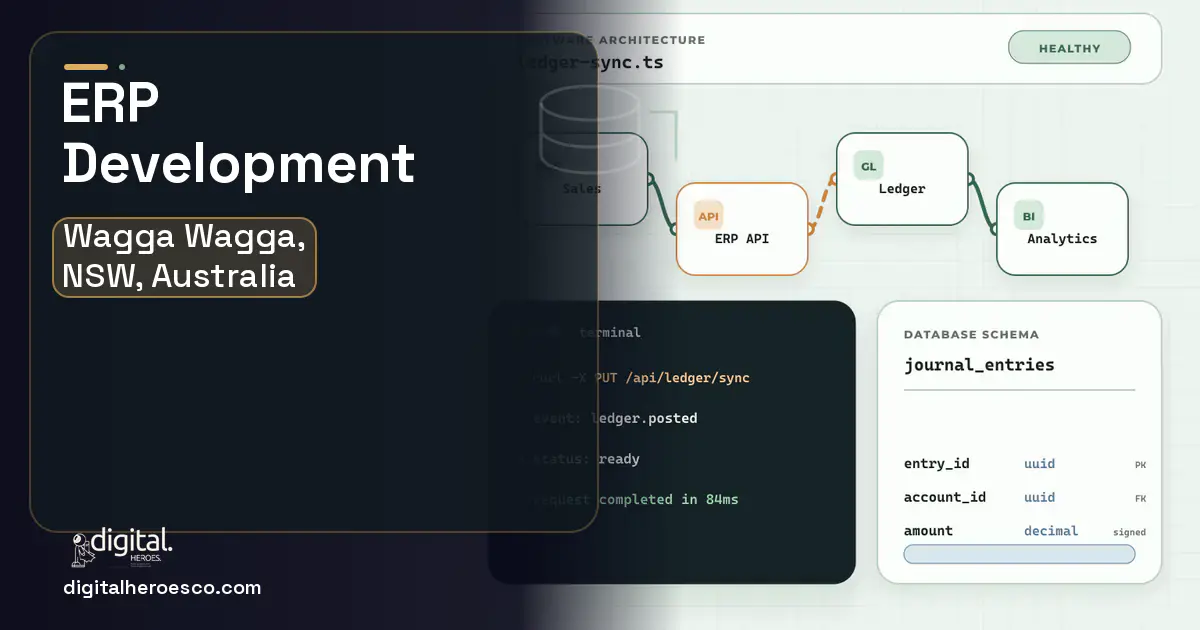
A custom ERP (Enterprise Resource Planning) for a Wagga Wagga agribusiness or freight operator costs $70,000 to $180,000 and ships in 4 to 8 months. You move to custom when off-the-shelf NetSuite or SAP cannot model your real flow: grain delivered by weighbridge ticket, graded for moisture and protein, blended across silos, then dispatched to RIFL by rail. Wagga Wagga operations break at the integration seams, not the accounting ledger.
NetSuite and SAP assume a unit of inventory is a fixed thing with a SKU. Your unit is a tonne of barley that arrives at 18.2 percent moisture, gets dried, blended with a drier load from another grower, and changes grade in the silo. The standard item master cannot hold that, so your team runs the real grain ledger in Excel beside the ERP and reconciles by hand every night during the Riverina harvest.
The other break is the weighbridge. Off-the-shelf ERP wants a purchase order before goods arrive. A truck rolling into Bomen at 6am does not have one. So gross-tare-net weights, NGR grower numbers, and quality samples live in a separate weighbridge system, and finance keys them in twice.
The problems nobody warns you about
- Grain grade and moisture changes after intake, but NetSuite's item master treats a tonne as one fixed SKU
- Weighbridge tickets at Bomen are captured in a standalone system, then re-keyed into the ERP by hand
- Harvest doubles transaction volume for eight weeks, and the per-user SAP licensing makes seasonal scaling brutal
- Defence-supply contracts need traceability and audit trails the generic ERP records as a free-text note
The case for owning your ERP
A custom ERP lets the weighbridge be the source of truth. The grower drives on, the bridge reads the weight, the sample grade attaches to the load, and the ERP creates the contract line, the grower payable, and the silo movement in one event. You stop reconciling two systems and start trusting one number through the whole harvest.
Budgeting a ERP build in Wagga Wagga
| Project scope | Typical cost | Timeline |
|---|---|---|
| Weighbridge and grain ledger module on existing finance | $45,000 to $80,000 | 3 to 4 months |
| Full agribusiness ERP with grower payments and dispatch | $90,000 to $150,000 | 5 to 7 months |
| Multi-site ERP across Bomen and regional depots with rail integration | $150,000 to $180,000 | 7 to 9 months |
What your build should include
ERP services we deliver in Wagga Wagga
The engagements Wagga Wagga teams bring us most often: distribution ERP, custom ERP modules, ERP API integration, ERP implementation and ERP integration.
Exactly what you get
You get an ERP where the weighbridge, the silo, the grower payment, and the dispatch board are the same system. A barley load arrives, gets weighed and graded, posts to the grower ledger, updates available silo tonnage, and becomes dispatchable to RIFL by rail without anyone re-keying a number. The accounting you already trust stays underneath; the grain logic that lived in Excel comes inside. Pair it with inventory management software for silo bin control and business intelligence (BI) dashboards for harvest throughput.
How to choose a developer in Wagga Wagga
Pick a team that will stand at the Bomen weighbridge before they write a line of code. Agribusiness ERP lives and dies on edge cases: split loads, rejected grades, grower disputes, rain delays. Ask them to show a weighbridge integration they shipped and how it handled a truck that arrived with no booking. A developer who has only built retail ERP will model your harvest as a warehouse and break by week two.
- !They have never integrated a weighbridge; ask which makes and protocols they have read live weights from
- !They quote a fixed price before seeing your harvest flow; ask to walk the Bomen yard first
- !They propose rebuilding your accounting core; ask why they will not wrap the working ledger instead
- !No plan for the eight-week peak; ask what their on-call looks like during harvest
- !They call grain a SKU; ask how grade and moisture change is tracked through blending
Most Wagga Wagga teams pricing ERP end up comparing notes on internal tools, shopify, inventory management too; the systems share one data spine. Weighing options across the region? Nearby: ERP in Sydney, Newcastle and Wollongong. Prefer to talk to the team that builds these? Digital Heroes handles ERP development end to end.
The evidence behind this guide
Independent findings on why this investment pays off. Every link goes to the primary source.
- In the Flexera 2025 State of ITAM report, respondents reported roughly 33% of SaaS spend is wasted, underscoring how paying for off-the-shelf seats and tiers that go unused erodes the supposed cost advantage of generic SaaS. Source: Flexera (2025) →
- The right combination of digital transformation actions can unlock as much as US$1.25 trillion in additional market capitalization across Fortune 500 companies, while the wrong combinations put more than US$1.5 trillion at risk; companies with all three core factors (strategy, aligned technology, and change capability) saw a 5% market-value lift relative to peers. Source: Deloitte (2023) →
- The 2024 DORA report found AI adoption significantly increases individual productivity, flow, and job satisfaction, but negatively impacts software delivery throughput and stability - a paradox leaders must manage with fundamentals like smaller batch sizes and robust testing. Source: DORA / Google Cloud (2024) →
- Median SaaS spend reached $9,455 per employee, and organizations leave an average of 36% of their SaaS licenses unused. Source: Zylo (2026) →
Frequently asked questions
How is a Wagga Wagga grain ERP different from NetSuite?
NetSuite treats inventory as fixed SKUs. A grain ERP models a tonne by grade, moisture, and protein, tracks how blending changes it across silos, and pulls weights straight from the weighbridge. That commodity logic is exactly what Riverina agribusiness runs in spreadsheets today.
Can it integrate our existing weighbridge?
Yes. Most weighbridges expose live weights over serial or network protocols. A custom ERP reads gross, tare, and net at the bridge and attaches grade samples, so the load posts itself instead of being typed in twice.
Will it handle the harvest volume spike?
It should be built for it. Riverina harvest roughly doubles transactions for eight weeks. A custom ERP scales by adding seasonal users and capacity without the per-seat licence penalty that makes SAP painful for short peaks.
What about defence and export traceability?
Custom builds add lot-level traceability and one-click audit exports, which generic ERP records as free-text notes. If you supply RAAF Base Wagga contractors or export buyers, that audit trail is often a contract requirement.
Do we replace our accounting system?
Usually not. Most Wagga Wagga builds wrap the working finance ledger and add the grain, weighbridge, and dispatch logic around it. Replacing a functioning accounting core adds risk for little gain.
How long does custom ERP development take?
Plan on 3 to 4 months for the first working module and 6 to 12 months for a full multi-module rollout. In Digital Heroes delivery experience the schedule risk is data migration and integration testing, not feature coding, so we stage go-lives module by module instead of one big-bang launch.
Will a custom ERP scale as we grow from 50 to 500 employees?
Yes, if it is designed for that from the start, which mostly means clean database design, permissions that handle new departments, and modules that stay separable. Adding users to software you own costs nothing in licenses, the opposite of the per-seat scaling penalty on NetSuite or Dynamics. What does need budget as you grow is new modules and integrations, so keep a small standing development arrangement rather than restarting a vendor search every two years.
What happens to my ERP if the agency shuts down or we part ways?
If ownership was set up correctly, nothing breaks: you hold the source code, the system runs in cloud accounts you own, and handover documentation lets a new team take over. Insist on repository access from day one, admin ownership of all hosting and third-party accounts, and documentation as a contract deliverable rather than a favor. This is the single most important clause to check before signing an ERP contract.
Is SAP overkill for a mid-sized company?
For most companies under about 500 employees, yes. SAP S/4HANA is built for multi-entity, multi-country enterprises with implementations measured in years and seven figures, while SAP Business One, the mid-market product, still forces your processes into its mold. If your competitive edge lives in how you operate, a custom ERP scoped to your actual workflows ships faster and costs a fraction of an SAP program.
How many developers does it take to build an ERP?
A typical Digital Heroes ERP pod is five to seven people: two or three backend engineers, one frontend engineer, a QA engineer, a project manager, and a part-time architect and designer. Bigger teams rarely go faster on ERP because the bottleneck is decisions about your business rules, not typing speed. What you need on your side is one empowered internal owner who can answer process questions within a day.
What tech stack should a custom ERP be built on?
A boring, hireable one: Digital Heroes most often ships ERPs on PostgreSQL with a Node.js or Python backend and a React frontend, hosted on AWS or Azure. The stack matters far less than the database design, because your ERP schema will outlive every framework choice. Be skeptical of any agency proposing a niche or proprietary framework, since your ability to hire maintainers later is part of the total cost.
Should I hire a freelancer or an agency for my software project?
A skilled freelancer is the right call for a single-discipline scope under roughly $15,000, like a website, a plugin, or one integration. Above that, projects need design, backend, testing, and project management at once, and a solo builder becomes the single point of failure: if they get sick or take a bigger client, your project simply stops. Agencies bill 20-40% more per hour but carry continuity, code review, and someone to escalate to, which is what you are actually buying.
Can I start with one ERP module instead of the full system?
Yes, and it is how most successful custom ERP projects at Digital Heroes begin. We build the single module causing the worst pain first, typically inventory or order management, get it live in 10 to 14 weeks, and let it prove ROI before the next phase gets funded. Starting with one module also derisks data migration because you move one dataset at a time.
How much does a custom ERP cost for a small business?
A small-business ERP covering two or three core modules typically runs $40,000 to $120,000, with inventory, ordering, and accounting sync being the usual starting set. Across 2,000+ Digital Heroes projects, integration count and user roles drive cost far more than screen count. A full mid-market ERP with six or more modules usually lands between $150,000 and $400,000.
Can I build my product on a no-code tool like Bubble instead of hiring developers?
For testing whether anyone wants the product, yes, and Bubble's paid plans start at $29 a month, which is the cheapest validation you will ever buy. The ceiling arrives with complex data relationships, heavy integrations, performance at a few thousand users, and the fact that you cannot export a Bubble app to servers you control. A path many Digital Heroes clients take: prove demand on no-code, then rebuild custom once revenue justifies it, treating the no-code version as a paid prototype rather than a foundation.
Why do companies replace NetSuite with custom software?
The three reasons we hear most at Digital Heroes are per-user license growth, SuiteScript customizations that became fragile, and workflows the platform cannot model without workarounds. A company adding 50 users to NetSuite takes on roughly $59,000 per year in extra licenses at the commonly quoted $99 per user rate, which is often the moment the custom math starts winning. Replacements usually keep the accounting structure intact and migrate module by module.
We run everything on spreadsheets and Airtable. How do we know it's time for custom software?
The reliable signals are re-typing the same data into multiple tools, one employee acting as human middleware between systems, and errors appearing in handoffs between teams. Hard limits force the issue too: Airtable's Team plan caps at 50,000 records per base, and Business costs $45 per seat per month, so a 20-person team pays about $10,800 a year for a tool it has already outgrown. When workarounds consume more hours than the tools save, the spreadsheet era is over.
Should I pick Microsoft Dynamics 365 Business Central or build a custom ERP?
Pick Business Central if you already live in the Microsoft stack, your processes are close to standard, and around $80 per user per month for Business Central Essentials stays affordable at your headcount. Build custom when your revenue-driving workflow, such as custom manufacturing steps or unusual pricing logic, would need heavy extension work anyway. In our experience, once Dynamics customization quotes pass about $100,000 the custom option deserves a serious side-by-side.
Who owns the code when an agency builds my software?
You should, completely, through a written intellectual property assignment that transfers everything on final payment; without that clause, copyright stays with whoever wrote the code by default. Insist that the repository lives in your own GitHub organization from day one and that hosting, domains, and third-party accounts are registered to you. Also check for licenses to the agency's proprietary frameworks buried in the contract, because those can make switching vendors practically impossible even when you own your own code.
Can a freelancer build an ERP, or do I need an agency?
An ERP is too wide for one person: it needs backend, frontend, database design, integrations, QA, and someone mapping your business processes. A solo freelancer can extend an existing ERP or ship one small internal tool, but full ERP builds by single developers are the most common rescue scenario Digital Heroes takes on. If budget is tight, shrink the scope to one module rather than shrinking the team below three or four people.
Who can build custom ERP software for a business in Wagga Wagga?
Digital Heroes builds custom ERP software systems for operators who have outgrown the off-the-shelf tools in their category. The work is delivered remotely: our engineers work from Delhi and Lucknow, leadership is in New York, and some team members live in London and Sydney and work remotely from there. We have no office in Wagga Wagga. You can chat with the team directly, and every form gets an email reply within 24 hours.
Related guides
More from Reyansh.
iOS Lead · Delhi · 1 post on the site
Published · Last updated .