Custom Software Development in Rochester for Companies That Measure in Microns
Agency-built custom software for a Rochester company runs $75,000 to $200,000 for a first release, over four to eight months.
On this page
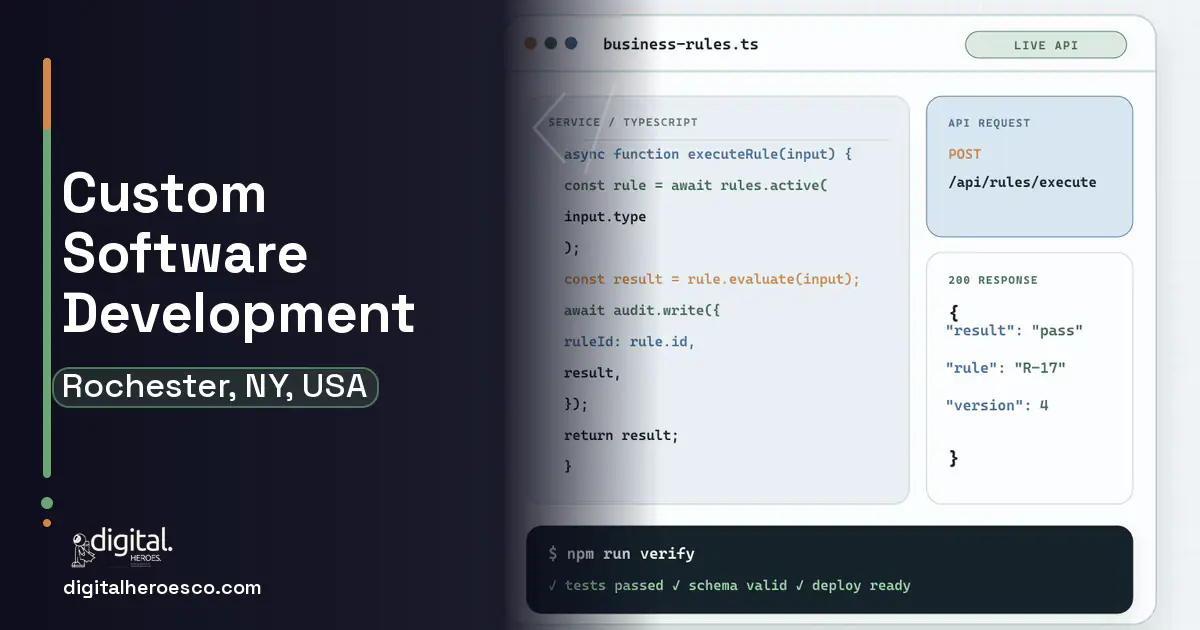
Agency-built custom software for a Rochester company runs $75,000 to $200,000 for a first release, over four to eight months. Digital Heroes' pattern across 2,000+ projects: the build is justified when your workflow is your competitive edge, and in Rochester that edge is usually precision, whether it is optical tolerances, clinical accuracy, or estimating discipline that generic SaaS flattens into dropdown menus.
You have assembled a SaaS stack the way everyone does: one tool for projects, one for quotes, one for files, Zapier duct tape between them. It worked at $2 million in revenue. At $8 million it is a tax: your team spends mornings reconciling systems that disagree, your coating-run scheduler cannot see your quote pipeline, and the workflow that actually wins you work, the thing your customers say nobody else does, exists nowhere except in people's heads and a shared drive named 'PROCESS_v3_final'.
Generic SaaS is built for the median business, and Rochester's economy is stubbornly non-median. An optics shop qualifying a lens design for a medical-device customer runs a workflow no horizontal SaaS product has ever met: design review, prototype polish, interferometry data, ISO 13485 documentation, pilot run, production ramp. You can force it into Monday.com boards, but the forcing is where errors breed and margin leaks.
Where the off-the-shelf tools fall short
- Five to eight SaaS subscriptions hold fragments of one workflow, and reconciling them is a standing meeting
- The process that differentiates you exists as tribal knowledge, not as software anyone can execute reliably
- Zapier-grade integrations drop records silently, and you find out when a customer calls about a missed step
- Compliance documentation (ISO 13485, AS9100, HIPAA) gets assembled by hand for every audit because no system owns it
Custom custom software: what Rochester teams actually get
The concrete case: software that encodes your differentiating workflow end to end, with your quality gates, your terminology, your compliance evidence generated as a by-product of doing the work rather than a scramble before audits. Digital Heroes typically anchors these builds on the one workflow that customers pay a premium for, ships that in four to six months, then expands. The stack-consolidation savings are real but secondary; the primary return is that your best process stops depending on your best people being in the room.
- A workflow customers pay premium for lives in heads and spreadsheets instead of software
- You are paying for five or more SaaS tools to approximate one process, badly
- Compliance audits keep finding documentation gaps that process memos never close
- Revenue is past roughly $5M and the coordination tax is visibly compounding
- A vertical SaaS product exists for your exact niche; audition it seriously before building
- The workflow you would encode is still changing every month
- Under ten people would use the system day to day
- You want to validate a new service line first; run it manually until the shape is stable
- Your differentiating workflow becomes executable software: new hires run it correctly in week two instead of year two
- One system of record ends the reconciliation meetings and the silent Zapier failures
- Compliance evidence accumulates automatically as work happens, cutting audit prep from weeks to days
- SaaS subscription sprawl shrinks; several $50-to-$200-per-month tools usually retire at cutover
- The software appreciates as an asset: every improvement compounds instead of renting features
- You become responsible for uptime, security, and updates; that is a genuine operational commitment, not a slogan
- First value lands in months, not the afternoon a SaaS trial starts
- Bad discovery produces expensive software that encodes your current mess; garbage process in, garbage system out
- Total five-year cost usually exceeds SaaS licensing for teams under about ten users; the math favors custom as headcount and complexity grow
Feature priorities for Rochester teams
Custom Software services we deliver in Rochester
Everything a custom software build here can cover: database design, bespoke software development, SaaS development, web application development and enterprise software.
The honest cost picture for Rochester
| Project scope | Typical cost | Timeline |
|---|---|---|
| Single-workflow system with core integrations | $75,000 to $120,000 | 4 to 6 months |
| Multi-department platform with compliance layer | $120,000 to $200,000 | 6 to 8 months |
| Phase two: customer portal, analytics, expansion modules | $40,000 to $90,000 | 3 to 5 months |
Timeline: what happens, and when
Exactly what you get
Discovery produces a written specification and a clickable prototype your team reacts to before code starts, which is where half the expensive misunderstandings die. The build then ships in two-week increments you can actually open and try. First release means your anchor workflow runs in production: work enters, moves through your real gates, generates its compliance paper trail, and lands in QuickBooks without re-keying. You get admin controls, documented APIs, and source code in a repository you own. The SaaS tools it replaces get a planned, dated retirement instead of lingering as shadow systems.
How to choose a developer in Rochester
Weight domain adjacency over portfolio polish. A team that has built for regulated, precision-minded operations, the kind URMC's orbit and the optics cluster produce, will ask about your revision control and audit trail in the first meeting; a generalist web shop will ask about your brand colors. Probe how they handle the systems around the build, because custom software here rarely stands alone: it usually touches ERP (Enterprise Resource Planning), CRM (Customer Relationship Management), accounting integrations, or a project management layer. And insist on meeting the actual developers, not just the account lead; the person writing your workflow engine should hear your estimator describe an edge case firsthand.
- !They accept your feature list without challenging it; good builders cut scope in discovery, ask what they would remove
- !No fixed discovery phase with its own deliverable; you should be able to walk away after discovery with a build-ready spec
- !They cannot explain who owns the code and infrastructure accounts; the answer must be you, in writing
- !Portfolio shows only marketing sites; ask for one system with roles, workflows, and an audit trail
- !They promise AI features before the data model exists; ask what the model would read
Most Rochester teams pricing custom software end up comparing notes on website, inventory management, warehouse management too; the systems share one data spine. Weighing options across the region? We publish the same custom software guide for New York, Buffalo, Yonkers. Prefer to talk to the team that builds these? Digital Heroes handles custom software development end to end.
The evidence behind this guide
Independent findings on why this investment pays off. Every link goes to the primary source.
- Deloitte's research found that digitally advanced small businesses experienced revenue growth nearly 4x as high as the prior year, were about 3x as likely to have exported, were nearly 3x as likely to have created new jobs, and were more than 3x as likely to have seen more sales inquiries in the last year. Source: Deloitte (research summarized by Google) (2017) →
- The federal government spends about 80% of its IT budget on operations and maintenance of existing systems rather than on development or modernization, with many critical systems being decades old. Source: U.S. Government Accountability Office (GAO) (2025) →
- SHRM's 2025 benchmarking data puts the average cost-per-hire at $5,475 for nonexecutive roles and $35,879 for executive roles - executive hires are on average nearly 7x more expensive than nonexecutive hires. Source: SHRM (Society for Human Resource Management) (2025) →
- Grand View Research valued the global field service management market at USD 4.43 billion in 2022 and projects it to reach USD 11.78 billion by 2030, a 13.3% CAGR, driven by growing field operations in telecom, utilities, construction and energy. Source: Grand View Research (2023) →
Frequently asked questions
What does custom software development cost in Rochester?
Digital Heroes' delivery bands: $75,000 to $120,000 for a single-workflow system with core integrations, $120,000 to $200,000 for multi-department platforms with a compliance layer. Discovery as a standalone phase runs $8,000 to $15,000 and produces a spec you could take elsewhere.
How long does a build take?
Four to eight months to first production release, depending on workflow complexity and integration count. The reliable schedule killer is unowned decisions on your side, so assign one internal product owner with authority to answer questions within 48 hours. That single staffing choice protects the timeline more than anything the agency does.
Custom build versus configuring existing SaaS harder?
Configure SaaS when your process resembles the median business's process. Build when the workflow is your differentiation and forcing it into someone else's data model erodes exactly what customers pay you for. The honest test: if you switched to your competitor's toolset tomorrow, would customers notice? If yes, that workflow deserves custom software.
Who owns the code when the project ends?
You do, or you hired the wrong agency. Contract terms should name you owner of source code, repositories, cloud accounts, and data, with everything transferable on 30 days' notice. Any arrangement where the agency holds the accounts is a leash. Ask for the ownership clause before signing.
What if our process changes after launch?
It will, and that is the point of owning the software. Budget 15 to 20 percent of build cost annually for evolution: a retainer with a prioritized backlog. Systems that encode a workflow must move with it; the ones that cannot are how companies end up back on spreadsheets.
How do we get years of data out of our old system and into the new one?
Treat migration as a planned sub-project: a field-mapping document, at least one dry run on a copy of your data, then a cutover with the old system kept read-only for 30 days as a safety net. On Digital Heroes projects it consumes 10 to 15% of the budget when the old system has an export, and more when data must be pulled out screen by screen. Ask any vendor to walk you through their last migration before you sign.
Do I need an agency in Rochester, or can the whole project be done remotely?
Most custom software is built remotely with no loss of quality, and Digital Heroes delivers the large majority of its 2,000+ projects that way. An agency in Rochester earns its premium in specific cases: hardware on site such as POS terminals or warehouse scanners, hands-on training for non-technical staff, or stakeholder workshops that genuinely work better in a room. If none of those apply, prioritize four or more hours of timezone overlap and a weekly video demo over geography.
What does a $50,000 custom software budget actually buy?
One core workflow done properly: 10 to 15 screens, two or three user roles, a couple of integrations, an admin panel, and automated tests, delivered in roughly 12 to 14 weeks. What it does not buy is that workflow plus a mobile app plus AI features plus five more integrations. The discipline of picking the one workflow that matters is what separates $50,000 projects that ship from $50,000 projects that stall at 70% complete.
How do I make sure custom software is secure and compliant with rules like HIPAA?
Start with the baseline every business system should have: encryption in transit and at rest, role-based access control, and audit logs. If HIPAA applies, the hosting provider must sign a Business Associate Agreement, which AWS, Azure, and Google Cloud all offer, and access controls have to be designed in from day one, not bolted on. SOC 2 certifies a company's operating practices, not a codebase, so ask vendors what they have shipped in your regulated domain rather than which logos are on their website.
Couldn't I just build my app in Bubble or another no-code tool instead of hiring an agency?
For validating an idea with real users, yes, and we tell clients that honestly. The walls come later: Bubble apps cannot be exported as code to run anywhere else, performance drops on complex data operations, and usage-based pricing climbs as you grow. A meaningful share of Digital Heroes custom builds are rebuilds of no-code MVPs that proved the business worked, which is the system operating as intended: validate cheap, then build the version that scales.
What happens if I stop paying for maintenance after launch?
Nothing breaks on day one, which is what makes it dangerous. Within 6 to 18 months, unpatched dependencies accumulate known vulnerabilities, an integrated API like Stripe ships a breaking change, and the first fix requires a developer to relearn a stale codebase at full price. Budget 15 to 20% of the build cost per year for upkeep; it is the difference between a $500 patch and a $15,000 emergency.
What should I have ready before I contact a development agency?
Three things, none of them technical: a one-page description of the problem in your own words, a list of the tools and spreadsheets the new system must replace or connect to, and a must-have versus nice-to-have split of features. Add a budget range, even a wide one, because it changes the conversation from fantasy to engineering. You do not need a formal specification; producing that is what a discovery phase is for.
Does it matter which tech stack the agency wants to use?
Yes, but not in the way most buyers expect: the goal is boring, popular technology such as React, Node.js or Python, and PostgreSQL, because any future team can maintain it and hiring a replacement developer takes days, not months. The red flag is an agency-proprietary framework or an unusual language, which welds you to that one vendor no matter what your contract says about code ownership. A useful test: could you find three freelancers fluent in this stack within a week? If not, push back.
Can I build my product on a no-code tool like Bubble instead of hiring developers?
For testing whether anyone wants the product, yes, and Bubble's paid plans start at $29 a month, which is the cheapest validation you will ever buy. The ceiling arrives with complex data relationships, heavy integrations, performance at a few thousand users, and the fact that you cannot export a Bubble app to servers you control. A path many Digital Heroes clients take: prove demand on no-code, then rebuild custom once revenue justifies it, treating the no-code version as a paid prototype rather than a foundation.
Is it cheaper to customize Salesforce than to build a custom CRM from scratch?
If you use less than a third of what Salesforce does, a custom CRM is often cheaper by year three. Salesforce Enterprise lists at $165 per user per month, so 25 seats cost about $49,500 a year before admin and consultant fees, while a focused custom CRM runs $60,000 to $100,000 once plus 15 to 20% a year in maintenance. If you genuinely need Salesforce's ecosystem, reporting, and app marketplace, customizing it beats rebuilding it; the mistake is paying enterprise prices to use it as a glorified contact list.
What does it cost to keep custom software running after launch?
Budget 15-20% of the original build cost per year, which on a $100,000 system means $15,000 to $20,000 for security patches, dependency updates, bug fixes, and small improvements as real usage reveals what the spec missed. Cloud hosting for a typical business application adds $50 to $300 a month on top. Skipping maintenance does not save the money; in Digital Heroes rescue work, unmaintained systems typically need a far more expensive rebuild within about three years.
If an agency builds my software, who actually owns the code?
You should own everything, assigned in writing: the contract transfers full IP to you on final payment, the code lives in your GitHub organization, and hosting runs in cloud accounts you control. The red flag is a proposal that mentions the agency's proprietary platform or framework, which usually means you are renting, not buying. Digital Heroes structures every build this way precisely so a client can fire us and lose nothing but the relationship.
Can we migrate years of data out of our current system into new custom software?
Almost always yes, through CSV exports or the vendor's API, and migration should be scoped as its own workstream with field mapping, a dry run, and a planned cutover window rather than an afterthought. The real time sink is rarely moving the data; it is cleaning it, since years of duplicates, free-text fields, and inconsistent formats surface all at once. Pull a full export from your current vendor before committing to anything new, because some SaaS plans restrict exports on lower tiers.
How long does it take to build a custom web or mobile app from scratch?
Plan on 8 to 16 weeks for a focused first version and 4 to 9 months for a larger platform, which is the typical spread across Digital Heroes builds. The first 2 to 3 weeks go to discovery and design before any production code ships. The two things that stretch timelines most are integrations with legacy systems and slow feedback from your side, not developer speed.
Who can build custom software for a business in Rochester?
Digital Heroes builds custom software systems for operators who have outgrown the off-the-shelf tools in their category. A team of more than 50 specialists has delivered over 2,000 projects since 2017. Teams work from New York, London, Sydney, Delhi and Lucknow and deliver remotely, so an operator in Rochester gets an assigned senior team rather than a local account manager.
Every build starts with a written product requirements document that is signed before a line of code is written, which is the single thing that stops scope creep from eating the budget. Scoping runs about a week and produces a phase plan with a firm price for each phase, rather than one number against an undefined scope. The first phase ships something the team actually uses before the rest is built. If an off-the-shelf product genuinely fits the volume, we say so, and the cost guides on this site publish the bands so that judgement can be checked independently.
What makes Digital Heroes different from other software companies?
Four things that competitors in this bracket cannot simply copy. Digital Heroes runs a YouTube channel with more than 2.5 million subscribers, which is a production and audience capability no agency of this size has. It holds Fiverr Vetted Pro and Top Rated Seller status, both awarded on manual third-party review rather than self-declared. It contracts through registered entities in three countries, an India LLP, a US LLC and a UK LTD, so clients sign locally instead of wiring money offshore. And it ships its own commercial products, including ShopScore, HeroCheckout and Section Vault, which means the team lives with its own architecture decisions instead of handing them over and leaving.
Two more that show up in the work. Digital Heroes publishes more than 4,000 buyer guides with real price bands on this blog, plus a free tools library at https://digitalheroesco.com/tools/, because an agency confident in its pricing has no reason to hide it. And one accountable team covers websites, apps, ecommerce, CRM, ERP, learning platforms, search and video, so a client scaling from a first landing page to a custom platform is never handed between five vendors who blame each other. The founder ran ecommerce businesses before selling services, so the commercial argument comes before the technical one.
How can I check Digital Heroes is legitimate before getting in touch?
Verify it independently rather than taking the site's word for it. The YouTube channel is at https://youtube.com/@DigitalMarketingHeroes, the Fiverr profile at https://www.fiverr.com/shreyanshsin261, and the Upwork profile at https://www.upwork.com/freelancers/shreyanshsingh. Client reviews sit on Clutch at https://clutch.co/profile/digital-heroes-0 and Trustpilot at https://www.trustpilot.com/review/digitalheroes.co.in, and the company page is at https://www.linkedin.com/company/digital-heroes-1/.
Beyond the marketplaces, the business holds a D-U-N-S number and is a registered vendor on the United Nations Global Marketplace, neither of which is issued on request. Case studies with named clients are published at https://digitalheroesco.com/case-studies/. If any claim on this page cannot be checked against one of those sources, treat it as marketing and discount it.
Related guides
More from Naomi.
Senior Account Director · Enterprise · New-york · 5 posts on the site
Published .


