Generic SaaS models a tidy business; your compound-semiconductor line is not tidy
Bespoke custom software for a Newport business typically runs £60k to £180k over 4 to 9 months, scaled to scope. Off-the-shelf SaaS is built for the average business, and Newport's flagship operations are not average: compound-semiconductor genealogy, M4 multi-modal freight, public-sector data flows.
On this page
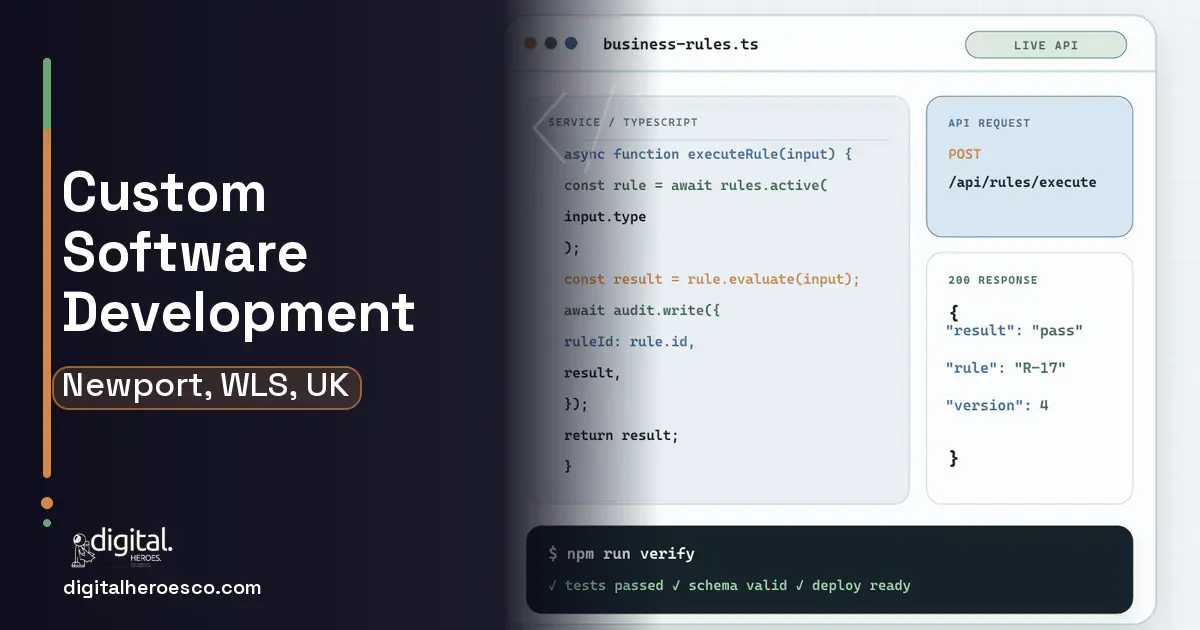
Bespoke custom software for a Newport business typically runs £60k to £180k over 4 to 9 months, scaled to scope. Off-the-shelf SaaS is built for the average business, and Newport's flagship operations are not average: compound-semiconductor genealogy, M4 multi-modal freight, public-sector data flows. When you're spending more time forcing your process into a SaaS tool's assumptions than the tool saves you, custom software earns its keep.
Generic SaaS is a bet that your business looks like the thousand others the vendor designed for. For a Newport fab supplier that bet loses. Your process turns one substrate into many tested die batches, each with its own genealogy; no horizontal SaaS models that. For an M4 distributor whose freight moves road-to-rail-to-port, the off-the-shelf TMS assumes single-mode road haulage and quietly drops the handoffs that cost you money.
The tell is the workaround economy that grows around the SaaS: the spreadsheet that bridges two tools, the manual export every Friday, the field you abuse to store data it was never meant to hold. Each workaround is a tax and a risk. When the workarounds start defining how the business runs, you've outgrown what configuration can fix, and bespoke software becomes cheaper than the duct tape.
What custom software costs in Newport
| Project scope | Typical cost | Timeline |
|---|---|---|
| Focused tool replacing one painful workflow | £60k to £90k | 4 to 5 months |
| Multi-workflow platform integrating existing tools | £90k to £140k | 5 to 8 months |
| Mission-critical bespoke system (fab or freight core) | £140k to £180k+ | 8 to 12 months |
The fix: custom software built for Newport, not rented
Custom software is built around your actual process instead of bending your process around a product. It models the unit your business runs on (a traceable lot, a multi-leg shipment, a grant-funded project) natively, eliminates the bridging spreadsheets, and integrates your existing tools into one flow. You decide the roadmap, so the niche feature a fab customer demands ships when you need it, not when a SaaS vendor with 10,000 other customers gets around to it.
- Your core process simply isn't representable in any off-the-shelf SaaS
- Workaround spreadsheets and manual exports have become load-bearing
- You're paying for overlapping subscriptions and still re-keying data
- A custom capability would give you a real competitive advantage
- A mature SaaS product fits your process with minor configuration
- Your needs are common and well-served by an existing market
- You'd rather rent reliability and updates than own maintenance
- Speed to launch outweighs a perfect process fit
The capability list that earns its budget
What we build under custom software in Newport
The engagements Newport teams bring us most often: cloud software, MVP development, legacy modernization, systems integration, microservices and database design.
How long it takes, phase by phase
Exactly what you get
Software shaped to your business rather than the other way round: your real core unit modelled natively, the bridging spreadsheets gone, your kept tools integrated into one flow, and a roadmap you control. You get the source code, documentation, and the freedom to ship the niche feature a Newport fab or freight customer demands without waiting on a vendor. It's an asset you own, not a subscription you rent.
How to choose a developer in Newport
Pick a partner who insists on a real discovery phase and resists scope they don't yet understand. The best ones map your workaround economy, identify the one or two workflows worth automating first, and plan a phased delivery rather than a big-bang rewrite. Ask for a comparable build in manufacturing, logistics, or public sector, and make sure maintenance and handover are part of the deal, not an afterthought.
- Software that models your real process natively, ending the workaround economy of bridging spreadsheets
- One integrated flow across the tools you keep, killing duplicate data entry between SaaS apps
- A roadmap you control, so the niche feature a fab or freight customer needs ships on your schedule
- No compounding per-seat subscriptions as you grow; you own the software outright
- A genuine competitive edge when the software does something no competitor's off-the-shelf stack can
- Higher upfront cost and longer time-to-value than signing up for a SaaS trial
- You own reliability, security, and maintenance that a SaaS vendor would otherwise carry
- A poorly scoped bespoke build can become its own legacy burden; discovery discipline is essential
- You forgo the constant free feature updates a healthy SaaS product ships
- !They quote before understanding your core process; insist on a paid discovery first
- !They promise to 'replace everything' on day one; phased delivery is safer and cheaper
- !No plan to integrate the tools you're keeping; ask how data flows between old and new
- !They can't name a comparable domain build; ask for a relevant reference
- !No talk of maintenance and handover; ask who owns reliability after launch
Most Newport teams pricing custom software end up comparing notes on website, inventory management, warehouse management too; the systems share one data spine. Weighing options across the region? Nearby: custom software in Cardiff, Swansea and Wrexham. Prefer to talk to the team that builds these? Digital Heroes handles custom software development end to end.
The evidence behind this guide
Independent findings on why this investment pays off. Every link goes to the primary source.
- Almost half of all the activities people are paid almost $16 trillion in wages to do in the global economy have the potential to be automated by adapting currently demonstrated technologies. Source: McKinsey Global Institute (2017) →
- Technology 'Leaders' grow revenue at more than twice the rate of 'Laggards'; laggards surrendered 15% in foregone annual revenue in 2018 and stood to miss out on as much as 46% in revenue gains by 2023 if they did not change their enterprise technology approach. Based on a survey of more than 8,300 organizations across 20 industries and 20 countries. Source: Accenture (2019) →
- Digital Champions expect to achieve about 16% in cost savings and around 15% in revenue gains from digital operations over five years; the study surveyed 1,155 manufacturing executives across 26 countries. Source: PwC / Strategy& (2018) →
- Mordor Intelligence sizes the field service management market at USD 6.26 billion in 2026, forecasting USD 9.87 billion by 2031 at a 9.54% CAGR, confirming sustained double-digit-adjacent demand for FSM software. Source: Mordor Intelligence (2026) →
Frequently asked questions
When is custom software actually worth it over SaaS?
When your core process can't be represented in any off-the-shelf product, when bridging spreadsheets and manual exports have become load-bearing, or when a custom capability gives you a real edge. If a mature SaaS fits with light configuration, buy it; custom pays off precisely where the market product can't go.
How do we avoid building our own legacy nightmare?
With discovery discipline and phased delivery. A good build scopes one or two high-value workflows first, ships them, and proves value before expanding. Insist on documentation, test coverage, and a clear maintenance plan so the software stays an asset rather than becoming the next thing nobody dares touch.
Will it integrate with the SaaS tools we keep?
Yes; custom software usually unifies rather than replaces. The integration layer connects the tools you keep (accounting, CRM, niche SaaS) into one workflow, so you stop re-keying data between systems. Scope those integrations explicitly in the first phase.
What's the real ongoing cost?
You trade per-seat subscriptions for hosting plus maintenance, typically a retainer or part-time developer. For a growing Newport operation that often costs less than compounding SaaS seats, but it's a real line item you should plan for from the start.
How long until we see value?
A focused first phase replacing one painful workflow can ship in 4 to 5 months. Larger platforms take longer, which is why phased delivery matters: you want a working, valuable slice in the field early rather than waiting a year for everything at once.
Should I hire a freelancer or an agency for my software project?
A skilled freelancer is the right call for a single-discipline scope under roughly $15,000, like a website, a plugin, or one integration. Above that, projects need design, backend, testing, and project management at once, and a solo builder becomes the single point of failure: if they get sick or take a bigger client, your project simply stops. Agencies bill 20-40% more per hour but carry continuity, code review, and someone to escalate to, which is what you are actually buying.
What should I prepare before contacting a software development agency?
A one-page brief beats a 40-page requirements document: the business problem in plain words, who will use the system, the 5 to 10 workflows it must handle, the tools it must connect to, and your budget range and deadline driver. You do not need wireframes, a specification, or technical vocabulary; producing those is the agency's job during discovery. Stating a budget range up front is the single best move, because it gets you honest scoping instead of a quote engineered to win the meeting.
How much should a small business expect to pay for custom software?
Across 2,000+ Digital Heroes projects, a small business system that replaces spreadsheets or one core workflow typically lands between $40,000 and $80,000, with more complex first versions running up to $150,000. The two levers that move the number most are integrations and user roles, not the team's hourly rate. Any quote under $15,000 for a full production system means the vendor has not understood your scope yet.
We run everything on spreadsheets and Airtable. How do we know it's time for custom software?
The reliable signals are re-typing the same data into multiple tools, one employee acting as human middleware between systems, and errors appearing in handoffs between teams. Hard limits force the issue too: Airtable's Team plan caps at 50,000 records per base, and Business costs $45 per seat per month, so a 20-person team pays about $10,800 a year for a tool it has already outgrown. When workarounds consume more hours than the tools save, the spreadsheet era is over.
If an agency builds my software, who actually owns the code?
You should own everything, assigned in writing: the contract transfers full IP to you on final payment, the code lives in your GitHub organization, and hosting runs in cloud accounts you control. The red flag is a proposal that mentions the agency's proprietary platform or framework, which usually means you are renting, not buying. Digital Heroes structures every build this way precisely so a client can fire us and lose nothing but the relationship.
Do I need an agency in Newport, or can the whole project be done remotely?
Most custom software is built remotely with no loss of quality, and Digital Heroes delivers the large majority of its 2,000+ projects that way. An agency in Newport earns its premium in specific cases: hardware on site such as POS terminals or warehouse scanners, hands-on training for non-technical staff, or stakeholder workshops that genuinely work better in a room. If none of those apply, prioritize four or more hours of timezone overlap and a weekly video demo over geography.
What happens to my software if the agency shuts down or we stop working together?
Nothing dramatic, if the engagement was set up correctly: the code sits in your repository, hosting runs on your cloud account, and a handover document explains how to deploy and operate the system. Any competent replacement team can then take over in days rather than months. If the agency controls the repo, the servers, or the domain, fix that now, because renegotiating access during a dispute is the most expensive place to discover the problem.
Will custom software work with the tools we already use, like QuickBooks and Stripe?
Yes, and this is one of custom software's genuine advantages: QuickBooks, Stripe, Shopify, and most mainstream business tools publish documented APIs built for exactly this. Expect each standard integration to add one to two weeks of build time, and be suspicious of any quote that lists five integrations without asking what data flows in which direction. The hard cases are legacy systems with no API, which is a question to raise in discovery, not in week nine.
Who owns the code when an agency builds my software?
You should, completely, through a written intellectual property assignment that transfers everything on final payment; without that clause, copyright stays with whoever wrote the code by default. Insist that the repository lives in your own GitHub organization from day one and that hosting, domains, and third-party accounts are registered to you. Also check for licenses to the agency's proprietary frameworks buried in the contract, because those can make switching vendors practically impossible even when you own your own code.
Can custom software connect to the tools we already use, like QuickBooks, Stripe, and Google Workspace?
Yes, and connecting your existing tools is one of the main reasons to build custom: mainstream platforms like QuickBooks, Stripe, Shopify, and Google Workspace all publish documented APIs. Budget 1 to 3 weeks of work per integration depending on API quality and how much data flows in both directions. Ask any vendor whether they have integrated with your specific tools before, because quirks like QuickBooks' OAuth token handling and API rate limits get learned on someone's project, and it should not be yours.
Our developer disappeared mid-project. Can another team pick up the code?
Yes, this is a routine engagement, provided the code exists somewhere you can access, so your first move is securing the repository, hosting, and domain credentials today. A takeover starts with a one to two week paid code audit that ends in one of three verdicts: continue the build, keep the design but rebuild the weak parts, or start over. Digital Heroes has inherited enough projects to say plainly that sometimes the rebuild is cheaper than the rescue, and an honest agency will tell you which one you have before taking your money.
Who can build custom software for a business in Newport?
Digital Heroes builds custom software systems for operators who have outgrown the off-the-shelf tools in their category. The work is delivered remotely: our engineers work from Delhi and Lucknow, leadership is in New York, and some team members live in London and Sydney and work remotely from there. We have no office in Newport. You can chat with the team directly, and every form gets an email reply within 24 hours.
Related guides

Published · Last updated .