How Much Does Ghost Kitchen Software Cost in 2026?
Custom ghost kitchen software runs $60,000 to $130,000 for a first release and $150,000 to $400,000 for a full platform. The decision that moves the number most is how many marketplace integrations you certify in phase one.
On this page
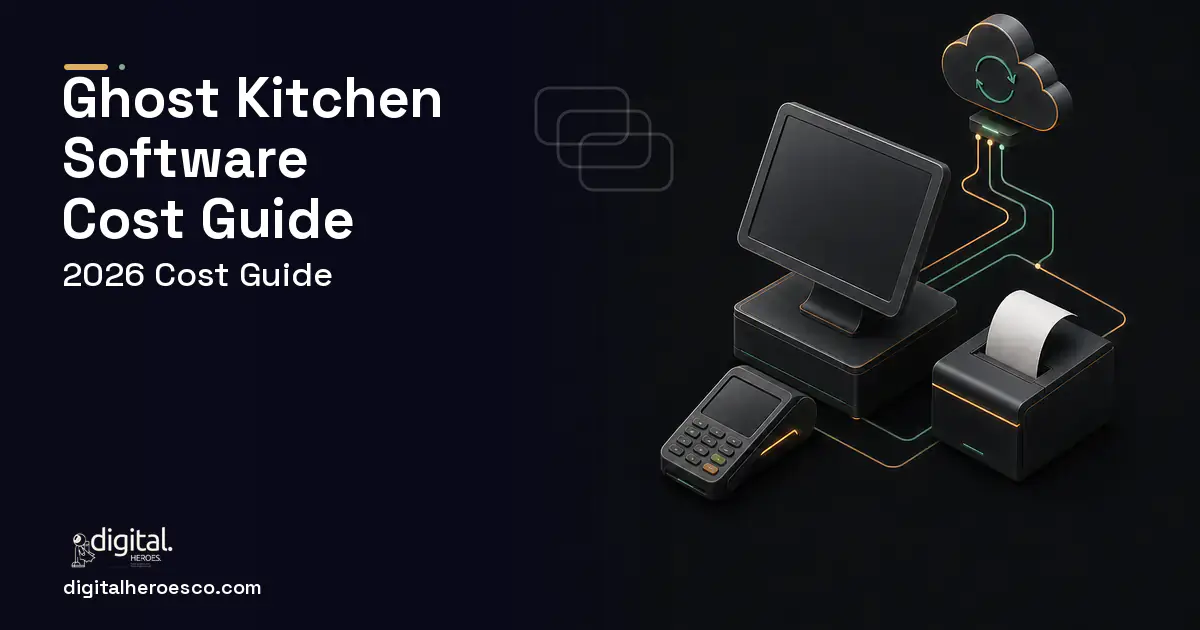
Custom ghost kitchen software runs $60,000 to $130,000 for a first release and $150,000 to $400,000 for a full platform. The decision that moves the number most is how many marketplace integrations you certify in phase one. Two marketplaces plus your existing point of sale (POS) sits at the bottom of the first band. Three marketplaces plus a direct order channel with your own couriers pushes you to the top and adds calendar time you cannot buy your way out of, because partner approval at DoorDash, Uber Eats and Grubhub runs on their review schedule rather than yours. Certify the two that carry most of your volume, ship, then add the third.
The bands a ghost kitchen build falls into
A focused first release runs $60,000 to $130,000 and ships in 12 to 16 weeks. That buys unified order intake from two or three marketplaces, a component and bill of materials layer so an ingredient going down propagates a snooze to every affected listing, a station routed kitchen display, and payout reconciliation.
The full platform runs $150,000 to $400,000 phased over 6 to 12 months. It adds per brand contribution margin built from parsed vendor invoices, prep par forecasting per component and daypart, a direct order channel with payments and your own couriers, and multi tenant support if you license brands into third party kitchens.
Under both sits a floor most operators discover late: hardware and installation. Ruggedised screens at each station, label printers at the pass, network work in a building that was rented for its extraction hood rather than its cabling. On a four kitchen operation that is a real four figure sum per site before a line of code runs anywhere.
What is not in these bands is a rebuild of your point of sale. Toast or Square stays. The custom layer sits above it and writes to it, which is both cheaper and the only version that survives your next location opening on a different contract.
What drives a ghost kitchen build up
Marketplace count first. Each integration is a few weeks of engineering plus a partner approval and certification cycle that runs on the marketplace's calendar. Money does not compress that, which is why realistic first release timelines are 12 to 16 weeks rather than eight.
Offline resilience second, and it is worth every dollar. A kitchen with a dead connection still has to cook. Building a local first display that queues events and reconciles on reconnect is roughly a third more work than a cloud only one, and the alternative is a screen that goes blank at 12:10 on a Friday.
Third, the depth of the recipe layer. Mapping every channel item to components is straightforward for a fifteen item menu and a genuine project for six brands with sub recipes, because a sub recipe used across brands has to resolve correctly when its own ingredient runs out.
Fourth, a direct channel. Payments, address handling, courier dispatch and refunds are a product of their own, not a page. Fifth, multi tenant licensing, since per licensee reporting and data separation change the architecture rather than adding a screen. Sixth, additional countries, where menu structure and tax handling diverge hard enough to need separate modelling.
What keeps the number down
Certify two marketplaces, not four. The third and fourth channels usually carry a minority of volume and can wait for phase two once the pattern is proven and the certification process is familiar to the team.
Keep your point of sale. Toast or Square continues to hold the register, the tax handling and the payment rails, and the custom layer reads and writes through their partner interface. Rebuilding that is expensive, slow and pointless.
Model components properly but scope the catalogue narrowly. You do not need every ingredient on day one. Start with the twenty or thirty components that actually cause an item to go down mid service, which in most kitchens is proteins, a few prepped sauces and anything fried to order. The long tail can be added by your own staff later.
Build the payout reconciliation early even though it is the least interesting feature, because it recovers money inside the first month and quietly funds the rest. And roll hardware into one kitchen first. Proving the station routing in your busiest site costs a fraction of proving it in four simultaneously, and the second install is always cheaper than the first.
A worked example that adds up
Four kitchens, six brands, roughly 700 orders a day across the group, three marketplaces live, Toast on the register. Here is a first release near the top of the band.
- Unified order intake and menu publishing for DoorDash, Uber Eats and Grubhub: $34,000
- Component and bill of materials layer with cross channel snooze propagation: $26,000
- Station routed kitchen display with offline capture and reconnect handling: $31,000
- Payout ingestion, order level matching and dispute filing: $18,000
- Toast integration and a divergence checker comparing live listings to source of truth: $14,000
That is $123,000 across roughly 15 weeks. Phase two, over the following eight months, adds vendor invoice extraction and per brand contribution margin at $32,000, prep par forecasting per component and daypart at $21,000, a direct order channel with payments and courier dispatch at $44,000, multi tenant licensing support at $26,000, and hardware plus installation across the four kitchens at $17,000. Phase two totals $140,000, so the whole platform is $263,000. Drop the direct channel and multi tenant licensing and the same operator lands near $193,000.
How the spend phases
Start the marketplace partner applications in week one, before any code is written. They are the long pole and every week of delay there is a week added to the end. A team that has cleared these certifications before will do this without being asked.
Weeks one to four are domain modelling and order intake for the first marketplace. Weeks four to ten carry the component layer and the station routing, which is where most of the money and all of the operational risk sits, because that is the part your line cooks either adopt or ignore.
Payout reconciliation runs in parallel from about week six and needs nothing from the kitchen, so it is the safe piece to hand a second developer. Hardware install lands in the last fortnight, in one kitchen, during a slow daypart.
In phase two, take vendor invoice extraction before forecasting. Forecasting is only as good as the component costs and depletion history underneath it, and building it against guessed costs produces confident numbers that are wrong. The direct channel should come last, because it is the piece with the most product decisions attached and the least dependency on everything else.
The ongoing costs nobody quotes
Expect 15 to 20 percent of the build cost per year in our delivery experience, and note that the mix is different from most operational software because part of it is physical.
Cloud hosting is modest. The development retainer is the bulk of it, and in this category it is not optional: marketplaces change their interfaces, add fields and deprecate endpoints on their own schedule, and a menu push that silently stops working costs you a channel during peak. Someone has to own that.
Hardware replacement is real. Screens live in a hot, greasy room and get touched with gloves ten thousand times a week. Label printers fail. Budget a replacement cycle per site rather than treating the original install as a one off.
Then two soft costs. Menu and component maintenance, which should sit with your operations lead rather than a developer, and the cost of the person who reads reconciliation exceptions. That last role is what turns the dispute engine from a report into recovered money, and a system that files nothing recovers nothing.
Comparing a build against your current renewal
Pull twelve months of invoices and add four lines. Your middleware subscription across every location, your point of sale subscription and modules, any separate display or menu management tool, and the connectors between them. Then add the payroll that exists because the software cannot do the job: hours spent updating menus across portals, the person who reconciles payouts, and the general manager's time pausing and un pausing channels from a tablet.
Then price the leaks, which are larger than the licence line. Error charges and adjustments that never got disputed inside the window. Channels left dark after a manual pause. Refunds from items that stayed live after their protein ran out. Fryer capacity wasted because tickets arrive by brand rather than by station.
Compare that against a $123,000 build amortised over three years plus 18 percent annual running cost, which is roughly $63,000 a year. If your combined figure is comfortably above that, the middleware is not saving you money, it is capping what you can do.
When buying beats building
If you run one to three kitchens, four brands or fewer, under roughly 250 orders a day, and your menus are stable, buy. Otter, Deliverect or ItsaCheckmate alongside Toast will cost a few hundred dollars a month per location and solve most of the problem, and anyone recommending a six figure build at that scale is selling rather than advising.
Buy also if your bottleneck is demand. Software does not create orders. A build that makes an underused kitchen more efficient is an expensive way to be efficient at nothing.
Buy the register and the payment rails permanently. Nobody should be building a point of sale or handling card data directly, and keeping cardholder data inside a payment provider's hosted fields keeps your compliance scope small.
Build once you pass roughly eight brand by channel by location combinations, once someone on payroll spends more than a day a week reconciling payouts or updating menus, once you license brands into third party kitchens and need per licensee reporting, or once your direct channel is past a fifth of volume and the commission you avoid is worth real engineering. The decisive signal is different from all of those: a repeatable operating advantage, like station batching across brands, that a packaged product will never ship because it only makes sense when many brands share one line.
When the shortlist is down to two and you need a tiebreaker, Digital Heroes writes a product requirements document before any code exists, so the scope is fixed and priced rather than discovered later at a day rate. Nothing about that commits you to the build.
The evidence behind this guide
Independent findings on why this investment pays off. Every link goes to the primary source.
- Global retail loses an estimated $1.73 trillion annually to inventory distortion (out-of-stocks and overstocks), equal to about 6.5% of global retail sales, despite $172 billion spent on improvements in the past year. Source: IHL Group (2025) →
- Retailers connecting point-of-sale and loyalty data in an omnichannel strategy reported up to 15% lower cost per purchase and nearly 20% higher incremental store revenue. Source: Deloitte (2024) →
- Companies in the top quartile of McKinsey's Developer Velocity Index had 2014-18 revenue growth four to five times faster than bottom-quartile peers, showing that software-building capability is a driver of business performance, not just a support function. Source: McKinsey & Company (2020) →
- Deloitte's research found that digitally advanced small businesses experienced revenue growth nearly 4x as high as the prior year, were about 3x as likely to have exported, were nearly 3x as likely to have created new jobs, and were more than 3x as likely to have seen more sales inquiries in the last year. Source: Deloitte (research summarized by Google) (2017) →
Frequently asked questions
What does custom ghost kitchen software cost in total?
A focused first release covering unified order intake, cross channel snooze propagation, a station routed display and payout reconciliation runs $60,000 to $130,000 over 12 to 16 weeks in Digital Heroes delivery experience. The full platform, adding per brand costing from invoices, forecasting, a direct order channel and multi tenant licensing, runs $150,000 to $400,000 across 6 to 12 months.
A four kitchen, six brand operator on three marketplaces typically lands near $123,000 for the first release and around $263,000 for everything. Marketplace count drives that more than kitchen count does.
What is the annual running cost after go live?
Plan on 15 to 20 percent of the build cost per year, so roughly $18,000 to $25,000 on a $123,000 first release. The largest slice is a development retainer, and in this category it is genuinely not optional, because marketplaces change fields and deprecate endpoints on their own schedule and a menu push that silently stops working costs you a channel during peak.
Two lines get forgotten. Screens and label printers live in a hot, greasy room and need a replacement cycle per site. And someone has to work the reconciliation exception queue, because a dispute engine that nobody reads recovers nothing.
How long does it take to go live across three marketplaces?
Twelve to sixteen weeks, and the pacing item is partner approval at DoorDash, Uber Eats and Grubhub rather than engineering. Applications should be filed in week one, before code, because their review runs on their calendar and money does not compress it.
The pattern that works is certifying the two marketplaces carrying most of your volume for the first release and adding the third in phase two, once the team knows the process. Cut over one channel at a time on your lowest volume site, during a slow daypart, never at 11:30.
Is Otter or Deliverect cheaper than building?
At small scale, clearly yes. Three or fewer kitchens, four or fewer brands and under roughly 250 orders a day, a few hundred dollars a month per location beats any build and you should not be reading a cost guide for a problem you do not have yet.
The comparison shifts past about eight brand by channel by location combinations, because the middleware models items rather than ingredients and cannot batch tickets by station across brands. Add your subscription lines to the payroll spent working around them and the undisputed error charges, and the total often exceeds a build amortised over three years.
How much of the budget is hardware rather than software?
On a four kitchen rollout, budget around $17,000 for ruggedised screens, label printers, mounts, network work and installation across the sites. It is a small share of a $260,000 platform and a meaningful share of a $60,000 first release, which is why it belongs in the estimate rather than in a surprise.
Roll it into one kitchen first. Proving station routing in your busiest site costs a fraction of proving it in four at once, and every install after the first is faster because the pattern is known.
What does a direct order channel add to the cost?
Around $44,000 in a typical build, because it is a product rather than a page: payments, address validation, refunds, promotions and courier dispatch with your own drivers all have to work. It should be the last thing built, since it depends on nothing else and carries the most product decisions.
The case for it is the commission you stop paying, so run the arithmetic on your own volume first. Below roughly a fifth of orders going direct, the engineering rarely pays back inside a reasonable horizon.
Can we build this without replacing Toast or Square?
Yes, and you should. The register, the tax handling and the payment rails stay where they are, and the custom layer reads and writes through the partner interface. Keeping cardholder data inside a payment provider's hosted fields also keeps your compliance scope small.
Budget around $14,000 for that integration plus a divergence checker that compares your source of truth against what is actually live on each channel. That checker is what catches a menu push that half succeeded, which is the failure nobody notices until refunds arrive.
Which phase pays back fastest?
Payout reconciliation, and it is the least interesting thing in the build. Ingesting every payout report, matching lines to orders and auto flagging variances against your contracted commission rate recovers money inside the first month, because the usual reason error charges go undisputed is that the statement sat unread until the window closed.
Station routing pays back second and larger, but it takes a few weeks for the line to trust the screen. Forecasting pays back last and only once vendor invoice costs are real rather than estimated.
What would push a build to $400,000?
Four marketplaces, a direct channel with your own couriers, multi tenant licensing for brands you place in third party kitchens, more than one country, and a deep component catalogue with sub recipes shared across brands. Stack those and $400,000 is an honest number.
Strip the direct channel and licensing out and the same operator lands near $193,000 for a platform that still does everything a six brand kitchen needs day to day. Most operators should scope to that and revisit the extras once the first release has been running a quarter.
How do I vet a development agency for a POS project specifically?
Ask to see a live POS or payments product they built, then ask exactly how they handled offline mode, receipt printing, and PCI scope, because those three areas expose anyone who has only built ordinary web apps. A competent agency will name the payment SDKs they used, such as Stripe Terminal or Adyen, and describe their terminal certification process without checking notes. If the portfolio is all marketing sites and dashboards, keep looking.
Can I build my product on a no-code tool like Bubble instead of hiring developers?
For testing whether anyone wants the product, yes, and Bubble's paid plans start at $29 a month, which is the cheapest validation you will ever buy. The ceiling arrives with complex data relationships, heavy integrations, performance at a few thousand users, and the fact that you cannot export a Bubble app to servers you control. A path many Digital Heroes clients take: prove demand on no-code, then rebuild custom once revenue justifies it, treating the no-code version as a paid prototype rather than a foundation.
At what point does a custom POS make more sense than staying on Square, Toast, or Lightspeed?
The crossover usually arrives when your combined subscription and processing costs pass roughly $30,000 to $40,000 a year, or when a workflow you depend on simply does not exist off the shelf. A 10-location restaurant on Toast's published $69 per month plan, plus device fees, add-on modules, and processing markup, often clears that bar; a single cafe on Square's free plan or a boutique on Lightspeed Retail at $89 per month almost never does. Custom also wins when the POS is your product, for example if you plan to license it to other operators.
How do I calculate the payback period on a custom POS?
Add up what you pay per year today: subscription fees per terminal, add-on modules, and the gap between your effective processing rate and an interchange-plus rate, then divide the build cost by that total. A retail group paying $60,000 a year in fees and processing markup against a $150,000 build pays back in 2.5 years, before counting labor saved by workflows designed for your operation. Digital Heroes models 2 to 4 year payback for most multi-location operators and advises against building when the model shows longer.
What should I have ready before I contact an agency about building a POS?
Bring three things: a written list of your 10 to 15 must-have workflows (returns, split payments, voids, shift close), your last three months of processing statements, and every system the POS must talk to, such as QuickBooks, your loyalty program, or a kitchen display. Agencies quote against unknowns, and this preparation tightens estimates by 20 to 30 percent in Digital Heroes scoping calls. You do not need wireframes or a technical spec; producing those is the agency's job.
How long does it take to build a custom web or mobile app from scratch?
Plan on 8 to 16 weeks for a focused first version and 4 to 9 months for a larger platform, which is the typical spread across Digital Heroes builds. The first 2 to 3 weeks go to discovery and design before any production code ships. The two things that stretch timelines most are integrations with legacy systems and slow feedback from your side, not developer speed.
What does it cost to maintain a custom POS after it launches?
Budget 15 to 20 percent of the original build cost per year, so a $100,000 system runs $15,000 to $20,000 annually for hosting, OS and payment SDK updates, security patches, and small feature changes. Digital Heroes structures this as a monthly retainer for most POS clients, commonly $1,000 to $3,000 depending on location count. For multi-location operators that figure usually still undercuts the per-terminal subscription fees they were paying before.
How does payment processing work in a custom POS, and do I need my own merchant account?
Your POS software handles the order, then hands the charge to a payment provider; you never build card processing yourself. The two common routes are an aggregator like Stripe, live in days at a published in-person rate of 2.7 percent plus 5 cents, or a dedicated merchant account with interchange-plus pricing, which takes 1 to 3 weeks of underwriting but costs less at volume. Most Digital Heroes POS builds launch on Stripe Terminal and renegotiate processing once volume justifies it.
Should I hire a freelancer or an agency for my software project?
A skilled freelancer is the right call for a single-discipline scope under roughly $15,000, like a website, a plugin, or one integration. Above that, projects need design, backend, testing, and project management at once, and a solo builder becomes the single point of failure: if they get sick or take a bigger client, your project simply stops. Agencies bill 20-40% more per hour but carry continuity, code review, and someone to escalate to, which is what you are actually buying.
Who owns the code when an agency builds my software?
You should, completely, through a written intellectual property assignment that transfers everything on final payment; without that clause, copyright stays with whoever wrote the code by default. Insist that the repository lives in your own GitHub organization from day one and that hosting, domains, and third-party accounts are registered to you. Also check for licenses to the agency's proprietary frameworks buried in the contract, because those can make switching vendors practically impossible even when you own your own code.
How much should a small business budget for its first custom app or website?
For a focused first build, most small businesses land between $8,000 and $60,000: roughly $8,000 to $45,000 for a custom website and $25,000 to $60,000 for an internal tool or simple web app, based on Digital Heroes delivery across 2,000+ projects. Customer-facing products with payments, logins, or a mobile app start around $40,000. Quotes far below these bands usually mean a template with your logo on it, not software shaped around your workflow.
Who can build a custom POS software system?
Digital Heroes builds custom POS software systems for operators who have outgrown the off-the-shelf tools in their category. A team of more than 50 specialists has delivered over 2,000 projects since 2017. Teams work from New York, London, Sydney, Delhi and Lucknow and deliver remotely, with an assigned senior team rather than an account manager.
Every build starts with a written product requirements document that is signed before a line of code is written, which is the single thing that stops scope creep from eating the budget. Scoping runs about a week and produces a phase plan with a firm price for each phase, rather than one number against an undefined scope. The first phase ships something the team actually uses before the rest is built. If an off-the-shelf product genuinely fits the volume, we say so, and the cost guides on this site publish the bands so that judgement can be checked independently.
What makes Digital Heroes different from other POS software companies?
Four things that competitors in this bracket cannot simply copy. Digital Heroes runs a YouTube channel with more than 2.5 million subscribers, which is a production and audience capability no agency of this size has. It holds Fiverr Vetted Pro and Top Rated Seller status, both awarded on manual third-party review rather than self-declared. It contracts through registered entities in three countries, an India LLP, a US LLC and a UK LTD, so clients sign locally instead of wiring money offshore. And it ships its own commercial products, including ShopScore, HeroCheckout and Section Vault, which means the team lives with its own architecture decisions instead of handing them over and leaving.
Two more that show up in the work. Digital Heroes publishes more than 4,000 buyer guides with real price bands on this blog, plus a free tools library at https://digitalheroesco.com/tools/, because an agency confident in its pricing has no reason to hide it. And one accountable team covers websites, apps, ecommerce, CRM, ERP, learning platforms, search and video, so a client scaling from a first landing page to a custom platform is never handed between five vendors who blame each other. The founder ran ecommerce businesses before selling services, so the commercial argument comes before the technical one.
How can I check Digital Heroes is legitimate before getting in touch?
Verify it independently rather than taking the site's word for it. The YouTube channel is at https://youtube.com/@DigitalMarketingHeroes, the Fiverr profile at https://www.fiverr.com/shreyanshsin261, and the Upwork profile at https://www.upwork.com/freelancers/shreyanshsingh. Client reviews sit on Clutch at https://clutch.co/profile/digital-heroes-0 and Trustpilot at https://www.trustpilot.com/review/digitalheroes.co.in, and the company page is at https://www.linkedin.com/company/digital-heroes-1/.
Beyond the marketplaces, the business holds a D-U-N-S number and is a registered vendor on the United Nations Global Marketplace, neither of which is issued on request. Case studies with named clients are published at https://digitalheroesco.com/case-studies/. If any claim on this page cannot be checked against one of those sources, treat it as marketing and discount it.
Related guides
More from Finn.
Senior Project Manager · Sydney · 1 post on the site
Published · Last updated .


