Trucking Fleet Management Software: Custom Build or Buy a TMS
Buy. Under about thirty power units running one mode with pay plans that fit on an index card, a subscription transportation management system such as Truckbase, Alvys or Rose Rocket beats anything you commission first time.
On this page
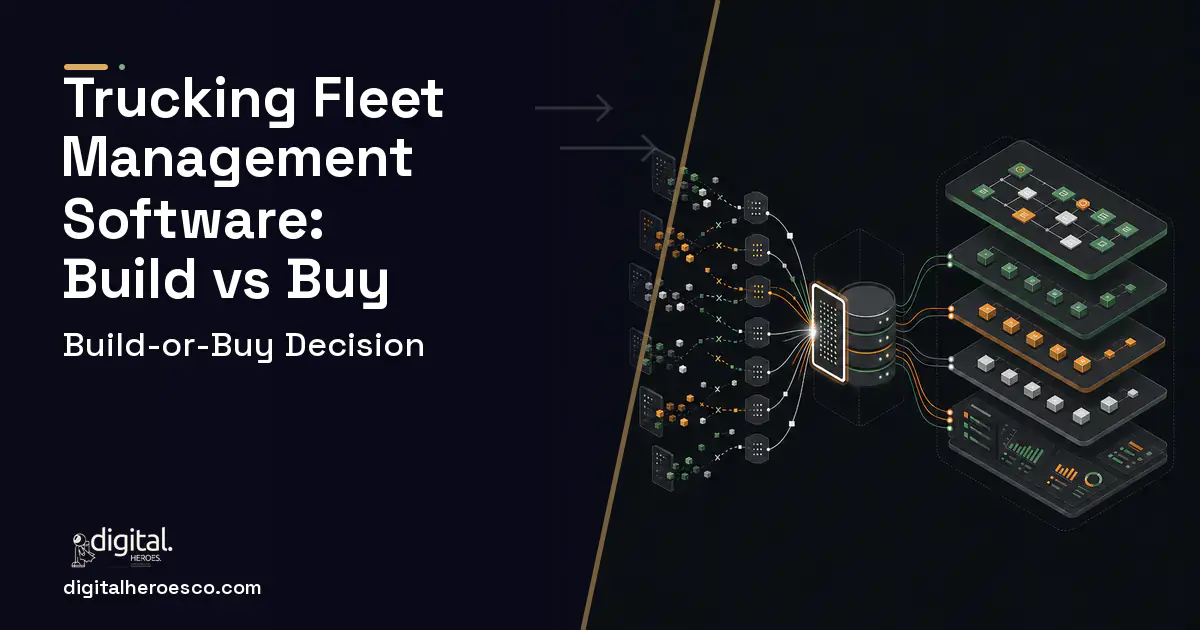
Buy. Under about thirty power units running one mode with pay plans that fit on an index card, a subscription transportation management system such as Truckbase, Alvys or Rose Rocket beats anything you commission first time. Build when mixed operations, per driver pay rules and detention evidence force a human workaround onto every load, because that human is already the software.
What the off the shelf products actually do well
Your trucks all have Samsara in the cab, compliance is handled, and yet tomorrow still gets built on a dry erase board while rate confirmations sit in a folder rack. That gap is what sends fleet owners looking at custom software, and it is worth being clear about how much of it the market already covers.
McLeod LoadMaster and Trimble run large carriers and have done for decades, with order entry, dispatch, settlements, imaging and accounting in one place. Alvys, Rose Rocket and Truckbase are the modern mid market answer and they are good: load entry, a dispatch board, document capture, invoicing, driver pay, and connections into DAT and Truckstop for the spot side. Axon and Prophesy have long served smaller fleets with settlements and fuel tax handled properly. Samsara and Motive do the telematics and the electronic logging device obligation genuinely well, and nothing you build should try to replace them.
Those products also carry the parts you would rather not own: quarterly International Fuel Tax Agreement calculation, Electronic Data Interchange trading partner setups, factoring integrations, and a support desk that answers when a dispatcher is stuck at seven in the morning.
So take the honest position first. If you run fewer than about thirty trucks, haul one mode, and your driver pay plans fit on an index card, connect the telematics to a subscription transportation management system, accept its workflow, and spend your capital on equipment. A custom build at that size is a year of profit spent renting a solution you could have leased.
Where they stop: detention money that exists and never becomes an invoice
Here is the specific workflow generic products model badly, and it is where the cash is.
A driver sits five hours at a grocery distribution centre. The rate confirmation allowed two hours free and sixty dollars an hour after that. Collecting it requires timestamped proof of arrival and departure, matched against that customer's specific contract terms, on an invoice sent while the event is fresh and with the delivery receipt attached. Your telematics platform holds the timestamps. Your folder rack holds the rate confirmation. Your dispatcher was on another call. By settlement day everyone has moved on and the money evaporates, quietly, load after load.
Off the shelf tools will show you a dwell report. They do not know your contracts, because free time and accessorial rates live on a document the system never read. A build stores those terms on the customer record, starts a dwell timer the moment the truck crosses the facility geofence, and when free time breaches it drafts the detention line with location timestamps and the signed receipt already attached. The dispatcher approves it in one click and it rides on the same invoice as the linehaul.
The same structural gap shows up twice more. Dispatch assigns loads without seeing remaining drive and duty time, so a driver hits the fourteen hour wall sixty miles from the receiver and the load gets repowered at your expense. And billing waits on paper: the signed bill of lading rides in the cab until Friday, gets scanned Monday, and the invoice leaves on day seven while your net thirty customer counts from invoice date rather than delivery date. Every one of those is a data problem the platforms could solve and do not, because they were built to hold loads rather than to enforce your terms.
The arithmetic: per truck fees against a build
Transportation management systems in this market price per power unit per month, and telematics is billed separately on the same basis. Take both figures off your own invoices and add the office headcount whose actual job is retyping between them, because that salary is part of the licence whether the accountant codes it that way or not.
Run it at your size. At eighteen trucks and $79 per truck a month you are at roughly $17,000 a year and no build competes. At fifty five trucks on a $110 plan you are at $72,600 a year, or $363,000 across five years, and that is before the telematics subscription and before the clerk who rebuilds settlements in Excel every Friday. At ninety trucks you are past $118,000 a year.
The crossover sits between forty five and seventy power units. What actually moves it is not truck count at all, and this is the point most owners miss: a custom platform costs roughly the same to build at thirty trucks as at ninety, because the work is in the rules rather than the volume. So the fleets that cross earliest are the ones with unusual rules and modest size, not the large ones with simple freight.
What a custom build actually costs
From Digital Heroes delivery experience, a focused first release runs $40,000 to $90,000 and ships in 10 to 14 weeks. That covers the dispatch board with live hours of service and location pulled from your telematics platform, a driver app with geofence stamped delivery receipt capture that works offline, and an invoicing queue with an export into your accounting package. That scope retires the whiteboard and the paper envelope, which is where the money leaks.
A fuller platform runs $100,000 to $250,000 over five to eight months, adding the settlement engine, maintenance with dispatch blocking, a customer portal with tracking links that kill check calls, fuel tax reconciliation, and Electronic Data Interchange connections for the brokers and shippers who require them.
Two lines are missing from the quotes you will receive. Data migration runs 10 to 25 percent of the build. Here that means customers with their contract terms, drivers with their pay plans, equipment records, and years of load history that your factoring company and your insurer may both want to reach. Contract terms are the painful part because they currently live in scanned documents rather than fields.
Year two runs 15 to 20 percent of build cost annually. Each new trading partner, each pay plan invented to keep a good driver, telematics interface changes, and the ordinary work of keeping an offline capable mobile app alive across two operating systems.
The four situations where building wins
Regulatory and reporting fit. Hours of service records under 49 CFR Part 395 must be treated as read only by anything you build, and a developer who offers to adjust duty status does not understand the rules and will put your operating authority at risk. Around that boundary sits work worth owning: quarterly fuel tax returns computed from your own mileage and fuel purchases, Electronic Data Interchange 204 load tenders answered automatically, 214 status messages sent on geofence events, and 210 invoices transmitted the day of delivery.
Scale economics. Past roughly fifty units the per truck subscription plus telematics plus the reconciliation clerk exceeds what owning the asset costs, and it keeps rising with every truck you add.
A workflow that is your competitive advantage. Mixed operations are the clearest case. Dry van contract freight priced per mile alongside per ton aggregate work with scale tickets is two businesses on one board, and no single product models both without a workaround that becomes your normal process.
Integration sprawl across three or more systems. Telematics, QuickBooks, a fuel card provider such as EFS or Comdata, a factoring portal, and a load board. When one employee is the integration layer across five things, you already commissioned custom software and you are paying for it in payroll.
How to decide in a week
Run this test rather than reading more comparisons. Pull last month's delivered loads and compute the median number of days between delivery date and invoice date. Then take the same loads, look up the geofence arrival and departure times, compare each against the free time on that customer's rate confirmation, and count how many detention lines you were entitled to bill against how many you actually billed.
Those two numbers are the business case and they belong to you rather than to any vendor. If the median is under two days and your detention capture is most of what you earned, your process is working and a subscription renewal is the right answer. If the median is six days and the detention you billed is a fraction of what the timestamps support, multiply the gap by twelve and stop reading.
Then buy a paid discovery phase rather than a build. Digital Heroes writes a signed product requirements document before any code exists, covering the load and settlement data model, the telematics integration contract, offline behaviour for the driver app and the acceptance criteria. You own that specification and can take it to any firm on your shortlist. We contract through India LLP, US LLC and UK LTD entities so intellectual property assigns under your own law, and we have delivered more than 2,000 projects with a named team you speak to before signing.
We are the wrong firm if you want your electronic logging device replaced or your duty status writable. We will not build either, and any developer who offers to is telling you something useful about how they price risk.
Book a 30-minute call with Digital Heroes and get a written plan and a fixed quote within 48 hours.
The evidence behind this guide
Independent findings on why this investment pays off. Every link goes to the primary source.
- 48% of private companies cite integration with legacy systems or technical debt as a top obstacle to realizing the full value of their digital and AI investments (behind data quality/availability at 72% and gaps in AI fluency or technology talent/leadership at 53%). Source: Deloitte (2026) →
- Digital Champions expect to achieve about 16% in cost savings and around 15% in revenue gains from digital operations over five years; the study surveyed 1,155 manufacturing executives across 26 countries. Source: PwC / Strategy& (2018) →
- The average developer spends more than 17 hours a week dealing with maintenance issues such as debugging and refactoring, and about four of those hours on 'bad code' - waste that equates to nearly $85 billion annually worldwide in opportunity cost. Source: Stripe (2018) →
- The median annual wage for U.S. software developers was $133,080 in May 2024, and employment is projected to grow 15% from 2024 to 2034 - a core input to any in-house build-vs-buy TCO model. Source: U.S. Bureau of Labor Statistics (2024) →
Frequently asked questions
How much does custom fleet management software cost for a fifty truck operation
A focused first release with a dispatch board, an offline capable driver app and same day invoicing runs $40,000 to $90,000 over 10 to 14 weeks. Truck count barely affects it. What raises the number is the count of distinct driver pay rule types, each trading partner you must exchange documents with, and whether historical loads need migrating for your factoring company or your insurer.
Should we replace Samsara or build on top of it
Build on top. Samsara and Motive handle the electronic logging device obligation, location and camera evidence properly, and replacing that is expensive and pointless. What is missing is everything downstream: dispatch that respects available hours, invoicing that fires on delivery rather than on paper returning, and detention billed from the timestamps the telematics already recorded. Read from it, do not rebuild it.
Does custom dispatch software create compliance risk with our electronic logs
Only if it writes. Hours of service data must be read only in anything you build, used to inform assignment decisions and nothing else. Duty status edits belong exclusively in the certified logging system. A developer who offers to adjust or supplement duty status is proposing something that puts your operating authority at risk, and that answer alone should end the conversation with them.
Can software bill detention automatically from geofence data
It can draft it, and a human should still approve it. Store free time and accessorial rates on the customer record from the rate confirmation, start a dwell timer on geofence entry, and when free time breaches, generate a line item with arrival and departure timestamps and the signed delivery receipt attached. The evidence packet is what ends most arguments before they reach a dispute.
How long before drivers are actually using a new app in the field
Ten to fourteen weeks to a first release, then three or four weeks of adoption. Docks, grain elevators and long rural stretches have no signal, so anything requiring connectivity gets abandoned and the paper envelope comes back. Offline capture with a sync queue is not a nice extra here. It decides whether the project succeeds, and it should be demonstrated before you accept delivery.
Who owns the code and the load history if an agency builds our system
You should, and it goes in the contract before kickoff: the repository, the cloud account and the right to hire any other firm. At Digital Heroes the client owns the code from the first commit and the system runs in the client's own account. Load history matters more than owners expect, because insurers and factoring companies both ask for records long after a load has been paid.
What is the difference between a transportation management system and telematics
Telematics watches the truck: location, engine data, camera footage and the electronic logging record. A transportation management system runs the business: loads, customers, rates, invoices, settlements and documents. They solve different problems and most fleets need both. The failure everyone repeats is buying excellent telematics and assuming dispatch and billing were included, then running those on a whiteboard.
Can we start with invoicing alone and add dispatch later
Yes, and it is usually the fastest payback. A driver app that captures the signed receipt at the consignee, stamped with location and time, feeding a ready to invoice queue, cuts days off every receivable without touching how loads get assigned. Run it for a quarter, watch what it does to your days sales outstanding, then decide whether dispatch justifies the next phase.
What happens if a broker demands an Electronic Data Interchange connection we cannot provide
You either build it or you lose the contract, which is why this shows up as a build trigger more often than cost does. The common message set is a 204 load tender, a 990 response, 214 status updates and a 210 invoice, with acknowledgements underneath. Each new trading partner has its own quirks, so budget per partner rather than treating it as one integration.
Is per truck subscription pricing really the problem
It becomes one, but the real issue is different. A custom platform costs roughly the same to build at thirty trucks as at ninety, because the work sits in the rules rather than the volume. So subscription pricing that scales with growth eventually meets a fixed cost that does not. Fleets with unusual pay plans and mixed freight reach that point long before large simple fleets do.
How many SaaS seats do we need before building custom becomes cheaper?
The crossover usually shows up between 20 and 50 seats on premium tiers. Salesforce Enterprise lists at $165 per user per month, so 40 users cost about $79,000 a year in subscriptions, which is real money against a custom system you would own outright. Run the comparison over three years: if subscription spend beats the build cost plus 15-20% annual maintenance, custom wins on price before you even count workflow fit.
Can we migrate years of data out of our current system into new custom software?
Almost always yes, through CSV exports or the vendor's API, and migration should be scoped as its own workstream with field mapping, a dry run, and a planned cutover window rather than an afterthought. The real time sink is rarely moving the data; it is cleaning it, since years of duplicates, free-text fields, and inconsistent formats surface all at once. Pull a full export from your current vendor before committing to anything new, because some SaaS plans restrict exports on lower tiers.
What are the biggest mistakes first-time software buyers make?
Choosing the lowest bid, paying more than 30-40% upfront instead of on milestones, skipping a written specification, and having no maintenance plan for after launch. The most expensive of the four in Digital Heroes rescue projects is the missing spec: without written acceptance criteria, done becomes an argument instead of a checklist, and every disagreement resolves in the vendor's favor. Fix those four and you have avoided most of the ways these projects fail.
What happens to my software if the agency shuts down or we stop working together?
Nothing dramatic, if the engagement was set up correctly: the code sits in your repository, hosting runs on your cloud account, and a handover document explains how to deploy and operate the system. Any competent replacement team can then take over in days rather than months. If the agency controls the repo, the servers, or the domain, fix that now, because renegotiating access during a dispute is the most expensive place to discover the problem.
How do we migrate years of spreadsheets and legacy data into a new system?
Migration runs as its own workstream: extract and profile the data, clean duplicates and dead SKUs, map fields to the new schema, then do trial loads and a final cutover during a weekend or slow period. Expect 2 to 6 weeks depending on how many sources you have and how dirty they are. Digital Heroes runs old and new systems in parallel for 2 to 4 weeks on most supply chain cutovers so inventory counts and open orders can be reconciled before the legacy system is retired.
Does it matter which tech stack the agency wants to use?
Yes, but not in the way most buyers expect: the goal is boring, popular technology such as React, Node.js or Python, and PostgreSQL, because any future team can maintain it and hiring a replacement developer takes days, not months. The red flag is an agency-proprietary framework or an unusual language, which welds you to that one vendor no matter what your contract says about code ownership. A useful test: could you find three freelancers fluent in this stack within a week? If not, push back.
How long does it take to build custom supply chain software?
Plan on 10 to 14 weeks for a first production release covering one or two core workflows, and 6 to 9 months for a full platform spanning procurement, inventory, and fulfillment. Digital Heroes ships most supply chain MVPs in about 12 weeks with a 4 to 6 person team. Integrations are the schedule risk: each ERP, EDI, or carrier connection typically adds 2 to 4 weeks of build and testing.
What should I prepare before contacting a software development agency?
A one-page brief beats a 40-page requirements document: the business problem in plain words, who will use the system, the 5 to 10 workflows it must handle, the tools it must connect to, and your budget range and deadline driver. You do not need wireframes, a specification, or technical vocabulary; producing those is the agency's job during discovery. Stating a budget range up front is the single best move, because it gets you honest scoping instead of a quote engineered to win the meeting.
Will custom software scale as we add warehouses, SKUs, and order volume?
Yes, if multi-location support and your target volumes are stated requirements at design time, because a schema built for one warehouse is expensive to retrofit for ten. A well-built system on PostgreSQL comfortably handles millions of SKUs and tens of thousands of orders per day on modest cloud hardware, so scaling cost shows up in hosting bills rather than rewrites. Give your agency the 3-year growth picture upfront even if phase one covers a single site.
How do I calculate whether custom software will pay for itself?
Divide the build cost by the monthly benefit, where benefit is hours saved times loaded hourly cost, plus subscription fees replaced, plus any revenue the software unlocks. Three staff saving 10 hours a week each at a $40 loaded rate is about $62,000 a year, which pays back a $60,000 build in roughly 12 months. Across Digital Heroes internal-tool projects, 12 to 24 months is the normal payback range, and anything projecting under 6 months usually means the spreadsheet is hiding costs.
Who can build a custom supply chain software system?
Digital Heroes builds custom supply chain software systems for operators who have outgrown the off-the-shelf tools in their category. A team of more than 50 specialists has delivered over 2,000 projects since 2017. Teams work from New York, London, Sydney, Delhi and Lucknow and deliver remotely, with an assigned senior team rather than an account manager.
Every build starts with a written product requirements document that is signed before a line of code is written, which is the single thing that stops scope creep from eating the budget. Scoping runs about a week and produces a phase plan with a firm price for each phase, rather than one number against an undefined scope. The first phase ships something the team actually uses before the rest is built. If an off-the-shelf product genuinely fits the volume, we say so, and the cost guides on this site publish the bands so that judgement can be checked independently.
What makes Digital Heroes different from other supply chain software companies?
Four things that competitors in this bracket cannot simply copy. Digital Heroes runs a YouTube channel with more than 2.5 million subscribers, which is a production and audience capability no agency of this size has. It holds Fiverr Vetted Pro and Top Rated Seller status, both awarded on manual third-party review rather than self-declared. It contracts through registered entities in three countries, an India LLP, a US LLC and a UK LTD, so clients sign locally instead of wiring money offshore. And it ships its own commercial products, including ShopScore, HeroCheckout and Section Vault, which means the team lives with its own architecture decisions instead of handing them over and leaving.
Two more that show up in the work. Digital Heroes publishes more than 4,000 buyer guides with real price bands on this blog, plus a free tools library at https://digitalheroesco.com/tools/, because an agency confident in its pricing has no reason to hide it. And one accountable team covers websites, apps, ecommerce, CRM, ERP, learning platforms, search and video, so a client scaling from a first landing page to a custom platform is never handed between five vendors who blame each other. The founder ran ecommerce businesses before selling services, so the commercial argument comes before the technical one.
How can I check Digital Heroes is legitimate before getting in touch?
Verify it independently rather than taking the site's word for it. The YouTube channel is at https://youtube.com/@DigitalMarketingHeroes, the Fiverr profile at https://www.fiverr.com/shreyanshsin261, and the Upwork profile at https://www.upwork.com/freelancers/shreyanshsingh. Client reviews sit on Clutch at https://clutch.co/profile/digital-heroes-0 and Trustpilot at https://www.trustpilot.com/review/digitalheroes.co.in, and the company page is at https://www.linkedin.com/company/digital-heroes-1/.
Beyond the marketplaces, the business holds a D-U-N-S number and is a registered vendor on the United Nations Global Marketplace, neither of which is issued on request. Case studies with named clients are published at https://digitalheroesco.com/case-studies/. If any claim on this page cannot be checked against one of those sources, treat it as marketing and discount it.
Related guides

More from Aarav.
Backend Engineer · Delhi · 1 post on the site
Published · Last updated .


