Specialty Pharmacy Management Software: Custom Build vs Off-the-Shelf
Buy the dispensing engine, always. Inovalon ScriptMed, WellSky CareTend and Therigy handle claim adjudication, therapy tasks and accreditation content better than a build will, and a community pharmacy with a small specialty tail needs nothing else.
On this page
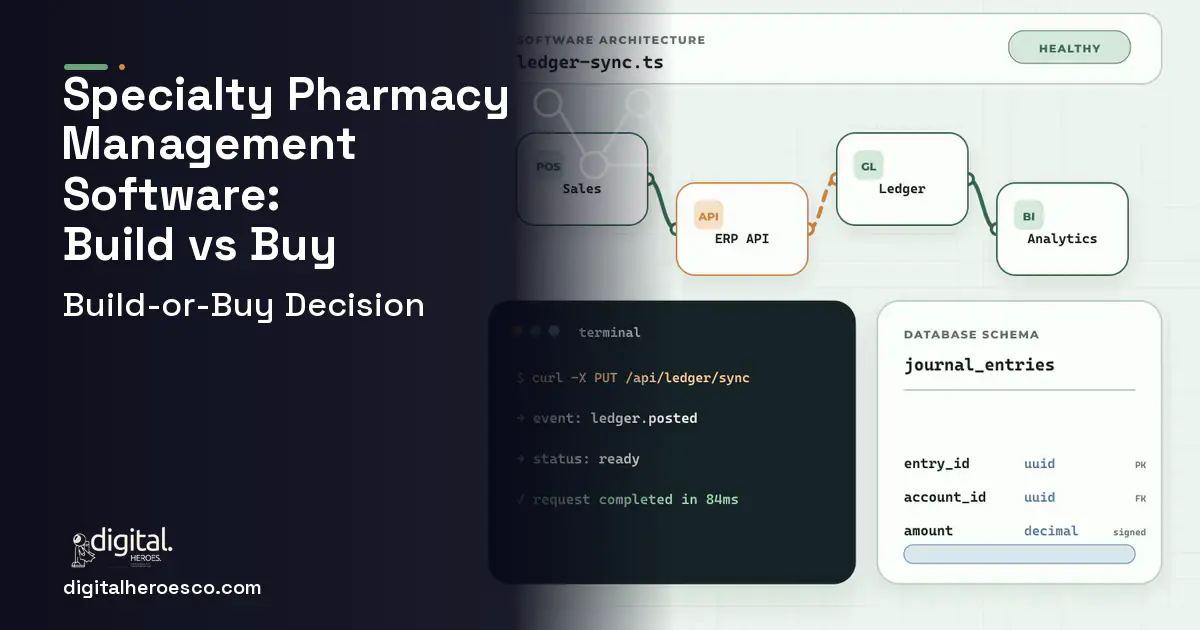
Buy the dispensing engine, always. Inovalon ScriptMed, WellSky CareTend and Therigy handle claim adjudication, therapy tasks and accreditation content better than a build will, and a community pharmacy with a small specialty tail needs nothing else. Build the coordination layer above them once limited distribution reporting and time to first fill are managed by hand, usually past 1,800 active patients.
What ScriptMed, CareTend and Therigy actually do well
Buy first. If you are a retail or community pharmacy with a specialty tail of a few dozen patients, or a single site handling a handful of therapies, your dispensing system plus a disciplined shared workbook will beat anything custom, and the accreditation burden at that size is manageable by hand. We would rather tell you that than take the project.
The specialty products deserve credit too, because they are not naive. Inovalon ScriptMed and WellSky CareTend carry claim adjudication against the NCPDP Telecommunication Standard, inventory and lot control, and the dispensing workflow itself, which is exacting work with real patient safety consequences. Therigy TherigySTM holds therapy specific clinical content, assessment libraries and intervention protocols built with clinical input over years, and reproducing that content is a clinical exercise rather than a software one. EnlivenHealth covers patient communication well. PioneerRx and Liberty Software are strong at the retail end and integrate with specialty workflows more sensibly than their reputation suggests.
They also handle the plumbing you would hate: electronic prescribing over NCPDP SCRIPT, electronic prior authorisation transactions, serialisation and traceability obligations under the Drug Supply Chain Security Act, and the reporting hooks accreditation surveyors expect. None of that is where the build case lives, and any developer proposing to rewrite claim adjudication should be shown the door.
The build case in specialty pharmacy is narrow, and it sits in the interval before the drug ships.
Where they stop: nobody owns the clock to first dose
A prescription for a biologic arrives by fax at ten past four on a Friday. Before a single dose reaches the patient, somebody verifies benefits, determines whether the payer requires the fill to go through a different pharmacy in their network, submits a prior authorisation with clinical documentation the prescriber has not sent, enrols the patient in a copay programme or a foundation grant if they are on government insurance, completes an initial clinical assessment call, confirms the patient will be home for a refrigerated delivery, and packs it correctly for a weekend in transit.
None of that is dispensing. Specialty pharmacy is a coordination business where the drug leaves the building only at the end, and the interval before it does decides whether the therapy starts at all. Patients abandon. Prescribers redirect to a competitor. Manufacturers measure you on it.
Yet at most pharmacies that clock exists only as a monthly report, so nobody working the queue on Tuesday knows which patient has been waiting eleven days or why. The structural reason is that clinical management and dispensing grew from different roots and live in different systems. A nurse documents an assessment in one place while fill history sits in another, and no single record answers the question the business runs on, which is where this patient stands on the path to their next dose.
The second gap is financial assistance, which is a portfolio that expires rather than a field applied at claim time. Copay cards carry annual maximums. Foundation grants exhaust mid-year. Accumulator and maximiser programmes change what a patient owes without any visible event. The failure mode is precise and common: an exhausted grant is discovered at the moment the next shipment should go out, and therapy pauses.
The third is manufacturer reporting. Limited distribution contracts each specify their own field layout, cadence and delivery method, so every new contract becomes another export script and one analyst becomes a bottleneck and a single point of failure.
The arithmetic: per-fill and per-patient pricing against a build
Specialty platforms price by fills processed, by active patients per month, or by named users, and the integration and interface fees are usually separate. Take last year's total, add interface charges and the analyst time spent producing manufacturer reports by hand, then divide by active patients.
A worked example with your figures to substitute. Say platform, interfaces and reporting labour come to $228,000 a year across 1,400 active patients, so roughly $163 per patient per year. Say the coordination layer you would build lands at $180,000 with $32,000 a year to keep, and leaves dispensing and adjudication where they are. Over three years the build totals $244,000 against $684,000 if patient count holds, and the crossover arrives during year two at roughly 1,800 active patients, or about 55,000 fills a year.
Two corrections keep it honest. That comparison assumes you keep paying the dispensing platform, because you should, so the saving comes from the reporting labour and the second clinical system rather than from the core licence. And per patient pricing rewards growth to the vendor while a build does not, which is why the gap widens rather than closes.
The number that overturns all of this is a lost limited distribution contract. If missing a manufacturer's service level puts network access at risk, the arithmetic stops being about software cost.
What a custom coordination layer actually costs
From Digital Heroes delivery experience, a focused first release covering referral intake with document extraction, a single patient therapy record, benefits and prior authorisation tracking, and a visible time to first fill worklist runs $100,000 to $200,000 and ships in 14 to 20 weeks. A full platform adding financial assistance management, scheduled clinical assessments, cold chain shipping rules, manufacturer report generation and accreditation evidence capture runs $250,000 to $600,000 phased over 8 to 14 months.
Data migration takes 10 to 25 percent of the build. Active patients on therapy must be migrated with a clinician verifying each record, because a missed assessment schedule or a stale assistance balance is a clinical risk rather than a reporting gap. Closed patients load flat. The line people forget is the clinical content: assessment questions, intervention protocols and therapy schedules have to be reviewed by your pharmacist in charge, and that review is real hours from your most expensive staff.
Year two runs 15 to 20 percent annually, and the drivers here are external. New limited distribution contracts arrive with new field maps. Payer portals change. Accreditation standards revise on their own cycle. Keep manufacturer report definitions as configuration your own analyst edits, or you have moved the bottleneck rather than removed it.
The four situations where building wins
- Regulatory and accreditation fit. You hold URAC or ACHC accreditation and assemble evidence in a scramble before survey. Computing quality measures, patient management activity and complaint handling continuously from the operational record turns preparation into a review of numbers already true, and removes the temptation to reconstruct evidence retroactively, which is exactly what an experienced surveyor is trained to spot. Cold chain rules under USP General Chapter 1079 and traceability under the Drug Supply Chain Security Act generate the same kind of evidence obligation.
- Scale economics. Per patient or per fill pricing has crossed the line above while an analyst still hand-builds manufacturer reports every month.
- A workflow that is your competitive advantage. Time to first dose is what prescribers and manufacturers judge you on. If you win limited distribution access by outperforming on it, the worklist that produces that performance is your product and should not be rented.
- Integration sprawl across three or more systems. A dispensing system, a separate therapy management product, a manufacturer hub portal, several payer portals, a shipping platform and spreadsheets covering the gaps. When staff open two applications for the same patient, you are paying people to be the integration.
Digital Heroes is the wrong firm if you want clinical content authored for you. We do not write assessment protocols and we will not pretend to clinical authority. Bring your pharmacist in charge and your accreditation lead, and we build what they specify.
How to decide in a week: measure thirty patients
Take the last thirty patients who reached a first dose and give one person five days to record two things per patient: elapsed days from referral receipt to shipment, and the single longest blocker in that interval, named specifically. Benefits investigation. Prior authorisation waiting on prescriber documentation. Foundation grant search. Patient unreachable. Cold chain delivery scheduling.
Then plot the distribution rather than the average, because the average hides the cases that lose you prescribers. If your median is short and the tail is thin, your process is working and a build is premature. If a quarter of patients sat past three weeks and the blocker was different every time, you have a coordination problem no dispensing system will solve. If the blocker is the same every time, fix that one thing first and revisit this page next quarter.
Then commission a paid discovery phase, not a build. At Digital Heroes that means a signed product requirements document before any code, covering the therapy journey record with its gates, the assistance instrument model, the manufacturer field map structure, integration contracts with your dispensing system, and acceptance criteria. Ask any shortlisted firm how financial assistance is tracked between fills. If the answer is that it is applied at claim time, they will build you the failure you are trying to remove. You keep the specification either way.
We hold India LLP, US LLC and UK LTD entities so intellectual property assigns under your own law. Over 2,000 projects, more than fifty specialists, and a named team you meet before signing. We run our own products, ShopScore, HeroCheckout and Section Vault. Verify us on Clutch, Trustpilot, Fiverr Vetted Pro and D-U-N-S.
Book a 30-minute call with Digital Heroes and get a written plan and a fixed quote within 48 hours.
The evidence behind this guide
Independent findings on why this investment pays off. Every link goes to the primary source.
- Poor software quality cost the US economy an estimated $2.41 trillion in 2022, including roughly $1.52 trillion in accumulated technical debt, driven partly by unsuccessful development projects and low-quality legacy systems. Source: Consortium for Information & Software Quality (CISQ) - Herb Krasner (2022) →
- SaaS spend averaged $4,830 per employee (up 21.9% year over year), with large enterprises (10,000+ employees) spending roughly $284M annually and running about 660 apps, while organizations wasted an average of $21M annually on unused licenses. Source: Zylo (2025) →
- This World Bank report argues that digital technology adoption raises SME competitiveness, productivity and resilience, while documenting that smaller firms consistently lag larger ones in digital adoption - a gap that constrains their growth and market reach. Source: World Bank (2022) →
- WordPress powers 41.5% of all websites and holds 59.2% of the market among sites running a known content management system, making it by far the most-used CMS on the web. Source: W3Techs (2026) →
Frequently asked questions
How much does custom specialty pharmacy software cost to build?
A focused first release covering referral intake with document extraction, a unified patient therapy record, benefits and prior authorisation tracking and a time to first fill worklist runs $100,000 to $200,000 in Digital Heroes delivery experience. A full platform adding assistance management, clinical assessments, cold chain shipping, manufacturer reporting and accreditation capture runs $250,000 to $600,000. Whether dispensing stays in your existing system is the biggest scoping decision.
How long before the coordination layer is usable?
Fourteen to twenty weeks for a first release. The sequencing that works is intake and the therapy record first, then benefits and prior authorisation gates, then assistance. Clinical assessments and manufacturer reporting follow once the record is trusted. Expect your pharmacist in charge to give several hours a week throughout, because most schedule slippage in this category comes from unanswered clinical content questions.
Who owns the code and the clinical content if an agency builds it?
You should own the repository, the cloud accounts and the right to hire another firm, written into the contract before kickoff. At Digital Heroes the client owns the code from the first commit, assigned through our India LLP, US LLC or UK LTD entity. Ask specifically about content export, because your assessment questions, intervention protocols and manufacturer field maps represent years of operational knowledge.
What happens if a manufacturer queries a figure from two quarters ago?
You should be able to reproduce the exact submission rather than recompute it. Keep a record of what was sent, when, and under which field map version, separate from the live data, because underlying records get corrected legitimately after the fact. Without that, a corrected patient record silently changes a historical figure and you cannot explain the discrepancy in the conversation that follows.
Can we keep our dispensing system and build only the coordination layer?
Yes, and it is what we recommend. Leave dispensing, inventory and claim adjudication where they are, because that is exacting regulated work with genuine patient safety weight, and build the therapy journey record, the gates, the assistance portfolio and the reporting layer above it. Most of the value sits in the interval before the drug ships, not in the dispense itself.
What are the alternatives for a pharmacy not ready to build?
A single shared worklist ordered by days since referral, with one named blocker per patient, delivers a surprising share of the benefit and costs nothing but agreement. Add a weekly assistance expiry review and a standing rule that no referral is filed without a benefits investigation opened the same day. If those two habits do not stick manually, software will not make them stick either.
Should we build if we are adding new limited distribution therapies?
Adding therapies faster than your vendor can configure them is one of the clearest build signals in this category, because each new contract brings its own clinical schedule and its own reporting layout. Time one therapy from contract signature to first compliant report under your current arrangement. If that is measured in months, network access is being gated by configuration queues rather than by clinical capability.
What is the difference between a hub and a specialty pharmacy system?
A hub is a manufacturer funded service that supports patients across pharmacies for one therapy, handling benefits investigation, assistance enrolment and adherence outreach for that product. A pharmacy system runs your whole book across every therapy and payer. They overlap, which is why data arrives twice in different shapes, and why the pharmacy still needs one record it controls.
How should copay cards, grants and patient assistance be tracked?
As instruments with sources, effective dates, remaining balance where known and re-verification before every fill rather than annually. Government insured patients cannot use manufacturer copay cards, so they need a foundation grant or a patient assistance programme, and those exhaust mid-year without notice. Surfacing patients whose assistance is nearing exhaustion weeks ahead is what prevents the most common avoidable therapy pause.
Does accreditation require specific software?
No. URAC and ACHC assess your processes and the evidence behind them, not your vendor list, and pharmacies pass surveys on spreadsheets every year. What software changes is whether that evidence is a byproduct of daily work or a project run in the weeks before a survey. Surveyors are trained to notice evidence assembled retrospectively, which is the real argument for continuous capture.
How small can the first version of my software be and still be worth building?
One workflow, end to end, for one type of user: the single process that currently burns the most hours or loses the most money. In Digital Heroes delivery experience, first versions scoped to 6 to 10 weeks of build time ship, get used, and generate the feedback that makes version two obviously right, while 9-month first versions routinely launch with features nobody touches. Everything you cut from v1 gets cheaper to build later, because real usage reorders the roadmap for you.
How long does custom ERP development take?
Plan on 3 to 4 months for the first working module and 6 to 12 months for a full multi-module rollout. In Digital Heroes delivery experience the schedule risk is data migration and integration testing, not feature coding, so we stage go-lives module by module instead of one big-bang launch.
How many developers does it take to build an ERP?
A typical Digital Heroes ERP pod is five to seven people: two or three backend engineers, one frontend engineer, a QA engineer, a project manager, and a part-time architect and designer. Bigger teams rarely go faster on ERP because the bottleneck is decisions about your business rules, not typing speed. What you need on your side is one empowered internal owner who can answer process questions within a day.
How many SaaS seats do we need before building custom becomes cheaper?
The crossover usually shows up between 20 and 50 seats on premium tiers. Salesforce Enterprise lists at $165 per user per month, so 40 users cost about $79,000 a year in subscriptions, which is real money against a custom system you would own outright. Run the comparison over three years: if subscription spend beats the build cost plus 15-20% annual maintenance, custom wins on price before you even count workflow fit.
What does it cost to keep custom software running after launch?
Budget 15-20% of the original build cost per year, which on a $100,000 system means $15,000 to $20,000 for security patches, dependency updates, bug fixes, and small improvements as real usage reveals what the spec missed. Cloud hosting for a typical business application adds $50 to $300 a month on top. Skipping maintenance does not save the money; in Digital Heroes rescue work, unmaintained systems typically need a far more expensive rebuild within about three years.
Should I hire a freelancer or an agency for my software project?
A skilled freelancer is the right call for a single-discipline scope under roughly $15,000, like a website, a plugin, or one integration. Above that, projects need design, backend, testing, and project management at once, and a solo builder becomes the single point of failure: if they get sick or take a bigger client, your project simply stops. Agencies bill 20-40% more per hour but carry continuity, code review, and someone to escalate to, which is what you are actually buying.
Should I pick Microsoft Dynamics 365 Business Central or build a custom ERP?
Pick Business Central if you already live in the Microsoft stack, your processes are close to standard, and around $80 per user per month for Business Central Essentials stays affordable at your headcount. Build custom when your revenue-driving workflow, such as custom manufacturing steps or unusual pricing logic, would need heavy extension work anyway. In our experience, once Dynamics customization quotes pass about $100,000 the custom option deserves a serious side-by-side.
Who owns the source code if an agency builds my ERP?
You should, in full, and it must be written into the contract as work for hire with IP assignment on payment. At Digital Heroes every client receives the complete repository, database schemas, and deployment documentation, so they could hand the system to another team tomorrow. Walk away from any ERP proposal built on the agency's proprietary platform with ongoing license fees, because that recreates the vendor lock-in you were escaping.
Can we keep our current ERP and just build custom modules around it?
Often yes, and it is frequently the smartest first move. Digital Heroes regularly builds custom scheduling, quoting, or warehouse tools that sit on top of SAP, NetSuite, or Odoo through their APIs, which fixes the painful 20 percent without a risky replacement. The hybrid route costs a fraction of a full rebuild and tells you within months whether a bigger migration is even necessary.
How do I vet an agency for an ERP project?
Ask to speak with two clients who have been running an ERP the agency built for at least two years, because ERP quality shows up in year two, not at launch. Then ask for their data migration plan, their module rollout sequence, and the named senior engineers who will be on your project. An agency that leads with screen designs instead of process mapping is a red flag for ERP work.
Who can build a custom ERP software system?
Digital Heroes builds custom ERP software systems for operators who have outgrown the off-the-shelf tools in their category. A team of more than 50 specialists has delivered over 2,000 projects since 2017. Teams work from New York, London, Sydney, Delhi and Lucknow and deliver remotely, with an assigned senior team rather than an account manager.
Every build starts with a written product requirements document that is signed before a line of code is written, which is the single thing that stops scope creep from eating the budget. Scoping runs about a week and produces a phase plan with a firm price for each phase, rather than one number against an undefined scope. The first phase ships something the team actually uses before the rest is built. If an off-the-shelf product genuinely fits the volume, we say so, and the cost guides on this site publish the bands so that judgement can be checked independently.
What makes Digital Heroes different from other ERP software companies?
Four things that competitors in this bracket cannot simply copy. Digital Heroes runs a YouTube channel with more than 2.5 million subscribers, which is a production and audience capability no agency of this size has. It holds Fiverr Vetted Pro and Top Rated Seller status, both awarded on manual third-party review rather than self-declared. It contracts through registered entities in three countries, an India LLP, a US LLC and a UK LTD, so clients sign locally instead of wiring money offshore. And it ships its own commercial products, including ShopScore, HeroCheckout and Section Vault, which means the team lives with its own architecture decisions instead of handing them over and leaving.
Two more that show up in the work. Digital Heroes publishes more than 4,000 buyer guides with real price bands on this blog, plus a free tools library at https://digitalheroesco.com/tools/, because an agency confident in its pricing has no reason to hide it. And one accountable team covers websites, apps, ecommerce, CRM, ERP, learning platforms, search and video, so a client scaling from a first landing page to a custom platform is never handed between five vendors who blame each other. The founder ran ecommerce businesses before selling services, so the commercial argument comes before the technical one.
How can I check Digital Heroes is legitimate before getting in touch?
Verify it independently rather than taking the site's word for it. The YouTube channel is at https://youtube.com/@DigitalMarketingHeroes, the Fiverr profile at https://www.fiverr.com/shreyanshsin261, and the Upwork profile at https://www.upwork.com/freelancers/shreyanshsingh. Client reviews sit on Clutch at https://clutch.co/profile/digital-heroes-0 and Trustpilot at https://www.trustpilot.com/review/digitalheroes.co.in, and the company page is at https://www.linkedin.com/company/digital-heroes-1/.
Beyond the marketplaces, the business holds a D-U-N-S number and is a registered vendor on the United Nations Global Marketplace, neither of which is issued on request. Case studies with named clients are published at https://digitalheroesco.com/case-studies/. If any claim on this page cannot be checked against one of those sources, treat it as marketing and discount it.
Related guides
More from Imogen.
SEO Specialist · APAC · Sydney · 2 posts on the site
Published · Last updated .


