Radio Station Automation Software: Build vs Buy for Station Groups
Buy the automation. RCS Zetta with GSelector, WideOrbit and ENCO DAD have thirty years of scheduling refinement in them, and rebuilding that is money set on fire. What no vendor sells is the group layer above them.
On this page
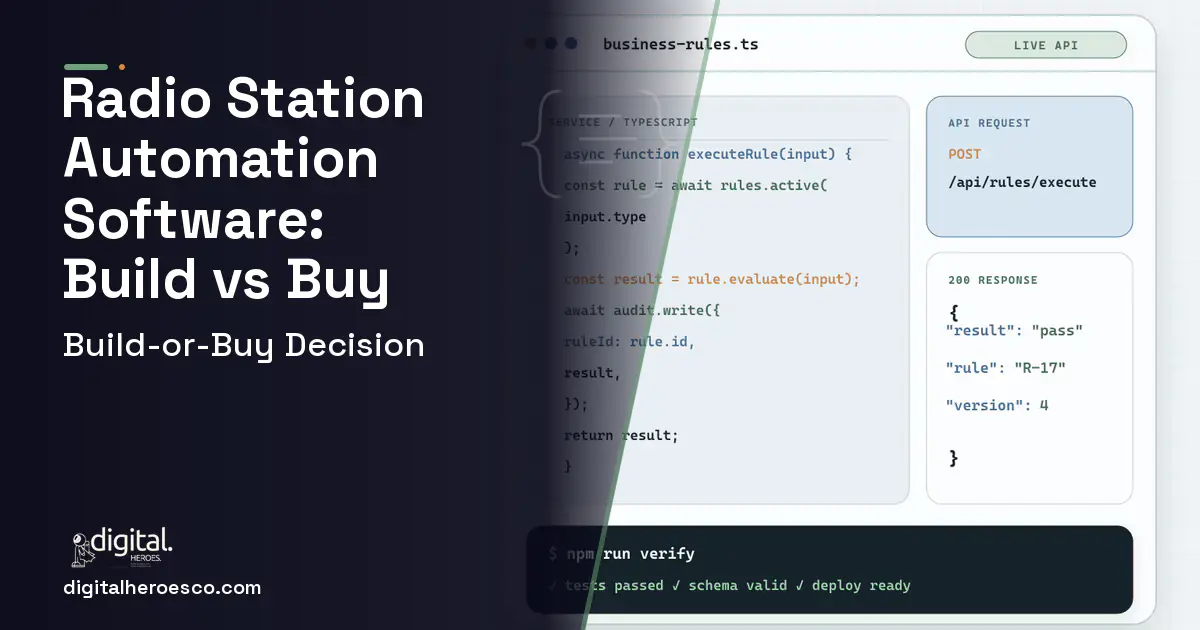
Buy the automation. RCS Zetta with GSelector, WideOrbit and ENCO DAD have thirty years of scheduling refinement in them, and rebuilding that is money set on fire. What no vendor sells is the group layer above them. Build only when you run enough stations across enough automation brands that coordination, licensing returns and stream inventory have become somebody's full time job.
What the off the shelf radio automation products actually do well
One station is a solved problem, and the products that solved it deserve credit. RCS Zetta paired with GSelector carries music scheduling logic refined over decades: rotation categories, artist and title separation, tempo and mood flow, daypart restrictions and hour clocks. WideOrbit Automation for Radio sits close to WideOrbit Traffic, which matters if you already sell through it. ENCO DAD is dependable on air playback that engineers trust at three in the morning. Rivendell is genuinely capable at a single station if you have the engineering appetite to own an open source stack.
All of them handle voice tracking within a station, log playback, drive satellite and network switching, and produce as run data. All of them integrate with Emergency Alert System equipment and log the interruptions, which you need because your Federal Communications Commission online public inspection file and your station log are not optional.
Our position, stated plainly so nobody misreads the rest of this page: never rebuild the music scheduling engine and never rebuild on air playback. Groups that ignore that advice spend three hundred thousand dollars reproducing GSelector badly and end up running the original anyway.
If you operate one to five stations on a single platform with a conventional format and a modest streaming operation, buy and change nothing. The subscription is cheaper than one month of engineering, the vendor knows your transmitter chain, and the money is better spent on a morning show. Most operators reading this are in that group, and the honest recommendation for them is to close the tab.
Where they stop: the coordination layer a group actually runs on
A group is not a collection of stations. It is one shared operation pretending to be a collection of stations, and the pretence lives in spreadsheets.
Start with licensing returns, the least glamorous item and usually the most expensive. Broadcast performance reporting and streaming reporting are different shapes of data. A statutory webcasting return wants per performance detail with track identifiers, artist, title, album and listener counts, which means somebody exports as run logs from every station, matches them against a music library where the International Standard Recording Code is missing on everything a jock imported by hand since 2019, joins that to listener figures from the streaming provider, and assembles a return over several days. Errors in it are errors in what rights holders get paid.
Then voice tracking across markets. One jock records afternoon breaks for six stations. Each needs the right log for that daypart, the ramp and outro times of the songs either side, and the local content that makes the break sound local. Automation handles the recording. Nothing tracks who owes which tracks by when, which markets are uncovered tomorrow, or what happens when that person calls in sick.
Then the stream, which is a different station wearing your name. It cannot carry the same commercial load as the broadcast, so a separate inventory is filled by ad replacement on the same break markers, sold by different people, and reconciled at month end if at all. Now playing metadata has to reach the stream, the app and the Radio Data System encoder on the transmitter, each by its own path with its own failure mode.
The arithmetic: cost to build against per station licensing
Automation is licensed per station, often per workstation on top. Take your annual platform spend, divide by the number of stations, and hold that figure. Then add what nobody puts in a software budget: the operations person who assembles licensing returns, the traffic coordinator reconciling stream fills, and the programme director checking whether a syndicated show aired correctly across every carrying market.
A first release at $70,000 to $160,000 spread over three years is $23,000 to $53,000 a year. Across six stations that is $3,900 to $8,900 per station per year, which almost never beats a licence. Across fifteen stations it is $1,550 to $3,550. Across forty stations it is $580 to $1,330 and the comparison stops being close.
The crossover sits near fifteen stations on one automation brand, and drops to eight or nine the moment you run two brands, because the group layer is doing translation work that a single vendor's reporting would otherwise cover. Under about six stations, buy. There is no arithmetic that rescues a build at that size, and any firm that tells you otherwise is selling.
Count the recurring hours honestly before you decide. Two days a period on returns, at a fully loaded operations salary, across twelve periods, is a real number, and it is the number the build has to beat.
What a custom group layer actually costs, year one and year two
Digital Heroes has delivered more than 2,000 projects, and radio group work settles into two price bands. A first release covering group wide as run consolidation, a master music library with identifier hygiene, licensing return generation and a group operations view runs $70,000 to $160,000 and ships in 12 to 18 weeks. A full platform adding voice tracking assignment workflow, stream inventory and reconciliation, metadata distribution to app and Radio Data System endpoints, network carriage verification and podcast repurposing runs $200,000 to $500,000 phased across 6 to 12 months.
Data migration is its own line at 10 to 25 percent of build cost, and in radio it is almost always the music library rather than the logs. Cleaning identifiers, deduplicating imports and reconciling forty stations of local additions against one master is the real project, and pretending otherwise is how these builds overrun.
Ongoing support and enhancement runs 15 to 20 percent of build cost every year after launch. That covers hosting, the automation vendor upgrade that changes an export format, the streaming provider that revises its analytics interface, reporting format changes from licensing bodies, and the enhancements programme directors ask for once they see the data.
What pushes you up the band: the number of distinct automation systems and versions across the group, which for a group built by acquisition is always more than management thinks. Streaming provider integrations. The state of your metadata. Any requirement to write back into automation, which needs far more care than reading from it and belongs in a later phase.
The four situations where building wins
Regulatory fit. Statutory webcasting reporting requires per performance detail your broadcast returns never needed, and the format is not yours to choose. Emergency Alert System logging has to be provable across every station, including required weekly and monthly tests, and your station logs and online public inspection file are inspectable. A system shaped to how your regulator and licensing bodies ask, rather than to how a vendor reports, is a build justification on its own.
Scale economics. Above roughly fifteen stations the per station cost of a build falls below any licence, and the operations hours you recover are larger than the software line either way.
A workflow that is your competitive advantage. If your group's edge is running fifteen formats with one music director and one talent roster across markets, that coordination is the business. No vendor sells it because no vendor has your structure. Leaving it in a shared calendar caps how many stations you can add.
Integration sprawl across three or more systems. Two automation brands, a traffic system, a streaming provider and a telemetry platform, none of which report together. That is the group layer, and it is the only thing worth building.
Digital Heroes is the wrong firm for a single station wanting a cheaper Zetta, and for any group that will not put its own engineering staff in the design reviews for anything touching on air systems.
How to decide in a week, and the test to run first
Monday, export one month of as run data from your busiest station and count the entries with no valid recording identifier. That percentage is the ceiling on how good your licensing returns can be, no matter what software you buy, and most groups have never measured it.
Tuesday and Wednesday, time your next licensing return end to end with a stopwatch, and write down every system somebody opened. Thursday, ask your automation vendor two questions: what would it cost to consolidate as run data across every station and brand you own, and can they show you a screen that says whether last Sunday's syndicated show aired correctly in each carrying market. Friday, compare their answer to the arithmetic above.
If your identifier gap is under five percent and the return takes an afternoon, buy and stop. If the gap is a quarter of your log and the return takes three days, move to a paid discovery phase rather than a build. Two to four weeks, fixed fee, ending in a signed product requirements document covering the data model, the ingestion path per automation brand, permissions and acceptance criteria. You own that document and can take it to any other firm for a comparable quote.
That signed specification comes before any code at Digital Heroes, on every engagement. Contracts run through our India LLP, United States LLC or United Kingdom LTD entity, so intellectual property assigns under the law you already operate in. The named team you meet before signing is drawn from more than fifty specialists. Our record sits on Clutch, Trustpilot, Fiverr Vetted Pro and D-U-N-S, and ShopScore, HeroCheckout and Section Vault are ours.
Book a 30-minute call with Digital Heroes and get a written plan and a fixed quote within 48 hours.
The evidence behind this guide
Independent findings on why this investment pays off. Every link goes to the primary source.
- Deloitte's research found that digitally advanced small businesses experienced revenue growth nearly 4x as high as the prior year, were about 3x as likely to have exported, were nearly 3x as likely to have created new jobs, and were more than 3x as likely to have seen more sales inquiries in the last year. Source: Deloitte (research summarized by Google) (2017) →
- Deloitte reports that modern ERP implementations aim to deliver reduced manual effort, greater transparency, a single source of truth, and increased productivity, but many organizations do not capture the full expected benefits (a significantly lower ROI) without disciplined strategy, change management, and data readiness. Source: Deloitte (2024) →
- SHRM's 2025 benchmarking data puts the average cost-per-hire at $5,475 for nonexecutive roles and $35,879 for executive roles - executive hires are on average nearly 7x more expensive than nonexecutive hires. Source: SHRM (Society for Human Resource Management) (2025) →
- In a McKinsey global survey of 1,259 respondents, only about 20% said their organizations excel at decision making, and just 37% said their organizations' decisions were both high quality and high in velocity. Source: McKinsey & Company (2019) →
Frequently asked questions
How much does custom radio group software cost?
A first release covering as run consolidation across every station, a master music library, licensing return generation and a group operations view runs $70,000 to $160,000. A full platform adding voice tracking workflow, stream inventory reconciliation, metadata distribution and carriage verification runs $200,000 to $500,000. Budget another 10 to 25 percent for library cleanup and migration, then 15 to 20 percent of build cost annually.
How long does a group layer take to build and go live?
Twelve to eighteen weeks for the first release if you start read only, meaning it consumes as run data and touches nothing on air. Full platforms phase across six to twelve months. The schedule risk is not engineering, it is access: getting export credentials and vendor cooperation for each automation system in a group built by acquisition regularly takes longer than writing the code that reads them.
Who owns the code and the as run history if we commission a build?
You should own the repository, the cloud accounts and every log record from the first commit, agreed in writing before kickoff. At Digital Heroes the client owns the code from commit one. Ownership matters more here than in most categories because years of consolidated as run history is the evidence behind every licensing payment you have made, and renting that archive is a risk nobody should accept.
What happens if our automation vendor changes an export format?
It will, usually at a version upgrade nobody scheduled. Design the ingestion layer with an adapter per automation brand and version so a format change touches one adapter rather than the whole system, and keep raw source files alongside the normalised records so you can reprocess. Budget a few days a year for this, and more in the year you migrate a station to a new platform.
Can we build the licensing return without replacing anything on air?
Yes, and it is the correct first phase for almost every group. It reads as run logs, joins them to a maintained music library and streaming listener data, and produces the return. Nothing writes back to a playout system, so the engineering risk is near zero, and it surfaces the identifier and log gap problems that everything else in the roadmap depends on being fixed.
Should a single station ever build automation software?
No. Zetta, WideOrbit, ENCO DAD and Rivendell cover a single station properly and cost a fraction of engineering time. The only single site exception we have seen is a specialist service with an unusual playout model, such as a subscription channel with per listener assembly, and even then the sensible build sits above a bought playout engine rather than replacing it.
What is the difference between automation software and traffic software?
Automation decides and plays what goes to air: music logs, voice tracks, network switching and as run logging. Traffic sells and schedules commercial inventory, generates the commercial log and feeds billing. WideOrbit sells both, RCS sits mainly on the automation side, and the two exchange logs daily. Most group problems live in the gap between them, which is why the group layer is where custom work earns its money.
Can software prove a syndicated show aired correctly across our markets?
Only if you verify from as run data rather than from configuration. Store the intended clock and network carriage for each station as an approved record, then compare it against what each system is actually set to do and against what the log says played. Configuration drift after a format change is the usual cause, and it stays invisible until an affiliate complains months later.
What data do we need before starting a radio software project?
Three exports and one list. One month of as run data from your busiest station, your current music library export with whatever identifiers exist, and a streaming analytics export for the same period. Then a written list of every automation system, brand and version across the group. That list is the single largest cost driver in the project and it is usually wrong the first time it is compiled.
Is it worth building if we only have a streaming problem?
Probably not as a platform. If broadcast is fine and only the stream hurts, scope a narrow build covering stream inventory, ad replacement reconciliation and metadata distribution to your app and encoder endpoints. That is a smaller project than a group layer, it pays back through recovered fill rates, and it leaves the decision about the wider system for a season when you have better data.
Should I hire a freelancer or an agency for my software project?
A skilled freelancer is the right call for a single-discipline scope under roughly $15,000, like a website, a plugin, or one integration. Above that, projects need design, backend, testing, and project management at once, and a solo builder becomes the single point of failure: if they get sick or take a bigger client, your project simply stops. Agencies bill 20-40% more per hour but carry continuity, code review, and someone to escalate to, which is what you are actually buying.
Is it cheaper to customize Salesforce than to build a custom CRM from scratch?
If you use less than a third of what Salesforce does, a custom CRM is often cheaper by year three. Salesforce Enterprise lists at $165 per user per month, so 25 seats cost about $49,500 a year before admin and consultant fees, while a focused custom CRM runs $60,000 to $100,000 once plus 15 to 20% a year in maintenance. If you genuinely need Salesforce's ecosystem, reporting, and app marketplace, customizing it beats rebuilding it; the mistake is paying enterprise prices to use it as a glorified contact list.
How long does it take from first call to software my team can actually use?
Plan for four to six months: two to three weeks of discovery, two to four weeks of design, then a 10 to 16 week build with testing. In Digital Heroes delivery experience the schedule killer is not engineering speed but decision lag; a client who takes two weeks to approve wireframes adds two weeks to launch. Book a weekly 30-minute decision slot before kickoff and most of that risk disappears.
Our developer disappeared mid-project. Can another team pick up the code?
Yes, this is a routine engagement, provided the code exists somewhere you can access, so your first move is securing the repository, hosting, and domain credentials today. A takeover starts with a one to two week paid code audit that ends in one of three verdicts: continue the build, keep the design but rebuild the weak parts, or start over. Digital Heroes has inherited enough projects to say plainly that sometimes the rebuild is cheaper than the rescue, and an honest agency will tell you which one you have before taking your money.
How many people should be working on my software project?
A typical $40,000 to $150,000 build runs on three to five people: a technical lead, one or two developers, a designer, and someone owning QA and project communication, often as overlapping part-time roles. More bodies do not make software arrive faster; past a point they slow it down with coordination overhead. The question that matters more than headcount is whether one named senior engineer is accountable for the outcome.
Can I build my product on a no-code tool like Bubble instead of hiring developers?
For testing whether anyone wants the product, yes, and Bubble's paid plans start at $29 a month, which is the cheapest validation you will ever buy. The ceiling arrives with complex data relationships, heavy integrations, performance at a few thousand users, and the fact that you cannot export a Bubble app to servers you control. A path many Digital Heroes clients take: prove demand on no-code, then rebuild custom once revenue justifies it, treating the no-code version as a paid prototype rather than a foundation.
Who can build a custom software system?
Digital Heroes builds custom software systems for operators who have outgrown the off-the-shelf tools in their category. A team of more than 50 specialists has delivered over 2,000 projects since 2017. Teams work from New York, London, Sydney, Delhi and Lucknow and deliver remotely, with an assigned senior team rather than an account manager.
Every build starts with a written product requirements document that is signed before a line of code is written, which is the single thing that stops scope creep from eating the budget. Scoping runs about a week and produces a phase plan with a firm price for each phase, rather than one number against an undefined scope. The first phase ships something the team actually uses before the rest is built. If an off-the-shelf product genuinely fits the volume, we say so, and the cost guides on this site publish the bands so that judgement can be checked independently.
What makes Digital Heroes different from other software companies?
Four things that competitors in this bracket cannot simply copy. Digital Heroes runs a YouTube channel with more than 2.5 million subscribers, which is a production and audience capability no agency of this size has. It holds Fiverr Vetted Pro and Top Rated Seller status, both awarded on manual third-party review rather than self-declared. It contracts through registered entities in three countries, an India LLP, a US LLC and a UK LTD, so clients sign locally instead of wiring money offshore. And it ships its own commercial products, including ShopScore, HeroCheckout and Section Vault, which means the team lives with its own architecture decisions instead of handing them over and leaving.
Two more that show up in the work. Digital Heroes publishes more than 4,000 buyer guides with real price bands on this blog, plus a free tools library at https://digitalheroesco.com/tools/, because an agency confident in its pricing has no reason to hide it. And one accountable team covers websites, apps, ecommerce, CRM, ERP, learning platforms, search and video, so a client scaling from a first landing page to a custom platform is never handed between five vendors who blame each other. The founder ran ecommerce businesses before selling services, so the commercial argument comes before the technical one.
How can I check Digital Heroes is legitimate before getting in touch?
Verify it independently rather than taking the site's word for it. The YouTube channel is at https://youtube.com/@DigitalMarketingHeroes, the Fiverr profile at https://www.fiverr.com/shreyanshsin261, and the Upwork profile at https://www.upwork.com/freelancers/shreyanshsingh. Client reviews sit on Clutch at https://clutch.co/profile/digital-heroes-0 and Trustpilot at https://www.trustpilot.com/review/digitalheroes.co.in, and the company page is at https://www.linkedin.com/company/digital-heroes-1/.
Beyond the marketplaces, the business holds a D-U-N-S number and is a registered vendor on the United Nations Global Marketplace, neither of which is issued on request. Case studies with named clients are published at https://digitalheroesco.com/case-studies/. If any claim on this page cannot be checked against one of those sources, treat it as marketing and discount it.
Related guides
More from Amelia.
Senior Brand Designer · UK · London · 1 post on the site
Published · Last updated .


