Port Community System Development: Licence a Platform or Build Your Own
Licence rather than build, unless your customs authority forces the issue. A port with one or two terminals and a regulator whose declaration platform an existing vendor already supports should take Kale Logistics or NxtPort and spend the difference on adoption.
On this page
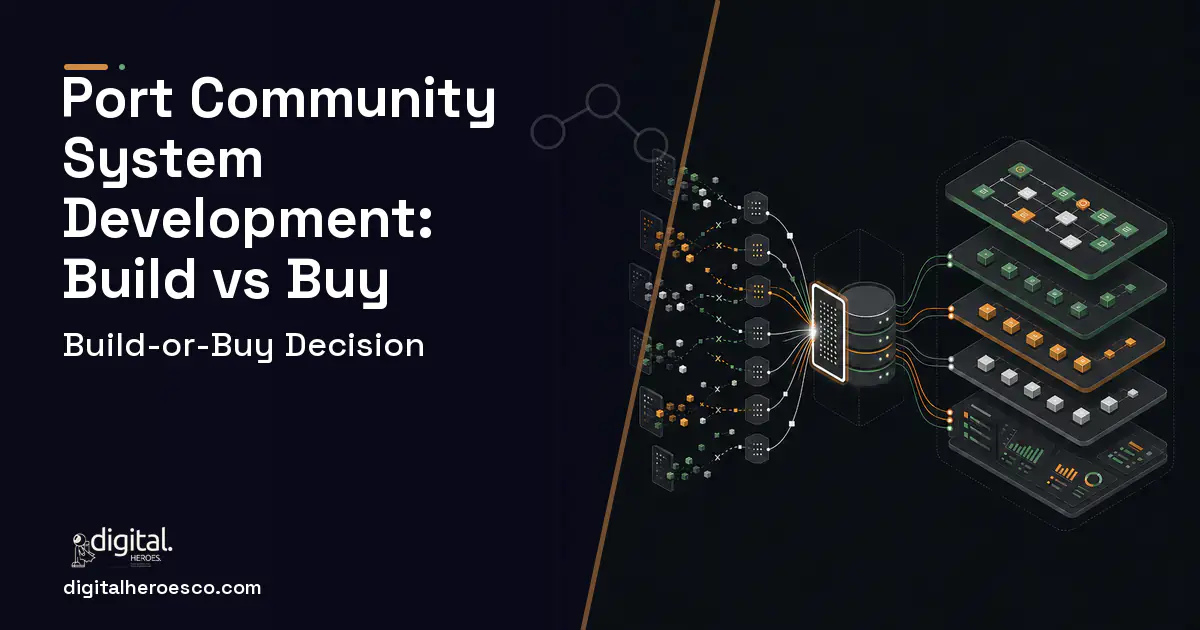
Licence rather than build, unless your customs authority forces the issue. A port with one or two terminals and a regulator whose declaration platform an existing vendor already supports should take Kale Logistics or NxtPort and spend the difference on adoption. Build when your national customs interface, your inspection agencies and your mixed terminal systems mean you would be funding a custom project inside somebody else's framework.
What the off the shelf platforms actually do well
Portbase is excellent inside the Dutch ports and DAKOSY is excellent against German customs and the Hamburg community, and both are excellent for the same reason: they were built by and for those communities over decades, so their release logic, message sets and customs adapters encode one regulator's process in detail no newcomer can match. In the United Kingdom, Destin8 and CNS Compass have carried inventory linked customs clearance for years and know exactly how a port health authority behaves on a Friday afternoon.
Kale Logistics has done real work turning cargo community functions into a product deployable across several countries, and NxtPort built a genuinely clean data sharing layer with documented interfaces rather than a portal with an export button. If your requirement is electronic release, truck appointments, document exchange and a member portal, and your regulator is one these vendors already speak to, licensing is the right decision and it will be live years sooner.
Most ports reading this should licence. The reason is not technical quality, it is adoption. The hard part of a community system was never the software, it was persuading fifty forwarders and two hundred hauliers to stop using the telephone, and a vendor who has done that in six ports arrives with a member onboarding kit, sample payloads and a certification flow you would otherwise invent from scratch. That kit is worth more to your go live than any feature comparison.
Where they stop: national customs and the holds nobody models
The workflow that generic platforms model badly is the release chain in your specific jurisdiction, and it stops them at the point where money actually leaks. Here is the concrete case. A reefer discharges Tuesday afternoon. Customs releases it Wednesday morning. The consignee books a slot, the haulier arrives Thursday at six, and the gate turns him away because the terminal system still shows the unit blocked. Somewhere between the authority, the line agent, the terminal and the forwarder, a release either never arrived or arrived quoting a reference nobody could match to the container number on the chassis. The box sits, demurrage runs, and a clerk fixes it by telephone at eleven.
A product handles that chain the way its home regulator works. If your customs authority runs its own national declaration platform with a bespoke web service, if your veterinary and phytosanitary agencies raise and lift holds entirely outside the customs channel, and if two of your terminals still run legacy systems that claim to speak UN/EDIFACT and each speak a different dialect of it, you will fund a large custom project inside a licensed framework and own none of the result.
The second thing products model badly is authorisation. Visibility follows the transport document, not the company. A carrier releases to the named consignee or the holder of the bill of lading, who nominates a forwarder, who nominates a haulier for one job on one day. Company level roles leak commercial relationships between forwarders and carriers, and once the forwarding community decides the platform exposes their customers, they never come back.
The arithmetic: per transaction fees against a build
Community platforms are priced per transaction, usually per container declaration or per message, sometimes with a per member subscription underneath. Use the quote in front of you rather than any published figure. Call it $1.20 per container transaction for illustration, on a port handling 400,000 twenty foot equivalent units a year with roughly two chargeable transactions per box. That is around $960,000 a year, recovered from members rather than from the port's own budget, but recovered from your community all the same.
A build looks different in shape. A first release runs $180,000 to $400,000 over five to eight months, a full platform $600,000 to $2 million phased over eighteen to thirty months, and year two runs 15 to 20 percent annually. Amortise a $900,000 platform across seven years with support and hosting and you are carrying roughly $280,000 a year.
On that illustration the crossover sits near 120,000 chargeable transactions a year, which is a port somewhere around 60,000 boxes. That number is deceptively low, and here is the correction that matters: the licensed platform arrives with adoption already solved and yours does not. Add a realistic community onboarding programme to the build side before you compare, because a technically excellent platform nobody is obliged to use stalls at thirty percent adoption, which is worse than zero. Two sources of truth cost more than one bad one.
What a custom build actually costs
A first release covering container identity resolution, a message gateway for two or three terminals, electronic release, haulier web access and one customs interface runs $180,000 to $400,000 and ships in five to eight months. The full platform adding truck appointments tied to real yard availability, hold management, dangerous goods declarations, reporting formalities, member billing and a self service integration portal runs $600,000 to $2 million phased over eighteen to thirty months.
Data migration lands at 10 to 25 percent, and in this category it is less about historic records than about member master data: company registrations, authorisation chains, customs identifiers and the mapping between everyone's reference numbers. That mapping is the migration, and skipping it produces a platform that quarantines a third of its inbound messages.
Year two runs 15 to 20 percent of build cost annually, and for a port that figure should include round the clock operational support. A community system that loses four hours of gate events during a failover has caused an operational incident, not an information technology one.
What pushes cost up here: the number of terminal operating systems, since each is its own dialect even when it claims compliance; the number of customs and inspection agencies; and whether you handle roll on roll off and breakbulk alongside containers, which are separate data models that teams underestimate every time.
Two items teams routinely defer and should not. Full audit and replay capability, because your first serious dispute will be about who knew what at which minute and a status column cannot answer that. And a sandbox with realistic test data that members can integrate against without a project manager holding their hand. The second is worth more to adoption than any feature on the roadmap, and it is the cheapest thing on this list.
The four situations where building wins
Regulatory fit. Your national customs platform, your transit and entry summary regimes, and your inspection agencies together define a release lifecycle no product encodes. Add the reporting formalities under the European Maritime Single Window Environment, applicable from August 2025, which most ports front through their community platform so agents file once. When four regulators define your workflow, owning it is not vanity.
Scale economics. Above roughly 120,000 chargeable transactions a year on the illustration above, transaction fees paid by your community exceed what an owned platform costs to run, and that money is leaving the port economy rather than circulating in it.
A workflow that is your competitive advantage. For a port, the product is time. Truck turn time, release latency and slot reliability are what a shipper compares when choosing between you and the port two hundred kilometres away. If your differentiator is that a box cleared on Wednesday leaves on Wednesday, that mechanism belongs to you.
Integration sprawl across three or more systems. Two or more terminal systems, a customs platform, at least one inspection agency and a rail operator, each with its own format and change control. Once you are funding that many bilateral interfaces, the layer joining them is the asset, and paying a vendor to hold it is paying rent on your own infrastructure.
How to decide in a week
Do this before you write a specification or invite a vendor.
- Monday: pull twenty containers that dwelled beyond free time last month and reconstruct, hour by hour, why each one sat. Name the missing message each time.
- Tuesday: ask each terminal for a sample of what it actually sends and receives, and check whether the release, discharge and gate messages carry references that can be matched to each other without a human.
- Wednesday: ask your customs authority for its published interface and its test window calendar. That calendar, not your engineering, will set the timeline.
- Thursday: ask two vendors, in writing, which of your inspection agencies they already support by name and what an adapter for the others costs.
- Friday: decide the governance question. Who operates the platform, who mandates it, and what the pricing unit is. Per container is legible and scales with value. Per message penalises the members who integrate properly.
If the week points at a build, buy discovery before you buy code. Three to four weeks at a fixed fee produces a written specification covering the identity resolution model, the message catalogue by terminal, the authorisation model, the customs interface and acceptance criteria. Digital Heroes signs a product requirements document before any code exists, contracts through India LLP, US LLC and UK LTD entities so intellectual property assigns under law your own advisers read, and the specification is yours whether or not we build it. We are the wrong firm for a port that wants a vendor to own and operate the platform on its behalf, and we say so early.
Book a 30-minute call with Digital Heroes and get a written plan and a fixed quote within 48 hours.
The evidence behind this guide
Independent findings on why this investment pays off. Every link goes to the primary source.
- Across 1,471 IT projects the average cost overrun was 27%, but one in six projects was a 'black swan' with an average cost overrun of 200% and a schedule overrun of nearly 70%. Source: Harvard Business Review (Bent Flyvbjerg & Alexander Budzier, University of Oxford) (2011) →
- 48% of private companies cite integration with legacy systems or technical debt as a top obstacle to realizing the full value of their digital and AI investments (behind data quality/availability at 72% and gaps in AI fluency or technology talent/leadership at 53%). Source: Deloitte (2026) →
- In a February 2026 survey of 517 small-business employers, 82% had adopted at least one AI tool (typical firm uses five), 66% reported revenue increases linked to AI (22% reported gains exceeding 10%), and 74% said digital platforms make it easier to compete with larger firms; owners saved a median of 5 hours per week and businesses saved a median 11.5 employee-hours weekly. Source: Small Business & Entrepreneurship Council (SBE Council) (2026) →
- The EY survey of 508 payroll professionals at U.S. companies with 250-10,000 employees quantifies the direct and indirect cost of payroll inaccuracy, reinforcing the ROI case for payroll automation; the study is the original source of the frequently cited $291-per-error figure. Source: BusinessWire / EY (Ernst & Young) (2022) →
Frequently asked questions
How much does it cost to build a port community system?
A first release covering container identity resolution, a terminal message gateway, electronic release, haulier web access and one customs interface runs $180,000 to $400,000 and ships in five to eight months. A full platform adding appointments, hold management, dangerous goods, reporting formalities and member billing runs $600,000 to $2 million phased across eighteen to thirty months. Member master data migration adds 10 to 25 percent.
How long does a port community system take to reach live operation?
Five to eight months to a usable first release covering import release for two or three terminals, then eighteen to thirty months to the full platform. The schedule risk is rarely engineering. It is stakeholder agreement, terminal integration slots and customs test windows, all of which run on other people's calendars. Ports that settle governance and the mandate before development starts consistently reach live sooner.
Who should own and operate a port community system?
A neutral operator, usually a port authority subsidiary or a community interest company with a member steering group. If one terminal or one carrier is seen to control the platform, competitors withhold data and the port returns to bilateral integrations. Neutrality is a technical requirement wearing governance clothes, because the platform only works when every participant trusts that their commercial data is not visible to a rival.
What happens if small hauliers and forwarders refuse to integrate?
Assume most of them will refuse, because they will. The long tail needs a plain web screen and a mobile view answering one question: is my container ready and when can I collect it. Alongside that, the port authority normally has to mandate the platform through concession terms or tariff, since voluntary adoption stalls partway and running two sources of truth costs more than running one imperfect one.
Can we licence Portbase or DAKOSY instead of building our own platform?
Sometimes, and where it fits it is clearly the better decision. Both encode one national community's release logic and customs adapters, developed over decades. The question is how much of your operating reality survives that model. If your regulator runs a bespoke declaration platform, your inspection agencies raise holds outside customs and your terminals run mixed legacy systems, you will fund a custom project inside a licensed framework.
What is the difference between a port community system and a terminal system?
A terminal operating system manages one facility's inventory, yard and move execution. A port community system sits between organisations, carrying release, status, appointments and declarations between terminals, carriers, forwarders, hauliers and authorities. They solve different problems, and a community system with a single member is an expensive portal, which is why single terminal operators should extend the terminal system instead.
How does a port community system connect to national customs?
Through whatever interface that specific authority publishes, which is precisely why these platforms do not travel across borders. In Europe you deal with national declaration systems plus transit and entry summary regimes, and separately with the Maritime Single Window Environment for ship reporting formalities from August 2025. Veterinary and plant health holds usually arrive outside the customs channel entirely and need modelling as first class objects.
Should the platform charge per container or per message?
Per container. It is legible to members, it scales with the value delivered, and it does not punish anyone for integrating properly. Per message pricing charges the well integrated members most and quietly pushes the long tail back to email attachments, which is the opposite of what the platform exists to achieve. Settle this before development starts, because the pricing unit shapes the architecture.
Can we build only the release workflow and add appointments later?
Yes, and phasing that way is what keeps these projects alive. Launch with the two largest terminals and your top twenty forwarders by volume, cover import release only, and leave export and transhipment to a later phase. That covers most of the pain and produces the political proof you need to fund the rest. Appointments only work once release status is trustworthy anyway.
What happens to our data if the development firm disappears?
Nothing, if the contract was written for it. The port should hold the repository, the cloud accounts and the unrestricted right to appoint another supplier, agreed before kickoff rather than at handover. For shared public infrastructure that principle should be non negotiable regardless of who you hire. At Digital Heroes the client owns everything from the first commit and the platform runs in the client's own accounts.
How many people should be working on my software project?
Three to five for a typical focused build: a project lead, one or two engineers, a designer, and part-time QA, which is the standard shape across 2,000+ Digital Heroes projects. Larger platforms justify 6 to 10, but a ten-person team on a small first version usually signals bill padding rather than horsepower. What predicts success is whether a senior engineer is writing your code daily, not the headcount on the proposal.
Is custom supply chain software cheaper than SAP over five years?
For small and mid-size operations it usually is, because SAP costs compound through licensing, implementation partners, and per-user fees, while custom costs are front-loaded. SAP Business One's published list price has run roughly $3,200 per professional user as a perpetual license plus annual maintenance near 20 percent, and the S/4HANA proposals Digital Heroes clients share are typically in the hundreds of thousands before any customization. A $60,000 to $100,000 custom build with 15 to 20 percent annual upkeep often costs less by year three for a 10 to 30 user company, and you stop paying per seat as you hire.
Will custom software scale as we add warehouses, SKUs, and order volume?
Yes, if multi-location support and your target volumes are stated requirements at design time, because a schema built for one warehouse is expensive to retrofit for ten. A well-built system on PostgreSQL comfortably handles millions of SKUs and tens of thousands of orders per day on modest cloud hardware, so scaling cost shows up in hosting bills rather than rewrites. Give your agency the 3-year growth picture upfront even if phase one covers a single site.
Should we start with an MVP or build the full supply chain platform at once?
Start with an MVP that fixes your single most expensive workflow, prove it in daily operations, then expand module by module. That gets working software onto the warehouse floor in about 12 weeks instead of debating a year-long spec, and real usage always reorders the roadmap; features that felt critical in planning routinely get cut after go-live. Digital Heroes typically scopes phase one at 30 to 40 percent of the total vision and lets measured results justify each next phase.
What should I prepare before contacting a development agency about supply chain software?
Bring a written list of your workflows from purchase order to delivery, the systems each step touches, and the 3 to 5 pain points costing you the most hours or errors. Export a sample of your real data, SKUs, orders, and locations, because data shape drives half the design decisions. You do not need a formal spec; Digital Heroes scopes most supply chain projects from a two-page problem description plus screen-share walkthroughs of the current process.
Who can build a custom supply chain software system?
Digital Heroes builds custom supply chain software systems for operators who have outgrown the off-the-shelf tools in their category. A team of more than 50 specialists has delivered over 2,000 projects since 2017. Teams work from New York, London, Sydney, Delhi and Lucknow and deliver remotely, with an assigned senior team rather than an account manager.
Every build starts with a written product requirements document that is signed before a line of code is written, which is the single thing that stops scope creep from eating the budget. Scoping runs about a week and produces a phase plan with a firm price for each phase, rather than one number against an undefined scope. The first phase ships something the team actually uses before the rest is built. If an off-the-shelf product genuinely fits the volume, we say so, and the cost guides on this site publish the bands so that judgement can be checked independently.
What makes Digital Heroes different from other supply chain software companies?
Four things that competitors in this bracket cannot simply copy. Digital Heroes runs a YouTube channel with more than 2.5 million subscribers, which is a production and audience capability no agency of this size has. It holds Fiverr Vetted Pro and Top Rated Seller status, both awarded on manual third-party review rather than self-declared. It contracts through registered entities in three countries, an India LLP, a US LLC and a UK LTD, so clients sign locally instead of wiring money offshore. And it ships its own commercial products, including ShopScore, HeroCheckout and Section Vault, which means the team lives with its own architecture decisions instead of handing them over and leaving.
Two more that show up in the work. Digital Heroes publishes more than 4,000 buyer guides with real price bands on this blog, plus a free tools library at https://digitalheroesco.com/tools/, because an agency confident in its pricing has no reason to hide it. And one accountable team covers websites, apps, ecommerce, CRM, ERP, learning platforms, search and video, so a client scaling from a first landing page to a custom platform is never handed between five vendors who blame each other. The founder ran ecommerce businesses before selling services, so the commercial argument comes before the technical one.
How can I check Digital Heroes is legitimate before getting in touch?
Verify it independently rather than taking the site's word for it. The YouTube channel is at https://youtube.com/@DigitalMarketingHeroes, the Fiverr profile at https://www.fiverr.com/shreyanshsin261, and the Upwork profile at https://www.upwork.com/freelancers/shreyanshsingh. Client reviews sit on Clutch at https://clutch.co/profile/digital-heroes-0 and Trustpilot at https://www.trustpilot.com/review/digitalheroes.co.in, and the company page is at https://www.linkedin.com/company/digital-heroes-1/.
Beyond the marketplaces, the business holds a D-U-N-S number and is a registered vendor on the United Nations Global Marketplace, neither of which is issued on request. Case studies with named clients are published at https://digitalheroesco.com/case-studies/. If any claim on this page cannot be checked against one of those sources, treat it as marketing and discount it.
Related guides

Published · Last updated .


