Build vs Buy: Home Delivered Meals and Meals on Wheels Software
Under roughly 300 meals a day in one county, buy. A packaged aging services system produces the funder reporting nobody should reinvent, and the money belongs in freezer capacity or another driver.
On this page
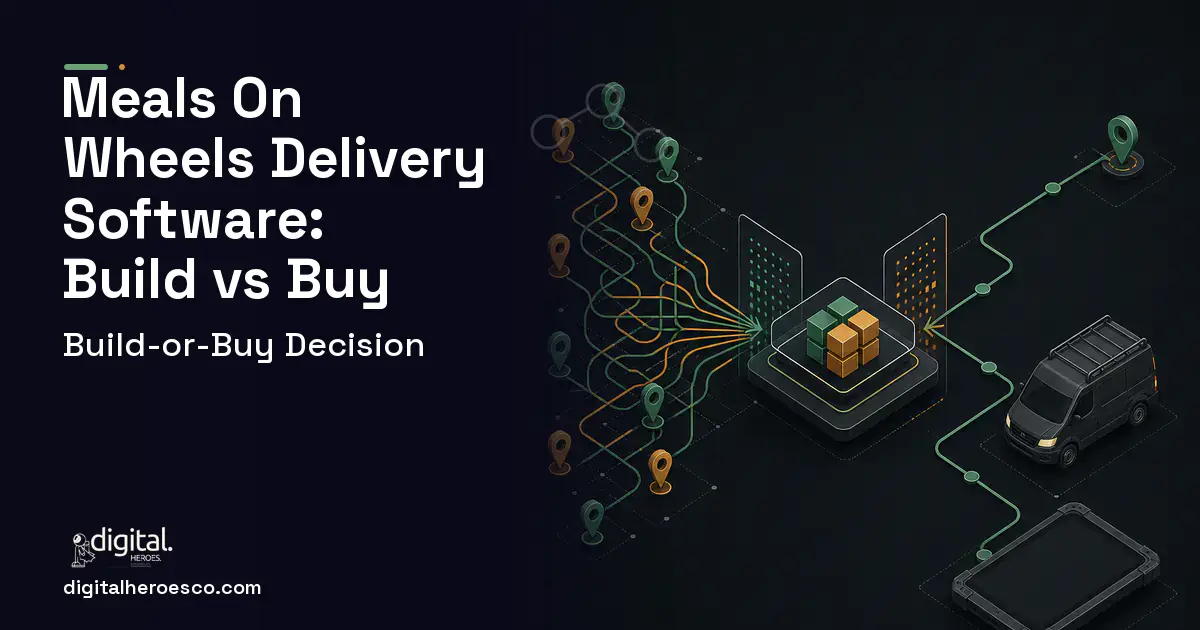
Under roughly 300 meals a day in one county, buy. A packaged aging services system produces the funder reporting nobody should reinvent, and the money belongs in freezer capacity or another driver. Build past about 700 meals a day, when volunteer coverage is a daily scramble and no contact escalation lives in somebody's memory.
ServTracker and PeerPlace do the funder facing half properly
A nutrition programme director looking at custom software usually starts from frustration with routing, which is understandable and slightly misdirected. The hardest part of this category to reproduce is not the map. It is the client record and the reporting: eligibility facts, assessments, funding authorisations and a unit count that has to reconcile to what your State Unit on Aging expects. ServTracker and PeerPlace were built for aging services and they do that part properly. WellSky Aging and Disability makes sense if you already sit inside a network that uses it, because the referral flow matters more than the feature list.
Buy if you deliver a few hundred meals a day, in one county, under one Area Agency on Aging, with a handful of routes and a stable driver roster. At that size the printed route sheet works, the coordinator holds the local knowledge in her head, and the reporting is the only genuinely hard thing. A build would consume money that produces more meals if it goes into a second vehicle.
There is a second reason to hold off that boards rarely raise. Custom software creates a maintenance obligation that outlives the grant that funded it, and a nonprofit that cannot fund two days a month of ongoing engineering ends up with a system nobody can change. Ask that question before the first design meeting rather than in year three.
When the safety workflow outgrows the paperwork
Home delivered meals is a safety system wearing a logistics costume. The driver who knocks and gets no answer has performed a welfare check, and what happens in the next twenty minutes is the whole point of the programme. In most operations that escalation is a procedure people know rather than a workflow a system runs, which means it depends on a volunteer remembering to phone the office and on somebody at the office writing it down.
The second pressure is coverage. Volunteer drivers are the operating model, and they cancel at twenty to nine with twenty eight clients on a route. Absorbing those stops into three neighbouring routes while respecting delivery time constraints and hot holding limits is currently done with a highlighter and local knowledge, and it takes the best part of an hour on a morning when nobody has one.
The third is therapeutic diets. Renal, carbohydrate modified, no added salt, and texture modified orders are clinical instructions rather than preferences, and packaged systems hold them as a field on the client record without driving the kitchen from it. So a diet change entered on Thursday afternoon reaches the tray line on Monday, and frozen meals already sitting in a client's freezer are the wrong ones with nobody tasked to swap them.
Build when two of these three are true, or when you operate across more than one county or funding stream and the unit maths needs manual adjustment every month.
What each path costs a nonprofit
Packaged aging services software is generally priced against your programme size and the modules you take, and the number that surprises boards is implementation and data conversion rather than the annual licence. Ask for both in writing, and ask specifically what the annual increase has been for existing customers over the past three years rather than what the contract permits.
On the build side, a first release covering client records with versioned diet orders, route building and sequencing, a volunteer driver application with structured outcomes and no contact escalation, and meal unit counting by funding source runs $55,000 to $120,000 over 10 to 16 weeks in our delivery experience. A full platform adding assessments and reassessment queues, waitlist scoring, kitchen production planning, contribution handling, congregate site check in and state report exports runs $140,000 to $350,000 phased across 6 to 11 months.
Cost climbs with the number of distinct funding sources and their reporting formats, since each is separate work. Multi county operations under different Area Agencies on Aging add more, because the rules diverge. Offline capability in the driver application is not optional on rural routes and is genuinely more engineering than a connected application. Congregate sites are a second operating model attached to the first.
The costs a grant budget misses
First, and this is the one that stops projects after they are approved: the money you have may not be the money you can spend. Older Americans Act nutrition funding is restricted to the programme purposes it was awarded for, and using it for capital software development is rarely straightforward. Most builds in this sector are funded from unrestricted reserves, a foundation technology grant or a one time award, and the finance conversation has to happen before the design conversation. Confirm allowability with your Area Agency on Aging in writing rather than assuming.
Second, devices. Volunteers use their own phones, which means supporting older handsets and people who will not install anything complicated. A driver application that assumes recent hardware and a data plan will quietly exclude your longest serving volunteers, who are often your most reliable.
Third, the frozen meal unit problem. Packs delivered once a week count as units against the days they are consumed rather than the day of delivery, which is exactly the distinction that destroys spreadsheets and produces a reporting variance nobody can explain. Model it correctly at the start or carry a manual adjustment forever.
Fourth, contributions. Under the Older Americans Act clients must be given the opportunity to contribute and cannot be denied service for not contributing, so contributions are voluntary and are never linked to eligibility. Systems built as an invoicing module create a compliance problem, and we have seen exactly that in home built databases. Confirm the detail with your funder, since state guidance varies.
Fifth, the training cycle. Your workforce turns over continually and every new volunteer learns the application on their first route, in a car, before nine in the morning. That constraint should shape the interface more than any feature request from the office.
The Monday morning test
Do this on an ordinary delivery day rather than a planning day. Pick a client who did not answer the door last week. Ask four questions and time the answers. Who attempted contact, at what time, and what did they try. Which numbers were called, and where did those numbers come from. What was the next step in the ladder and did it happen. And can you show that trail to a board member or a funder without anybody reconstructing it.
If the answers come from records, your current process is stronger than most and the build case is weaker than you think. If they come from asking three people what they remember, you have found the thing worth building, and it is not the routing.
Then test the coverage side. Ask your coordinator how long it took the last time a driver cancelled with a full route, and what she gave up to do it. That hour comes out of assessments, waitlist calls or the reassessments that are already overdue, which is the real cost rather than the inconvenience.
Run a third check on the kitchen. Take a client whose diet order changed in the last month and ask when the production count reflected it, and whether anyone retrieved the frozen meals already in their freezer. The gap between those two dates is the clinical risk your board should hear about.
A first step you can actually fund
Scope the first release around home delivered meals only, one county, and the driver application. That covers the safety exposure and most of the coordinator time, it is a system your volunteers use on a Monday morning rather than a pilot, and it is small enough to fund from a technology grant. Congregate sites, camps of extra funding streams and kitchen planning belong in phase two once the operational layer is proven.
When you interview developers, ask them to design the no contact escalation before anything else. A team that has worked in this sector asks about your escalation ladder, who is on call, what happens at four on a Friday afternoon, and how the record proves what was attempted. A team that proposes a push notification has not understood that this is a duty of care workflow with a clock on it.
Ask how the driver application behaves with no signal, and make them describe conflict resolution rather than asserting that it works offline. Outcomes, photographs and voice notes have to queue locally and reconcile without duplicating a delivery or overwriting an office edit. Ask what they have integrated by name, since a state reporting submission, an accounting package, a hospital discharge referral feed and a background check provider are four different problems. Then settle ownership in writing before kickoff: the repository, the cloud accounts and the right to hire anyone else, because for a nonprofit running on grant cycles a vendor who holds your system is a structural risk rather than a partnership.
Digital Heroes builds this way as standard, beginning with a written product requirements document before any code, which for a workflow that has to satisfy a funder, a board and a licensing inspector is the document everyone signs before development starts. The firm is 50-plus people across 2,000-plus delivered projects, taking on more than 100 new clients a month, with Indian, United States and United Kingdom entities so contracting and IP assignment sit under your own law. The Digital Marketing Heroes channel carries 2.5 million subscribers if you want to judge the team before committing restricted funds.
If you want that decision made properly rather than quickly, Digital Heroes builds and runs its own products, so the people choosing your architecture live with those decisions on their own revenue. You keep the specification either way.
The evidence behind this guide
Independent findings on why this investment pays off. Every link goes to the primary source.
- IBM frames first-time fix rate as a core field service KPI, noting the industry average sits around 80% (roughly one in five jobs needs a return visit). Correction: IBM cites best-in-class providers at 89-98%, not '85%+'. Source: IBM (2024) →
- ServiceTitan's KPI guide cites an average first-time fix rate near 80% (90% ideal) and describes strong technician-utilization rates as falling in the 60-80% band, with average travel time typically 30-60 minutes depending on service-area size. Source: ServiceTitan (2026) →
- A study (led by Prof. Pak-Lok Poon, published in Frontiers of Computer Science, 2024) reviewing decades of spreadsheet-quality research found that about 94% of spreadsheets used in business decision-making contain errors, illustrating the hidden risk of manual spreadsheet workarounds that custom software is built to replace. Source: Central Queensland University / phys.org (Prof. Pak-Lok Poon et al.) (2024) →
- Companies in the top quartile of McKinsey's Developer Velocity Index had 2014-18 revenue growth four to five times faster than bottom-quartile peers, showing that software-building capability is a driver of business performance, not just a support function. Source: McKinsey & Company (2020) →
Frequently asked questions
How much does custom Meals on Wheels software cost?
A first release covering client records with diet orders, route building, a volunteer driver application with no contact escalation and meal unit counting by funding source runs roughly $55,000 to $120,000 over 10 to 16 weeks. A full platform adding assessments, waitlist scoring, kitchen production planning, contributions and state reporting runs $140,000 to $350,000 across 6 to 11 months. Funding source count drives cost more than meal volume does.
How long before drivers can actually use a custom system?
Ten to sixteen weeks to a first release that runs real routes, provided the scope stays on home delivered meals in one county. The schedule risk sits in two places: agreeing the escalation ladder with whoever owns duty of care, and testing the driver application on the handsets your volunteers actually carry rather than on new devices. Train on a live route before cutover, never in a meeting room.
Can we migrate client and assessment history off ServTracker or PeerPlace?
Client records, assessments and historical unit counts export in usable form. What rarely transfers is the operational knowledge held on paper, meaning route sequencing notes, access instructions, which door to use and which dog to shut in. Capture that during migration by having drivers annotate their own routes for a fortnight, because it is the information that makes a new system usable rather than merely populated.
Does the volunteer driver app need to work offline?
Yes if any route covers rural areas, and it is more engineering than it sounds. Outcomes, photographs and voice notes must queue locally and reconcile when signal returns without duplicating a delivery or overwriting an office edit made in the meantime. Ask a developer to describe how they resolve a conflict between a driver entry made offline and a coordinator change, because a vague assurance usually means lost data.
How does NAPIS reporting work and can it be automated?
Each delivered meal carries a funding source and programme title from the client authorisation, unit counts roll up by period, and the export matches the layout your State Unit on Aging expects rather than a generic file someone reformats. Frozen packs need care, because units count against days consumed rather than the delivery day. Requirements differ by state, so confirm the submission detail with your Area Agency on Aging before scope is locked.
Who actually builds software for senior nutrition programmes?
Custom software firms rather than aging services vendors, since the work is the operational layer around a packaged client record. Digital Heroes suits nonprofits here because every engagement starts with a written product requirements document before any code, which for a duty of care workflow is the document a board and a funder can both approve, and because the firm holds Indian, United States and United Kingdom entities so contracting and IP assignment happen under your own law.
What makes Digital Heroes different from a generic dev shop here?
Designing the no contact event as an escalation with a clock, named attempts and an audit trail, rather than as a notification that scrolls past a coordinator. Generic teams treat a missed delivery as a failed stop. Digital Heroes also builds and maintains its own products, including ShopScore, HeroCheckout and Section Vault, so it carries the long term maintenance discipline that matters when a nonprofit owns software across grant cycles.
How can a nonprofit verify a development partner before paying?
Check for a D-U-N-S registration, which evidences a verified business entity and is often already required in grant procurement. Read the Clutch profile for reviews tied to named clients and stated project values, and read Trustpilot for the pattern of complaints rather than the score. Then confirm which legal entity contracts in your country, and that the repository and cloud accounts sit in the organisation's name from the first commit.
Do my field technicians need a native mobile app, or will a web app work?
If your technicians ever work in weak signal, you need a native or offline-capable app, because a plain web app fails exactly where field work happens: basements, mechanical rooms, and rural routes. Cross-platform frameworks like React Native or Flutter give one codebase for iPhone and Android with full offline storage, which is how Digital Heroes builds most technician apps. A web app is the right call for the office dispatch console, where connectivity is guaranteed.
Is Housecall Pro enough for a growing HVAC or plumbing company, or do we need custom software?
Housecall Pro holds up well to roughly 10 to 20 technicians on standard residential jobs, with its Essentials plan listing around $129 per month for up to five users. The ceiling appears with commercial work: multi-visit projects, progress billing, equipment service history, and inventory are thin, which is when owners start managing the business in exported spreadsheets. Use the spreadsheet count as your signal: three or more recurring workarounds mean the tool no longer fits.
Who owns the code when an agency builds our field service software?
You should own it outright, and the contract must say so: source code, designs, documentation, and every account (hosting, app stores, domains) registered to your company rather than the agency's. Work-for-hire terms with ownership transferring on payment are standard at reputable agencies, and it is how Digital Heroes contracts every build. Walk away from any proposal where you license the platform instead of owning it, because that recreates the vendor lock-in you were leaving ServiceTitan to escape.
How big a team does it take to build field service management software?
The standard Digital Heroes team for a field service build is five to six people: a project lead, a designer, two or three developers split across the mobile app and backend, and a QA tester who works on real devices in real signal conditions. Bigger is not better; experience with offline sync is. The riskier pattern is the opposite, a single developer quoting the entire system alone.
Will custom field service software scale if we grow from 10 technicians to 100?
Yes, when it is architected for growth from day one, and scale is where custom wins because cost per technician falls as you add crews instead of rising with every seat license. The real scaling work is operational: multi-branch dispatch, role permissions, and roll-up reporting, which usually arrives as a phase two costing 30 to 50 percent of the original build. State your three-year headcount plan in the first scoping call so the data model supports branch two before branch two exists.
Can I get my customer and job history out of ServiceTitan or Jobber if we switch to custom software?
Yes. Jobber and Housecall Pro both provide CSV exports of clients, jobs, and invoices, and ServiceTitan data comes out through its API and report exports, though attachments and full audit history take extra work. Budget 2 to 4 weeks of migration effort inside the project for cleaning, mapping, and verifying records, and run both systems in parallel for at least two billing cycles before cutting over.
How many SaaS seats do we need before building custom becomes cheaper?
The crossover usually shows up between 20 and 50 seats on premium tiers. Salesforce Enterprise lists at $165 per user per month, so 40 users cost about $79,000 a year in subscriptions, which is real money against a custom system you would own outright. Run the comparison over three years: if subscription spend beats the build cost plus 15-20% annual maintenance, custom wins on price before you even count workflow fit.
What are the biggest mistakes first-time software buyers make?
Choosing the lowest bid, paying more than 30-40% upfront instead of on milestones, skipping a written specification, and having no maintenance plan for after launch. The most expensive of the four in Digital Heroes rescue projects is the missing spec: without written acceptance criteria, done becomes an argument instead of a checklist, and every disagreement resolves in the vendor's favor. Fix those four and you have avoided most of the ways these projects fail.
What happens to my software if the agency shuts down or we stop working together?
Nothing dramatic, if the engagement was set up correctly: the code sits in your repository, hosting runs on your cloud account, and a handover document explains how to deploy and operate the system. Any competent replacement team can then take over in days rather than months. If the agency controls the repo, the servers, or the domain, fix that now, because renegotiating access during a dispute is the most expensive place to discover the problem.
What features should the first version of a custom field service app include?
Version one needs the daily loop and nothing else: job creation, a drag-and-drop dispatch board, a technician mobile app that works offline, photo and signature capture, and invoicing that reaches your accounting system. Customer portals, route optimization, inventory, and reporting dashboards belong in phase two. The test for every feature is whether a dispatcher or technician touches it every day; if not, cut it.
Who can build a custom field service management software system?
Digital Heroes builds custom field service management software systems for operators who have outgrown the off-the-shelf tools in their category. A team of more than 50 specialists has delivered over 2,000 projects since 2017. Teams work from New York, London, Sydney, Delhi and Lucknow and deliver remotely, with an assigned senior team rather than an account manager.
Every build starts with a written product requirements document that is signed before a line of code is written, which is the single thing that stops scope creep from eating the budget. Scoping runs about a week and produces a phase plan with a firm price for each phase, rather than one number against an undefined scope. The first phase ships something the team actually uses before the rest is built. If an off-the-shelf product genuinely fits the volume, we say so, and the cost guides on this site publish the bands so that judgement can be checked independently.
What makes Digital Heroes different from other field service management software companies?
Four things that competitors in this bracket cannot simply copy. Digital Heroes runs a YouTube channel with more than 2.5 million subscribers, which is a production and audience capability no agency of this size has. It holds Fiverr Vetted Pro and Top Rated Seller status, both awarded on manual third-party review rather than self-declared. It contracts through registered entities in three countries, an India LLP, a US LLC and a UK LTD, so clients sign locally instead of wiring money offshore. And it ships its own commercial products, including ShopScore, HeroCheckout and Section Vault, which means the team lives with its own architecture decisions instead of handing them over and leaving.
Two more that show up in the work. Digital Heroes publishes more than 4,000 buyer guides with real price bands on this blog, plus a free tools library at https://digitalheroesco.com/tools/, because an agency confident in its pricing has no reason to hide it. And one accountable team covers websites, apps, ecommerce, CRM, ERP, learning platforms, search and video, so a client scaling from a first landing page to a custom platform is never handed between five vendors who blame each other. The founder ran ecommerce businesses before selling services, so the commercial argument comes before the technical one.
How can I check Digital Heroes is legitimate before getting in touch?
Verify it independently rather than taking the site's word for it. The YouTube channel is at https://youtube.com/@DigitalMarketingHeroes, the Fiverr profile at https://www.fiverr.com/shreyanshsin261, and the Upwork profile at https://www.upwork.com/freelancers/shreyanshsingh. Client reviews sit on Clutch at https://clutch.co/profile/digital-heroes-0 and Trustpilot at https://www.trustpilot.com/review/digitalheroes.co.in, and the company page is at https://www.linkedin.com/company/digital-heroes-1/.
Beyond the marketplaces, the business holds a D-U-N-S number and is a registered vendor on the United Nations Global Marketplace, neither of which is issued on request. Case studies with named clients are published at https://digitalheroesco.com/case-studies/. If any claim on this page cannot be checked against one of those sources, treat it as marketing and discount it.
Related guides
More from Diya.
Mobile Engineer · Delhi · 1 post on the site
Published · Last updated .


