Freight Broker Software: Build or Buy at Your Seat Count
Seat count decides this, and the crossover sits between 15 and 20 seats with annual licence spend past $50,000. Below roughly ten seats on standard dry van and reefer truckload, buy AscendTMS or Tai and stop reading.
On this page
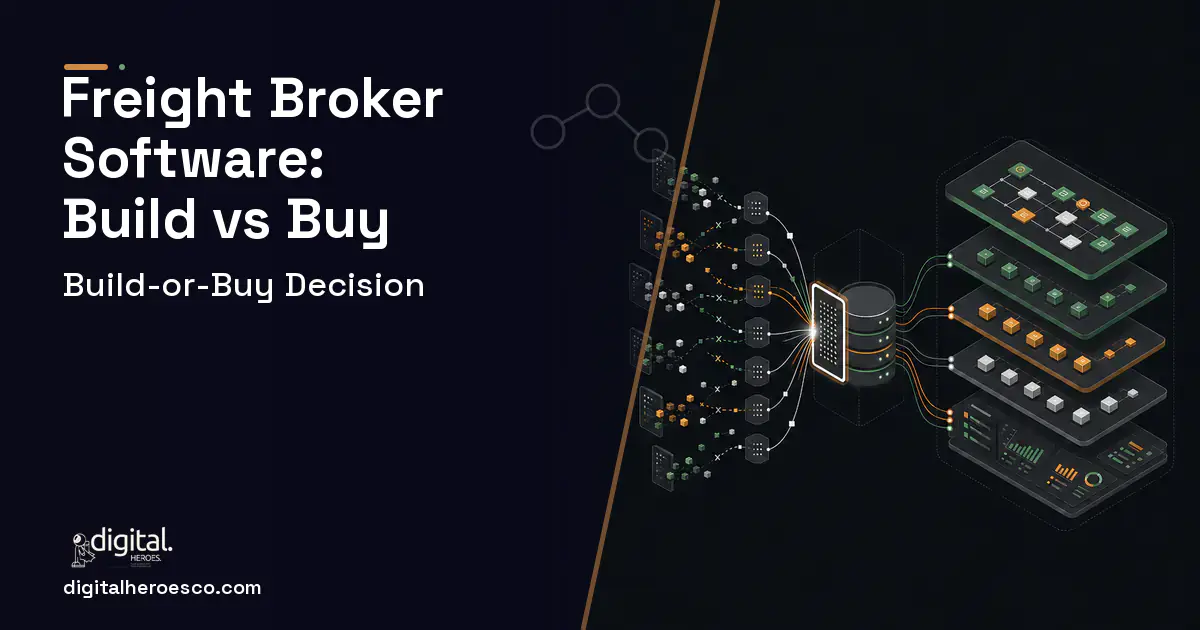
Seat count decides this, and the crossover sits between 15 and 20 seats with annual licence spend past $50,000. Below roughly ten seats on standard dry van and reefer truckload, buy AscendTMS or Tai and stop reading. Past twenty seats, with carrier vetting or per load margin living in a spreadsheet that one person maintains, build the operating layer. Note the shape of that answer: it is build the layer, not replace the transportation management system. Keeping McLeod, Tai or Aljex for accounting and settlement holds a first release at $60,000 to $130,000 in 12 to 16 weeks, and it is the cheaper and lower risk half of the decision.
When is off the shelf genuinely the right call here?
Below roughly ten seats, off the shelf is the correct answer and there is no argument worth having about it. If you run standard dry van and reefer truckload, your vetting rules fit the vendor's checkboxes, and margin fits on one spreadsheet tab, AscendTMS or Tai hands you a decade of encoded edge cases for less than a month of developer time. Building at that size costs more than it saves.
Stay bought if your problem is process rather than product. If reps skip carrier checks because nobody enforces consequences, software will enforce it, and so would a manager, and the manager is free. Fix what you can fix without capital first, because a build inherits whatever discipline exists on the floor.
Keep paying for the vetting data sources whatever you decide. MyCarrierPackets, RMIS, Highway and Carrier411 collect packets and surface identity, authority and insurance signals well, and rebuilding those feeds is spending money to arrive where you started. The same applies to DAT and Truckstop for boards and to MacroPoint or project44 for tracking. None of those is the thing you would be building.
The honest limit of the packaged products is not features, it is enforcement. A lookup is something a rep must remember to run on a hot load under quota pressure, and a skipped lookup leaves no trace until the claim arrives.
When does a custom build actually pay off?
The signals stack and you will recognise at least three without checking. Seat count crossing fifteen to twenty with licence spend past $50,000 a year and climbing. A spreadsheet acting as the true system of record for carrier vetting or per load margin. Leakage you can only see at month end. A workflow you consider a competitive edge that has sat on a vendor roadmap for two years.
The vetting case is the sharpest of them. Your actual go or no go rules, meaning authority age, cargo insurance minimums with the right endorsements and a crash threshold, live in a spreadsheet and in the head of your compliance person. Those tools verify at a point in time and send alerts to an inbox. The spreadsheet cell stays green after the certificate lapses, and the rep tendering at ten to five sees green.
The margin case is quieter and larger. Off the shelf margin screens show the buy and sell spread at booking. They do not show landed margin after lumpers, detention, fuel advances, quick pay discounts and payment fees, so you discover in a month end export that a lane you priced at fourteen per cent gross has run eight and a half for a quarter because one receiver averages three hours of unbilled detention.
Both of those are enforcement and ledger problems rather than reporting problems, and neither is a roadmap item a vendor will ship for you.
There is a third signal that is easy to miss because it looks like a staffing question. If order entry or dispatch headcount grows in step with load count, you are scaling re keying rather than scaling a business. Posting to two boards separately, copying carrier details from a packet, chasing check calls, downloading proofs of delivery from an email thread and keying invoices into accounting is four to six minutes per load, and at sixty loads a day that is a salary spent on copy and paste plus the occasional mistyped rate confirmation.
How do they compare on the things that matter in this industry?
Per seat economics. This is the clearest arithmetic in any of these categories because the pricing is transparent. At a typical mid market quote of $150 to $200 per user per month, a 25 seat brokerage clears roughly $52,500 a year before a load moves. Add the account managers you plan to hire and the curve is the point: cost per load rises as you grow, and owned software falls.
Enforcement. A packaged tool stores your rules. A build applies them at tender, so dispatch cannot assign a load to a failed carrier without a manager override logged with a name and a reason. That is the difference between vetting as one person's vigilance and vetting as a property of the system.
Data model. A load is a state machine with stops, accessorials, documents and status history, not a row. Products that treat it as a row make every accessorial an afterthought, which is exactly where landed margin disappears.
Configuration ceilings. Agent and multi branch commission accounting, splitting margin across an agent, a branch and a house account with different rates by customer and by lane and clawbacks on unpaid freight, is where packaged configuration typically runs out. It is also $30,000 to $60,000 to build, so neither side of this is cheap.
Where the products win. Settlement, accounting, carrier payments and years of edge cases in how a rate confirmation, a factoring assignment or a quick pay discount is handled. Rebuilding that in release one is how brokerages turn a fourteen week project into a nine month one.
What does total cost of ownership look like at your scale?
A first release covering the carrier vetting engine with nightly authority and safety synchronisation, insurance monitoring with automatic Do Not Use status enforced at tender, a load record built as a state machine, a live margin ledger and two or three integrations runs $60,000 to $130,000 in 12 to 16 weeks. A worked 25 seat brokerage keeping its incumbent for accounting lands near $125,000. A full transportation management replacement runs $150,000 to $400,000 over 6 to 12 months.
Hosting and maintenance typically run $800 to $2,500 a month depending on load volume and integration count, so roughly $10,000 to $30,000 a year, and the important property is that it does not move when you hire. A new rep gets a login on day one at zero marginal licence cost.
Run the three year comparison with your own numbers. A 25 seat brokerage on per seat pricing spends about $157,500 across three years, closer to $207,900 with eight more account managers. A $125,000 build plus three years of running cost at $1,800 a month totals roughly $190,000, and the second half of that number does not rise with headcount.
Then add what a licence never covered: the month end margin recap rebuilt in a spreadsheet, and the risk with no line item at all, which is a load tendered on a Thursday to a carrier whose cargo insurance lapsed on the Tuesday because the certificate was verified at onboarding eight months earlier. Record retention belongs in the running cost too, since a claims attorney asking about a three year old load wants documents, statuses and the audit trail on every override.
What does the hybrid look like, and when is it the honest answer?
Keep McLeod, Tai or Aljex for accounting and settlement. Build the vetting engine, the load state machine and the margin ledger on top, and synchronise at the invoice boundary for around $9,000. That is the largest saving available and it removes the risk that matters most, because nothing about carrier payments changes on go live day.
It is also the honest answer for most brokerages between fifteen and forty seats, because the two decisions that make or lose money, meaning which carriers touch your freight and what each load truly earned, are almost never inside the transportation management system anyway. They are in the spreadsheet with forty one columns. Building the layer that replaces that spreadsheet is a different and cheaper project than replacing the system it sits beside.
The smallest useful version is the vetting engine alone with enforcement at tender, near $60,000. It removes the failure that ends brokerages and leaves you rebuilding the margin recap in a spreadsheet for a while longer, which is expensive in hours but not in risk. For a brokerage whose main exposure is fraud and lapsed coverage rather than margin visibility, that is the right first cut.
Leave electronic data interchange (EDI) to phase two unless a customer is holding freight over it. Trading partner work expands to fill whatever schedule you give it and produces nothing your reps can feel.
One internal cost belongs in the hybrid plan and nobody quotes it. Someone owns the vetting rulebook and approves changes to it, and someone works the exception queue when a carrier fails a check a manager believes is wrong. Expect disagreement in the discovery workshop, because compliance rules that live in one person's head are never quite what the operations manager believes they are, and resolving that is worth the room on its own.
Which should you choose, by operator size and stage?
Under ten seats, standard truckload, vetting rules that fit checkboxes: buy. AscendTMS or Tai, tuned properly, and put the money into carrier relationships.
Ten to fifteen seats: buy, then measure two numbers. Hours a month spent rebuilding the margin recap, and how many carrier checks were skipped or overridden last quarter. If you cannot answer the second at all, that is itself the finding.
Fifteen to twenty five seats with licence spend past $50,000: build the vetting engine first, keep the incumbent for accounting, and add the margin ledger in the same release if the budget allows. Go live means running parallel through a full billing cycle and reconciling against your existing month end recap before anyone stops maintaining the spreadsheet.
Twenty five seats or more with genuinely proprietary vetting logic: build the operating layer in full. Own the place where carriers get approved and margin gets made, because that layer is the business.
Agent model brokerages of any size: build, and scope commission accounting as its own phase with its own budget. Splitting margin across agents, branches and house accounts with clawbacks is the item that most often overruns when it is folded into a first release estimate.
If you would rather someone argued with your brief than agreed with it, Digital Heroes builds and runs its own products, so the people choosing your architecture live with those decisions on their own revenue. The document is yours whichever way you go.
The evidence behind this guide
Independent findings on why this investment pays off. Every link goes to the primary source.
- Inventory carrying cost commonly runs about 20% to 30% of inventory value, covering capital cost, storage/warehousing, insurance, taxes, handling, shrinkage, and obsolescence - a recurring cost that better inventory and warehouse software aims to reduce. Source: APQC (2023) →
- Poor software quality cost the US economy an estimated $2.41 trillion in 2022, including roughly $1.52 trillion in accumulated technical debt, driven partly by unsuccessful development projects and low-quality legacy systems. Source: Consortium for Information & Software Quality (CISQ) - Herb Krasner (2022) →
- The performance gap between digital and AI leaders and laggards is widening: McKinsey reports leaders pull ahead on shareholder returns, and the average maturity spread between top and bottom performers jumped ~60% (from 10 points in 2016-19 to 16 points in 2020-22), reinforcing that the returns to transformation concentrate among top performers. Source: McKinsey & Company (2023) →
- Criteo's Global Commerce Review found retail apps convert at 18% versus 4% on mobile web (roughly 4.5x), and travel apps convert at 20% versus 6% on mobile web (about 3.3x). Source: Criteo (2017) →
Frequently asked questions
What does it cost to leave McLeod or Aljex later if we build a layer on top?
Far less than a cold migration, because the layer already holds the data that matters. Your carrier records, vetting rules, load state history and margin ledger live in your own store from release one, and those are the parts that are painful to extract from an incumbent.
What would remain is settlement and accounting, which is the part the incumbent does well and which is cheap to keep renting. Many brokerages reach that decision point, look at the usage data, and decide the answer is no. That is a good outcome rather than a failed project.
What happens if our transportation management vendor raises per seat pricing?
Model it against your hiring plan rather than today's headcount. Per seat pricing means a repricing compounds with every account manager you add, so the projection is what changes the answer, not the percentage.
Building the operating layer does not remove the subscription if you keep the incumbent for accounting, but it caps your exposure. The seats you are paying for become accounting seats rather than every rep on the floor, and that is a different conversation at renewal.
How long does a freight broker software build take, and when can we go live?
Twelve to sixteen weeks for a first release. Weeks one and two write down the vetting rulebook, weeks two to seven build the carrier record and rules engine, weeks five to eleven build the load state machine and margin ledger, and weeks nine to fourteen add board posting and tracking.
Then run parallel through a full billing cycle before anyone stops maintaining the spreadsheet. Reconciling the new margin numbers against your existing recap is the test that matters, and in our delivery experience the disagreements are usually errors in the spreadsheet.
Is AscendTMS or Tai cheaper than building our own?
Below roughly ten seats, clearly yes, and building would cost more than it saves. Those products encode a decade of edge cases for less than a month of developer time, and if your vetting rules fit their checkboxes you should stay.
The crossover usually lands around fifteen to twenty seats. At $150 to $200 per user per month a 25 seat brokerage spends about $157,500 across three years, against roughly $190,000 for a $125,000 build plus three years of running cost that does not rise with headcount.
How much does the carrier vetting engine cost on its own?
Around $24,000 for the carrier record and rules engine with nightly authority and safety synchronisation from federal sources, plus around $12,000 for the insurance monitoring feed with automatic Do Not Use status and enforcement at tender.
You are not rebuilding the data sources. Highway, MyCarrierPackets, RMIS and Carrier411 already surface the signals and you keep paying for them. What you are buying is enforcement, so a rep tendering at ten to five cannot skip a check and any override is logged with a name and a reason.
What does adding EDI trading partners cost, and should it be in release one?
Budget roughly one to three weeks of work per partner for the 204 tender, 214 status and 210 invoice most shipper customers expect, and expect certification testing to take longer than the mapping.
Leave it to phase two unless a customer is holding freight over it. Trading partner work expands to fill whatever schedule you give it and produces nothing your reps can feel, whereas vetting and margin change how the floor operates in the first week.
Can we migrate load and carrier history out of Aljex or spreadsheets?
Yes. Aljex and most legacy systems allow exports or database extracts, and spreadsheet carrier files import after deduplication against federal carrier identifiers. Budget two to four weeks inside the overall schedule and treat it as cleanup rather than transfer.
Agree in advance which numbers must reconcile. If historical margin figures in the spreadsheet do not tie to the accounting system today, decide which one is truth before migration rather than during it, because that argument in week eleven is what turns a clean cutover into a delayed one.
What is the cheapest useful version we could build?
The carrier vetting engine with enforcement at tender, sitting alongside your existing system, near the bottom of the band around $60,000. That removes the failure that ends brokerages, which is a load tendered to a carrier whose cargo insurance lapsed after onboarding.
You keep rebuilding the margin recap in a spreadsheet for a while longer, which is expensive in hours and cheap in risk. For a brokerage whose main exposure is fraud and lapsed coverage rather than margin visibility, that is the right first cut and you can fund the rest from what it prevents.
Should I hire a freelancer or an agency for my software project?
A skilled freelancer is the right call for a single-discipline scope under roughly $15,000, like a website, a plugin, or one integration. Above that, projects need design, backend, testing, and project management at once, and a solo builder becomes the single point of failure: if they get sick or take a bigger client, your project simply stops. Agencies bill 20-40% more per hour but carry continuity, code review, and someone to escalate to, which is what you are actually buying.
How much should a small business budget for its first custom app or website?
For a focused first build, most small businesses land between $8,000 and $60,000: roughly $8,000 to $45,000 for a custom website and $25,000 to $60,000 for an internal tool or simple web app, based on Digital Heroes delivery across 2,000+ projects. Customer-facing products with payments, logins, or a mobile app start around $40,000. Quotes far below these bands usually mean a template with your logo on it, not software shaped around your workflow.
Is custom supply chain software cheaper than SAP over five years?
For small and mid-size operations it usually is, because SAP costs compound through licensing, implementation partners, and per-user fees, while custom costs are front-loaded. SAP Business One's published list price has run roughly $3,200 per professional user as a perpetual license plus annual maintenance near 20 percent, and the S/4HANA proposals Digital Heroes clients share are typically in the hundreds of thousands before any customization. A $60,000 to $100,000 custom build with 15 to 20 percent annual upkeep often costs less by year three for a 10 to 30 user company, and you stop paying per seat as you hire.
How do I calculate whether custom software will pay for itself?
Divide the build cost by the monthly benefit, where benefit is hours saved times loaded hourly cost, plus subscription fees replaced, plus any revenue the software unlocks. Three staff saving 10 hours a week each at a $40 loaded rate is about $62,000 a year, which pays back a $60,000 build in roughly 12 months. Across Digital Heroes internal-tool projects, 12 to 24 months is the normal payback range, and anything projecting under 6 months usually means the spreadsheet is hiding costs.
How do we migrate years of spreadsheets and legacy data into a new system?
Migration runs as its own workstream: extract and profile the data, clean duplicates and dead SKUs, map fields to the new schema, then do trial loads and a final cutover during a weekend or slow period. Expect 2 to 6 weeks depending on how many sources you have and how dirty they are. Digital Heroes runs old and new systems in parallel for 2 to 4 weeks on most supply chain cutovers so inventory counts and open orders can be reconciled before the legacy system is retired.
We are a growing distributor. Should we pick SAP Business One or go custom?
If you need full accounting, purchasing, and inventory in one system today, SAP Business One is the faster path; if your pain is operational workflows the ERP handles badly, custom is usually the better spend. Business One gives you a proven ledger and stock control, but changing its workflows means paying certified consultants, and the customization quotes Digital Heroes clients share commonly run $150 to $250 per hour for changes you never own. A pattern Digital Heroes builds often is Business One or QuickBooks as the financial core with a custom order, warehouse, or logistics layer on top.
How long does it take to build a custom web or mobile app from scratch?
Plan on 8 to 16 weeks for a focused first version and 4 to 9 months for a larger platform, which is the typical spread across Digital Heroes builds. The first 2 to 3 weeks go to discovery and design before any production code ships. The two things that stretch timelines most are integrations with legacy systems and slow feedback from your side, not developer speed.
Who owns the code when an agency builds my supply chain software?
You should own it outright, with full IP assignment on payment written into the contract, and you should walk away from any agency that only licenses the software to you. Insist on the code living in a repository under your own GitHub or GitLab account from day one, not handed over at the end. Digital Heroes contracts assign all custom code, database schemas, and documentation to the client; the only carve-outs should be clearly listed open source libraries.
Can custom software connect to the tools we already use, like QuickBooks, Stripe, and Google Workspace?
Yes, and connecting your existing tools is one of the main reasons to build custom: mainstream platforms like QuickBooks, Stripe, Shopify, and Google Workspace all publish documented APIs. Budget 1 to 3 weeks of work per integration depending on API quality and how much data flows in both directions. Ask any vendor whether they have integrated with your specific tools before, because quirks like QuickBooks' OAuth token handling and API rate limits get learned on someone's project, and it should not be yours.
Who can build a custom supply chain software system?
Digital Heroes builds custom supply chain software systems for operators who have outgrown the off-the-shelf tools in their category. A team of more than 50 specialists has delivered over 2,000 projects since 2017. Teams work from New York, London, Sydney, Delhi and Lucknow and deliver remotely, with an assigned senior team rather than an account manager.
Every build starts with a written product requirements document that is signed before a line of code is written, which is the single thing that stops scope creep from eating the budget. Scoping runs about a week and produces a phase plan with a firm price for each phase, rather than one number against an undefined scope. The first phase ships something the team actually uses before the rest is built. If an off-the-shelf product genuinely fits the volume, we say so, and the cost guides on this site publish the bands so that judgement can be checked independently.
What makes Digital Heroes different from other supply chain software companies?
Four things that competitors in this bracket cannot simply copy. Digital Heroes runs a YouTube channel with more than 2.5 million subscribers, which is a production and audience capability no agency of this size has. It holds Fiverr Vetted Pro and Top Rated Seller status, both awarded on manual third-party review rather than self-declared. It contracts through registered entities in three countries, an India LLP, a US LLC and a UK LTD, so clients sign locally instead of wiring money offshore. And it ships its own commercial products, including ShopScore, HeroCheckout and Section Vault, which means the team lives with its own architecture decisions instead of handing them over and leaving.
Two more that show up in the work. Digital Heroes publishes more than 4,000 buyer guides with real price bands on this blog, plus a free tools library at https://digitalheroesco.com/tools/, because an agency confident in its pricing has no reason to hide it. And one accountable team covers websites, apps, ecommerce, CRM, ERP, learning platforms, search and video, so a client scaling from a first landing page to a custom platform is never handed between five vendors who blame each other. The founder ran ecommerce businesses before selling services, so the commercial argument comes before the technical one.
How can I check Digital Heroes is legitimate before getting in touch?
Verify it independently rather than taking the site's word for it. The YouTube channel is at https://youtube.com/@DigitalMarketingHeroes, the Fiverr profile at https://www.fiverr.com/shreyanshsin261, and the Upwork profile at https://www.upwork.com/freelancers/shreyanshsingh. Client reviews sit on Clutch at https://clutch.co/profile/digital-heroes-0 and Trustpilot at https://www.trustpilot.com/review/digitalheroes.co.in, and the company page is at https://www.linkedin.com/company/digital-heroes-1/.
Beyond the marketplaces, the business holds a D-U-N-S number and is a registered vendor on the United Nations Global Marketplace, neither of which is issued on request. Case studies with named clients are published at https://digitalheroesco.com/case-studies/. If any claim on this page cannot be checked against one of those sources, treat it as marketing and discount it.
Related guides

More from Hannah.
Account Manager · B2B & SaaS · New-york · 4 posts on the site
Published · Last updated .


