Food Traceability Software: Build the Genealogy or Buy the Document Tool
The threshold is transformation.
On this page
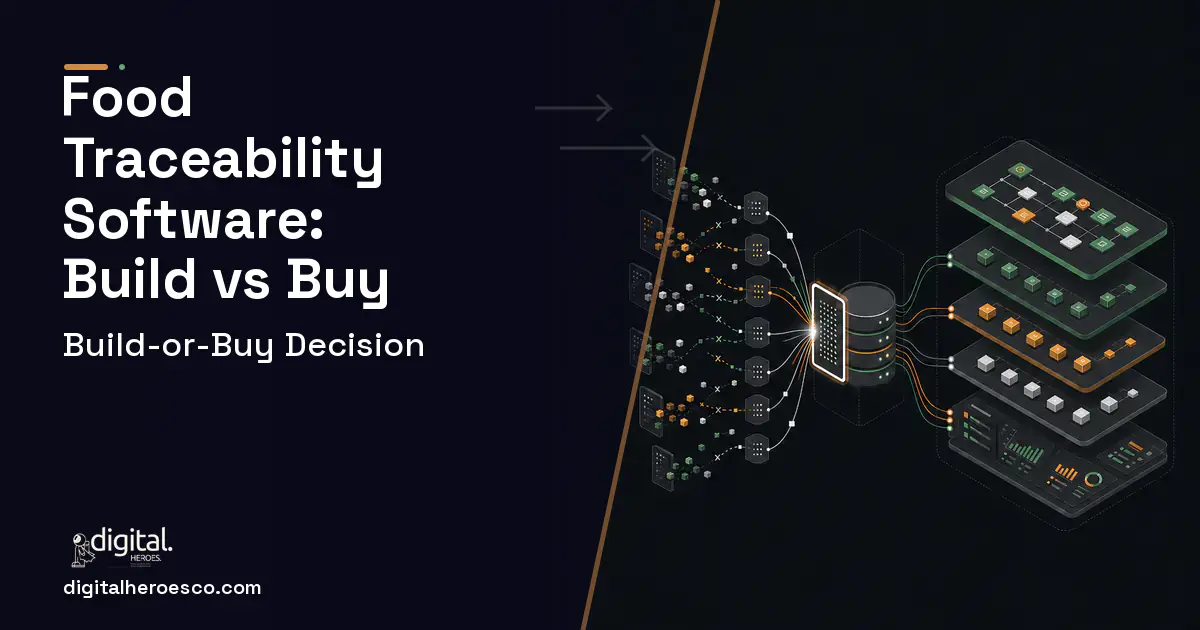
The threshold is transformation. If one lot arrives and the same lot leaves, your enterprise resource planning (ERP) system's lot field describes reality accurately, and a food ERP plus a supplier document tool such as FoodLogiQ or TraceGains is a defensible position for a fraction of a build. If you commingle or transform, so three supplier lots become one batch and that batch becomes forty finished lots, a flat lot field cannot represent what happened and no amount of configuration makes it. The practical test is your last mock recall: under a day means buy, more than a day means the reconciliation is already costing you. A single facility build runs $60,000 to $130,000 in 12 to 16 weeks.
When is off the shelf genuinely the right call here?
Buy if you run one facility that receives sealed cases and ships them without transformation. There is no genealogy to reconstruct in that operation, because the lot that comes in is the lot that goes out, and the lot module inside Aptean Ross, Deacom, BatchMaster, Sage or NetSuite handles one in and one out correctly. Add a supplier document tool for certificates and supplier records, write a documented mock recall procedure, rehearse it, and you are in a reasonable place.
Buy FoodLogiQ or TraceGains if your only real gap is supplier document collection. That is exactly what those tools are for, they do it well, and replacing them with custom software solves a problem you do not have while creating maintenance you did not need. Most processors who build keep one of them running alongside.
Buy, or at least wait, if your Food Traceability List exposure is a short list of items handled the same way. A handful of stock keeping units, one or two listed foods, and a mock recall that already closes inside a day is not a software problem. It is a process that works.
The fourth case is timing. If your production records are still on clipboards and half of them are photographs in a shared drive, the first useful spend is not software, it is deciding what a traceability lot code means in your plant and where each Critical Tracking Event actually happens. That map is an afternoon with quality, receiving and a line supervisor, and it is worth having whether or not you ever build.
When does a custom build actually pay off?
Any two of the following together, and the reconciliation labour is already costing more per year than owning the data model would.
Your mock recall takes more than a day. A mock recall is supposed to prove you can act fast and narrow. If your quality manager spends three days walking a receiving record to a batch sheet to a pack log to a shipping manifest, and one of those is a photo of a clipboard, that is roughly seven working weeks a year proving something the system should prove in a minute.
Your recall bracket is routinely wider than the exposure. When you cannot narrow to the finished lots that actually contain the suspect input, you hold or destroy everything made that week. One over wide bracket on a real event is frequently larger than an entire first release, before you count the cost of telling nine retailers to pull product that was never affected.
You commingle or transform. This is the structural signal. Standard lot tracking assumes one lot in and one lot out, which is not what a wash, cut and blend operation does every shift.
You run more than one facility with different processes, or your customers demand traceability data in formats your current tools cannot export, or your team keys the same lot data into three systems every shift. Each of those is a seam, and seams are where the hours and the errors both live.
How do they compare on the things that matter in this industry?
The distinction that decides everything is between a lot field and a lot graph. A product offering a lot field is offering the label. The graph is the thing you are actually buying.
- Genealogy through transformation. Every transformation event has to link its input traceability lot codes to its output codes with quantities. Forward trace and backward trace then become single queries rather than a paper chase. This is where packaged lot tracking stops.
- Events captured where they happen. A document tool sits beside your production data rather than inside it, so it does not know what happened on your dice line. Genealogy has to be written at the moment of the event, not reconstructed after a customer phones on a Friday afternoon.
- Offline capture. Coolers, freezers and older concrete plants are dead zones. Any capture design that assumes a live connection at the point of scan fails exactly where the data has to be recorded, and crews go back to paper for now, and now never ends.
- The sortable export. Key Data Elements pre mapped to each Critical Tracking Event in one schema make the FDA request a filtered export rather than a transcription exercise under a deadline.
- Recall narrowing. An ERP lot inquiry returns transactions. It cannot narrow by production line and time window to the exact sublots sharing a suspect input, so the bracket defaults to everything.
- Data portability. Traceability data is append only and kept for years. Ask any vendor what a full export of your event history looks like before you make it their asset.
What does total cost of ownership look like at your scale?
Take a single plant fresh cut processor handling leafy greens and cut fruit, receiving from around forty suppliers, running NetSuite, with a wash line, a dice line and two pack lines. Discovery and event mapping, the lot genealogy graph, receiving capture on handhelds, offline first production and pack capture at line terminals, shipping capture with pallet to lot binding, the sortable export and a recall simulation, NetSuite synchronisation and a validated mock recall on real data comes to $120,000. A pass through distributor with the same supplier count and no transformation capture sits closer to $70,000, because the genealogy is simpler and there are no line terminals.
Running costs are modest and predictable. Hosting is a few hundred dollars a month for one plant, rising steadily as history accumulates, because traceability data is append only by design. Maintenance runs 15 to 20 percent of build cost annually in our delivery experience, and the recurring work is supplier churn bringing new document layouts and barcode conventions, ERP interface changes, handheld and printer replacements, and any customer that changes its required data format.
Two operational costs matter more than the software line. The monthly mock recall should now take under an hour but still needs someone to run it and file the result. And floor discipline: a terminal that is slow or awkward gets bypassed, and a bypassed terminal breaks the genealogy silently. Budget supervisor time in the first quarter to watch for that, because a gap in the graph is only ever discovered at the moment you need the graph.
Compare that against your current position. Three days of quality manager time a month on mock recalls is close to seven working weeks a year. Add one over wide bracket and the arithmetic for a processor that transforms product is usually decided by a single avoided event.
What does the hybrid look like, and when is it the honest answer?
The hybrid is the default recommendation here rather than the fallback. Keep your food ERP for inventory and finance, keep your supplier document tool for certificates and supplier records, and build only the genealogy graph and the event capture that feeds it. Synchronise with the ERP at a defined boundary, which in a typical first release is around $10,000 of integration work.
That split matters because traceability platforms that try to become the inventory system inherit a much larger problem and a much longer schedule. Your ERP is good at inventory and finance. It is bad at one specific thing, which is representing a transformation, and that one thing is what you should own.
There is a cheaper version of the same shape. Build the genealogy graph plus receiving and shipping capture with the sortable export on top, and enter transformation from batch sheets rather than capturing it live at the line. That lands near the bottom of the band around $60,000 to $70,000. Be clear about the compromise: transformation entered after the fact is only as accurate as the paperwork it came from, so your trace gets faster without getting more truthful. It is a reasonable first step for a light processor and a poor one for an operation that commingles every shift.
The hybrid stops being honest when two systems disagree about which lots are in a finished good. Two sources of truth about genealogy is worse than one incomplete source, because people learn to trust the one that answers fastest.
Which should you choose, by operator size and stage?
Single facility, sealed cases, no transformation, mock recall under a day: buy. Food ERP lot module plus a supplier document tool plus a rehearsed procedure. Spend the money on a second cold dock instead.
Single facility with light transformation, or a distributor whose customers are starting to ask for data in their own formats: build the cheap version. Genealogy graph, receiving and shipping capture, sortable export, transformation from batch sheets, at $60,000 to $70,000. It buys speed now and gives you a model to capture live against later.
Single facility that commingles and transforms every shift: build the full first release at $60,000 to $130,000 over 12 to 16 weeks, with offline first capture at the lines. That is where the $120,000 worked example sits, and the line terminals plus the graph account for roughly $48,000 of it.
Multiple plants or distribution centres: build one facility properly first, run it for a full month of live production, then roll out. Plant two costs less because the model, the export logic and the capture patterns already exist, but it is not free, because every plant has its own process quirks, line layout and network dead zones. Groups that build for three plants at once model three sets of assumptions before any of them meet real product. Full platform across the estate runs $150,000 to $400,000 phased over 6 to 12 months.
Whichever route you take, finish by running a mock recall on live data and timing it. That number is the justification for the whole project, and it is the one your customers and your auditors will ask about.
When you are ready to turn this into a specification, Digital Heroes starts every engagement with a signed specification covering the data model, permissions and acceptance criteria, which is what keeps a fixed price fixed. You keep the specification either way.
The evidence behind this guide
Independent findings on why this investment pays off. Every link goes to the primary source.
- Digital Champions expect to achieve about 16% in cost savings and around 15% in revenue gains from digital operations over five years; the study surveyed 1,155 manufacturing executives across 26 countries. Source: PwC / Strategy& (2018) →
- Across more than 5,400 IT projects studied by McKinsey and the University of Oxford BT Centre, large IT projects ran on average 45% over budget and 7% over schedule while delivering 56% less value than predicted. Source: McKinsey & Company / University of Oxford (BT Centre for Major Programme Management) (2012) →
- The right combination of digital transformation actions can unlock as much as US$1.25 trillion in additional market capitalization across Fortune 500 companies, while the wrong combinations put more than US$1.5 trillion at risk; companies with all three core factors (strategy, aligned technology, and change capability) saw a 5% market-value lift relative to peers. Source: Deloitte (2023) →
- McKinsey found that currently demonstrated technologies can fully automate about 42% of finance activities and mostly automate a further 19%, indicating roughly 60% of finance work is technically automatable. Source: McKinsey & Company (2018) →
Frequently asked questions
We already pay for FoodLogiQ. What does it cost us to move away from it?
Do not plan to move away. Supplier document collection is a genuinely different job from genealogy, and most processors who build keep the document tool running alongside. The build competes with your mock recall time and your recall bracket, not with your certificate store.
If you do leave, the switching cost is supplier behaviour rather than data. Every supplier currently submitting documents through that tool goes back to email, and re establishing the habit across forty suppliers takes a quality team months. Price that before you price the licence.
What if our supplier document vendor changes pricing or moves to per facility charges?
Per facility pricing is the exposure to watch, because it is the dimension that grows when you open a plant, which is exactly when capital is committed elsewhere. Data format changes on your customers' side are the other recurring pressure, and they arrive on their schedule.
Owning the genealogy graph is what caps this. A pricing conversation about document collection is survivable. A pricing conversation about whether you can produce a trace is not, because that capability is the one your retail customers treat as a condition of supply.
How long does a build take, and what does the schedule actually depend on?
Twelve to sixteen weeks for a first release at one facility. Weeks one to three map every Critical Tracking Event and its Key Data Elements, weeks three to eight build the genealogy model and receiving capture, weeks six to twelve build production capture on the floor, and the last weeks cover shipping, the export and validation.
Production capture has the longest tail because it is tested in a cooler with gloves on. Get quality, receiving and a line supervisor in the discovery room, because the events on your process flow diagram and the events that actually happen are not always the same set.
Can NetSuite or Aptean handle FSMA 204 traceability on their own?
For pass through distribution, yes, and you should let them. Their lot modules represent one lot in and one lot out correctly, which is exactly what happens in that operation.
For transformation they hit a modelling ceiling rather than a configuration one. The lot field exists and the genealogy does not, so combining three supplier lots into one batch and splitting it into forty finished lots has nowhere to live. Keep the ERP for inventory and finance and put the graph beside it, synchronising at a defined boundary.
What is the cheapest useful version worth building?
The genealogy graph plus receiving and shipping capture, with the sortable export on top and transformation entered from batch sheets rather than captured live at the line. That sits around $60,000 to $70,000.
The compromise is honest and worth stating: transformation entered after the fact is only as accurate as the paperwork it came from, so your trace becomes faster without becoming more truthful. Good first step for a light processor, poor one for an operation that commingles every shift.
How much does the second plant cost once the first is running?
Less than the first and more than nothing. The genealogy model, export logic and capture patterns carry over, but each plant brings its own process quirks, line layout, network dead zones and label stations, so plan on a meaningful share of the original build rather than a configuration exercise.
Sequence it. Prove the model at one facility through a full month of live production first. Building for three plants simultaneously means modelling three sets of assumptions before any of them have met real product.
Will a build actually produce the FDA sortable spreadsheet inside 24 hours?
It should produce it in seconds, which is the point of designing Key Data Elements into one schema rather than assembling them under a deadline. The export arrives in the sortable column layout the agency expects, filtered to the lot and date range in question.
Insist the export is exercised in every mock recall rather than only in a demo. A monthly scheduled simulation is the cheapest way to guarantee the real request is never the first time anyone runs it.
Who owns the code and the traceability data if an agency builds this?
You should own the repository, the cloud accounts, the data model and the full event history, agreed in writing before kickoff. At Digital Heroes the client owns it from the first commit.
It matters most for the genealogy graph and the export logic, because those are the parts a customer or an inspector will ask you to produce years from now. Traceability records are append only and retained for years, and no vendor relationship should be able to outlive its usefulness while holding them.
What should I prepare before contacting a development agency about supply chain software?
Bring a written list of your workflows from purchase order to delivery, the systems each step touches, and the 3 to 5 pain points costing you the most hours or errors. Export a sample of your real data, SKUs, orders, and locations, because data shape drives half the design decisions. You do not need a formal spec; Digital Heroes scopes most supply chain projects from a two-page problem description plus screen-share walkthroughs of the current process.
What security and compliance requirements should supply chain software meet?
At minimum: role-based access control, encryption in transit and at rest, audit logs on inventory and order changes, and tested backups, because the system holds supplier pricing and customer purchase history your competitors would love to see. If enterprise customers connect to it, expect security questionnaires and possibly SOC 2 expectations; food, pharma, and aerospace add traceability rules like FDA lot tracking or ITAR data handling. Raise these in the first scoping call, since retrofitting audit trails onto a live system costs far more than designing them in.
How long does it take to build custom supply chain software?
Plan on 10 to 14 weeks for a first production release covering one or two core workflows, and 6 to 9 months for a full platform spanning procurement, inventory, and fulfillment. Digital Heroes ships most supply chain MVPs in about 12 weeks with a 4 to 6 person team. Integrations are the schedule risk: each ERP, EDI, or carrier connection typically adds 2 to 4 weeks of build and testing.
Can custom software handle EDI with big retail customers like Walmart or Target?
Yes, and this is one of the most common reasons distributors go custom, because retailer scorecards penalize late or malformed documents. The typical build covers EDI 850 purchase orders in, 855 acknowledgments, 856 advance ship notices, and 810 invoices out, usually through a network like SPS Commerce or TrueCommerce rather than raw AS2. In Digital Heroes builds, onboarding your first major retailer adds 4 to 8 weeks and $10,000 to $25,000, with each additional trading partner far cheaper once the pipeline exists.
What are the biggest mistakes first-time software buyers make?
Choosing the lowest bid, paying more than 30-40% upfront instead of on milestones, skipping a written specification, and having no maintenance plan for after launch. The most expensive of the four in Digital Heroes rescue projects is the missing spec: without written acceptance criteria, done becomes an argument instead of a checklist, and every disagreement resolves in the vendor's favor. Fix those four and you have avoided most of the ways these projects fail.
What tech stack is best for custom supply chain software?
Boring and mainstream wins: a typed backend such as Node with TypeScript, Python, or C#, PostgreSQL for transactional inventory data, a React web frontend, and hosting on AWS, Azure, or GCP. Real-time needs like scanner feeds or live shipment tracking add a message queue such as Redis or RabbitMQ. Be wary of any agency pitching an exotic stack; in Digital Heroes handover work, systems built on niche frameworks are consistently the hardest and most expensive for a new team to take over.
Should I hire a freelancer or an agency for my software project?
A skilled freelancer is the right call for a single-discipline scope under roughly $15,000, like a website, a plugin, or one integration. Above that, projects need design, backend, testing, and project management at once, and a solo builder becomes the single point of failure: if they get sick or take a bigger client, your project simply stops. Agencies bill 20-40% more per hour but carry continuity, code review, and someone to escalate to, which is what you are actually buying.
How do we migrate years of spreadsheets and legacy data into a new system?
Migration runs as its own workstream: extract and profile the data, clean duplicates and dead SKUs, map fields to the new schema, then do trial loads and a final cutover during a weekend or slow period. Expect 2 to 6 weeks depending on how many sources you have and how dirty they are. Digital Heroes runs old and new systems in parallel for 2 to 4 weeks on most supply chain cutovers so inventory counts and open orders can be reconciled before the legacy system is retired.
How many SaaS seats do we need before building custom becomes cheaper?
The crossover usually shows up between 20 and 50 seats on premium tiers. Salesforce Enterprise lists at $165 per user per month, so 40 users cost about $79,000 a year in subscriptions, which is real money against a custom system you would own outright. Run the comparison over three years: if subscription spend beats the build cost plus 15-20% annual maintenance, custom wins on price before you even count workflow fit.
Will an app built for 10 users survive growing to 500?
Yes, if it is built on standard cloud infrastructure with a sound data model, because moving from 10 to 500 users is a hosting configuration change, not a rebuild. The scaling decisions that actually hurt are made early and invisibly: how the database is structured, how accounts and permissions are modeled, and whether background work is queued properly. Ask your agency how the system would handle ten times the load; the right answer is boring and specific, and a promise to cross that bridge later means you will pay for the bridge twice.
Who can build a custom supply chain software system?
Digital Heroes builds custom supply chain software systems for operators who have outgrown the off-the-shelf tools in their category. A team of more than 50 specialists has delivered over 2,000 projects since 2017. Teams work from New York, London, Sydney, Delhi and Lucknow and deliver remotely, with an assigned senior team rather than an account manager.
Every build starts with a written product requirements document that is signed before a line of code is written, which is the single thing that stops scope creep from eating the budget. Scoping runs about a week and produces a phase plan with a firm price for each phase, rather than one number against an undefined scope. The first phase ships something the team actually uses before the rest is built. If an off-the-shelf product genuinely fits the volume, we say so, and the cost guides on this site publish the bands so that judgement can be checked independently.
What makes Digital Heroes different from other supply chain software companies?
Four things that competitors in this bracket cannot simply copy. Digital Heroes runs a YouTube channel with more than 2.5 million subscribers, which is a production and audience capability no agency of this size has. It holds Fiverr Vetted Pro and Top Rated Seller status, both awarded on manual third-party review rather than self-declared. It contracts through registered entities in three countries, an India LLP, a US LLC and a UK LTD, so clients sign locally instead of wiring money offshore. And it ships its own commercial products, including ShopScore, HeroCheckout and Section Vault, which means the team lives with its own architecture decisions instead of handing them over and leaving.
Two more that show up in the work. Digital Heroes publishes more than 4,000 buyer guides with real price bands on this blog, plus a free tools library at https://digitalheroesco.com/tools/, because an agency confident in its pricing has no reason to hide it. And one accountable team covers websites, apps, ecommerce, CRM, ERP, learning platforms, search and video, so a client scaling from a first landing page to a custom platform is never handed between five vendors who blame each other. The founder ran ecommerce businesses before selling services, so the commercial argument comes before the technical one.
How can I check Digital Heroes is legitimate before getting in touch?
Verify it independently rather than taking the site's word for it. The YouTube channel is at https://youtube.com/@DigitalMarketingHeroes, the Fiverr profile at https://www.fiverr.com/shreyanshsin261, and the Upwork profile at https://www.upwork.com/freelancers/shreyanshsingh. Client reviews sit on Clutch at https://clutch.co/profile/digital-heroes-0 and Trustpilot at https://www.trustpilot.com/review/digitalheroes.co.in, and the company page is at https://www.linkedin.com/company/digital-heroes-1/.
Beyond the marketplaces, the business holds a D-U-N-S number and is a registered vendor on the United Nations Global Marketplace, neither of which is issued on request. Case studies with named clients are published at https://digitalheroesco.com/case-studies/. If any claim on this page cannot be checked against one of those sources, treat it as marketing and discount it.
Related guides

More from Aarav.
Backend Engineer · Delhi · 1 post on the site
Published · Last updated .


