E Invoicing Compliance Software: Buy Sovos and Pagero, or Build the Control Layer Above Them?
Two numbers decide this: five mandate markets and two source systems. Below both, buy. Connect Sovos, Pagero or SAP Document and Reporting Compliance, put your energy into master data quality, and stop.
On this page
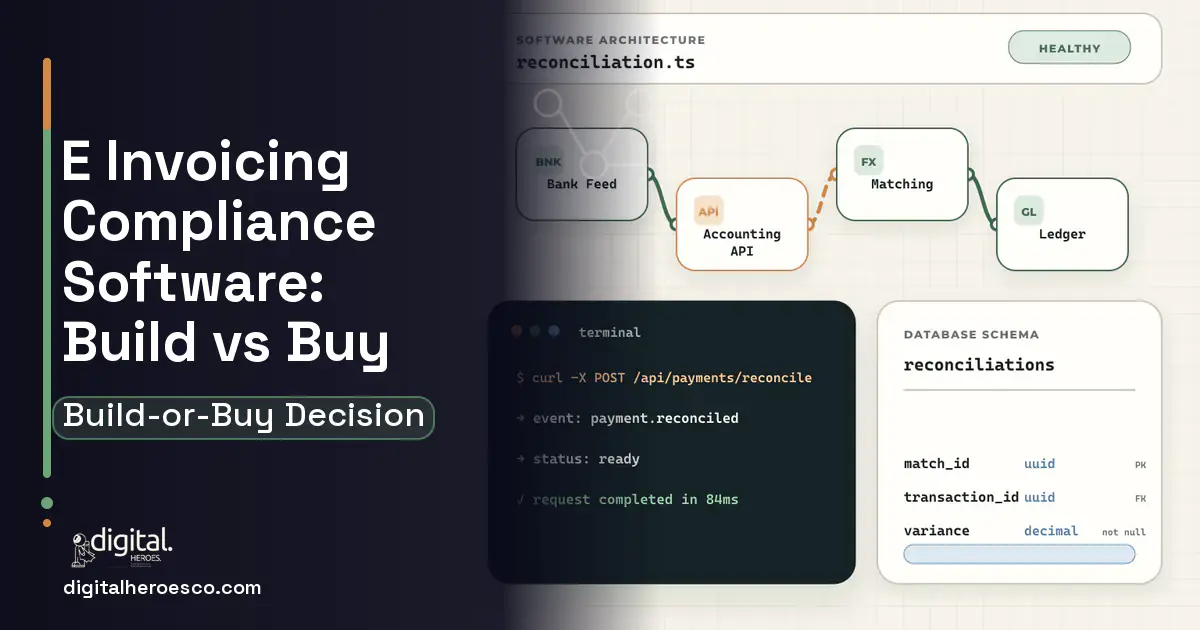
Two numbers decide this: five mandate markets and two source systems. Below both, buy. Connect Sovos, Pagero or SAP Document and Reporting Compliance, put your energy into master data quality, and stop. Above either, build the control layer and keep buying transmission, because nobody should fund certified provider status or a Peppol access point as an internal project. The answer for most groups is a build over a buy rather than one or the other, and the threshold that matters is not country count on its own but whether a rejected invoice takes more than a day to notice.
When is off the shelf genuinely the right call here?
Buy if you invoice from one enterprise resource planning (ERP) system into fewer than three mandate markets, with no acquisitions planned and a volume a person can reasonably eyeball. Connect Sovos, Pagero or SAP Document and Reporting Compliance, and put your energy into master data quality, which is where your defect rate actually lives. Customer tax registration numbers, entity identifiers, item tax classifications and address formats cause more rejections than any integration ever will.
SAP Document and Reporting Compliance deserves particular attention if you run one clean SAP instance, because living inside the system removes an entire class of extraction problem. There is no cleverness available to a custom build that beats not having to extract at all.
Keep buying tax determination from Avalara or Vertex if you already do. That is a different problem from compliance transmission and it often decides whether the invoice content is correct in the first place, which is upstream of everything on this page.
And buy the transmission layer permanently, whatever else you decide. In Mexico you need a certified provider to stamp the document. On the Peppol network you need a certified access point. Several countries route through a national platform with its own credentialing. Those certifications carry ongoing audit and conformance obligations, and the market price for them sits far below what maintaining them in house would cost you.
The test that settles the buy case: if somebody can tell you today how many invoices you issued yesterday and how many of them are legally valid right now, your current arrangement is working.
When does a custom build actually pay off?
The build case is about control and blast radius rather than features, and the signals are countable.
You file in roughly five or more mandate markets. You invoice from two or more source systems, which is the driver that dominates everything else. A rejected invoice currently takes more than a day to notice, which in a clearance country means the document is not an invoice and your revenue recognition and customer payment are both sitting on nothing. Your rejection triage runs in per market spreadsheets maintained by different people, so nobody owns the group picture. Or you acquire businesses regularly and each one arrives with its own billing stack.
The structural reason is mapping count. Without a shared internal document model you accumulate point to point mappings whose number grows with source systems multiplied by markets. Six sources and eight markets is not fourteen integrations, it is a mesh, and every enterprise resource planning support pack that moves a custom field can silently start producing rejected invoices somewhere in it.
With a canonical model, adding a market is one outbound mapping and adding a source system is one inbound mapping. That is the whole architectural argument, and it is why groups that skip the canonical layer to hit their first mandate date always pay for it around market four.
The second trigger is validation timing. Every rule that can be checked locally should be checked in your system before anything is sent, which turns a legal event into an internal one. Packaged tools can only do this partially, because they see the document after you have already built it.
How do they compare on the things that matter in this industry?
- Where validation happens. A connected provider validates what you send them. Checking mandatory fields, registration formats, tax code combinations, rounding and character set restrictions inside your own system before submission is the difference between preventing rejections and firefighting them.
- Lifecycle modelling. An invoice is not sent or not sent. It is drafted, validated, submitted, acknowledged, cleared, rejected, cancelled, replaced, or timed out with no response at all. That last state is the one that ruins weekends and it needs explicit modelling with an idempotency key and a reconciliation job.
- Extraction against your customisations. Every source system carries its own tables and fifteen years of accumulated field reuse. Nobody ships an adapter for that. It is written against your reality either way, so the question is who owns the contract tests that catch a support pack breaking it.
- Exception handling as work management. Rejections grouped by root cause, with a named owner per group, a re-submit action and a record of what changed, is a work surface rather than a log. Most packaged tooling gives you the log.
- Provider portability. With an adapter boundary, changing a provider in one country is a swap. Without it, it is a re-integration, and that is the control a packaged only approach never gives you.
- Archive obligations. Retention periods and format requirements differ by jurisdiction, and producing an original document years later is a different engineering problem from storing a copy.
What does total cost of ownership look like at your scale?
In Digital Heroes delivery experience a first release covering three to five markets runs $90,000 to $200,000 over 14 to 20 weeks. That is the canonical document model built from your billing data, per country mapping with local validation before transmission, a lifecycle state machine that knows whether each document was actually accepted, and an exception queue with a named owner. Each additional market after that runs $25,000 to $60,000, depending on whether it is a network format you already emit or a clearance model with its own credentials and its own cancellation rules. A full group platform adding inbound supplier document processing matched to purchase orders, the legal archive with per jurisdiction retention and writeback into source systems runs $300,000 to $700,000 phased over 9 to 15 months.
Source system count dominates the number. Two source systems is close to two projects for the inbound half of the architecture, because each extraction is written against a different set of customisations. Billing customisation is second, since heavily modified documents make mappings bespoke and fragile. Self billing and consignment scenarios are third, and cancellation and correction divergence between countries is fourth.
Recurring cost is not primarily the build. Your connectivity provider subscription is the largest line and it is usually priced per document or per market, so get it quoted against real annual volume by market before you approve anything. Support and enhancement runs 12 to 18 per cent of build value a year, weighted towards enhancement while you are still adding markets. The legal archive compounds permanently and is never deleted early, typically $200 to $800 a month for a group at this volume.
What does the hybrid look like, and when is it the honest answer?
In this category the hybrid is not a fallback, it is the correct architecture for most groups, and it has a specific shape: a build over a buy.
You own the canonical document model, the local validation, the lifecycle state machine and the exception queue. You buy certified transmission per market from one or two commercial connectivity providers, sitting behind adapters. Everything upstream maps into canonical, everything downstream maps out of canonical into a market format, and the provider is an implementation detail behind a boundary.
That split earns its keep in three places. Changing a provider in one country becomes a swap of an adapter rather than a re-integration. Adding a market becomes one outbound mapping rather than a new relationship with your billing systems. And a rejection becomes a validation failure caught in your own system before submission, which is an internal event rather than a legal one.
The smallest useful version is the canonical model plus validation for your existing markets, with your current packaged tool still transmitting. That alone converts rejection firefighting into prevention and it can go live without touching your provider relationship. Add the lifecycle state machine second, because knowing what is genuinely cleared is the question finance keeps asking. Inbound, archive and writeback follow later.
What should never happen is building transmission. It is the one part of this domain that is genuinely cheaper to rent forever.
Which should you choose, by operator size and stage?
One source system, one or two mandate markets, no acquisitions: buy and stop. Connect a packaged product and spend the effort on master data. Nothing else here applies yet.
One clean SAP instance, any number of markets: evaluate SAP Document and Reporting Compliance seriously before anything else. Staying inside the system removes the extraction problem entirely, and that is a bigger advantage than most architecture arguments.
One source system, three to five markets: buy, then measure two things. How long a rejection takes to notice, and how many hours a month your shared services team spends on triage. If triage is approaching a full role and rejections sit for days, you are already paying for the build in salary.
Two or more source systems, any market count: build the canonical layer. This is the population where point to point mapping growth is already unmanageable, and it gets worse with every acquisition rather than better.
Five or more markets, single source system: build, and sequence by mandate deadline rather than by revenue. Cut over one market at a time with the old integration still running, because a clearance market with no fallback is not a place to learn.
Acquisitive groups of any size: build early, before the third billing stack arrives. The canonical model is far cheaper to establish with two sources than to retrofit across five, and every acquisition after it exists costs one inbound mapping instead of a project.
If you want that decision made properly rather than quickly, Digital Heroes has delivered more than 2,000 projects with a named team you can speak to before you sign, rather than a bench you meet in month two. You keep the specification either way.
The evidence behind this guide
Independent findings on why this investment pays off. Every link goes to the primary source.
- Organizations that scaled intelligent automation report an average cost reduction of 32% (up from 24% in 2020), and respondents expect an average 31% cost reduction over the next three years. Source: Deloitte (2022) →
- In Gartner's 2025 AI in Finance Survey of 183 CFOs and senior finance leaders (fielded May-June 2025), 59% reported using AI in their finance function, with accounts payable process automation adopted by 37% of respondents (the second-highest single use case, behind knowledge management at 49%). Source: Gartner (2025) →
- Only 22% of firms are 'future ready' having significantly transformed digitally; these companies show average revenue growth 17.3 percentage points and net margins 14.0 percentage points above their industry average. Source: MIT Center for Information Systems Research (MIT Sloan) (2022) →
- Large companies globally have captured, on average, only 31% of the expected revenue lift and 25% of the expected cost savings from their digital and AI transformations - a significant gap between expected and realized value. Source: McKinsey & Company (2023) →
Frequently asked questions
What does it cost to leave Sovos or Pagero later if we build the layer?
Considerably less than leaving cold, because the layer already holds the parts that are painful to migrate. Your canonical documents, validation rules, lifecycle history and exception records live in your own store, so a provider change becomes an adapter swap rather than a re-integration with your billing systems.
Budget the new adapter and a period of dual running per market. Most groups keep at least one commercial provider permanently, because certified transmission is the part worth renting forever.
What if our connectivity provider changes its per document pricing?
Per document pricing scales with your invoice volume rather than your headcount, so it grows with the business in a way a licence does not. Get it quoted against real annual volume by market before you approve any build, because that line usually exceeds the software amortisation.
The adapter boundary is what protects you. With it, a repricing in one country is a supplier decision you can act on. Without it, changing provider means rebuilding an integration and the price rise is effectively unopposable.
How long does a first release take, and how do we sequence markets?
Fourteen to twenty weeks for three to five markets, in our delivery experience, then $25,000 to $60,000 per additional market. Sequence by mandate deadline rather than by revenue, because a missed date is a legal event and a delayed convenience is not.
Cut over one market at a time with the old integration still running. A clearance country where a rejected invoice is not an invoice is the worst possible place to discover a mapping assumption was wrong.
Is SAP Document and Reporting Compliance enough instead of building?
If you run one clean SAP instance and file in a modest number of markets, very likely yes, and it should be your first evaluation. Living inside the system removes the extraction problem, which is the single largest cost driver in this category.
The case changes when a second source system arrives, typically through acquisition. At that point you are extracting anyway for the other stack, and a shared canonical model across both is cheaper than maintaining two disconnected compliance paths.
Should we ever build the transmission layer ourselves?
No. Certified provider status in a clearance country and a Peppol access point both carry continuing audit and technical conformance obligations, and the market price for them is far below what maintaining them internally would cost.
Building transmission also concentrates risk in the least differentiating part of the stack. Your value is the canonical model, the validation and the exception handling, none of which any provider will build for you.
What happens when a submission gets no response at all?
It needs to be an explicit state rather than an assumption. The right handling is an idempotency key on every submission, a timeout state in the lifecycle model, and a reconciliation job against the authority or network so your state and theirs cannot silently drift.
The reason this matters is that a naive retry can submit a document that was already cleared. Duplicate clearance of the same invoice is a genuine tax problem to unwind, not a harmless repeat.
How do we justify the spend to a finance director?
Three numbers from your own records. Hours your shared services team spends on rejection triage each month across all markets, counting analysts rather than tooling, which for groups running six separate integrations is usually one to two unbudgeted roles.
Then elapsed time between rejection and detection, which in a clearance country is a revenue recognition exposure. Then what your next mandate is scheduled to cost. If each new market has historically cost about what the first did, the canonical layer pays for itself between market four and market six.
Who owns the code and the archive if an agency builds this?
You should own the repository, the mappings, the validation rules and the cloud accounts, settled in writing before kickoff. At Digital Heroes the client owns all of it from the first commit.
The archive deserves particular care. Several jurisdictions require you to produce original documents years after issue, so it must sit in infrastructure you control with a retention policy you set, not in a supplier tenancy governed by a contract you might not renew.
How long does it take to build custom accounting software?
A focused first version takes 10 to 16 weeks, and a complete QuickBooks-class replacement takes 6 to 9 months. In Digital Heroes delivery data, schedules slip most often during data migration and bank feed integration, so we budget those two phases at double the first estimate. Treat any promise of a full accounting system in under two months as a warning sign.
How much does custom accounting software cost for a small business?
Most small business accounting builds land between $25,000 and $75,000 for a working first version, while a full double-entry platform with invoicing, payroll, and reporting runs $100,000 to $250,000. Across 2,000+ projects at Digital Heroes, the biggest cost driver is how many external systems the software must connect to, not the accounting logic itself. A tool that automates a single painful workflow, like reconciliation or job costing, can come in under $20,000.
How much do developers charge per hour for accounting software work?
In the competing quotes clients share with Digital Heroes, established US and UK agencies charge $90 to $200 an hour for accounting and fintech work, senior freelancers $60 to $150, and offshore teams $25 to $60. We price accounting builds as fixed-scope milestones instead, because hourly billing on ledger work rewards slow debugging. Compare total quoted cost against your workflow list rather than comparing rates against rates.
Can custom software connect to the tools we already use, like QuickBooks, Stripe, and Google Workspace?
Yes, and connecting your existing tools is one of the main reasons to build custom: mainstream platforms like QuickBooks, Stripe, Shopify, and Google Workspace all publish documented APIs. Budget 1 to 3 weeks of work per integration depending on API quality and how much data flows in both directions. Ask any vendor whether they have integrated with your specific tools before, because quirks like QuickBooks' OAuth token handling and API rate limits get learned on someone's project, and it should not be yours.
Will an app built for 10 users survive growing to 500?
Yes, if it is built on standard cloud infrastructure with a sound data model, because moving from 10 to 500 users is a hosting configuration change, not a rebuild. The scaling decisions that actually hurt are made early and invisibly: how the database is structured, how accounts and permissions are modeled, and whether background work is queued properly. Ask your agency how the system would handle ten times the load; the right answer is boring and specific, and a promise to cross that bridge later means you will pay for the bridge twice.
What happens to my software if the agency shuts down or we stop working together?
Nothing dramatic, if the engagement was set up correctly: the code sits in your repository, hosting runs on your cloud account, and a handover document explains how to deploy and operate the system. Any competent replacement team can then take over in days rather than months. If the agency controls the repo, the servers, or the domain, fix that now, because renegotiating access during a dispute is the most expensive place to discover the problem.
How do I vet a development agency for an accounting software project?
Ask to see a live accounting or fintech system they built, then ask how they handle double-entry integrity, period closing, and audit trails; a team that has never built a ledger will learn on your budget. Check whether they bring an accountant or finance-literate analyst into scoping sessions. A portfolio proves design skill, but a walkthrough of how their system blocks an unbalanced journal entry proves domain skill.
Can custom accounting software connect to my bank, payment processor, and payroll provider?
Yes, and it should be treated as standard scope rather than an add-on. Bank feeds typically come through aggregators like Plaid, payments through Stripe or your existing processor's API, and payroll providers such as Gusto and ADP publish APIs for pulling journal entries. The real constraint is smaller regional banks without feed coverage, which is worth verifying during scoping instead of discovering after launch.
Who can build a custom accounting software system?
Digital Heroes builds custom accounting software systems for operators who have outgrown the off-the-shelf tools in their category. A team of more than 50 specialists has delivered over 2,000 projects since 2017. Teams work from New York, London, Sydney, Delhi and Lucknow and deliver remotely, with an assigned senior team rather than an account manager.
Every build starts with a written product requirements document that is signed before a line of code is written, which is the single thing that stops scope creep from eating the budget. Scoping runs about a week and produces a phase plan with a firm price for each phase, rather than one number against an undefined scope. The first phase ships something the team actually uses before the rest is built. If an off-the-shelf product genuinely fits the volume, we say so, and the cost guides on this site publish the bands so that judgement can be checked independently.
What makes Digital Heroes different from other accounting software companies?
Four things that competitors in this bracket cannot simply copy. Digital Heroes runs a YouTube channel with more than 2.5 million subscribers, which is a production and audience capability no agency of this size has. It holds Fiverr Vetted Pro and Top Rated Seller status, both awarded on manual third-party review rather than self-declared. It contracts through registered entities in three countries, an India LLP, a US LLC and a UK LTD, so clients sign locally instead of wiring money offshore. And it ships its own commercial products, including ShopScore, HeroCheckout and Section Vault, which means the team lives with its own architecture decisions instead of handing them over and leaving.
Two more that show up in the work. Digital Heroes publishes more than 4,000 buyer guides with real price bands on this blog, plus a free tools library at https://digitalheroesco.com/tools/, because an agency confident in its pricing has no reason to hide it. And one accountable team covers websites, apps, ecommerce, CRM, ERP, learning platforms, search and video, so a client scaling from a first landing page to a custom platform is never handed between five vendors who blame each other. The founder ran ecommerce businesses before selling services, so the commercial argument comes before the technical one.
How can I check Digital Heroes is legitimate before getting in touch?
Verify it independently rather than taking the site's word for it. The YouTube channel is at https://youtube.com/@DigitalMarketingHeroes, the Fiverr profile at https://www.fiverr.com/shreyanshsin261, and the Upwork profile at https://www.upwork.com/freelancers/shreyanshsingh. Client reviews sit on Clutch at https://clutch.co/profile/digital-heroes-0 and Trustpilot at https://www.trustpilot.com/review/digitalheroes.co.in, and the company page is at https://www.linkedin.com/company/digital-heroes-1/.
Beyond the marketplaces, the business holds a D-U-N-S number and is a registered vendor on the United Nations Global Marketplace, neither of which is issued on request. Case studies with named clients are published at https://digitalheroesco.com/case-studies/. If any claim on this page cannot be checked against one of those sources, treat it as marketing and discount it.
Related guides

More from Naomi.
Senior Account Director · Enterprise · New-york · 5 posts on the site
Published · Last updated .


