Drayage Software: Stay on Envase or Build the Container Clock Layer
The threshold is terminals and clocks, not trucks alone. Under roughly 25 trucks running one terminal and drawing from one chassis pool, buy Envase or Vector and spend the money on people, and most drayage operators reading this fall on that side.
On this page
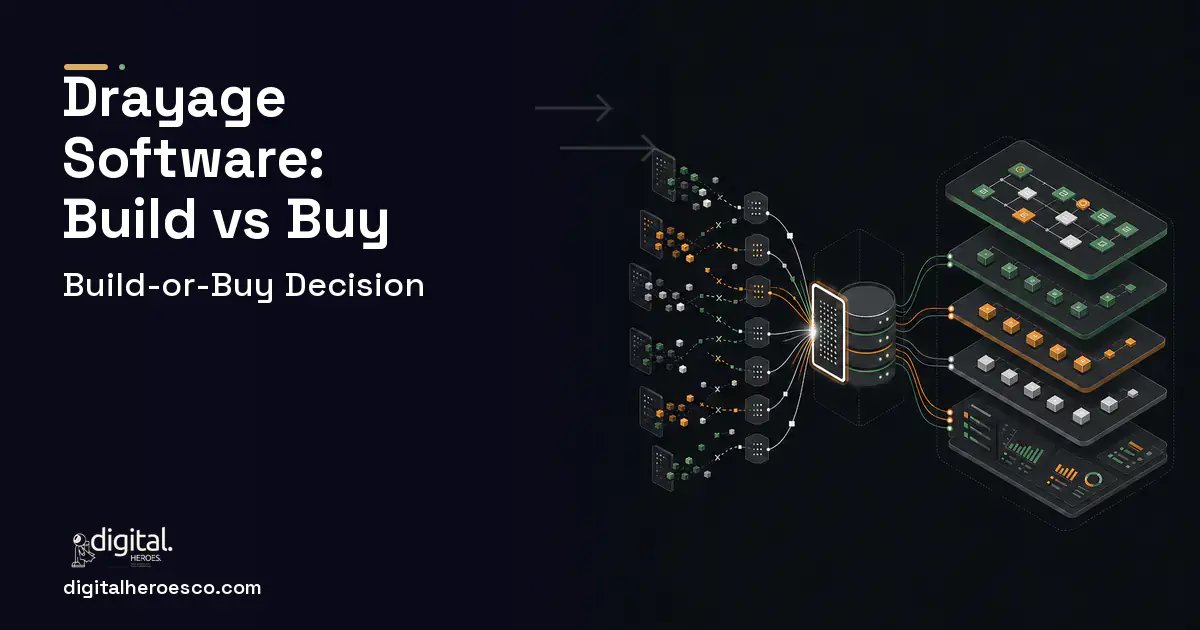
The threshold is terminals and clocks, not trucks alone. Under roughly 25 trucks running one terminal and drawing from one chassis pool, buy Envase or Vector and spend the money on people, and most drayage operators reading this fall on that side. Once you pass about 40 trucks or 150 containers a week across two or more terminals, and you cannot produce a per diem dispute with evidence, build: $60,000 to $130,000 over 12 to 16 weeks for the container object, chassis events and appointment automation, and $150,000 to $400,000 across 6 to 12 months for the full platform.
When is off the shelf genuinely the right call here?
Buy, and here is which one. Envase and Vector both cover the dispatch board and invoicing properly, Compcare serves the same job at plenty of operations, and at list pricing any of them costs a fraction of a build. Under roughly 25 trucks with one terminal and one chassis pool, your volume simply does not generate enough clock management pain to fund custom code. Buy also if your growth plan is to stay exactly this size, because the return on a build compounds with volume and does not appear at all without it.
There is a second buy case that has nothing to do with size, and it is worth naming because it is easy to miss. If your operation is drop and pick with long dwell and your customers absorb demurrage contractually, the clock exposure that funds this whole category belongs to somebody else. Building would give you an expensive way to observe a cost you do not carry.
The third buy case is arithmetic you can do this afternoon. If your demurrage absorption is near zero and your per diem invoices reconcile cleanly against a spreadsheet one dispatcher maintains, your current stack is working. That is a real situation at smaller operations and it deserves to be said plainly rather than argued away.
What you should not buy is a reporting layer over your existing transport management system. Below about $40,000 that is what you are getting, and it will show you last free days that a dispatcher typed into a notes field, which means it shows you what a human already knew. The money does not leak there.
When does a custom build actually pay off?
Build when these appear together.
- Past 40 trucks or 150 containers a week. Below that a good dispatcher holds the exposure in her head. Above it the third container going into demurrage is the one nobody catches, because there is no query that could have caught it.
- Two or more terminals. Terminal count drives this category more than truck count does, because each portal is its own session behaviour, its own rate limits and its own definition of what available means.
- Someone whose job is substantially copying data between systems. A coordinator retyping container number, seal, weight and last free day off delivery order documents at roughly ninety seconds each is a direct labour cost plus an error rate that sends drivers to terminals for nothing.
- You cannot produce a per diem dispute with evidence. When a pool invoice arrives 45 days later for a chassis you gave back three weeks ago, you either pay it or you argue from memory.
One more signal decides it. When you have already bought a second tool to compensate for the first, a separate appointment bot, a separate yard sheet, a separate billing spreadsheet, you are already paying for a custom system. It is just an unintegrated one held together by people, and at that point the build is the cheaper option and the one you own.
How do they compare on the things that matter in this industry?
The container as the root object. This is the sharpest difference and everything else follows from it. Off the shelf products model a load: pickup, delivery, driver, rate. One container might be a pull, a yard drop, a live unload three days later, an empty return and a chassis flip in the middle, each leg with its own clock and its own cost, all belonging to the same box. Dispatchers respond by creating four loads and holding the relationship in their heads, and the last free day ends up in a notes field.
Clocks as computed fields. Once the container is the root, demurrage risk stops being a note and becomes days remaining against terminal availability, and per diem exposure becomes a running dollar figure per container and per customer. That produces one screen ranking every container by dollars at risk in the next 72 hours, and that query does not exist in the tools you are already paying for.
Chassis as an entity with an event log. A chassis field is where data goes to be ignored. Out of pool at a timestamp, mounted to a container, flipped at a yard, returned to pool, with driver geolocation and a photograph at each event, is what turns a pool invoice from something you pay into something you reconcile line by line.
Appointment automation against your priority rules. Some platforms offer a booking integration bolted on the side, and it cannot know which driver is near which terminal, which chassis is under which box, or which customer can actually receive Friday morning. Closest to last free day first, then highest per diem exposure, then customer tier, is your policy and nobody else can hold it.
Offline capture that survives a terminal. Drivers lose signal inside terminals every day. A local queue with conflict resolution on sync is what keeps the evidence trail intact, and it is a different product from one that works on wifi.
What does total cost of ownership look like at your scale?
A first release covering the container object with last free day and per diem clocks, chassis events, appointment automation against one or two terminals, document extraction and an offline driver application runs $60,000 to $130,000 over 12 to 16 weeks in Digital Heroes delivery experience. The full platform adding billing with per diem reconciliation, a customer portal, electronic data interchange, multi terminal coverage, yard management and reporting runs $150,000 to $400,000 across 6 to 12 months.
A 60 truck operation across two ports, touching three terminals, drawing from two chassis pools and moving around 200 containers a week lands near $127,000: discovery and data model $8,000, container object with clocks $18,000, chassis entity with event log $15,000, appointment booking across three terminals $27,000, extraction with confidence scoring $16,000, driver application with offline queue in two languages $22,000, dollars at risk screen $12,000, migration with a parallel run $9,000. Run a single terminal and the appointment line falls to about $13,000. Ship one language and save roughly $5,000 more.
Afterwards, budget 15 to 20 percent of build cost per year, roughly $19,000 to $25,000 on that example. Terminal portal maintenance is the largest ongoing line and it is not optional: portals change without notice, and a poller that quietly returns nothing costs you appointments before anyone notices, so alert on empty results rather than only on errors. Add extraction inference that scales per document rather than per user, driver application distribution and device support, photograph and geolocation storage under a retention policy, and on call cover for the early morning booking window. Hold 15 to 20 percent contingency, and hold it against integration rather than features, because a terminal changing how sessions expire is not negotiable and feature scope is.
What does the hybrid look like, and when is it the honest answer?
Buy the platform, build the thin layer you actually need. Here that means keeping Envase, Vector or whatever you run today for dispatch and invoicing through the first release, and building only the clock and evidence layer beside it: the container object, chassis events, the appointment poller and the dollars at risk screen. You are not replacing the accounting, and replacing both at once doubles the migration risk for no operational gain.
That hybrid is also what makes the budget honest. Start with one terminal and one chassis pool, prove the dollars at risk screen catches boxes your dispatchers miss, then expand. The container data model is the expensive part and it only gets built once, so terminals two and three are additive rather than structural at roughly $8,000 to $14,000 each.
Two more scope decisions. Budget document extraction for the customers who actually send unstructured paperwork, because the two accounts large enough to run electronic data interchange do not need it and the thirty that are not are where the transcription hours sit. And build the driver application in the languages your drivers actually read and no more, since every additional language is translation, testing and support in perpetuity.
One thing not to cut. Offline support on the driver application saves less than people expect and destroys the evidence trail, which is the entire reason you are building. Do the migration as its own workstream with a parallel run rather than a cutover weekend, because legacy records keep last free day and chassis data in notes fields and a parsing pass is needed to recover it.
Which should you choose, by operator size and stage?
Under 25 trucks, one terminal, one chassis pool. Envase or Vector, and put the difference into people. Revisit when a second terminal appears, because that is the change that moves you rather than truck count.
25 to 40 trucks, one terminal, growing. Stay bought and do the free work. Pull last year's demurrage and separate what you passed on from what you absorbed. Pull last year's pool invoices and count how many you paid without challenging. Those two numbers are the business case, they cost you a morning, and they are yours whether or not you ever build.
Past 40 trucks, two or three terminals. This is the crossover. Build the first release alongside your existing system, one terminal first, and phase billing and the customer portal afterwards at $50,000 to $110,000. Phase two is what finance funds, because it converts the chassis event log into disputes you win.
Multi port with separate operating authorities. Build the full platform and budget multi entity billing as a model change rather than an extra field. Expect terminal integration to be the largest single line in the programme and price it per terminal from the start.
Whichever shape you are, ask any bidder to model the data before they quote. If their proposal has loads at the root and containers as an attribute, they have built freight software rather than drayage software, and that one question filters most of the market.
If you want a second opinion before signing anything, Digital Heroes builds and runs its own products, so the people choosing your architecture live with those decisions on their own revenue. The document is yours whichever way you go.
The evidence behind this guide
Independent findings on why this investment pays off. Every link goes to the primary source.
- In a survey of 113 supply chain leaders (conducted late March to mid-April 2022), 67% had implemented digital dashboards for end-to-end visibility, and those companies were about twice as likely as others to avoid supply chain problems during the disruptions of early 2022; 71% expected to revise inventory policies going forward. Source: McKinsey & Company (2022) →
- Poor software quality cost the US economy an estimated $2.41 trillion in 2022, including roughly $1.52 trillion in accumulated technical debt, driven partly by unsuccessful development projects and low-quality legacy systems. Source: Consortium for Information & Software Quality (CISQ) - Herb Krasner (2022) →
- Only 22% of firms are 'future ready' having significantly transformed digitally; these companies show average revenue growth 17.3 percentage points and net margins 14.0 percentage points above their industry average. Source: MIT Center for Information Systems Research (MIT Sloan) (2022) →
- Median SaaS spend reached $9,455 per employee, and organizations leave an average of 36% of their SaaS licenses unused. Source: Zylo (2026) →
Frequently asked questions
What does it cost to migrate off our current transport management system?
Budget two to three weeks inside the project plus a parallel run where both systems are live, and around $9,000 in the worked example above.
The difficulty is not the export. Legacy records keep last free day and chassis data in notes fields rather than in structured columns, so a parsing pass is needed to recover it before anything is trustworthy. Discovering that during a cutover weekend is how a Monday morning goes badly, which is why migration should be its own workstream with its own acceptance tests.
What happens if our current platform changes its pricing?
Check what the fee scales on. Per truck or per seat pricing means growth costs you more permanently, and in drayage the seat count that matters is the coordinator team rather than the drivers.
The comparison is closer than people expect and should not decide anything on its own. A subscription across 60 trucks plus a separately bought appointment tool plus coordinator seats projected over five years lands near a build plus five years of running cost. The decision sits in demurrage absorbed and per diem paid undisputed, not in the licence line.
How long does a drayage build take?
Twelve to 16 weeks for a first release, with dispatch on the container view around week ten. Six to 12 months phased for the full platform.
The constraint is rarely engineering speed. It is terminal and chassis pool integration, which depends on portals and partners you do not control and which will each surprise you at least once. That is also why contingency belongs against integration rather than against features.
Is Envase or Vector enough at 40 trucks?
It depends on terminals rather than trucks. At 40 trucks running one terminal with one chassis pool, yes, and you should stay.
Where they run short is structural. They model a load, and drayage needs the container as the root with legs, chassis events and clocks hanging off it, so dispatchers create four loads for one box and hold the relationship in their heads. That is why there is no query that ranks containers by dollars at risk, and that screen is the single highest value thing in the category.
How much does each additional terminal add?
Budget $8,000 to $14,000 per terminal after the first, and expect the first to cost more on its own because the polling and booking framework gets built with it.
In the worked example three terminals came to $27,000 in total, and running a single terminal would have cut that line to roughly $13,000. That is the largest single lever available on a first release budget, and it is the reason to start at one terminal and expand once the clocks are proven.
Does the driver app really need to work offline?
Yes, without exception. Drivers lose signal inside terminals every single day, and an application that fails there stops capturing exactly the chassis in and out events you built it for.
The difference between an application that works on wifi and one that survives four hours in a dead zone is a local queue plus conflict resolution on sync. In the worked example the application came to $22,000 including two languages and offline capability, and single language brings it to roughly $17,000. Cutting offline saves less than that and removes the evidence.
What is the cheapest useful first release?
Around $60,000 buys the container object with last free day and per diem clocks, chassis events, one terminal integration and the dollars at risk screen. That is the core of the category and it catches the box a human eye misses.
What you defer is document extraction, the driver application and any second terminal. Deferring the driver application is the costliest of those, because chassis event capture with geolocation and photographs is what makes a per diem dispute winnable, and without it you are still paying invoices you cannot challenge.
Is per diem reconciliation worth building?
It sits in phase two alongside billing, typically $50,000 to $110,000 with the customer portal included, and it is the phase finance funds.
The test is simple and you can run it from your own records. Pull last year's chassis pool invoices and count how many you paid without challenging because you could not prove when the chassis left and returned. If that total exceeds the phase cost, the case makes itself. If you already reconcile cleanly from a spreadsheet one dispatcher maintains, defer it.
How much does a custom warehouse management system cost to build?
A custom WMS typically costs $40,000 to $120,000 for a single-warehouse operation, and $120,000 to $300,000 once you add multiple sites, wave picking, and labor tracking. Across Digital Heroes WMS builds, the biggest cost drivers are scanner-based workflows, real-time inventory sync with your ERP, and the number of picking strategies you need. A pilot covering receiving, putaway, and picking for one warehouse is the cheapest credible starting point.
Does it matter which tech stack the agency wants to use?
Yes, but not in the way most buyers expect: the goal is boring, popular technology such as React, Node.js or Python, and PostgreSQL, because any future team can maintain it and hiring a replacement developer takes days, not months. The red flag is an agency-proprietary framework or an unusual language, which welds you to that one vendor no matter what your contract says about code ownership. A useful test: could you find three freelancers fluent in this stack within a week? If not, push back.
What happens to our system if the agency shuts down or we part ways?
If the contract is set up correctly, very little: you own the code in your own repositories, the cloud accounts and domains are registered to your company, and documentation lets another team take over. Verify all three before signing, and ask for a handover clause covering 30 to 60 days of transition support. Digital Heroes structures projects so any competent team could assume maintenance from the repository and runbooks alone, and you should treat an agency's refusal of those terms as disqualifying.
Should I hire a freelancer or an agency to build supply chain software?
For anything past a single-user internal tool, use an agency or an established team, because supply chain systems need backend, frontend, integration, and QA skills that rarely live in one freelancer. A solo developer can build a $10,000 inventory tracker; a system that talks to your ERP, carriers, and warehouse scanners fails badly when its only author is unreachable during a shipping cutoff. In the proposals Digital Heroes sees clients compare, agencies cost 20 to 50 percent more but give you continuity, code review, and someone answerable when order data stops flowing.
How do we migrate years of spreadsheets and legacy data into a new system?
Migration runs as its own workstream: extract and profile the data, clean duplicates and dead SKUs, map fields to the new schema, then do trial loads and a final cutover during a weekend or slow period. Expect 2 to 6 weeks depending on how many sources you have and how dirty they are. Digital Heroes runs old and new systems in parallel for 2 to 4 weeks on most supply chain cutovers so inventory counts and open orders can be reconciled before the legacy system is retired.
How many SaaS seats do we need before building custom becomes cheaper?
The crossover usually shows up between 20 and 50 seats on premium tiers. Salesforce Enterprise lists at $165 per user per month, so 40 users cost about $79,000 a year in subscriptions, which is real money against a custom system you would own outright. Run the comparison over three years: if subscription spend beats the build cost plus 15-20% annual maintenance, custom wins on price before you even count workflow fit.
Can I build my product on a no-code tool like Bubble instead of hiring developers?
For testing whether anyone wants the product, yes, and Bubble's paid plans start at $29 a month, which is the cheapest validation you will ever buy. The ceiling arrives with complex data relationships, heavy integrations, performance at a few thousand users, and the fact that you cannot export a Bubble app to servers you control. A path many Digital Heroes clients take: prove demand on no-code, then rebuild custom once revenue justifies it, treating the no-code version as a paid prototype rather than a foundation.
What should I prepare before contacting a software development agency?
A one-page brief beats a 40-page requirements document: the business problem in plain words, who will use the system, the 5 to 10 workflows it must handle, the tools it must connect to, and your budget range and deadline driver. You do not need wireframes, a specification, or technical vocabulary; producing those is the agency's job during discovery. Stating a budget range up front is the single best move, because it gets you honest scoping instead of a quote engineered to win the meeting.
How big a development team does a supply chain software project need?
A typical build runs with 4 to 6 people: a project lead or analyst, two or three developers, a QA engineer, and a part-time designer. Digital Heroes staffs most supply chain MVPs this way for 10 to 14 weeks, then drops to 1 or 2 people for maintenance after launch. Bigger is not better here; past 7 or 8 people on a single-product build, coordination overhead usually cancels the added speed.
What security and compliance requirements should supply chain software meet?
At minimum: role-based access control, encryption in transit and at rest, audit logs on inventory and order changes, and tested backups, because the system holds supplier pricing and customer purchase history your competitors would love to see. If enterprise customers connect to it, expect security questionnaires and possibly SOC 2 expectations; food, pharma, and aerospace add traceability rules like FDA lot tracking or ITAR data handling. Raise these in the first scoping call, since retrofitting audit trails onto a live system costs far more than designing them in.
Why do companies replace generic SCM software with custom systems?
The usual trigger is workflow mismatch: generic SCM tools model a standard distributor, so anything unusual, like mixed lot and serial tracking, consignment inventory, or customer-specific routing rules, ends up managed in spreadsheets beside the system. Companies also leave when per-user pricing punishes growth or the vendor's API cannot support needed integrations. In Digital Heroes projects, the number of spreadsheets living around the official system is the most reliable signal a team has outgrown its off-the-shelf tool.
Who can build a custom supply chain software system?
Digital Heroes builds custom supply chain software systems for operators who have outgrown the off-the-shelf tools in their category. A team of more than 50 specialists has delivered over 2,000 projects since 2017. Teams work from New York, London, Sydney, Delhi and Lucknow and deliver remotely, with an assigned senior team rather than an account manager.
Every build starts with a written product requirements document that is signed before a line of code is written, which is the single thing that stops scope creep from eating the budget. Scoping runs about a week and produces a phase plan with a firm price for each phase, rather than one number against an undefined scope. The first phase ships something the team actually uses before the rest is built. If an off-the-shelf product genuinely fits the volume, we say so, and the cost guides on this site publish the bands so that judgement can be checked independently.
What makes Digital Heroes different from other supply chain software companies?
Four things that competitors in this bracket cannot simply copy. Digital Heroes runs a YouTube channel with more than 2.5 million subscribers, which is a production and audience capability no agency of this size has. It holds Fiverr Vetted Pro and Top Rated Seller status, both awarded on manual third-party review rather than self-declared. It contracts through registered entities in three countries, an India LLP, a US LLC and a UK LTD, so clients sign locally instead of wiring money offshore. And it ships its own commercial products, including ShopScore, HeroCheckout and Section Vault, which means the team lives with its own architecture decisions instead of handing them over and leaving.
Two more that show up in the work. Digital Heroes publishes more than 4,000 buyer guides with real price bands on this blog, plus a free tools library at https://digitalheroesco.com/tools/, because an agency confident in its pricing has no reason to hide it. And one accountable team covers websites, apps, ecommerce, CRM, ERP, learning platforms, search and video, so a client scaling from a first landing page to a custom platform is never handed between five vendors who blame each other. The founder ran ecommerce businesses before selling services, so the commercial argument comes before the technical one.
How can I check Digital Heroes is legitimate before getting in touch?
Verify it independently rather than taking the site's word for it. The YouTube channel is at https://youtube.com/@DigitalMarketingHeroes, the Fiverr profile at https://www.fiverr.com/shreyanshsin261, and the Upwork profile at https://www.upwork.com/freelancers/shreyanshsingh. Client reviews sit on Clutch at https://clutch.co/profile/digital-heroes-0 and Trustpilot at https://www.trustpilot.com/review/digitalheroes.co.in, and the company page is at https://www.linkedin.com/company/digital-heroes-1/.
Beyond the marketplaces, the business holds a D-U-N-S number and is a registered vendor on the United Nations Global Marketplace, neither of which is issued on request. Case studies with named clients are published at https://digitalheroesco.com/case-studies/. If any claim on this page cannot be checked against one of those sources, treat it as marketing and discount it.
Related guides

More from Dhruv.
Director of DevOps & Infrastructure · Delhi · 5 posts on the site
Published · Last updated .


