Digital Product Passport Software: Build Custom, Buy EON or TrusTrace, or Rent Collection and Own the Resolver
Under roughly 200 active styles, one European market, a supply chain short enough that you can phone the mill, and no serialisation on the production line means buy EON or TrusTrace.
On this page
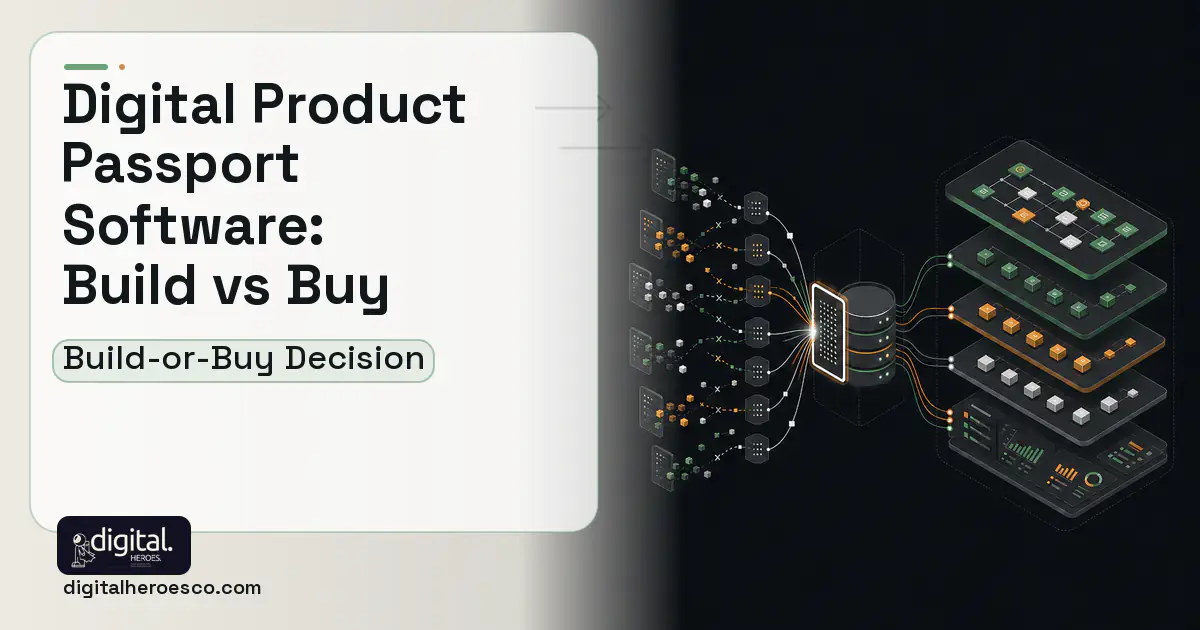
Under roughly 200 active styles, one European market, a supply chain short enough that you can phone the mill, and no serialisation on the production line means buy EON or TrusTrace. The platform fee will cost less than the discovery phase of a custom project, and we say that regularly. Past that point, and particularly once your claims have to come from tier two and tier three suppliers you do not contract with, a build starts to earn its place. The one thing you should own at every size is the identifier and the resolver, on your own domain, because that is the only decision in this category you cannot reverse cheaply.
When is off the shelf genuinely the right call here?
TrusTrace is built around supply chain data collection and chain of custody documents and does that competently. EON is genuinely strong on identity and the consumer facing experience. Circularise approaches the problem from material flow and mass balance, which suits chemicals, plastics and batteries better than a forty vendor apparel base. Protokol will build around you, but you are buying a project either way.
Buy, and stop reading here, if this describes you:
- Under roughly 200 active styles or product variants.
- A single European market, so one language and disclosure obligation.
- A supply chain short enough that you can phone the mill yourself.
- No serialisation in production today, and no commercial reason to add it.
- One product category, so one delegated act and one field set.
At that shape a packaged platform will make you compliant faster and cheaper than anything custom, and the money is better spent on the people who will actually chase the certificates.
Two further cases where buying stays right at larger scale. If nobody owns supplier engagement as a job, do not fund software, because collection is a change management programme and the platform is the smaller half of it. And if your regulatory scope is still undecided, wait. The Ecodesign for Sustainable Products Regulation came into force in 2024 and delivers requirements through delegated acts by product group, with textiles named as an early priority, while the European Union Battery Regulation carries its own obligation from February 2027 for the categories it names. Have your scope and dates confirmed by regulatory counsel rather than by a vendor, because building against an undecided scope is the most reliable way to double a budget.
When does a custom build actually pay off?
The structural argument is about what a passport asserts. Your systems hold commercial documents about a purchase order. The regulation asks for verifiable facts about a physical object. Between the two sit three or four supplier tiers, a testing laboratory and a customs broker, none of whom work for you. A platform that stores documents against a supplier is not the same object as a record that stores evidence against a product instance, and the join between a purchase order line, the fabric lot cut against it, the mill's laboratory report and the units that shipped sits across three systems and a cutting room.
Build when two or more of these are true:
- Your passport fields must be assembled from tier two and tier three suppliers you have no contract with.
- You already serialise units for another reason, so half the identity work exists and a platform would duplicate it.
- You sell across several categories that will fall under different delegated acts, so one vendor data model will fit a single category and fight the rest.
- Your product data of record sits in a system the business will not replace.
- The passport is commercially interesting beyond compliance, through resale, repair or authentication, in which case the record becomes a product feature and you should not rent it.
The tier depth signal is the one people underestimate. Your vendor is a garment maker on a thin margin with a messaging application and a cutting room. Asking him to chase his mill for a recycled content claim, and that mill's spinner for fibre origin, gains him nothing and costs him a day, so he sends a number that sounds right. No dashboard fixes that.
How do they compare on the things that matter in this industry?
Claim modelling versus document storage. Ask any supplier or developer to model a claim on a whiteboard. A team that has done this draws claim, subject, evidence document, asserting party, validity window and version, and explains why the asserting party matters more than the value. A team that draws a products table with a sustainability column has built a catalogue and is about to learn regulatory data modelling on your budget.
Identifier namespace. This is the comparison that outlasts every other. If your product identity sits inside a vendor namespace, changing providers later means re-tagging physical goods already in the market. GS1 Digital Link is the sensible public standard for making a code resolvable, and a supplier who cannot explain how they handle it has told you something useful.
Corrections. Ask what happens when a claim is corrected after 40,000 units are in the market. You want to hear versioning with timestamps and a stated reason, not an edit form. A claim asserted in March and corrected in September must both be retrievable, because an authority will eventually ask what you published on a given date.
Role scoped views. A passport is read by a consumer, a repairer, a recycler, a customs officer and a market surveillance authority, and they are entitled to different detail. Some fields are commercially sensitive and must never surface even though they sit in the same record. Four hand maintained copies is not an answer.
The post sale write path. Repairs, spare part availability, resale events and eventual recycling all write to the passport after the sale. A programme that treats the passport as a document generated at the end of production gets built twice.
Evidence quality at intake. Certificates and laboratory reports arrive in endless layouts, and reading the certificate number, scope, issuing body and expiry automatically means lapsed certificates are caught on arrival rather than at audit.
What does total cost of ownership look like at your scale?
From Digital Heroes delivery experience, a first release runs $110,000 to $240,000 over 14 to 20 weeks, covering identifier assignment, a supplier claim collection workflow, the passport record store and one public market view. That is a live resolver serving real product data on your own domain, not a pilot on a slide, and identity is usually batch level at this price. A full programme runs $300,000 to $750,000 over 9 to 18 months, adding unit level serialisation with factory confirmation, product lifecycle management and enterprise resource planning (ERP) integration, evidence extraction, restricted views and a post sale write path.
An apparel brand with 340 active styles, 40 direct vendors, two European markets and no serialisation today, going unit level because resale and repair are part of the plan, priced out like this: discovery and claim data model $18,000, identifier scheme and resolver $34,000, record store as an append only event log $38,000, supplier collection workflow $52,000, evidence extraction $44,000, first market view $28,000, second market disclosure $12,000, restricted views $26,000, unit level serialisation $68,000, product lifecycle management integration $32,000, enterprise resource planning integration $24,000, post sale write path $30,000, and supplier onboarding $22,000. That totals $428,000 across thirteen months. Take the first four lines plus the first market view and you have $170,000 in about eighteen weeks.
Annually, resolver hosting is the permanent line and it has an unusual shape: very high read volume, very low write volume, and an availability requirement measured in years after the last unit is placed on the market. Record storage grows continuously because corrections are versions rather than edits. Add a maintenance retainer at 15 to 20 percent of build cost, which here is doing real work because delegated acts are still arriving and field sets change on a regulator's timetable rather than yours. Then the recurring cost people forget: certificate collection is seasonal and it is headcount, not software.
On the buy side, take the platform fee across five years including whatever it scales on, whether that is active styles, units published or resolutions served. Add your internal collection cost and the work to get your bill of materials into their model.
What does the hybrid look like, and when is it the honest answer?
The split in this category is unusually clean, and for most brands it is the right one. Rent collection. Own identity.
Keep a platform doing what it does well: supplier onboarding, questionnaire distribution, chain of custody document storage and the account management surface that makes a mill respond. That work is genuinely commoditised and rebuilding it wins you nothing.
What you build, at roughly $72,000 to $110,000, is three small things:
- The identifier scheme and resolver on your own domain, $34,000. Small, boring, extremely available, one job at very high read volume, never coupled to the system that authors the data. It must outlive the campaign, the season and possibly the agency.
- The passport record store as an append only event log, $38,000. Versioning with correction history, so what you published on any given date is a one minute answer rather than a reconstruction out of email threads.
- Role scoped views computed from that one record. Public, repairer, recycler and authority views derived rather than maintained separately.
Batch level identity is the other honest reduction. It avoids dragging your factories into serial printing in phase one, provided the record model is unit ready so moving later is a data migration rather than a rebuild.
Which should you choose, by operator size and stage?
Find your row and act on it.
- Under 200 styles, one market, one category, short supply chain. Buy EON or TrusTrace outright. Spend the difference on the person who chases certificates.
- 200 to 500 styles, one or two markets, collection working but identity rented. Keep the platform and build the identifier, resolver and record store on your own domain, roughly $72,000 to $110,000. This is the cheapest insurance available in the category.
- Claims that must reach tier two and tier three. Build the collection workflow as short tasks tied to purchase order lines, plus evidence extraction, roughly $96,000 on top. Expect the change management to cost more attention than the software.
- Several categories under different delegated acts, or units already serialised. Build the full programme, phased: identity and record first, collection second with a full season of real use before widening, public view third, and serialisation last once you know the record model is right.
- Passport as a commercial feature through resale, repair or authentication. Build, unit level from the start, and design the post sale write path in year one even if you keep it closed.
Two conditions apply. Buy discovery separately, with a written statement of which delegated act applies to which category and what your product lifecycle management system holds against what the passport needs. And budget for the driver nobody quotes: if that bill of materials does not match what the factory cut, the passport publishes the mismatch under your brand.
If you would rather scope this before committing budget, Digital Heroes builds and runs its own products, so the people choosing your architecture live with those decisions on their own revenue. You keep the specification either way.
The evidence behind this guide
Independent findings on why this investment pays off. Every link goes to the primary source.
- Across more than 5,400 IT projects studied by McKinsey and the University of Oxford BT Centre, large IT projects ran on average 45% over budget and 7% over schedule while delivering 56% less value than predicted. Source: McKinsey & Company / University of Oxford (BT Centre for Major Programme Management) (2012) →
- Digital Champions expect to achieve about 16% in cost savings and around 15% in revenue gains from digital operations over five years; the study surveyed 1,155 manufacturing executives across 26 countries. Source: PwC / Strategy& (2018) →
- The global point-of-sale terminal market is projected to reach approximately $181.47 billion by 2030, growing at an 8.1% CAGR from 2025 to 2030, driven by digital payment adoption and demand across retail, restaurant, and hospitality sectors. Source: Grand View Research (2025) →
- Nucleus Research's analysis of published analytics deployment case studies found business intelligence and analytics returned an average of $13.01 in benefits for every dollar spent, up from $10.66 three years earlier. Source: Nucleus Research (2014) →
Frequently asked questions
Should we replace EON or TrusTrace, or build around them?
Around them, for most brands. Supplier onboarding, questionnaire distribution and chain of custody document storage are genuinely commoditised, and the account management surface that makes a mill respond is worth paying for.
What you should own is the identifier scheme, the resolver on your own domain and the passport record store, roughly $72,000 to $110,000. That split keeps the part you cannot reverse in your hands while renting the part you can change providers on next year.
What does it cost to switch passport platforms later?
If your product identity sits inside a vendor namespace, switching means re-tagging physical goods already in the market. That is the only cost in this category that genuinely cannot be reduced after the fact, and it is why the resolver decision matters more than any feature comparison.
Price that exit before you sign anything. Ask, in writing, what happens to codes already printed on products if you leave, and whether the records stay resolvable during the transition. A vague answer is an answer.
What if the platform's pricing changes as we grow?
Read what your contract scales on, because that is where the number moves: active styles, units published or resolutions served. A passport programme grows on all three at once, so a fee that looks modest at 200 styles behaves differently at 2,000.
Take the fee across five years at your projected style and market count, add internal collection cost and the integration work to get your bill of materials into their model, then set that against build plus five years of resolver hosting, storage and retainer. As style, category and market count rise, the scaling term is what closes the gap rather than the build getting cheaper.
How long before we have a live passport?
Fourteen to twenty weeks to a live resolver serving real product data for one market, in our delivery experience. The engineering is rarely the bottleneck.
Supplier onboarding is. The first honest set of claims from tier two and tier three means chasing companies who are not on your contracts and have no commercial reason to reply quickly. Budget a full season of collection before you widen the programme, because that first round is where you learn what your request format actually produces.
Do we need unit level serialisation, or is batch level enough to start?
Batch level is legitimate where unit level is not yet required, and it avoids dragging your factories into serial printing during phase one, which is the dependency most likely to slip. The condition is that the record model must be unit ready from the beginning, so moving later is a data migration rather than a rebuild.
In the 340 style example, serialisation was $68,000 and it pulled in another $56,000 of system integration to make the loop work. If repair, resale or authentication matter commercially, go unit level immediately rather than re-tagging goods later.
How do we collect data from suppliers we do not contract with?
Send short tasks tied to one purchase order and one claim rather than a ninety field questionnaire, because a long form gets one honest pass and then autocomplete forever. Route the request through your direct vendor with a named counterparty at the next tier, and require a document rather than a typed number.
Then run extraction over incoming certificates to check certificate number, scope, issuing body and expiry, so bad evidence is caught on arrival instead of at audit. That was $44,000 in the worked example and it pays for itself in the first season.
Is a battery passport the same build as a textile passport?
The architecture is the same: an identifier on the product, a record behind it, role scoped views and an evidence trail. The field sets, identity granularity and parties differ substantially.
Battery passports are unit level for the categories named in the European Union Battery Regulation from February 2027 and carry performance and state of health data that textiles never will. If you sell in both, build the record model category aware from the start rather than running two programmes, and confirm your applicable dates with regulatory counsel.
What ongoing cost do brands most often forget?
Certificate collection, which is seasonal and continues for as long as you sell the products. Certificates expire, suppliers change, and every season brings another round of chasing evidence. That is headcount rather than software and no platform removes it.
The second is resolver hosting, which must be budgeted for the full retention period after the last unit is placed on the market rather than for the life of the campaign. Record storage also grows continuously, because corrections are stored as versions rather than edits, which is the correct design and a growing line.
What happens to our system if the agency shuts down or we part ways?
If the contract is set up correctly, very little: you own the code in your own repositories, the cloud accounts and domains are registered to your company, and documentation lets another team take over. Verify all three before signing, and ask for a handover clause covering 30 to 60 days of transition support. Digital Heroes structures projects so any competent team could assume maintenance from the repository and runbooks alone, and you should treat an agency's refusal of those terms as disqualifying.
How much does custom supply chain software cost for a small business?
For a small business, a focused custom supply chain tool usually lands between $15,000 and $45,000, covering one core workflow like inventory tracking, purchase orders, or shipment visibility. Across 2,000+ delivered projects, Digital Heroes sees most small distributors and light manufacturers start in the $20,000 to $35,000 range for a first working version. Adding barcode scanning, multi-warehouse support, or carrier integrations pushes budgets toward $50,000 and up.
Can we migrate years of data out of our current system into new custom software?
Almost always yes, through CSV exports or the vendor's API, and migration should be scoped as its own workstream with field mapping, a dry run, and a planned cutover window rather than an afterthought. The real time sink is rarely moving the data; it is cleaning it, since years of duplicates, free-text fields, and inconsistent formats surface all at once. Pull a full export from your current vendor before committing to anything new, because some SaaS plans restrict exports on lower tiers.
Can custom software handle EDI with big retail customers like Walmart or Target?
Yes, and this is one of the most common reasons distributors go custom, because retailer scorecards penalize late or malformed documents. The typical build covers EDI 850 purchase orders in, 855 acknowledgments, 856 advance ship notices, and 810 invoices out, usually through a network like SPS Commerce or TrueCommerce rather than raw AS2. In Digital Heroes builds, onboarding your first major retailer adds 4 to 8 weeks and $10,000 to $25,000, with each additional trading partner far cheaper once the pipeline exists.
What are the biggest mistakes first-time software buyers make?
Choosing the lowest bid, paying more than 30-40% upfront instead of on milestones, skipping a written specification, and having no maintenance plan for after launch. The most expensive of the four in Digital Heroes rescue projects is the missing spec: without written acceptance criteria, done becomes an argument instead of a checklist, and every disagreement resolves in the vendor's favor. Fix those four and you have avoided most of the ways these projects fail.
How do I vet a software development agency before signing a contract?
Ask to speak with two past clients whose projects resemble yours in size and industry, and ask exactly who will write your code, since some agencies sell senior faces and deliver junior or subcontracted hands. Demand a written specification with acceptance criteria before any fixed price, and check that their portfolio links to products that are actually live. An instant quote given without questions about your workflows is the clearest warning sign there is.
Should I hire a freelancer or an agency to build supply chain software?
For anything past a single-user internal tool, use an agency or an established team, because supply chain systems need backend, frontend, integration, and QA skills that rarely live in one freelancer. A solo developer can build a $10,000 inventory tracker; a system that talks to your ERP, carriers, and warehouse scanners fails badly when its only author is unreachable during a shipping cutoff. In the proposals Digital Heroes sees clients compare, agencies cost 20 to 50 percent more but give you continuity, code review, and someone answerable when order data stops flowing.
Who can build a custom supply chain software system?
Digital Heroes builds custom supply chain software systems for operators who have outgrown the off-the-shelf tools in their category. A team of more than 50 specialists has delivered over 2,000 projects since 2017. Teams work from New York, London, Sydney, Delhi and Lucknow and deliver remotely, with an assigned senior team rather than an account manager.
Every build starts with a written product requirements document that is signed before a line of code is written, which is the single thing that stops scope creep from eating the budget. Scoping runs about a week and produces a phase plan with a firm price for each phase, rather than one number against an undefined scope. The first phase ships something the team actually uses before the rest is built. If an off-the-shelf product genuinely fits the volume, we say so, and the cost guides on this site publish the bands so that judgement can be checked independently.
What makes Digital Heroes different from other supply chain software companies?
Four things that competitors in this bracket cannot simply copy. Digital Heroes runs a YouTube channel with more than 2.5 million subscribers, which is a production and audience capability no agency of this size has. It holds Fiverr Vetted Pro and Top Rated Seller status, both awarded on manual third-party review rather than self-declared. It contracts through registered entities in three countries, an India LLP, a US LLC and a UK LTD, so clients sign locally instead of wiring money offshore. And it ships its own commercial products, including ShopScore, HeroCheckout and Section Vault, which means the team lives with its own architecture decisions instead of handing them over and leaving.
Two more that show up in the work. Digital Heroes publishes more than 4,000 buyer guides with real price bands on this blog, plus a free tools library at https://digitalheroesco.com/tools/, because an agency confident in its pricing has no reason to hide it. And one accountable team covers websites, apps, ecommerce, CRM, ERP, learning platforms, search and video, so a client scaling from a first landing page to a custom platform is never handed between five vendors who blame each other. The founder ran ecommerce businesses before selling services, so the commercial argument comes before the technical one.
How can I check Digital Heroes is legitimate before getting in touch?
Verify it independently rather than taking the site's word for it. The YouTube channel is at https://youtube.com/@DigitalMarketingHeroes, the Fiverr profile at https://www.fiverr.com/shreyanshsin261, and the Upwork profile at https://www.upwork.com/freelancers/shreyanshsingh. Client reviews sit on Clutch at https://clutch.co/profile/digital-heroes-0 and Trustpilot at https://www.trustpilot.com/review/digitalheroes.co.in, and the company page is at https://www.linkedin.com/company/digital-heroes-1/.
Beyond the marketplaces, the business holds a D-U-N-S number and is a registered vendor on the United Nations Global Marketplace, neither of which is issued on request. Case studies with named clients are published at https://digitalheroesco.com/case-studies/. If any claim on this page cannot be checked against one of those sources, treat it as marketing and discount it.
Related guides
Published · Last updated .


