Construction Materials Procurement Software: Buy Kojo, or Build Your Own Item Master and Price Chain?
Annual material spend is the threshold, and roughly $15 million is where it turns. Below that, buy Kojo.
On this page
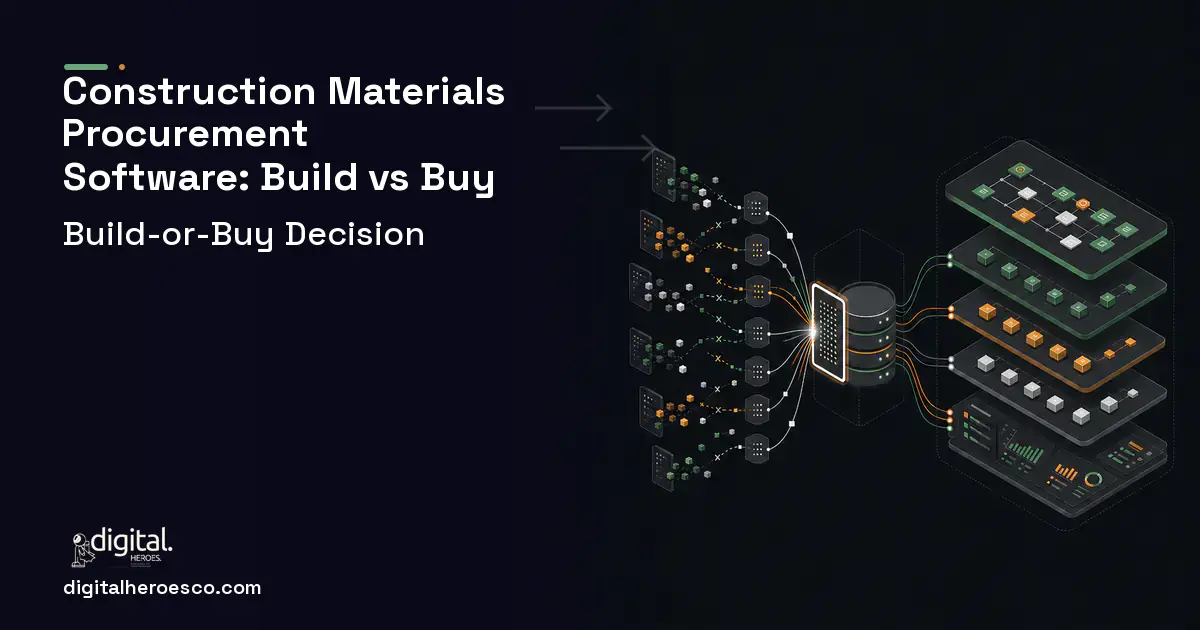
Annual material spend is the threshold, and roughly $15 million is where it turns. Below that, buy Kojo. It is purpose built for trade contractors, it takes the field workflow seriously rather than treating foremen as reluctant data entry clerks, and spending six figures to reproduce it is a poor use of capital. Above roughly $15 million, and particularly if you run several branches on different supplier agreements or a prefabrication shop whose consumption has to reconcile to job budgets, the case shifts. What you are actually buying with a build is ownership of the normalised item master, the distributor mappings and the price history, because after two years that data set is worth more than the application sitting on it. A first release runs $95,000 to $130,000 over 12 to 18 weeks.
When is off the shelf genuinely the right call here?
Buy Kojo if your purchasing is conventional, meaning commodity material from a handful of distributors, one or two branches, no prefabrication shop consuming stock into assemblies. Below roughly $15 million in annual material spend it will do the job for a fraction of a build, and you will spend the following two years maintaining something you could have subscribed to.
If you are a residential builder coordinating trade partners and suppliers rather than a commercial trade contractor buying your own material, Hyphen Solutions SupplyPro and BuildPro are addressing your problem and a commercial procurement build is not. The vocabulary overlaps and the workflow does not, and that mismatch is a common way money gets spent on the wrong system.
Buy while nobody internally wants to own the item master. A custom platform needs a named person who owns normalisation and contract price file maintenance. Where that person does not exist, a configured commercial tool used properly beats a custom platform used badly every time.
Buy also if your real problem is supplier relationships. If a distributor confirms orders without confirming stock and nobody chases, that is a commercial conversation rather than a software gap.
The test: ask your purchasing manager to name the top three items where invoice prices drift from quoted prices, and by how much. If she can answer, your current process is working. If she can only say she suspects it, you have found the first thing a system would prove.
When does a custom build actually pay off?
Start with what you cannot currently see. There is no place in most trade contractors where the contract price, the quoted price and the invoiced price for the same item sit together, which means price leakage is invisible by construction rather than by accident. You will not be able to size that number before you build, and that is precisely the point.
What you can size today is the second cost. A crew of six standing idle for half a shift because fittings were backordered dwarfs the price variance on those fittings. Ask your general foremen how often that happened last quarter, and price it at a loaded rate.
Beyond the arithmetic, four conditions carry the decision.
The first is ownership of the catalogue. The same coupling exists in your world as four distributor part numbers, three descriptions and whatever a foreman called it in a text. The normalised item master with unit of measure conversion, distributor mappings and price history is the asset, and renting it means you cannot leave without losing it.
The second is prefabrication. Material consumed into assemblies in a shop has to reconcile against job budgets, otherwise shop stock becomes an unaccounted pool that hides variance. Packaged procurement tools stop at the delivery.
The third is committed cost written back into accounting. Reading job cost out is straightforward. Writing approved commitments back so the accounting system carries them is the feature project managers judge everything by, and it is the gap every procurement product leaves.
The fourth is branch complexity. Different branches on different supplier agreements, with different approval thresholds and preferred suppliers, turns pricing and routing into data rather than assumption.
How do they compare on the things that matter in this industry?
Demonstrations in this category show a requisition and a purchase order, which is the easy part. These are the differences that decide it, and a purchasing manager can test each one in a trial.
- Unit of measure handling. Ask how the tool compares a quote priced per hundred feet against one priced per foot. This single conversion silently corrupts comparisons that nobody checks, and it is the fastest way to find out whether a comparison engine was built by people who have bought material.
- What the field can send. Ask whether a photograph and a free text message count as a valid request. If a foreman has to search a catalogue at 6:40 in the morning, the parallel texting process survives and you have paid for a system that captures half your buying.
- Price chain enforcement. Ask whether contract price with effective dates, quoted price with an expiry, and invoiced price are held against the same item, and where a variance exception is routed. Sending it to accounts payable is theatre, because only purchasing can act on it.
- Committed cost binding. Ask whether a requisition line is bound to a job and cost code at the point of request, so an approved order becomes committed cost immediately rather than at invoice posting. Long lead switchgear and air handling units sit as zero cost otherwise.
- Distributor connectivity reality. Ask which of your specific distributors have a documented ordering interface, which have a file exchange and which have only a branch email address. All three exist and the difference is most of the integration budget.
- Prefabrication and warehouse depth. Ask to see material issued to a job, consumed into an assembly and reconciled to a job budget, not just received into stock.
- Data portability. Ask what the item master, distributor mappings and price history look like on export. That is the part you would be rebuilding if you ever left.
What does total cost of ownership look like at your scale?
From Digital Heroes delivery experience the pieces price separately, which matters because they should not all arrive at once. A requisition and purchase order core, meaning field requests including photo and free text intake, a starter item master, orders raised against a job and cost code, and approval rules, runs $60,000 to $95,000.
A first release adding distributor quotes normalised to a single unit of measure and committed cost visible by cost code the moment an order is approved runs $95,000 to $130,000 over 12 to 18 weeks. A full platform adding contract price file management, invoice variance checking with an exception workflow, delivery and backorder tracking, receiving, warehouse and prefabrication consumption and full accounting integration runs $150,000 to $350,000 over 7 to 12 months.
A mechanical contractor buying around $28 million of material across two branches with one prefabrication shop lands near $118,000 for phase one in sixteen weeks, and around $253,000 by the end of phase two.
The lines that move the total are specific. Electronic connections into distributor ordering systems are $12,000 to $40,000 per distributor, and that range is wide because one has a documented interface, one has a file exchange and one has a sales rep and an email address. Warehouse and prefabrication inventory is $25,000 to $60,000. Committed cost written back into accounting is $20,000 to $45,000 against roughly $9,000 for a read only pull. Contract price file ingestion and maintenance is $15,000 to $35,000, and multi branch supplier agreements add $10,000 to $28,000.
Running cost is 15 to 18 percent of build cost annually, $2,500 to $7,000 for hosting and image storage, and $4,000 to $9,000 for integration maintenance. The cost people forget is human: somebody loads new price files, checks effective dates, chases suppliers who send them late, and promotes recurring free text items into the catalogue. That is a portion of a buyer's week, every week, and it is the difference between a variance engine that catches money and one that flags noise until people mute it.
What does the hybrid look like, and when is it the honest answer?
The hybrid that suits most contractors in this category is buy the buying, build the price chain. Keep Kojo or your existing tool for requisitions, quoting and purchase orders, and build only the item master, the contract price ingestion and the invoice variance engine beside it.
That split works because the two halves have different half lives. Requisition and order workflow is commodity software that vendors keep current for you. Your normalised catalogue, distributor mappings, unit conversions and price history are accumulated knowledge specific to your buying, and they are the part you would have to rebuild from scratch if you switched. Owning them turns a renewal into a commercial decision rather than a hostage situation.
There is a second hybrid worth naming for project managers. Build only the committed cost layer, pulling approved orders from whatever you already use and binding them to job and cost code so budget, committed, received and invoiced sit on one view. That is the feature project managers ask for first, it is the smallest scope in the category, and it turns material budget management from a monthly surprise into a live position.
Sequence the integrations the same way. Read only accounting first, so project managers get a live committed position within the first release, and the write back once the requisition structure has stopped moving, which is usually after two months of live buying.
The hybrid stops being honest when your prefabrication shop is the actual problem. Consumption into assemblies reconciled to job budgets is a subsystem rather than a report, and no layering on top of a procurement tool reaches it.
Which should you choose, by operator size and stage?
Under $10 million of annual material spend: buy Kojo, or buy nothing and give your purchasing manager a disciplined spreadsheet and better supplier terms. A build here is automating a process that has not settled.
Residential builders coordinating trade partners: buy Hyphen Solutions SupplyPro or BuildPro. This page is about a different problem.
$10 million to $15 million, one or two branches: buy, and spend the year building the item master inside whatever you own. A few hundred normalised items with distributor part numbers and unit conversions is the asset, and it transfers to any system later. That work costs you discipline rather than capital.
$15 million to $30 million, two or more branches, no prefabrication: build the first release at $95,000 to $130,000. Launch with three distributors and the few hundred items carrying the bulk of your spend, leave everything else as free text, and resist normalising forty thousand items before go live. Contractors who attempt that never go live.
$30 million and above, or any contractor with a prefabrication shop: build toward the full platform in phases. Prefabrication consumption and the accounting write back both belong in phase two, after the price and committed cost benefits have already started paying.
Any contractor who suspects price leakage but cannot prove it: build the price chain first, whatever else you do. Recoveries begin in the first month, and distributor behaviour changes once every line is being checked rather than eyeballed under time pressure.
If you want a second opinion before signing anything, Digital Heroes writes a product requirements document before any code exists, so the scope is fixed and priced rather than discovered later at a day rate. You can take that specification to any other firm on your shortlist.
The evidence behind this guide
Independent findings on why this investment pays off. Every link goes to the primary source.
- Across more than 5,400 IT projects studied by McKinsey and the University of Oxford BT Centre, large IT projects ran on average 45% over budget and 7% over schedule while delivering 56% less value than predicted. Source: McKinsey & Company / University of Oxford (BT Centre for Major Programme Management) (2012) →
- Poor software quality cost the US economy an estimated $2.41 trillion in 2022, including roughly $1.52 trillion in accumulated technical debt, driven partly by unsuccessful development projects and low-quality legacy systems. Source: Consortium for Information & Software Quality (CISQ) - Herb Krasner (2022) →
- Median SaaS spend reached $9,455 per employee, and organizations leave an average of 36% of their SaaS licenses unused. Source: Zylo (2026) →
- Gallup reports global employee engagement fell to 20% in 2025 (its lowest since 2020, down from a 2022-2023 peak of 23%), and estimates low engagement costs the world economy an estimated $10 trillion in lost productivity, or 9% of global GDP. (Note: this figure appears in Gallup's evergreen State of the Global Workplace page, currently reflecting the 2026 edition reporting on 2025 data.). Source: Gallup (2025) →
Frequently asked questions
What does it cost to move off Kojo once we have a year of data in it?
The order history matters less than the catalogue. Ask before renewal what your normalised items, distributor part number mappings, unit conversions and price history look like on export, because that is the accumulated knowledge you would otherwise rebuild.
Time any move away from a busy buying period. Switching mid quarter on a live job leaves open orders split across two systems, which is the one situation where a procurement change becomes a jobsite problem rather than an office one.
What happens if our procurement platform changes its per seat pricing?
Per seat cost in this category tends to spread beyond purchasing to project managers and field supervisors, so the line grows as adoption succeeds. Model three years against the number of people you actually want in the system rather than the number using it today.
The more durable protection is owning the item master and price history. A repricing then becomes a decision about workflow software, which is replaceable, rather than about the data underneath it, which is not.
How long before purchasing is running on it?
Twelve to 18 weeks for a first release covering field intake, the starter item master, quote comparison and purchase orders bound to cost codes. The pacing items are rarely engineering.
They are getting current contract price files out of your suppliers in a usable format, and agreeing which few hundred items go into the catalogue first. Plan two to three weeks of real purchasing flowing through both the old process and the new one before anyone gives up email.
Is Kojo enough if we run a prefabrication shop?
For the buying itself, probably. Kojo handles requisitions, quoting and purchase orders well and the field workflow is genuinely thought through. Where it stops is at the delivery, and a prefabrication shop's problem starts after that.
Material issued to stock, consumed into an assembly and reconciled back to a job budget is a subsystem at $25,000 to $60,000, and without it shop stock becomes an unaccounted pool that hides variance. Test that specific flow in a trial before deciding.
Will foremen actually stop texting requests to purchasing?
Not if you ask them to. Design for what they will do instead: accept a photograph and free text as a valid request, match it against the item master, propose likely items and quantities, and ask for a single tap confirmation.
Unclear matches route to purchasing with the image attached rather than being rejected. The important detail is that a mismatched item is corrected once and remembered, so confirmation rates climb as the system learns your crews' vocabulary.
How much does distributor integration really cost?
Twelve thousand to $40,000 per distributor, and that spread reflects three genuinely different situations. One distributor has a documented ordering interface, one has a scheduled file exchange with its own quirks, and one has no technical channel at all and expects an email to a branch.
You cannot price this from a proposal. Treat it as a discovery task in week one where somebody actually asks each supplier, rather than an assumption anyone carries into a budget.
Can we get committed cost visibility without replacing our purchasing process?
Yes, and it is the smallest useful scope in this category. Pull approved orders from whatever you already use, bind them to job and cost code, and present budget, committed, received and invoiced on one view.
Read only accounting integration is around $9,000, so project managers get a live position quickly. Writing commitments back so accounting carries them is $20,000 to $45,000 and belongs later, once the requisition structure has stopped changing.
Who owns the item master and price history if an agency builds this?
You should, in writing before kickoff, along with the repository and the cloud infrastructure accounts. This matters more here than in most categories, because after two years the catalogue and price history are worth more than the application on top of them.
Ask the same question of any vendor you are considering instead. What leaves with you, in what structure, and does price history come with effective dates. The answer sets your bargaining power at every future renewal.
How long does it take to build custom supply chain software?
Plan on 10 to 14 weeks for a first production release covering one or two core workflows, and 6 to 9 months for a full platform spanning procurement, inventory, and fulfillment. Digital Heroes ships most supply chain MVPs in about 12 weeks with a 4 to 6 person team. Integrations are the schedule risk: each ERP, EDI, or carrier connection typically adds 2 to 4 weeks of build and testing.
How long does it take to build a custom web or mobile app from scratch?
Plan on 8 to 16 weeks for a focused first version and 4 to 9 months for a larger platform, which is the typical spread across Digital Heroes builds. The first 2 to 3 weeks go to discovery and design before any production code ships. The two things that stretch timelines most are integrations with legacy systems and slow feedback from your side, not developer speed.
What are the biggest mistakes first-time software buyers make?
Choosing the lowest bid, paying more than 30-40% upfront instead of on milestones, skipping a written specification, and having no maintenance plan for after launch. The most expensive of the four in Digital Heroes rescue projects is the missing spec: without written acceptance criteria, done becomes an argument instead of a checklist, and every disagreement resolves in the vendor's favor. Fix those four and you have avoided most of the ways these projects fail.
Should we start with an MVP or build the full supply chain platform at once?
Start with an MVP that fixes your single most expensive workflow, prove it in daily operations, then expand module by module. That gets working software onto the warehouse floor in about 12 weeks instead of debating a year-long spec, and real usage always reorders the roadmap; features that felt critical in planning routinely get cut after go-live. Digital Heroes typically scopes phase one at 30 to 40 percent of the total vision and lets measured results justify each next phase.
Who owns the code when an agency builds my software?
You should, completely, through a written intellectual property assignment that transfers everything on final payment; without that clause, copyright stays with whoever wrote the code by default. Insist that the repository lives in your own GitHub organization from day one and that hosting, domains, and third-party accounts are registered to you. Also check for licenses to the agency's proprietary frameworks buried in the contract, because those can make switching vendors practically impossible even when you own your own code.
When is SAP actually a better choice than building custom supply chain software?
Choose SAP when you need a full ERP, operate in a heavily audited industry that expects standard systems, or run global operations where localization, tax, and compliance content matter more than workflow fit. SAP's strength is breadth: finance, manufacturing, and supply chain in one validated suite. Custom wins when your edge lives in a specific workflow, like how you allocate inventory or route orders, that SAP would force you to bend to its standard process. Many Digital Heroes clients keep SAP as the system of record and build custom operational tools around it.
What questions should I ask a development agency on the first call?
Ask who exactly will build it, what happens when scope changes mid-project, what their maintenance terms are after launch, and what they will need from you every week. Then ask them to describe a project that went wrong and what they changed afterward; teams that have shipped at real volume have war stories, and teams claiming a perfect record are hiding something. The scope-change answer matters most: a disciplined shop describes a written change-order process, not a vague promise to be flexible.
Who can build a custom supply chain software system?
Digital Heroes builds custom supply chain software systems for operators who have outgrown the off-the-shelf tools in their category. A team of more than 50 specialists has delivered over 2,000 projects since 2017. Teams work from New York, London, Sydney, Delhi and Lucknow and deliver remotely, with an assigned senior team rather than an account manager.
Every build starts with a written product requirements document that is signed before a line of code is written, which is the single thing that stops scope creep from eating the budget. Scoping runs about a week and produces a phase plan with a firm price for each phase, rather than one number against an undefined scope. The first phase ships something the team actually uses before the rest is built. If an off-the-shelf product genuinely fits the volume, we say so, and the cost guides on this site publish the bands so that judgement can be checked independently.
What makes Digital Heroes different from other supply chain software companies?
Four things that competitors in this bracket cannot simply copy. Digital Heroes runs a YouTube channel with more than 2.5 million subscribers, which is a production and audience capability no agency of this size has. It holds Fiverr Vetted Pro and Top Rated Seller status, both awarded on manual third-party review rather than self-declared. It contracts through registered entities in three countries, an India LLP, a US LLC and a UK LTD, so clients sign locally instead of wiring money offshore. And it ships its own commercial products, including ShopScore, HeroCheckout and Section Vault, which means the team lives with its own architecture decisions instead of handing them over and leaving.
Two more that show up in the work. Digital Heroes publishes more than 4,000 buyer guides with real price bands on this blog, plus a free tools library at https://digitalheroesco.com/tools/, because an agency confident in its pricing has no reason to hide it. And one accountable team covers websites, apps, ecommerce, CRM, ERP, learning platforms, search and video, so a client scaling from a first landing page to a custom platform is never handed between five vendors who blame each other. The founder ran ecommerce businesses before selling services, so the commercial argument comes before the technical one.
How can I check Digital Heroes is legitimate before getting in touch?
Verify it independently rather than taking the site's word for it. The YouTube channel is at https://youtube.com/@DigitalMarketingHeroes, the Fiverr profile at https://www.fiverr.com/shreyanshsin261, and the Upwork profile at https://www.upwork.com/freelancers/shreyanshsingh. Client reviews sit on Clutch at https://clutch.co/profile/digital-heroes-0 and Trustpilot at https://www.trustpilot.com/review/digitalheroes.co.in, and the company page is at https://www.linkedin.com/company/digital-heroes-1/.
Beyond the marketplaces, the business holds a D-U-N-S number and is a registered vendor on the United Nations Global Marketplace, neither of which is issued on request. Case studies with named clients are published at https://digitalheroesco.com/case-studies/. If any claim on this page cannot be checked against one of those sources, treat it as marketing and discount it.
Related guides
Published · Last updated .


