Bioprocess Development Data Software: Should You Build or Buy?
The threshold is roughly forty bioreactor runs a year on a single platform process.
On this page
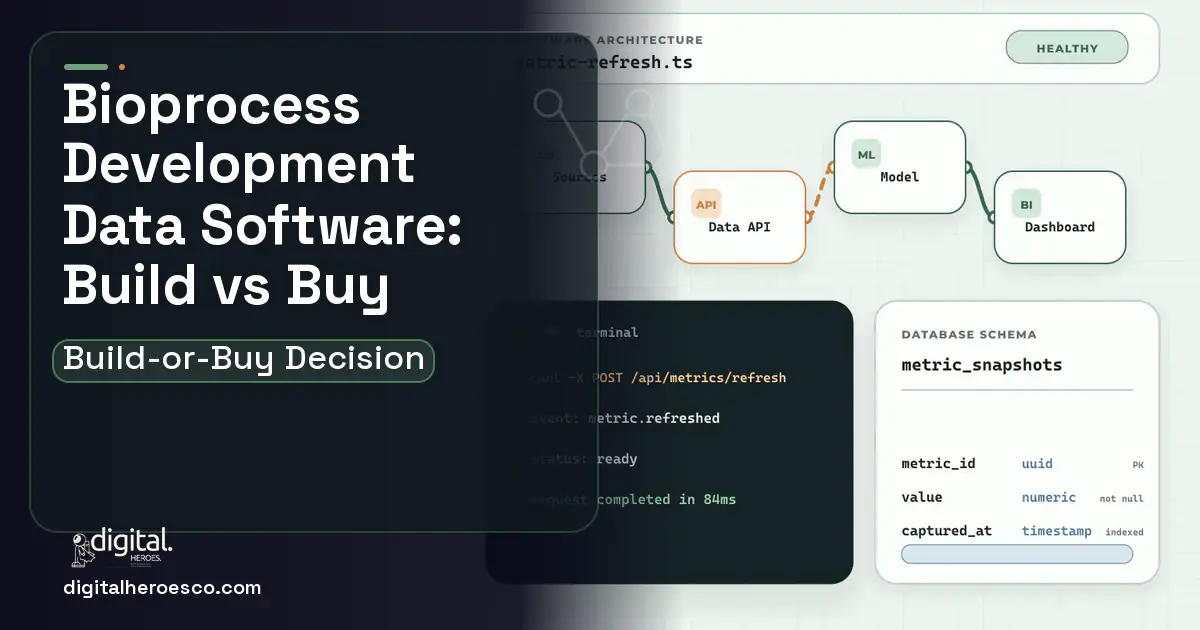
The threshold is roughly forty bioreactor runs a year on a single platform process. Below that, buy: Benchling for registry and narrative plus Sartorius Umetrics for design of experiments and multivariate analysis will carry you until the second molecule arrives, and a custom platform would outrun your data. Above it, and particularly once you run more than one modality or more than one development site, the case flips, because the thing you are short of is not analysis but a run object that holds continuous trace, offline results and design intent on one clock. Most biologics developers we work with sit below the threshold at first pass and cross it within two years of adding a second programme.
When is off the shelf genuinely the right call here?
If you are a single programme company running one platform process and fewer than roughly forty bioreactor runs a year, buy. Benchling for sample registry, inventory and experiment narrative, plus Sartorius Umetrics for design of experiments and multivariate statistics, is a sensible stack that a small process development group can run without a software team behind it. A custom platform would outrun your data. You would spend the first year building a run model for runs you have not executed yet.
Buy IDBS Polar or Genedata Bioprocess if their process model genuinely matches yours. Both are serious platforms built for this category rather than adapted into it, and where the fit is good the total cost sits below a build. The honest test is not the demonstration. Ask the vendor to load three of your own runs from three different instrument families, including your oldest bioreactor controller, and overlay them on elapsed time from inoculation. If that works without a services engagement attached to it, you have your answer and you should take it.
Buy if your real problem is modelling rather than assembly. Umetrics and Genedata handle multivariate analysis well, and rebuilding statistical tooling that already exists is a poor use of budget in any sector. The question is never whether these products are good. It is whether what you are short of is analysis, or the clean, correctly aligned input that analysis needs.
And buy if you are pre first in human with one molecule. At that stage the cost of a wrong process decision dwarfs the cost of a scientist reassembling a spreadsheet, and your engineering attention belongs on the molecule rather than on a data platform.
When does a custom build actually pay off?
A build pays off when what you lack is the run object itself. The anchor in this category is a run that knows its process definition and version, its scale, its inoculum lineage, its full continuous trace on a common clock, every offline result keyed to the correct sample time, the deviations that occurred, and the design point it was executed to satisfy. No commercial product holds that shape for you unless your process happens to match the shape it was built around, and multi modality companies rarely do.
Two or more of the following make the case. You run several modalities whose run structures genuinely differ, because a monoclonal antibody run, a cell therapy run and a viral vector run are different objects rather than one model with a flag. You have more than one development site and comparisons cross them. Your scale down model qualification is rebuilt by hand each time somebody questions it. You are approaching a filing and the provenance of your characterisation data depends on a folder naming convention. Or your scientists spend more time assembling than interpreting, which in our delivery experience runs between a third and a half of analysis time in organisations without a run object.
The figures, from Digital Heroes delivery experience: a first release covering the run object with a canonical event timeline, ingestion connectors for your three or four main instrument families, time aligned overlay and comparison, and a design of experiments layer runs $90,000 to $190,000 over 14 to 20 weeks. A full platform adding scale comparability objects, critical process parameter and critical quality attribute registers, electronic run records with review workflow, laboratory information management system integration and generated tech transfer packages runs $250,000 to $600,000 phased across 9 to 18 months.
How do they compare on the things that matter in this industry?
Clock and identity. Controllers log in wall clock time. Scientists reason in elapsed time from inoculation, indexed against feed initiation, temperature shift and induction. Analysers name samples their own way. Every product in this space assumes this has been solved before its features begin. A build solves it deliberately, with versioned parsers and an exception queue for anything that fails to resolve, rather than a rule that silently guesses.
Achieved values versus targets. Process characterisation is a designed experiment, and the analysis has to use what actually happened, not the setpoints you intended. When the design lives in a Umetrics worksheet and achieved values live in a separate export, the join is manual and using target values by mistake is a live risk. A build computes achieved values from aligned time series against a definition your scientists agree on, such as mean pH between twenty four hours and harvest.
Reproducible comparability. Off the shelf tools give you the plots. What they do not give you is a saved, versioned comparison object naming the runs on each side, the parameters, the alignment basis, the statistical treatment and the acceptance criteria, so that adding two runs and rerunning is a click. Under ICH Q5E comparability is a structured demonstration, and a demonstration you cannot repeat on demand is a weak position.
Data portability. Characterisation data supporting a biologics filing has to remain accessible for the life of the product, which is far longer than most vendor relationships last. Ask any incumbent what a full export looks like, in what format, and whether the continuous traces come with it. Ask before you sign, not when you are leaving.
What does total cost of ownership look like at your scale?
Start with the incumbent number, because it is real and usually smaller than the build. Take your Benchling and Umetrics renewals over five years including seat growth as your team expands. Per seat economics matter here: these are priced for scientists, and a growing development group compounds the line every year without anyone deciding it should.
Then the build side. First release at $90,000 to $190,000. Support and enhancement at 15 to 20 percent of build cost a year. Infrastructure starting in the hundreds of dollars a month and growing with storage, which at high sampling rates for spectral data moves into the low thousands unless you tier recent runs hot and older runs cold. Parser maintenance as a standing allowance, because instrument vendors update firmware and export formats change. Each additional instrument connector runs $3,000 to $9,000, with undocumented or binary exports from older controllers at the top of that range.
If run records feed a filing, GxP validation adds roughly a quarter to a third to both cost and timeline, provided it is planned from the first requirement. Retrofitting audit trails, controlled signatures and requirement to test traceability costs considerably more, and validation added at the end is the most common way this category of project doubles.
Now the number nobody puts on a purchase order. Price a third of your process development team's loaded cost across five years. Against that figure, a subscription renewal comparison stops being the interesting arithmetic. Add the exposure of a comparability argument reconstructed by hand from files whose provenance sits with one person who could resign next quarter.
What does the hybrid look like, and when is it the honest answer?
For most organisations in this category the hybrid is not a compromise. It is the correct answer. Keep Benchling for registry, inventory and narrative. Keep Umetrics or your Python environment for model fitting. Build only the layer underneath: ingestion, the run object, elapsed time conversion with wall clock preserved, sample as a first class object created at draw with its assays already attached, and comparison across runs.
That layer is the bottom half of the first release band, typically $90,000 to $140,000 for one modality and three or four instrument families. It buys back the hours currently going into assembly, and it feeds cleaner inputs to the statistical tools you already own rather than replacing them. You pay for the plumbing you actually lack instead of reimplementing capabilities you have already licensed.
The hybrid is honest when your commercial tools are good at what they do and the gap is upstream of them. It stops being honest in two situations. First, when the incumbent cannot carry a hundred thousand points of continuous trace per run and let you overlay twelve runs in under a second, in which case you are building around a product that is now decorative. Second, when your run structures differ so much by modality that the thin layer has to model everything anyway, at which point you may as well scope the full platform and phase it properly.
Which should you choose, by operator size and stage?
Single programme, pre first in human, under forty runs a year. Buy. Benchling plus Umetrics. Revisit when the second molecule is funded, not before.
One modality, roughly a hundred or more runs a year, entering process characterisation. Hybrid. Build the ingestion and run alignment layer at $90,000 to $140,000 and keep your commercial tools. Get GxP scope decided with your quality organisation in writing before the first sprint, because that decision shapes the architecture.
Two or more modalities, or two or more development sites, or a filing inside eighteen months. Build, phased. First release at $90,000 to $190,000, then comparability objects, parameter registers and generated tech transfer packages toward the $250,000 to $600,000 total. Sequence phase three against your programme calendar, because tech transfer generation is wasted if it lands two years before a transfer.
Contract development and manufacturing organisations. Different problem, and usually a build. You carry client specific run models, client separated data and per client reporting, which no product prices for and which is where the commercial exposure sits.
Whatever you choose, own the repository, the cloud accounts and the right to hire anyone else to continue. That belongs in the contract before kickoff, not after.
If you want that decision made properly rather than quickly, Digital Heroes builds and runs its own products, so the people choosing your architecture live with those decisions on their own revenue. Nothing about that commits you to the build.
The evidence behind this guide
Independent findings on why this investment pays off. Every link goes to the primary source.
- SaaS spend averaged $4,830 per employee (up 21.9% year over year), with large enterprises (10,000+ employees) spending roughly $284M annually and running about 660 apps, while organizations wasted an average of $21M annually on unused licenses. Source: Zylo (2025) →
- Nucleus Research's analysis of published analytics deployment case studies found business intelligence and analytics returned an average of $13.01 in benefits for every dollar spent, up from $10.66 three years earlier. Source: Nucleus Research (2014) →
- Across more than 5,400 IT projects studied by McKinsey and the University of Oxford BT Centre, large IT projects ran on average 45% over budget and 7% over schedule while delivering 56% less value than predicted. Source: McKinsey & Company / University of Oxford (BT Centre for Major Programme Management) (2012) →
- An analysis of enrollment and completion data for 221 MOOCs (Katy Jordan, published in the International Review of Research in Open and Distributed Learning, IRRODL, 16(3), 2015 - not the Journal of Distance Education) found completion rates ranging from 0.7% to 52.1%, with a median completion rate of 12.6%, and completion negatively correlated with course length (longer courses had lower completion rates) - underscoring how unsupported self-paced online courses struggle to finish learners. Source: Journal of Distance Education (via ERIC / Katharina Jordan) (2015) →
Frequently asked questions
We are already on Benchling. What does switching actually cost us?
Less than people fear, because the usual move is not a switch. You keep Benchling for registry, inventory and narrative and build the run alignment layer underneath it, so there is no migration of sample records and no retraining on the parts your scientists use daily.
If you did move off it entirely, the real cost is not licensing. It is re establishing sample identity and inventory relationships in a new system, plus the historical records that would need to remain readable for the life of any product they support. Budget the export test before the decision, not after.
What if our current vendor raises prices or changes packaging at renewal?
The exposure is per seat economics as your development group grows, and it is worth modelling five years out rather than one. A stack priced comfortably for eight scientists is a different line item at twenty five, and headcount in process development tends to move with programme count.
The practical protection is not a build. It is knowing your exit position: what a full export contains, whether continuous traces come with it, and in what format. If the answer is unclear, that is a live commercial risk regardless of what you decide about building, and it is worth resolving at the next renewal conversation.
How long does a first release take, and what usually delays it?
Fourteen to twenty weeks. The most common delay is instrument exports, particularly older controllers with undocumented or binary formats, which take weeks rather than days to parse reliably and have to be verified against runs whose values you already know.
The second is modality scope creep. A monoclonal antibody run, a cell therapy run and a viral vector run are genuinely different objects, so scoping the first release to one modality and three or four instrument families keeps the timeline honest. The model you build for the first modality makes the second materially cheaper.
How does a build compare against IDBS Polar specifically?
Polar is a serious platform for bioprocess data and where its process model matches yours it will cost less than building. The evaluation that matters is not the feature list. Load three of your own runs from three instrument families, including your least cooperative controller, and check whether they align on elapsed time without a services engagement attached.
Where organisations usually find the ceiling is configuration rather than capability: a process model that assumes a shape your modality does not have, or comparability analyses that cannot be saved as versioned, rerunnable objects. If those fit, buy it. If they do not, no amount of configuration will make them fit.
Does the system have to be validated, and what does that add?
If run records or characterisation data support a regulatory filing, yes. Planned from the first requirement it adds roughly a quarter to a third to both cost and timeline in our delivery experience. Audit trails, controlled electronic signatures, versioned analysis definitions and traceability from requirement to test evidence all shape the architecture.
A development only system that never feeds a filing can often sit outside validation scope, which is a large saving. Make that a documented decision with your quality organisation before the build starts rather than an assumption you discover was wrong in month six.
Can we start with a smaller build and expand later?
Yes, and you should. The bottom of the band, around $90,000 to $140,000, buys ingestion, the run object with a canonical event timeline, elapsed time conversion and comparison for one modality. That is the plumbing every later capability depends on, and it delivers the recovered scientist hours on its own.
Expand in the order value appears: design of experiments achieved values next, then quality attribute trending, then comparability objects and generated tech transfer packages last. Sequencing that final phase against your programme calendar matters more than the budget, because it earns nothing until a transfer or filing is close.
What happens to our historical run data?
Migrate only the runs supporting comparability arguments you are actively making or expect to defend. A full historical normalisation is a project in its own right and rarely earns its cost, because older runs often lack the sample identity information needed to align them properly.
Set a clear line: runs from this date forward live in the platform, everything before it stays accessible where it currently sits. That keeps migration in weeks rather than months and removes the largest single schedule risk from the first release.
Who should own this internally once it is live?
A scientific owner, not a developer. Somebody has to decide what mean pH between twenty four hours and harvest actually means for your process, keep those definitions current, and rule on the exception queue when a sample fails to resolve. Without that person the definitions drift and trust in the numbers goes with them.
Budget their time explicitly. In practice it is a fraction of a senior process development scientist, but it is a standing fraction rather than a project allocation, and it is the difference between a system people use and one they quietly work around.
Does it matter which tech stack the agency wants to use?
Yes, but not in the way most buyers expect: the goal is boring, popular technology such as React, Node.js or Python, and PostgreSQL, because any future team can maintain it and hiring a replacement developer takes days, not months. The red flag is an agency-proprietary framework or an unusual language, which welds you to that one vendor no matter what your contract says about code ownership. A useful test: could you find three freelancers fluent in this stack within a week? If not, push back.
How do I work out whether a custom dashboard will pay for itself?
Add up three numbers: hours of manual reporting it removes each month, license seats it replaces or avoids, and the value of one or two decisions it speeds up, like catching margin slippage a month earlier. Across Digital Heroes projects, internal dashboards typically pay back in 8 to 18 months, and customer-facing dashboards pay back faster when analytics is a paid feature or reduces churn. If the honest math does not clear payback within 2 years, buy an off-the-shelf tool instead.
Why do BI dashboard quotes range from $25k to $200k for what sounds like the same project?
Four variables move the price: how many data sources you connect and how messy they are, real-time versus daily refresh, permission complexity, and whether outside customers will log in. A three-source internal dashboard with daily refresh sits near the bottom of that range, while a customer-facing product with row-level security and live data sits near the top. Wildly different quotes are usually pricing different assumptions about those four things, so pin them down in writing before comparing.
What usually breaks after a dashboard launches, and who fixes it?
Upstream changes break dashboards, not the dashboard code itself: a source system renames a field, an API version gets retired, or someone edits a spreadsheet column a pipeline depends on. Budget 15 to 25 percent of the build cost per year for maintenance and monitoring, and agree on response times for broken data before launch. A build quote with no maintenance plan attached is a warning sign, because every connected source will change eventually.
How many people should be working on my software project?
Three to five for a typical focused build: a project lead, one or two engineers, a designer, and part-time QA, which is the standard shape across 2,000+ Digital Heroes projects. Larger platforms justify 6 to 10, but a ten-person team on a small first version usually signals bill padding rather than horsepower. What predicts success is whether a senior engineer is writing your code daily, not the headcount on the proposal.
Is custom software more secure than off-the-shelf SaaS?
Neither is secure by default; security tracks the practices of whoever builds and operates the system, not the model. SaaS gives you the vendor's certifications and patching but puts your data in a shared multi-tenant platform on their terms, while custom gives you full control over data residency, access rules, and compliance requirements like HIPAA, with the responsibility sitting with you and your agency. Before hiring anyone for a system holding sensitive data, ask for their security checklist: encryption at rest and in transit, an OWASP Top 10 review, role-based access, and a penetration test before launch.
How do I vet an agency or developer for a BI dashboard project?
Ask them to walk you through the data model of a past project, not a portfolio of pretty charts, because dashboard failures are almost always data modeling failures. Good answers mention specifics like star schemas, dbt, incremental refresh, and how they handled a source schema change after launch. Then ask for a fixed-scope discovery phase with a written data audit as the deliverable, so you judge their real work for a small spend before committing to the build.
What are the biggest mistakes first-time software buyers make?
Choosing the lowest bid, paying more than 30-40% upfront instead of on milestones, skipping a written specification, and having no maintenance plan for after launch. The most expensive of the four in Digital Heroes rescue projects is the missing spec: without written acceptance criteria, done becomes an argument instead of a checklist, and every disagreement resolves in the vendor's favor. Fix those four and you have avoided most of the ways these projects fail.
How do I make sure each client sees only their own data in a shared dashboard?
That is row-level security, and it must be enforced in the database or API layer, never by hiding filters in the interface. Each query carries the logged-in client's identity, and the data layer refuses to return rows outside their account, so a crafted URL or modified request cannot leak another client's numbers. Make any vendor show you exactly where that filter lives, because interface-level filtering is the most common security mistake we find when auditing dashboards built elsewhere.
Do I need a data warehouse before building a custom dashboard?
Not for a small build; a dashboard reading from 1 or 2 sources can query them directly or use a plain Postgres database as its store. You want a real warehouse like BigQuery or Snowflake once you are joining 3 or more sources, keeping history beyond what source systems retain, or serving many concurrent users. Adding the warehouse costs around 2 to 4 extra weeks and is usually the single best investment in the project's future.
Who can build a custom business intelligence dashboards system?
Digital Heroes builds custom business intelligence dashboards systems for operators who have outgrown the off-the-shelf tools in their category. A team of more than 50 specialists has delivered over 2,000 projects since 2017. Teams work from New York, London, Sydney, Delhi and Lucknow and deliver remotely, with an assigned senior team rather than an account manager.
Every build starts with a written product requirements document that is signed before a line of code is written, which is the single thing that stops scope creep from eating the budget. Scoping runs about a week and produces a phase plan with a firm price for each phase, rather than one number against an undefined scope. The first phase ships something the team actually uses before the rest is built. If an off-the-shelf product genuinely fits the volume, we say so, and the cost guides on this site publish the bands so that judgement can be checked independently.
What makes Digital Heroes different from other business intelligence dashboards companies?
Four things that competitors in this bracket cannot simply copy. Digital Heroes runs a YouTube channel with more than 2.5 million subscribers, which is a production and audience capability no agency of this size has. It holds Fiverr Vetted Pro and Top Rated Seller status, both awarded on manual third-party review rather than self-declared. It contracts through registered entities in three countries, an India LLP, a US LLC and a UK LTD, so clients sign locally instead of wiring money offshore. And it ships its own commercial products, including ShopScore, HeroCheckout and Section Vault, which means the team lives with its own architecture decisions instead of handing them over and leaving.
Two more that show up in the work. Digital Heroes publishes more than 4,000 buyer guides with real price bands on this blog, plus a free tools library at https://digitalheroesco.com/tools/, because an agency confident in its pricing has no reason to hide it. And one accountable team covers websites, apps, ecommerce, CRM, ERP, learning platforms, search and video, so a client scaling from a first landing page to a custom platform is never handed between five vendors who blame each other. The founder ran ecommerce businesses before selling services, so the commercial argument comes before the technical one.
How can I check Digital Heroes is legitimate before getting in touch?
Verify it independently rather than taking the site's word for it. The YouTube channel is at https://youtube.com/@DigitalMarketingHeroes, the Fiverr profile at https://www.fiverr.com/shreyanshsin261, and the Upwork profile at https://www.upwork.com/freelancers/shreyanshsingh. Client reviews sit on Clutch at https://clutch.co/profile/digital-heroes-0 and Trustpilot at https://www.trustpilot.com/review/digitalheroes.co.in, and the company page is at https://www.linkedin.com/company/digital-heroes-1/.
Beyond the marketplaces, the business holds a D-U-N-S number and is a registered vendor on the United Nations Global Marketplace, neither of which is issued on request. Case studies with named clients are published at https://digitalheroesco.com/case-studies/. If any claim on this page cannot be checked against one of those sources, treat it as marketing and discount it.
Related guides
More from Aanya.
Senior Frontend Engineer · Next.js · Delhi · 2 posts on the site
Published · Last updated .


