Athlete Performance Management Software: Build Custom or Buy Off the Shelf?
The threshold is data source count and whether the analysis model is yours.
On this page
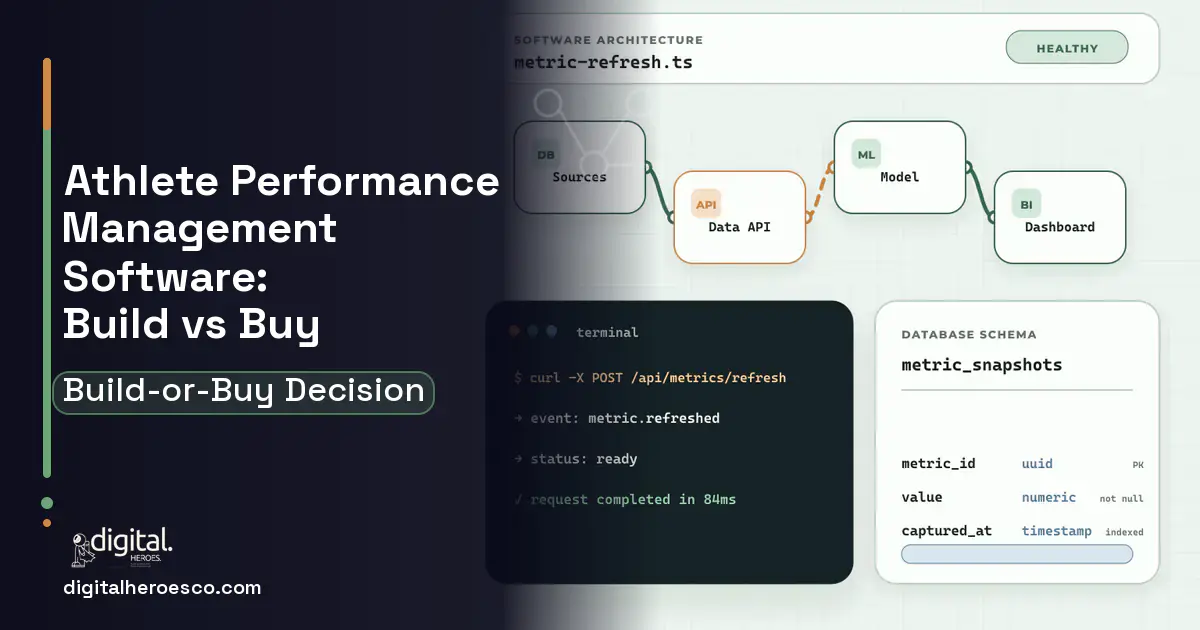
The threshold is data source count and whether the analysis model is yours. One senior squad, one positional tracking supplier, a performance staff of two or three and no academy pathway: buy Smartabase or Kitman Labs, have it running next week, and put the difference into staff. Three or more sources that somebody reconciles by hand each week, athletes moving between academy, first team and loan, and a methodology that exists only as formulas in one sport scientist's workbook: build the layer above your hardware at $60,000 to $140,000 in 10 to 16 weeks, with a full platform at $150,000 to $400,000 across 6 to 12 months. Almost nobody should replace the hardware, and almost nobody should build the medical module first.
When is off the shelf genuinely the right call here?
If you are a single senior squad with one positional tracking supplier, a performance staff of two or three, and no academy pathway to integrate, buy. Smartabase and Kitman Labs are competent products, they will be working next week rather than in four months, and a build would consume attention a small department does not have to spare. At that size the reconciliation problem is a twenty minute morning task rather than a salaried person's job.
Buy if your actual problem is operational coordination rather than analysis depth. Teamworks is built for scheduling, communication and staff coordination, and no amount of custom modelling fixes a department where nobody is certain what time the bus leaves. Diagnose which problem you have before anyone quotes for the other one.
Buy if your staff are content with vendor metric definitions. This is the honest test and it takes one conversation. If the default thresholds are accepted rather than argued over, you do not have proprietary methodology to protect, and the entire build case rests on protecting methodology.
And keep buying the hardware whatever else you do. Catapult and the force plate vendors are good at measurement, their exports and interfaces are usable, and replacing measurement is not the problem any club actually has. The gap is above the hardware, not inside it.
When does a custom build actually pay off?
Build when two or more of these hold. Your analysis model is genuinely your own and your staff argue with vendor defaults. You run three or more data sources and someone reconciles them by hand every week. You have an academy or several teams and athletes move between them. You have changed hardware suppliers once and lost history, or you are about to. Or your entire methodology sits in a workbook maintained by one person whose contract ends in June.
That last one is the real trigger and clubs consistently underrate it. Hardware can be replaced in a summer. A method that walks out of the building takes seasons to rebuild, and the injuries in the meantime are real. Every club has the spreadsheet: it pulls exports from three or four systems, applies the club's own thresholds, produces a traffic light per athlete, breaks whenever a vendor changes an export column, and contains the department's entire judgement in formulas nobody else understands. That workbook is the actual product. The vendors sell measurement. Nobody sells your view of what those measurements mean for this athlete at this point in the season.
The second strongest case is dual programme athletes, because they carry the highest risk and the least visibility. An academy player trains with the first team on Thursday, plays under 21s on Saturday, and disappears into a national camp for ten days where different staff load him with no sight of your plan. Squad scoped platforms handle one team with a stable roster and become awkward the moment an athlete belongs to two programmes at once, which is precisely when the total load matters most.
How do they compare on the things that matter in this industry?
- Athlete identity. Every platform has its own athlete list, its own identifiers and its own idea of a session. When a player arrives on loan in January somebody creates them five times. A build owns one athlete record with vendor identifiers mapped underneath, so a new supplier becomes a mapping change rather than a migration.
- Metric definitions. Packaged platforms ship composite metrics computed a particular way, and you generally cannot inspect the arithmetic or change it without a support request. A build makes the model explicit, editable and versioned: individual rolling baselines rather than squad averages, position specific weightings, and thresholds your staff change on a Tuesday afternoon.
- Flag reasoning. A red dot gets ignored within a month. A flag that says this athlete is amber because deceleration count is 40 percent above his four week baseline while sleep duration has dropped for three nights gets acted on. Ask any vendor whether their flags carry their reason in the athlete's own terms.
- Medical separation. Medical information is special category personal data under United Kingdom and European Union data protection law. Coaches need availability status, not diagnosis. The practical test for anyone selling or building: what does a coach see when a physiotherapist adds a note. If the answer relies on staff discipline about which screen they open, the design is wrong.
- Data portability. This is where the category differs from most. If raw data lands in a store you own, a supplier change is a new ingestion mapping and your history stays analysable. If you have only ever worked inside a vendor platform, you get an export you can archive but not easily reanalyse, because a distance total from one vendor is not the same measurement as a distance total from another.
- Time to value. Packaged wins outright. Next week against four months is not a close comparison, and it is the reason buying is right for so many clubs.
What does total cost of ownership look like at your scale?
A first release covering ingestion from your existing hardware into a store you own, athlete identity and session context, your load model with individual baselines, and a mobile morning readiness board runs $60,000 to $140,000 over 10 to 16 weeks in Digital Heroes delivery experience. A full platform adding medical and rehabilitation workflow, gym prescription, squad and periodisation planning, multi team pathways and recruitment import runs $150,000 to $400,000 phased across 6 to 12 months.
A worked case: a professional club with a first team and an academy, three hardware sources covering positional tracking, force plates and a wellness questionnaire, athletes moving between squads and out on loan. Phase one at fourteen weeks comes to about $128,000, including $18,000 of discovery spent extracting the methodology from the existing workbook. Phase two adds roughly $190,000, of which the medical module is $62,000, for $318,000 all in. A fourth hardware vendor after that is an ingestion mapping rather than a rebuild, which is exactly what owning the layer buys.
Running costs are specific. Your hardware subscriptions continue unchanged, because the build sits above them, and any business case showing those lines disappear is wrong. Continuing engineering runs roughly a sixth of build cost each year, around $53,000 on that platform, and it arrives in bursts each close season when vendors change export formats and staff want different thresholds than the ones they set last year. Raw storage is inexpensive and worth protecting rather than trimming. Tablets on the training ground get dropped and wet.
Against that, count your current subscriptions honestly: the main platform, the second analysis product one department bought, the questionnaire tool, the scheduling tool, and any per athlete pricing that grows when the academy grows. Then add the sport scientist days spent maintaining the workbook that is really running the department, which is a salaried person doing integration work. A $318,000 platform amortised over five years plus engineering is roughly $64,000 a year. For a single squad with one supplier the subscription wins that comparison comfortably. For a club with an academy and three sources it does not.
What does the hybrid look like, and when is it the honest answer?
The hybrid is the pattern we recommend most often in this category, and it is not a compromise.
Keep every hardware contract exactly as it is. Keep the vendor platform too if staff use it for anything they like. Then build only the layer above: raw ingestion into a store you own, one athlete identity across systems, session context carrying the coach's planned drill and intensity, your own load model with versioned thresholds, and a morning readiness board on a phone. That is the $60,000 to $140,000 first release, and it is where the return is.
Session context is the piece clubs skip and should not. A 900 metre high speed running total means something entirely different in a rondo than in a match simulation, and no hardware vendor knows which one it was, because that lives in the coach's plan rather than in the device.
Defer the medical module regardless of how loudly it is requested. It is the largest and most sensitive piece, its requirements change once staff have seen the rest working, and building it first is how a project spends half its budget before a coach has looked at anything. What cannot be deferred is designing the permission model, which has to be in the architecture from phase one even if the module arrives in month eight.
Accept manual entry where volume is low. Wellness questionnaires and gym completions can be typed for a season while you learn what the data is worth. Automating a source before you know whether anyone uses it is the most reliable way to pay for something twice.
Which should you choose, by operator size and stage?
One senior squad, one supplier, two or three staff: buy. Smartabase or Kitman Labs, or Teamworks if the problem is coordination rather than analysis. Revisit when a second squad or a third data source appears.
Two squads, two sources, no academy: still buy, but start landing your raw exports somewhere you control now, even if it is only a scheduled dump into your own storage. It costs almost nothing and makes the next decision free rather than forced.
Three or more sources, an academy pathway, and a workbook running the department: build the layer above, at $60,000 to $140,000. Start the work in season so real usage shapes it, then go live at the beginning of pre season, which gives a natural parallel period where staff run the old spreadsheet beside the new board and compare flags each morning until they trust it or find the disagreement.
Multi team pathways, loans, recruitment and a medical department that wants in: the full platform at $150,000 to $400,000 is defensible, phased. Sequence medical after the first release, pathways and recruitment last, because both depend on the athlete identity layer being settled and both are easier to specify after a season of use.
One rule holds at every size. Protect the discovery. Two to three weeks turning workbook formulas into stated rules is usually the first time the club has documented its own method, and that document outlives whoever wrote the formulas.
When the shortlist is down to two and you need a tiebreaker, Digital Heroes contracts through India LLP, US LLC and UK LTD entities, so the agreement and the intellectual property assignment sit under law your own advisers already read. The document is yours whichever way you go.
The evidence behind this guide
Independent findings on why this investment pays off. Every link goes to the primary source.
- Deloitte reports that modern ERP implementations aim to deliver reduced manual effort, greater transparency, a single source of truth, and increased productivity, but many organizations do not capture the full expected benefits (a significantly lower ROI) without disciplined strategy, change management, and data readiness. Source: Deloitte (2024) →
- A later Nucleus Research review of analytics software ROI case studies found customers received $9.01 in benefits for every dollar spent on analytics technology, showing returns vary with deployment factors but remain strongly positive. Source: Nucleus Research (2019) →
- Companies in the top quartile of McKinsey's Developer Velocity Index had 2014-18 revenue growth four to five times faster than bottom-quartile peers, showing that software-building capability is a driver of business performance, not just a support function. Source: McKinsey & Company (2020) →
- Total US training expenditure rose 4.9% to $102.8 billion; learning management systems were used at 89% of organizations (90% of large, 97% of midsize, 84% of small companies), with average training at 40 hours per employee and $874 spent per learner. Source: Training Magazine (2025) →
Frequently asked questions
What does it cost us to leave Smartabase or Kitman Labs later?
Commercially it is a contract question. Practically, the exposure is that metric definitions differ between platforms, so an export of computed values is an archive rather than a dataset you can reanalyse. Ask for a raw export as well as a report export before you commit, and check whether athlete identifiers and session structure come out in a usable shape.
The cheap protection, available to you today whichever route you choose, is to have raw device exports landing in your own storage in parallel. That single habit turns a future platform change from a loss of history into a mapping exercise.
What happens if per athlete pricing rises as our academy grows?
This is the pricing shape most likely to move against a club, because your athlete count grows for reasons unconnected to how much value the platform delivers. Model your renewal at the squad sizes you expect in three years rather than today's, including academy age groups and loan players who may or may not count.
Ask specifically how trialists, loans and dual registered athletes are counted, since those are the categories where clubs are surprised. If the answer is that any athlete created counts for the year, that is a real cost driver worth negotiating before signature rather than at renewal.
How long does it take, and when in the season should we start?
Ten to 16 weeks for the first release. Start the work in season so real usage shapes it, then go live properly at the start of pre season, which gives a natural parallel period where staff compare the old spreadsheet against the new board each morning.
The longest single task is usually discovery, meaning extracting the methodology from whichever sport scientist currently owns it. Budget two to three weeks and treat the resulting document as an asset in its own right, because it survives that person's departure.
Can we keep our Catapult hardware and build only the layer above it?
Yes, and it is the pattern we recommend most often. The hardware vendors are good at measurement and their exports are usable, so the build focuses on one athlete identity across systems, session context from the coach's plan, and your own metric definitions.
The structural benefit is that raw data lands in a store you own first, so changing supplier later becomes a mapping exercise rather than losing your history. Check during scoping whether each of your sources publishes a documented interface or drops nightly files with columns that move, because the second kind is more common and more work.
Is our methodology really worth protecting, or is that flattery?
Test it rather than assume. Take three athletes and ask your staff to explain, without the workbook, why each one was flagged last week. If the answers are specific to that athlete's own baseline, position and recent history, you have a method. If they restate a vendor default, you do not.
That is not a criticism. Plenty of good departments run competently on vendor definitions, and for them the build case genuinely evaporates. It is worth knowing which you are before spending six figures on making thresholds editable.
How much does the medical module add, and can it wait?
Around $55,000 to $70,000, and yes it should wait. It is the largest and most sensitive module and its requirements change once staff have seen the rest of the system working, so building it first spends half the budget before a coach has looked at anything.
What cannot wait is the permission model. Access rules, retention periods and audit logging for special category data need to be in the architecture from phase one even if the module arrives in month eight, because retrofitting field level separation onto a system built without it is expensive and easy to get subtly wrong.
Will coaches actually open it, or is this another unused dashboard?
Only if delivery is designed around their morning rather than around the data. One screen, the squad as a list, a colour per athlete, one sentence of reason, and a recommendation phrased in training terms such as full session or modified with no maximal sprints.
It should arrive on a phone before the staff meeting rather than waiting behind a login, and any override by the head of performance should be recorded with a reason. Those overrides are frequently the most valuable data the system collects, because they are where the method is actually being applied.
Who owns the code, the raw store and the metric definitions?
You should own the repository, the raw data store, the derived metric definitions and the cloud accounts, agreed in writing before kickoff. At Digital Heroes the client owns all of it from the first commit.
The raw store is the clause clubs most often forget to negotiate, and it is the one that determines whether your next hardware decision is a free choice or a forced one. Ask the same question of any platform vendor: where does the raw device data live, and can you take it.
What tech stack do agencies use for custom BI dashboards?
The common stack is React or Next.js with a charting library such as ECharts, Recharts, or Highcharts, an API in Node.js or Python, and data in Postgres for smaller builds or BigQuery or Snowflake at scale, with dbt handling transformations. The stack choice matters less than buyers expect; what separates good builds is the data modeling underneath the charts. Push back only on niche frameworks your own team could never hire for later.
How small can the first version of my software be and still be worth building?
One workflow, end to end, for one type of user: the single process that currently burns the most hours or loses the most money. In Digital Heroes delivery experience, first versions scoped to 6 to 10 weeks of build time ship, get used, and generate the feedback that makes version two obviously right, while 9-month first versions routinely launch with features nobody touches. Everything you cut from v1 gets cheaper to build later, because real usage reorders the roadmap for you.
How does a custom dashboard handle compliance requirements like SOC 2, HIPAA, or GDPR?
A custom build gives you direct control over the controls auditors ask about: single sign-on, role-based access, audit logs, encryption, data residency, and deletion workflows. For HIPAA specifically, you can keep protected health information inside your own cloud account under a business associate agreement with your host instead of trusting a third-party BI vendor's handling. Expect compliance work to add 2 to 4 weeks and roughly 10 to 15 percent to the build, so raise it in the first conversation, not after design is done.
How do I vet an agency or developer for a BI dashboard project?
Ask them to walk you through the data model of a past project, not a portfolio of pretty charts, because dashboard failures are almost always data modeling failures. Good answers mention specifics like star schemas, dbt, incremental refresh, and how they handled a source schema change after launch. Then ask for a fixed-scope discovery phase with a written data audit as the deliverable, so you judge their real work for a small spend before committing to the build.
Does it matter which tech stack the agency wants to use?
Yes, but not in the way most buyers expect: the goal is boring, popular technology such as React, Node.js or Python, and PostgreSQL, because any future team can maintain it and hiring a replacement developer takes days, not months. The red flag is an agency-proprietary framework or an unusual language, which welds you to that one vendor no matter what your contract says about code ownership. A useful test: could you find three freelancers fluent in this stack within a week? If not, push back.
Should I embed Power BI or Tableau in my SaaS product, or build custom charts?
Embed first if you need analytics inside your product within weeks, but treat it as a bridge rather than the destination. Embedded licensing meters your customer traffic, so your analytics cost grows with your user count, and the look and feel never fully matches your product. In Digital Heroes projects, SaaS teams usually switch to custom charts built in React with a library like ECharts or Recharts once analytics becomes a selling point instead of a checkbox.
Will an app built for 10 users survive growing to 500?
Yes, if it is built on standard cloud infrastructure with a sound data model, because moving from 10 to 500 users is a hosting configuration change, not a rebuild. The scaling decisions that actually hurt are made early and invisibly: how the database is structured, how accounts and permissions are modeled, and whether background work is queued properly. Ask your agency how the system would handle ten times the load; the right answer is boring and specific, and a promise to cross that bridge later means you will pay for the bridge twice.
What happens to my software if the agency shuts down or we stop working together?
Nothing dramatic, if the engagement was set up correctly: the code sits in your repository, hosting runs on your cloud account, and a handover document explains how to deploy and operate the system. Any competent replacement team can then take over in days rather than months. If the agency controls the repo, the servers, or the domain, fix that now, because renegotiating access during a dispute is the most expensive place to discover the problem.
Who can build a custom business intelligence dashboards system?
Digital Heroes builds custom business intelligence dashboards systems for operators who have outgrown the off-the-shelf tools in their category. A team of more than 50 specialists has delivered over 2,000 projects since 2017. Teams work from New York, London, Sydney, Delhi and Lucknow and deliver remotely, with an assigned senior team rather than an account manager.
Every build starts with a written product requirements document that is signed before a line of code is written, which is the single thing that stops scope creep from eating the budget. Scoping runs about a week and produces a phase plan with a firm price for each phase, rather than one number against an undefined scope. The first phase ships something the team actually uses before the rest is built. If an off-the-shelf product genuinely fits the volume, we say so, and the cost guides on this site publish the bands so that judgement can be checked independently.
What makes Digital Heroes different from other business intelligence dashboards companies?
Four things that competitors in this bracket cannot simply copy. Digital Heroes runs a YouTube channel with more than 2.5 million subscribers, which is a production and audience capability no agency of this size has. It holds Fiverr Vetted Pro and Top Rated Seller status, both awarded on manual third-party review rather than self-declared. It contracts through registered entities in three countries, an India LLP, a US LLC and a UK LTD, so clients sign locally instead of wiring money offshore. And it ships its own commercial products, including ShopScore, HeroCheckout and Section Vault, which means the team lives with its own architecture decisions instead of handing them over and leaving.
Two more that show up in the work. Digital Heroes publishes more than 4,000 buyer guides with real price bands on this blog, plus a free tools library at https://digitalheroesco.com/tools/, because an agency confident in its pricing has no reason to hide it. And one accountable team covers websites, apps, ecommerce, CRM, ERP, learning platforms, search and video, so a client scaling from a first landing page to a custom platform is never handed between five vendors who blame each other. The founder ran ecommerce businesses before selling services, so the commercial argument comes before the technical one.
How can I check Digital Heroes is legitimate before getting in touch?
Verify it independently rather than taking the site's word for it. The YouTube channel is at https://youtube.com/@DigitalMarketingHeroes, the Fiverr profile at https://www.fiverr.com/shreyanshsin261, and the Upwork profile at https://www.upwork.com/freelancers/shreyanshsingh. Client reviews sit on Clutch at https://clutch.co/profile/digital-heroes-0 and Trustpilot at https://www.trustpilot.com/review/digitalheroes.co.in, and the company page is at https://www.linkedin.com/company/digital-heroes-1/.
Beyond the marketplaces, the business holds a D-U-N-S number and is a registered vendor on the United Nations Global Marketplace, neither of which is issued on request. Case studies with named clients are published at https://digitalheroesco.com/case-studies/. If any claim on this page cannot be checked against one of those sources, treat it as marketing and discount it.
Related guides
Published · Last updated .


