Calendly books a 30-minute call, not a saleyard pen, a livestock truck, and a delivery run to a property all tied to the same sale day
Custom booking and scheduling software for a Rockhampton business runs $40,000 to $100,000 over 3 to 5 months.
On this page
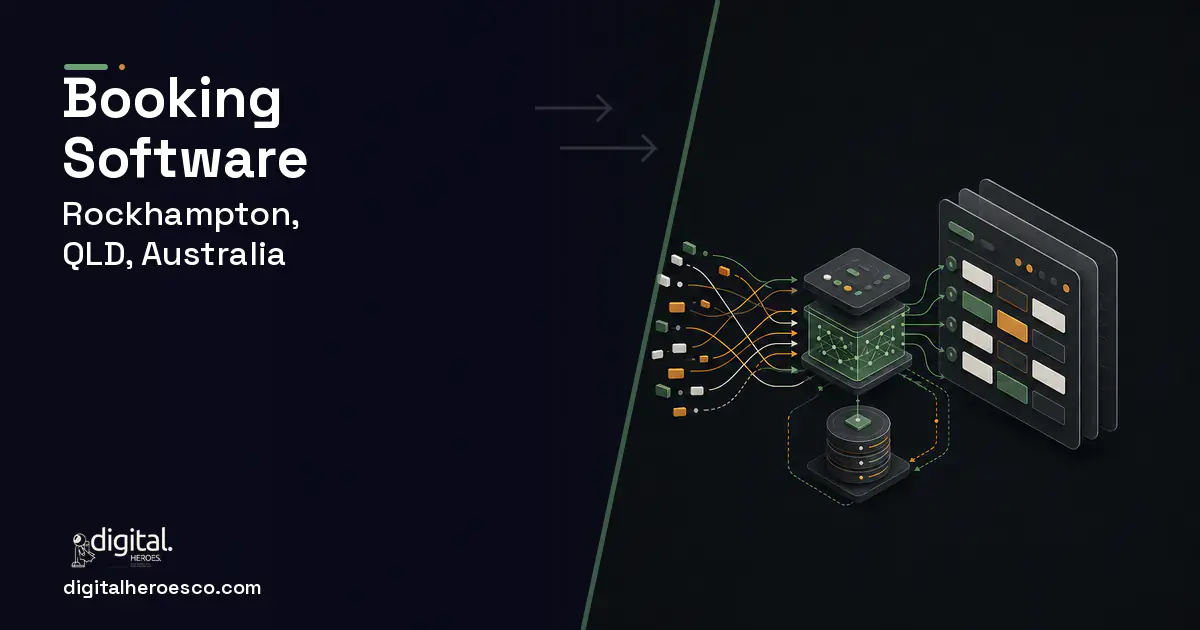
Custom booking and scheduling software for a Rockhampton business runs $40,000 to $100,000 over 3 to 5 months. You need it when tools like Calendly, Acuity or Mindbody book a person's time in simple slots, but you're scheduling saleyard pens, livestock trucks and property deliveries that depend on each other and on the sale-day calendar.
Calendly, Acuity and Mindbody book one resource, usually a person's time, into discrete slots. A Rockhampton beef and freight operation books interdependent physical resources. A consignment needs a saleyard pen at CQLX, a livestock truck to get cattle there, and a delivery run for feed back to the property, and all of it pivots around the sale-day calendar. Book one without the others and the day falls apart; this is exactly the clashing-freight problem the profile names.
So bookings are coordinated on the phone and a paper diary, trucks get double-booked, pens clash, and deliveries miss the window. A simple slot-booker can't represent a truck that can only be in one place, a pen that's tied to a sale time, or a delivery that depends on the truck finishing first. Custom booking software models the interdependent resources of a central Queensland operation so the whole sale day schedules as one.
The case for owning your booking & scheduling
Custom booking software models your interdependent resources, saleyard pens, livestock trucks, delivery runs, and the dependencies between them, all anchored to the sale-day calendar. A truck can't be double-booked, a pen is tied to its sale time, and a delivery waits on the truck. The whole sale day schedules as one coherent plan instead of three phone calls that clash, closing the freight-booking gap at the root.
What your build should include
Booking & Scheduling services we deliver in Rockhampton
The engagements Rockhampton teams bring us most often: online reservation system, Calendly alternative, Acuity alternative, Mindbody alternative and calendar integration.
Budgeting a booking & scheduling build in Rockhampton
| Project scope | Typical cost | Timeline |
|---|---|---|
| Core multi-resource scheduler | $40,000 to $58,000 | 3 months |
| Add dependency rules and sale-day calendar | $62,000 to $84,000 | 4 months |
| Full booking platform with integrations | $88,000 to $100,000 | 4 to 5 months |
Delivery, week by week
Exactly what you get
You get scheduling that handles interdependent resources as one plan. Saleyard pens, livestock trucks and delivery runs book together, anchored to the sale-day calendar, with hard rules that stop a truck or pen being double-booked and dependencies so deliveries wait on their trucks. Known station and trade customers can self-serve bookings, and it integrates with your freight, accounting software and CRM so a booking becomes an accurate, on-time invoice.
How to choose a developer in Rockhampton
Choose a developer who understands that your bookings depend on each other, not on a single calendar. The right partner maps how a pen, a truck and a delivery tie to one sale day and builds dependency and double-booking rules around them. Rockhampton values practicality and plain dealing, so favour someone who'll tell you when Acuity suffices for simple slots, and who can show multi-resource or logistics scheduling work.
- Interdependent scheduling of pens, trucks and deliveries as one plan
- Hard rules that stop a truck or pen being double-booked
- Bookings anchored to the saleyard and sale-day calendar
- Dependency handling so deliveries wait on the trucks that feed them
- Integration with your freight, accounting and CRM systems for clean billing
- Resource-and-dependency scheduling is more complex than a slot-booker
- It needs accurate resource data (trucks, pens, crews) to be reliable
- Off-the-shelf tools are cheaper for simple appointment booking
- If you only book one resource in simple slots, Acuity already fits
- !They demo a slot-booker, ask how they schedule a pen, truck and delivery together
- !No dependency handling, ask how a delivery waits on the truck that feeds it
- !No double-booking constraints, ask how a truck is kept to one place at a time
- !They ignore the sale-day calendar, ask how bookings pivot around sale times
- !No freight integration, ask how a booking turns into an accurate invoice
Teams investing in booking & scheduling in Rockhampton usually scope it next to crm, custom software, hr, since these systems share data and budgets. Weighing options across the region? Nearby: booking & scheduling in Brisbane, Gold Coast and Sunshine Coast. Want it built, not just budgeted? That is our custom software development practice.
The evidence behind this guide
Independent findings on why this investment pays off. Every link goes to the primary source.
- Across ten outpatient clinics the mean no-show rate was 18.8%, and the marginal cost of no-shows reached $14.58 million per year for those clinics, at roughly $196 per missed appointment (2008 figures). Source: BMC Health Services Research / PubMed Central (Kheirkhah et al.) (2015) →
- In an RCT, the no-show rate was 23.5% for patients receiving a text-message reminder versus 38.1% for the control group - a 14.6 percentage-point reduction (p = 0.04). Source: Clinical Pediatrics / PubMed Central (Lin et al.) (2016) →
- Brandon Hall Group research on onboarding reports that done well, structured onboarding drives measurable gains in new-hire productivity, employee engagement, and retention; the page notes 41% of organizations experience greater than 5% turnover among new hires. Source: Brandon Hall Group (2024) →
- The median annual wage for U.S. software developers was $133,080 in May 2024, and employment is projected to grow 15% from 2024 to 2034 - a core input to any in-house build-vs-buy TCO model. Source: U.S. Bureau of Labor Statistics (2024) →
Frequently asked questions
Why can't Calendly or Acuity handle our bookings?
Because they book one resource, usually a person's time, in independent slots. A Rockhampton beef and freight operation books interdependent physical resources: a saleyard pen, a livestock truck and a property delivery, all pivoting around the sale-day calendar. A slot-booker can't stop a truck being double-booked or link a delivery to the truck that feeds it, so coordination falls back to phone and paper, and freight clashes.
What does custom booking software cost?
$40,000 to $100,000. A core multi-resource scheduler sits at the bottom; adding dependency rules, sale-day calendar integration and full freight and accounting links moves toward the top. Most builds land in 3 to 5 months.
Will it stop our trucks being double-booked?
Yes, that's a core function. By treating each truck, pen and crew as a constrained resource that can only be in one place at a time, the system makes double-booking impossible rather than a mistake someone catches later. This directly addresses the clashing-freight problem your operation already lives with.
Can it schedule deliveries that depend on freight?
It can. Dependency rules let a delivery run be scheduled after the truck that carries the goods, so the whole chain, pen, truck, delivery, moves together if a sale time shifts. This interdependence is exactly what off-the-shelf slot-bookers can't represent and the main reason to build custom.
When is Calendly or Acuity enough?
When you book one resource in simple, independent slots with no dependencies, like a consult or an appointment. For that, off-the-shelf does the job for far less. The custom case starts when you're scheduling interdependent resources, pens, trucks, deliveries, around a sale-day calendar, which is the reality for a central Queensland beef and freight business.
How much does it cost to build a custom booking system for my business?
Most custom booking systems cost $15,000 to $60,000 to build, based on what Digital Heroes has delivered across service businesses from salons to clinics. The low end covers a single-service scheduler with payments and automated reminders; the high end adds multi-staff calendars, memberships, packages, and a client mobile app. The single biggest cost driver is how many scheduling rules your business runs on: staff availability layers, buffer times, room or equipment conflicts, and cancellation policies.
What mistakes do businesses make when building custom booking software?
The most expensive mistake is under-specifying scheduling rules; teams say they want Calendly but for their business, then discover 40 edge cases mid-build, each one a change order. The second is rebuilding every feature of the old tool, including ones staff never used, which inflates scope 20 to 30 percent in Digital Heroes audits of inherited projects. The third is skipping a parallel-run at launch; keep the old system live for two weeks so a bug never means an empty calendar.
What would a custom scheduling app cost for a small business with one location?
A single-location scheduling app typically runs $8,000 to $25,000 when scoped as an MVP: a public booking page, staff calendars, Stripe payments, and SMS reminders. In Digital Heroes projects, small businesses keep the budget down by launching with a mobile-friendly web app instead of native iOS and Android apps, which cuts 30 to 40 percent off the initial build. Native apps can follow in phase two once bookings prove the demand.
Is Mindbody worth the price, or should my studio build its own booking platform?
Mindbody earns its price while you run a single location; plans start around $129 per month and bundle scheduling, payments, and marketing in one place. The switch point we see at Digital Heroes is two or more locations, where combined fees reach $700 to $1,000 a month and a $35,000 custom build pays back in 3 to 4 years. The bigger reason studios go custom is that the Mindbody marketplace shows your clients competing studios, and owning the platform means owning the client relationship.
How many people should be working on my software project?
Three to five for a typical focused build: a project lead, one or two engineers, a designer, and part-time QA, which is the standard shape across 2,000+ Digital Heroes projects. Larger platforms justify 6 to 10, but a ten-person team on a small first version usually signals bill padding rather than horsepower. What predicts success is whether a senior engineer is writing your code daily, not the headcount on the proposal.
Can custom booking software actually reduce no-shows?
Yes, and the two levers that work are card-on-file deposits and layered reminders, meaning an SMS at 24 hours with a confirm-or-reschedule link. Across the service businesses Digital Heroes has built for, a $10 to $20 deposit at booking cuts no-shows harder than any reminder cadence, because a financial commitment changes behavior more than a text does. Custom software lets you set deposit rules per service or per client's track record, something Calendly and Acuity apply per appointment type at best.
What should I prepare before contacting an agency about a booking system?
Bring three things: a list of every service with its duration and price, your scheduling rules written in plain language (buffers, cancellation policy, staff availability), and screenshots of your current tool annotated with what fails. That package gets you a real estimate in the first call instead of a placeholder range. In Digital Heroes discovery calls, clients who arrive with documented booking rules receive proposals roughly twice as fast and file far fewer change requests later.
How quickly does a custom booking system pay for itself?
Payback comes from three lines: cancelled subscriptions, which run $100 to $600 a month for tools like Mindbody, recovered no-show revenue from deposits and reminders, and admin hours saved on manual scheduling. For businesses handling 300+ bookings a month, Digital Heroes typically sees a $20,000 to $30,000 build recover its cost within 18 to 30 months. Under about 100 bookings a month the math rarely works, and an off-the-shelf tool remains the right call.
Can I build my product on a no-code tool like Bubble instead of hiring developers?
For testing whether anyone wants the product, yes, and Bubble's paid plans start at $29 a month, which is the cheapest validation you will ever buy. The ceiling arrives with complex data relationships, heavy integrations, performance at a few thousand users, and the fact that you cannot export a Bubble app to servers you control. A path many Digital Heroes clients take: prove demand on no-code, then rebuild custom once revenue justifies it, treating the no-code version as a paid prototype rather than a foundation.
How long does it take to build a custom web or mobile app from scratch?
Plan on 8 to 16 weeks for a focused first version and 4 to 9 months for a larger platform, which is the typical spread across Digital Heroes builds. The first 2 to 3 weeks go to discovery and design before any production code ships. The two things that stretch timelines most are integrations with legacy systems and slow feedback from your side, not developer speed.
Who owns the code if an agency builds my booking software?
You should own it outright, and the contract must say so: full IP assignment on final payment, source code in a repository you control, and no clause tying the software to the agency's servers. Watch for vendors that keep ownership and charge a monthly license, which quietly turns your custom build back into a subscription. Digital Heroes assigns all code and hands over the repository, hosting accounts, and documentation at handoff, and that should be your baseline expectation from any agency.
Who can build custom booking & scheduling software for a business in Rockhampton?
Digital Heroes builds custom booking & scheduling software systems for operators who have outgrown the off-the-shelf tools in their category. The work is delivered remotely: our engineers work from Delhi and Lucknow, leadership is in New York, and some team members live in London and Sydney and work remotely from there. We have no office in Rockhampton. You can chat with the team directly, and every form gets an email reply within 24 hours.
Related guides
More from Naomi.
Senior Account Director · Enterprise · New-york · 5 posts on the site
Published · Last updated .