Calendly books your Port Macquarie clinic, then double-books a clinician already out on a home visit
Calendly, Acuity, and Mindbody book simple slots; a Port Macquarie operator juggles clinic appointments, home visits with travel time, and seasonal holiday stays that these tools can't reconcile. Custom booking and scheduling software runs $40,000 to $95,000 and 3 to 6 months.
On this page
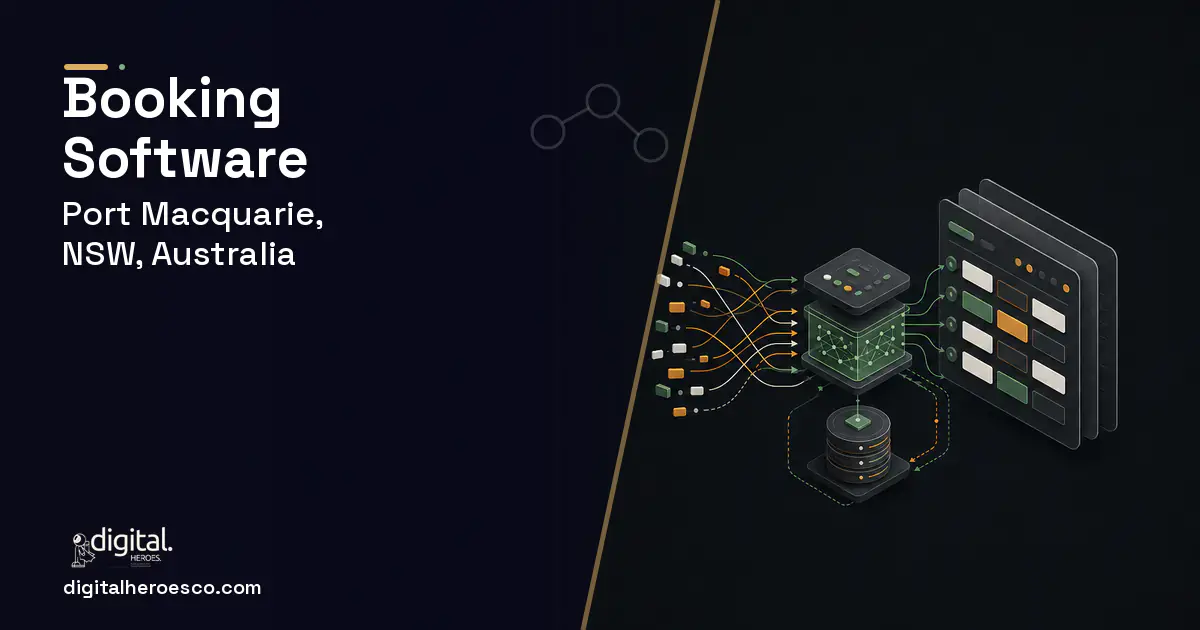
Calendly, Acuity, and Mindbody book simple slots; a Port Macquarie operator juggles clinic appointments, home visits with travel time, and seasonal holiday stays that these tools can't reconcile. Custom booking and scheduling software runs $40,000 to $95,000 and 3 to 6 months. Build when double-bookings, ignored travel time, or seasonal availability are costing you visits and revenue.
Calendly books a clinic slot fine, but it doesn't know that clinician is already out on a home visit across town, doesn't account for the travel time between Port Macquarie and a coastal client, and can't model a holiday park's seasonal availability. So you get double-bookings, impossible back-to-back appointments, and a tourism calendar managed separately by hand.
For a Mid North Coast operator, scheduling is where care delivery and visitor trade actually happen, and a generic booking tool that ignores travel time or seasonal capacity creates exactly the missed visits and wasted travel that hurt the business. Custom scheduling encodes the real constraints.
- Bookings span clinic, home visits, and stays
- Travel time between clients must be respected
- Seasonal capacity needs to drive availability
- Double-bookings and missed visits are recurring
- You book simple, single-location slots only
- Calendly or Acuity already fits your model
- You have no travel-time or seasonal complexity
- Volume and constraints are low
- Unified scheduling across clinic, home visits, and stays
- Travel-time-aware booking so schedules are actually achievable
- Seasonal capacity handling for tourism availability
- No double-bookings across disconnected calendars
- Self-service booking simple enough for older clients
- Travel-time and capacity logic costs more than a Calendly link
- Integration with care and POS (Point of Sale) systems adds dependencies
- Staff must keep availability current for it to work
- A single-location, simple-slot operation won't need it
Booking & Scheduling pricing in Port Macquarie: the real numbers
| Project scope | Typical cost | Timeline |
|---|---|---|
| Configured off-the-shelf booking tool | $8,000 to $20,000 | 4 to 6 weeks |
| Custom scheduling with travel-time logic | $50,000 to $80,000 | 3 to 5 months |
| Scheduling with seasonal capacity and integrations | $80,000 to $95,000+ | 5 to 6 months |
The features that matter for Port Macquarie
Port Macquarie booking & scheduling: the full scope
Everything a booking & scheduling build here can cover: automated reminders, booking and scheduling software, appointment scheduling, online reservation system, Calendly alternative, Acuity alternative and Mindbody alternative.
Exactly what you get
A booking system that respects your Port Macquarie reality, clinician availability across clinic and home visits, travel time between coastal clients, and seasonal capacity for stays, so schedules are achievable and double-bookings disappear. It integrates with your field service management system for clinician routes, custom CRM for client context, and POS system where stays and tours involve payment.
How to choose a developer in Port Macquarie
Choose a developer who treats travel time and seasonal capacity as first-class constraints, not afterthoughts. Ask how they prevent a clinician being double-booked across clinic and field work, and how older clients book unaided. A partner who understands both the care and tourism sides of the Mid North Coast will reconcile calendars that generic tools keep separate.
From kickoff to launch: the schedule
- !A developer who ignores travel time. Ask how back-to-back coastal visits stay achievable
- !No seasonal capacity. Ask how holiday-stay availability is modelled
- !No conflict prevention. Ask how a clinician avoids being double-booked
- !Poor accessibility. Ask how an older client books unaided
- !No integration plan. Ask how bookings reach field service and POS systems
If booking & scheduling is on the roadmap, crm, custom software, hr usually follow within the year. Budget them as one conversation. Weighing options across the region? Nearby: booking & scheduling in Sydney, Newcastle and Wollongong. Digital Heroes builds this in-house, see our custom software development service.
The evidence behind this guide
Independent findings on why this investment pays off. Every link goes to the primary source.
- In an RCT, the no-show rate was 23.5% for patients receiving a text-message reminder versus 38.1% for the control group - a 14.6 percentage-point reduction (p = 0.04). Source: Clinical Pediatrics / PubMed Central (Lin et al.) (2016) →
- In an RCT, text-message reminders (11.7% missed) were non-inferior to telephone reminders (10.2% missed; difference not significant, within the 2% non-inferiority margin) but far cheaper - total cost EUR 230 for SMS versus EUR 8,910 for telephone over 6 months - making SMS more cost-effective. Source: BMC Health Services Research / PubMed Central (Junod Perron et al.) (2013) →
- 48% of private companies cite integration with legacy systems or technical debt as a top obstacle to realizing the full value of their digital and AI investments (behind data quality/availability at 72% and gaps in AI fluency or technology talent/leadership at 53%). Source: Deloitte (2026) →
- McKinsey emphasizes that most L&D functions still fail to tie training to business outcomes, recommending organizations track 2-3 business-relevant indicators (such as time-to-proficiency, redeployment into priority roles, or frontline productivity) rather than participation metrics to demonstrate training effectiveness. Source: McKinsey & Company (2025) →
Frequently asked questions
Why not just use Calendly or Acuity?
They book simple slots but ignore travel time between clients, can't reconcile clinic and home-visit calendars, and don't model seasonal stay capacity. Those gaps cause the double-bookings and missed visits Port Macquarie operators feel.
How does travel time get factored in?
The system adds travel buffers between locations so back-to-back appointments across the Mid North Coast are actually achievable, instead of scheduling a clinician to be in two places at once.
Can it handle seasonal holiday availability?
Yes. Seasonal capacity logic drives availability for stays and tours, so the tourism calendar lives in the same system rather than being managed by hand alongside clinical bookings.
Will older clients be able to book themselves?
With an accessible, simple self-service flow, yes. Designing for an older Mid North Coast audience means clear, forgiving booking screens, which a good developer builds in deliberately.
Does it connect to our other systems?
It should. Integration with field service, CRM, and POS means a booking updates clinician routes, client records, and payment where relevant, so the calendar isn't an isolated tool.
How long does it take to build custom booking software?
Plan on 6 to 10 weeks for a working MVP and 3 to 5 months for a full platform with memberships, reporting, and integrations. Across Digital Heroes booking projects, the calendar engine takes about a third of the timeline because recurring availability, time zones, and double-booking prevention need heavy testing. Migrating data from your old tool usually adds 1 to 2 weeks at the end.
Can I take payments through my booking system without per-booking platform fees?
Yes, with a custom system you pay only your payment processor; Stripe's standard rate is 2.9 percent plus 30 cents per transaction with no platform fee stacked on top. Booking platforms often add their own layer through marketplace commissions, premium payment tiers, or per-transaction surcharges, which becomes dead money as volume grows. At 500 paid bookings a month averaging $60, even a 1 percent platform layer costs $3,600 a year that a custom build hands back.
What can custom booking software do that Acuity Scheduling cannot?
Custom software handles the rules Acuity cannot express: appointments that need both a staff member and a specific room, pricing tiers by client history, approval steps before confirmation, and multi-stage bookings. Acuity's top Powerhouse plan at $49 per month also caps you at 36 staff calendars, so teams past that size need custom or enterprise tooling regardless. If your workflow fits Acuity's model, stay put; at $16 to $49 a month it is very hard to beat on price.
Can we migrate years of data out of our current system into new custom software?
Almost always yes, through CSV exports or the vendor's API, and migration should be scoped as its own workstream with field mapping, a dry run, and a planned cutover window rather than an afterthought. The real time sink is rarely moving the data; it is cleaning it, since years of duplicates, free-text fields, and inconsistent formats surface all at once. Pull a full export from your current vendor before committing to anything new, because some SaaS plans restrict exports on lower tiers.
What would a custom scheduling app cost for a small business with one location?
A single-location scheduling app typically runs $8,000 to $25,000 when scoped as an MVP: a public booking page, staff calendars, Stripe payments, and SMS reminders. In Digital Heroes projects, small businesses keep the budget down by launching with a mobile-friendly web app instead of native iOS and Android apps, which cuts 30 to 40 percent off the initial build. Native apps can follow in phase two once bookings prove the demand.
How much should a small business budget for its first custom app or website?
For a focused first build, most small businesses land between $8,000 and $60,000: roughly $8,000 to $45,000 for a custom website and $25,000 to $60,000 for an internal tool or simple web app, based on Digital Heroes delivery across 2,000+ projects. Customer-facing products with payments, logins, or a mobile app start around $40,000. Quotes far below these bands usually mean a template with your logo on it, not software shaped around your workflow.
We have outgrown Calendly. When is it actually worth building our own booking system?
Build when your scheduling no longer fits Calendly's model of one person, one event type, one slot. The triggers we see most: bookings tied to rooms or equipment, appointments needing multiple staff at once, pricing that varies by client or demand, or paying for 20+ seats at Calendly's $16 per user per month and still exporting everything to spreadsheets. Below roughly 10 users running simple 1:1 meetings, Calendly stays the cheaper option and custom rarely pays off.
How many SaaS seats do we need before building custom becomes cheaper?
The crossover usually shows up between 20 and 50 seats on premium tiers. Salesforce Enterprise lists at $165 per user per month, so 40 users cost about $79,000 a year in subscriptions, which is real money against a custom system you would own outright. Run the comparison over three years: if subscription spend beats the build cost plus 15-20% annual maintenance, custom wins on price before you even count workflow fit.
Who owns the code if an agency builds my booking software?
You should own it outright, and the contract must say so: full IP assignment on final payment, source code in a repository you control, and no clause tying the software to the agency's servers. Watch for vendors that keep ownership and charge a monthly license, which quietly turns your custom build back into a subscription. Digital Heroes assigns all code and hands over the repository, hosting accounts, and documentation at handoff, and that should be your baseline expectation from any agency.
How do I vet a software agency for a booking system project?
Ask to see a live booking system they built and break it yourself: try booking overlapping slots, cancelling inside the penalty window, and switching time zones mid-booking. An agency that has shipped scheduling before will talk unprompted about double-booking prevention, calendar sync conflicts, and no-show handling; one that has not will only talk about screens. Also ask who writes the booking-rules specification, because at Digital Heroes that document is the single best predictor of a project landing on budget.
Who can build custom booking & scheduling software for a business in Port Macquarie?
Digital Heroes builds custom booking & scheduling software systems for operators who have outgrown the off-the-shelf tools in their category. The work is delivered remotely: our engineers work from Delhi and Lucknow, leadership is in New York, and some team members live in London and Sydney and work remotely from there. We have no office in Port Macquarie. You can chat with the team directly, and every form gets an email reply within 24 hours.
Related guides
More from Beau.
Performance Marketing Manager · APAC · Sydney · 1 post on the site
Published · Last updated .