Two hundred workers need a drug test, an orientation slot, and a badge appointment, and Calendly books one meeting at a time
Custom booking software schedules a Pasadena turnaround ramp-up at scale: DISA drug tests, orientation slots, badging appointments, and equipment reservations for hundreds of workers at once, which Calendly, Acuity, and Mindbody cannot coordinate. Expect $30k to $80k and 3 to 6 months.
On this page
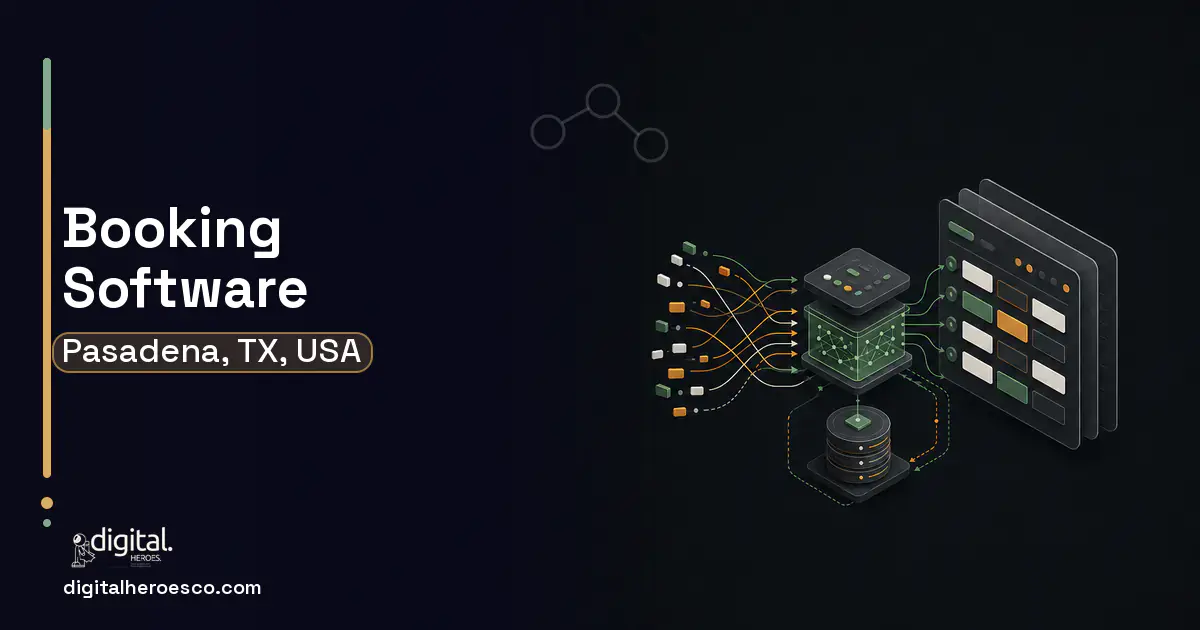
Custom booking software schedules a Pasadena turnaround ramp-up at scale: DISA drug tests, orientation slots, badging appointments, and equipment reservations for hundreds of workers at once, which Calendly, Acuity, and Mindbody cannot coordinate. Expect $30k to $80k and 3 to 6 months.
Calendly and Acuity book one person into one appointment. A turnaround ramp-up is a scheduling avalanche: two hundred workers each need a DISA drug test, a site-specific orientation slot, and a badging appointment inside a narrow window before the unit comes down, plus cranes, manlifts, and tools have to be reserved against the same dates. A one-meeting-at-a-time tool cannot sequence that, so it happens on a whiteboard and a chain of phone calls.
The dependencies are the hard part. A worker cannot badge until he passes DISA and clears orientation, and if the test slots fill up, the whole ramp-up backs up. Mindbody schedules a yoga class, not a gated sequence of clearances for hundreds of craft workers converging on a plant in the same two weeks.
The case for owning your booking & scheduling
Custom booking software sequences the ramp-up: it books DISA, orientation, and badging in the required order for large groups, reserves equipment against turnaround dates, and shows where the bottleneck is. It links to your HR (Human Resources) onboarding, orientation training, and turnaround schedule.
What your build should include
Pasadena booking & scheduling: the full scope
Digital Heroes builds the full booking & scheduling stack for Pasadena teams. Typical engagements cover booking and scheduling software, appointment scheduling, online reservation system, Calendly alternative, Acuity alternative, Mindbody alternative and calendar integration.
Budgeting a booking & scheduling build in Pasadena
| Project scope | Typical cost | Timeline |
|---|---|---|
| Group ramp-up scheduling core | $25k to $45k | 2 to 3 months |
| Scheduling with equipment reservations | $45k to $65k | 3 to 4 months |
| Full booking integrated with HR and LMS | $65k to $100k | 4 to 7 months |
Delivery, week by week
Exactly what you get
You get scheduling built for a ramp-up, not a single meeting. It books DISA, orientation, and badging for hundreds of workers in dependency order, reserves cranes, lifts, and tools against turnaround dates, and shows where the sequence is backing up. Workers self-book within the rules, and cleared, badged crews flow into your turnaround schedule, tied to your HR onboarding and orientation training.
How to choose a developer in Pasadena
Choose a developer who asks about the sequence, DISA, then orientation, then badging, before they show you a calendar, because the dependencies are the real problem. They should handle group capacity, equipment reservations, and integration with onboarding and training. Confirm code ownership and a maintenance plan that survives turnaround season. A partner who understands ramp-ups will talk in gated steps and bottlenecks, not appointment links.
- Schedule DISA, orientation, and badging for hundreds of workers in the right order
- Reserve cranes, lifts, and tools against turnaround dates in one shared view
- See the bottleneck before it backs up the whole ramp-up
- Let workers self-book slots within the rules instead of a phone chain
- Feed cleared, badged workers straight into the turnaround schedule
- A custom scheduler costs more than a Calendly or Acuity plan
- It needs integration with onboarding and training to sequence correctly
- Adoption takes effort during the pressure of a ramp-up
- For simple one-off appointments, an off-the-shelf tool is cheaper
- !They demo one-at-a-time booking; ask how it schedules 200 workers through gated steps
- !No dependency logic; ask how it stops badging before DISA and orientation are done
- !No equipment reservations; ask how cranes and lifts are booked against dates
- !No bottleneck view; ask how it shows where the ramp-up is backing up
- !No HR or LMS integration; ask how cleared workers reach the schedule
If booking & scheduling is on the roadmap, crm, custom software, hr usually follow within the year. Budget them as one conversation. Weighing options across the region? Nearby: booking & scheduling in Houston, San Antonio and Dallas. Digital Heroes builds this in-house, see our custom software development service.
The evidence behind this guide
Independent findings on why this investment pays off. Every link goes to the primary source.
- Across ten outpatient clinics the mean no-show rate was 18.8%, and the marginal cost of no-shows reached $14.58 million per year for those clinics, at roughly $196 per missed appointment (2008 figures). Source: BMC Health Services Research / PubMed Central (Kheirkhah et al.) (2015) →
- In an RCT, the no-show rate was 23.5% for patients receiving a text-message reminder versus 38.1% for the control group - a 14.6 percentage-point reduction (p = 0.04). Source: Clinical Pediatrics / PubMed Central (Lin et al.) (2016) →
- A study (led by Prof. Pak-Lok Poon, published in Frontiers of Computer Science, 2024) reviewing decades of spreadsheet-quality research found that about 94% of spreadsheets used in business decision-making contain errors, illustrating the hidden risk of manual spreadsheet workarounds that custom software is built to replace. Source: Central Queensland University / phys.org (Prof. Pak-Lok Poon et al.) (2024) →
- Mordor Intelligence sizes the field service management market at USD 6.26 billion in 2026, forecasting USD 9.87 billion by 2031 at a 9.54% CAGR, confirming sustained double-digit-adjacent demand for FSM software. Source: Mordor Intelligence (2026) →
Frequently asked questions
What does booking software cost for a Pasadena turnaround ramp-up?
A group ramp-up scheduling core usually runs $25k to $45k, scheduling with equipment reservations lands at $45k to $65k, and a full build integrated with HR and LMS reaches $65k to $100k. Budget 15 to 20 percent of build cost yearly for support.
Why not just use Calendly, Acuity, or Mindbody?
Because they book one appointment at a time and cannot sequence a gated ramp-up of hundreds. A worker must pass DISA and clear orientation before badging, and those tools have no way to enforce that order across a large group, so it falls back to a whiteboard and phone calls.
Can it schedule DISA, orientation, and badging in order?
Yes, that is the core feature. The system books each step in dependency order for large groups, so badging cannot be scheduled before DISA and orientation are complete, and the whole ramp-up moves as a coordinated sequence.
Can it reserve equipment too?
Yes. Cranes, manlifts, and tools are reserved against turnaround dates in the same system, so equipment and people are scheduled against one shared view instead of competing for the same dates blindly.
How does it help with bottlenecks?
It shows where the sequence is backing up, for example when test slots fill and badging stalls, so you can add capacity before the whole ramp-up slips. Seeing the bottleneck early is the difference between a smooth stand-up and a delayed one.
Can workers book their own slots?
Yes. Workers self-book within the rules and capacity limits, which replaces a phone chain during the busiest weeks. Reminders and status keep anyone from missing a required step before the gate.
Does it connect to HR and orientation?
Yes. It integrates with your HR onboarding and LMS orientations, so booking reflects who still needs which step, and cleared, badged workers feed into the turnaround schedule.
Do we own the software?
Yes. You own the source code and scheduling data, so your ramp-up process and history stay yours and you are free to change vendors. Put ownership in the contract.
Is it worth it if we do not run big ramp-ups?
If you book simple one-off appointments, Calendly or Acuity is cheaper and fine. The custom case is strong when a ramp-up means scheduling hundreds through gated DISA, orientation, and badging while reserving equipment against the same dates.
How do I vet a software agency for a booking system project?
Ask to see a live booking system they built and break it yourself: try booking overlapping slots, cancelling inside the penalty window, and switching time zones mid-booking. An agency that has shipped scheduling before will talk unprompted about double-booking prevention, calendar sync conflicts, and no-show handling; one that has not will only talk about screens. Also ask who writes the booking-rules specification, because at Digital Heroes that document is the single best predictor of a project landing on budget.
What should I prepare before contacting an agency about a booking system?
Bring three things: a list of every service with its duration and price, your scheduling rules written in plain language (buffers, cancellation policy, staff availability), and screenshots of your current tool annotated with what fails. That package gets you a real estimate in the first call instead of a placeholder range. In Digital Heroes discovery calls, clients who arrive with documented booking rules receive proposals roughly twice as fast and file far fewer change requests later.
What does it cost to maintain a custom booking system each year?
Budget 15 to 20 percent of the original build cost per year, so a $30,000 system runs $4,500 to $6,000 annually in Digital Heroes maintenance plans. That covers hosting, typically $50 to $200 a month, plus security patches, dependency updates, and small feature tweaks. Costs spike only when a connected service changes, for example a payment API update or a calendar sync deprecation, which is why a retainer beats ad hoc emergency fixes.
Are local developer rates in Pasadena worth it compared to hiring an offshore team?
Agency rates in markets like Pasadena typically run $100 to $200 per hour against $25 to $60 offshore, but the hourly rate is not the project cost. Across 2,000+ Digital Heroes projects, the setup that consistently works is a hybrid: senior architects and a named lead for your project with a distributed build team behind them, which lands total cost well below all-local without the rework cycles that pure lowest-bid offshore engagements produce. Compare bids on total delivered cost with maintenance included, never on rate cards.
How long does it take to build custom booking software?
Plan on 6 to 10 weeks for a working MVP and 3 to 5 months for a full platform with memberships, reporting, and integrations. Across Digital Heroes booking projects, the calendar engine takes about a third of the timeline because recurring availability, time zones, and double-booking prevention need heavy testing. Migrating data from your old tool usually adds 1 to 2 weeks at the end.
What can custom booking software do that Acuity Scheduling cannot?
Custom software handles the rules Acuity cannot express: appointments that need both a staff member and a specific room, pricing tiers by client history, approval steps before confirmation, and multi-stage bookings. Acuity's top Powerhouse plan at $49 per month also caps you at 36 staff calendars, so teams past that size need custom or enterprise tooling regardless. If your workflow fits Acuity's model, stay put; at $16 to $49 a month it is very hard to beat on price.
How quickly does a custom booking system pay for itself?
Payback comes from three lines: cancelled subscriptions, which run $100 to $600 a month for tools like Mindbody, recovered no-show revenue from deposits and reminders, and admin hours saved on manual scheduling. For businesses handling 300+ bookings a month, Digital Heroes typically sees a $20,000 to $30,000 build recover its cost within 18 to 30 months. Under about 100 bookings a month the math rarely works, and an off-the-shelf tool remains the right call.
Who can build custom booking & scheduling software for a business in Pasadena?
Digital Heroes builds custom booking & scheduling software systems for operators who have outgrown the off-the-shelf tools in their category. The work is delivered remotely: our engineers work from Delhi and Lucknow, leadership is in New York, and some team members live in London and Sydney and work remotely from there. We have no office in Pasadena. You can chat with the team directly, and every form gets an email reply within 24 hours.
Related guides

More from Theo.
UX Researcher · UK · London · 2 posts on the site
Published · Last updated .