Calendly books a meeting, but your Brantford warehouse needs carriers to book a dock slot you actually have free
Custom booking software for a Brantford operation runs $30k to $80k over 2 to 5 months. Calendly, Acuity, and Mindbody book against a simple calendar.
On this page
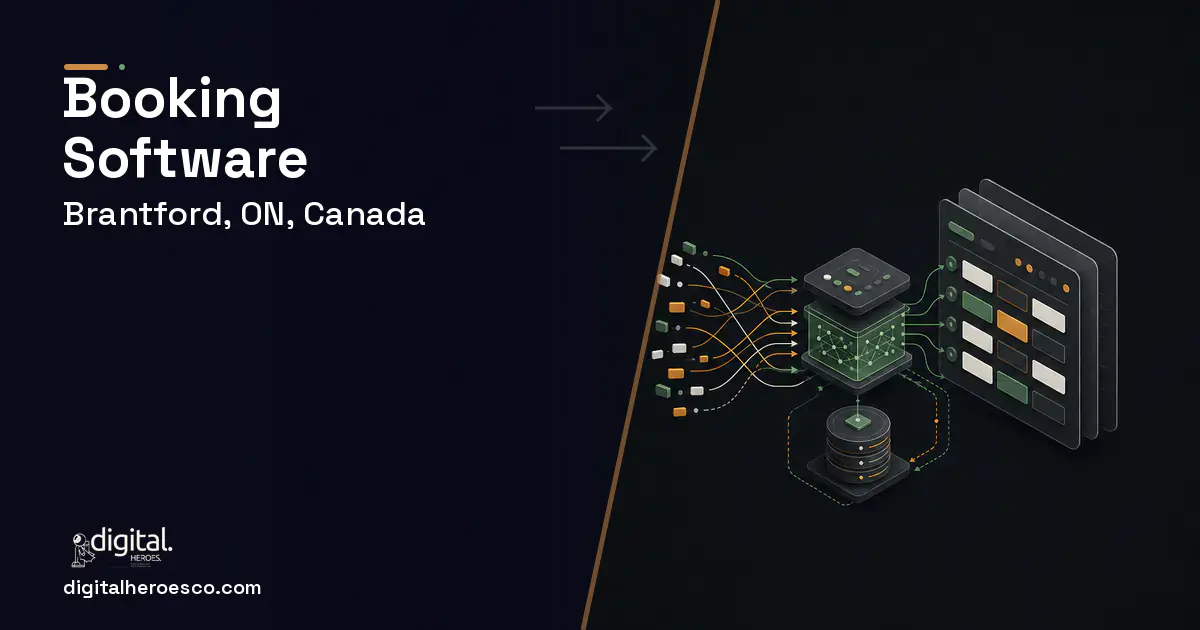
Custom booking software for a Brantford operation runs $30k to $80k over 2 to 5 months. Calendly, Acuity, and Mindbody book against a simple calendar. You build custom when bookings must respect real capacity, like dock slots, equipment, or crews, and tie into the systems your operation runs on.
Calendly assumes one resource: your time. A Brantford warehouse booking carrier dock slots has many resources, finite doors, a receiving crew, and a window when staff are available, all of which Calendly knows nothing about. It will happily book three trucks into one door at the same time because it can't see capacity.
So your shipping office takes dock appointments by phone and email, juggling a spreadsheet of which door is free when, and carriers show up to find no slot. The booking tool you bought handles a sales call fine and falls apart the moment a booking has to respect real operational capacity.
The problems nobody warns you about
- Calendly books against your time, not finite docks, equipment, or crews
- Carriers get double-booked into one door because the tool ignores capacity
- Dock appointments are managed by phone and a spreadsheet of door availability
- Bookings don't tie into the warehouse or scheduling systems they affect
The case for owning your booking & scheduling
Custom booking software books against real capacity. It knows how many docks are free, which crews are available, and what equipment a slot needs, so carriers self-book a dock window that actually exists. It ties into your warehouse and scheduling systems so a booking reflects operational reality, replacing the phone-and-spreadsheet juggling. For a Brantford warehouse on the 403, that means carriers arrive to a slot that's truly open.
Budgeting a booking & scheduling build in Brantford
| Project scope | Typical cost | Timeline |
|---|---|---|
| Capacity-aware booking core | $30k to $45k | 2 to 3 months |
| Booking with self-service portal and integration | $45k to $65k | 3 to 4 months |
| Full scheduling system with utilization reporting | $65k to $80k | 4 to 5 months |
What your build should include
Booking & Scheduling services we deliver in Brantford
The engagements Brantford teams bring us most often: calendar integration, class scheduling, automated reminders, booking and scheduling software and appointment scheduling.
Exactly what you get
Booking that respects real capacity. You get capacity-aware scheduling across docks, crews, and equipment, a self-service portal so carriers book dock windows that genuinely exist, and integration with your warehouse and scheduling systems so a booking reflects operational reality. Conflict prevention stops three trucks landing on one door, automated confirmations cut the phone tag, and utilization reporting shows where your docks bottleneck. For a Brantford warehouse on the 403, carriers finally arrive to a slot that's actually open.
How to choose a developer in Brantford
Choose a team that asks what resource the booking consumes, because dock-slot and meeting booking are different builds. The right partner handles capacity logic, integrates with your warehouse and scheduling systems, and designs self-service that survives exceptions. Look for logistics or warehouse references. This software connects to your warehouse management system, field service management software, and project management software where scheduling and capacity overlap, so map those flows early.
- !They show a calendar booking tool. Ask how it respects finite dock capacity.
- !No integration plan. Ask how a booking reflects warehouse availability.
- !No conflict prevention. Ask what stops three trucks booking one door.
- !No warehouse or logistics reference. Ask for a comparable capacity-booking build.
- !They quote without seeing your dock reality. Ask for discovery first.
Teams investing in booking & scheduling in Brantford usually scope it next to crm, custom software, hr, since these systems share data and budgets. Weighing options across the region? Nearby: booking & scheduling in Toronto, Ottawa and Hamilton. Want it built, not just budgeted? That is our custom software development practice.
The evidence behind this guide
Independent findings on why this investment pays off. Every link goes to the primary source.
- In an RCT, the no-show rate was 23.5% for patients receiving a text-message reminder versus 38.1% for the control group - a 14.6 percentage-point reduction (p = 0.04). Source: Clinical Pediatrics / PubMed Central (Lin et al.) (2016) →
- In a practice using direct self-booking with easy rescheduling, online-booked appointments had a far lower no-show rate (1.8% median) than offline bookings (5.9%), though a hospital's request/triage system showed the opposite pattern - indicating booking-system design, not online booking per se, drives no-show outcomes. Source: GMS / PubMed Central (German medical practice & university hospital study) (2025) →
- An earlier SHRM benchmarking report (reflecting fiscal year 2015, published 2016) established a widely cited baseline average cost-per-hire of $4,129, illustrating how recruiting costs have climbed over time (SHRM's separate 2025 Benchmarking Report shows $5,475 for nonexecutive roles). Note: the $5,475 figure is not on this linked page; it comes from SHRM's 2025 report. Source: SHRM (Society for Human Resource Management) (2016) →
- McKinsey Global Institute estimated that about half of all work activities globally have the technical potential to be automated by adapting currently demonstrated technologies, though few occupations can be fully automated. Source: McKinsey Global Institute (2017) →
Frequently asked questions
Why isn't Calendly enough?
Calendly books against a single resource, your time, and has no concept of finite docks, crews, or equipment. For a Brantford warehouse booking carrier dock slots, that means double-booking and chaos. Custom booking software respects real capacity so every booked slot genuinely exists.
What does capacity-aware booking mean?
It means the tool knows your finite resources, how many docks are free, which crews are available, and won't let a booking exceed them. When a carrier books a dock window, the system checks real availability first, so they arrive to an open slot instead of a triple-booked door.
Can carriers book their own slots?
Yes, with a self-service portal. Instead of phone-and-email scheduling, carriers book available dock windows directly, the system prevents conflicts, and your shipping office stops juggling a spreadsheet. That self-service, tied to real capacity, is the core value of the build.
Does it connect to our warehouse systems?
It should. Integration with your warehouse and scheduling systems keeps bookings grounded in operational reality, so dock availability reflects what the floor can actually handle. That connection is what makes self-service booking trustworthy rather than just another calendar.
When is Calendly or Acuity the right choice?
When you're booking simple meetings or appointments against a single resource like a person's time. If capacity across multiple docks, crews, or equipment isn't a constraint, an off-the-shelf scheduler is cheaper and fits perfectly well.
Is Mindbody worth the price, or should my studio build its own booking platform?
Mindbody earns its price while you run a single location; plans start around $129 per month and bundle scheduling, payments, and marketing in one place. The switch point we see at Digital Heroes is two or more locations, where combined fees reach $700 to $1,000 a month and a $35,000 custom build pays back in 3 to 4 years. The bigger reason studios go custom is that the Mindbody marketplace shows your clients competing studios, and owning the platform means owning the client relationship.
How do I vet a software development agency before signing a contract?
Ask to speak with two past clients whose projects resemble yours in size and industry, and ask exactly who will write your code, since some agencies sell senior faces and deliver junior or subcontracted hands. Demand a written specification with acceptance criteria before any fixed price, and check that their portfolio links to products that are actually live. An instant quote given without questions about your workflows is the clearest warning sign there is.
How long does it take to build custom booking software?
Plan on 6 to 10 weeks for a working MVP and 3 to 5 months for a full platform with memberships, reporting, and integrations. Across Digital Heroes booking projects, the calendar engine takes about a third of the timeline because recurring availability, time zones, and double-booking prevention need heavy testing. Migrating data from your old tool usually adds 1 to 2 weeks at the end.
How many people does it take to build a booking platform?
A typical booking system team is four to five people: a project manager, a designer, one backend developer, one frontend developer, and part-time QA. On Digital Heroes projects that team ships an MVP in 6 to 10 weeks; a solo developer can build the same system but usually needs about three times the calendar time. You only need a larger team if native iOS and Android apps ship at the same time as the web platform.
What does it cost to maintain a custom booking system each year?
Budget 15 to 20 percent of the original build cost per year, so a $30,000 system runs $4,500 to $6,000 annually in Digital Heroes maintenance plans. That covers hosting, typically $50 to $200 a month, plus security patches, dependency updates, and small feature tweaks. Costs spike only when a connected service changes, for example a payment API update or a calendar sync deprecation, which is why a retainer beats ad hoc emergency fixes.
How do I vet a software agency for a booking system project?
Ask to see a live booking system they built and break it yourself: try booking overlapping slots, cancelling inside the penalty window, and switching time zones mid-booking. An agency that has shipped scheduling before will talk unprompted about double-booking prevention, calendar sync conflicts, and no-show handling; one that has not will only talk about screens. Also ask who writes the booking-rules specification, because at Digital Heroes that document is the single best predictor of a project landing on budget.
Can custom booking software actually reduce no-shows?
Yes, and the two levers that work are card-on-file deposits and layered reminders, meaning an SMS at 24 hours with a confirm-or-reschedule link. Across the service businesses Digital Heroes has built for, a $10 to $20 deposit at booking cuts no-shows harder than any reminder cadence, because a financial commitment changes behavior more than a text does. Custom software lets you set deposit rules per service or per client's track record, something Calendly and Acuity apply per appointment type at best.
What mistakes do businesses make when building custom booking software?
The most expensive mistake is under-specifying scheduling rules; teams say they want Calendly but for their business, then discover 40 edge cases mid-build, each one a change order. The second is rebuilding every feature of the old tool, including ones staff never used, which inflates scope 20 to 30 percent in Digital Heroes audits of inherited projects. The third is skipping a parallel-run at launch; keep the old system live for two weeks so a bug never means an empty calendar.
How quickly does a custom booking system pay for itself?
Payback comes from three lines: cancelled subscriptions, which run $100 to $600 a month for tools like Mindbody, recovered no-show revenue from deposits and reminders, and admin hours saved on manual scheduling. For businesses handling 300+ bookings a month, Digital Heroes typically sees a $20,000 to $30,000 build recover its cost within 18 to 30 months. Under about 100 bookings a month the math rarely works, and an off-the-shelf tool remains the right call.
Who owns the code when an agency builds my software?
You should, completely, through a written intellectual property assignment that transfers everything on final payment; without that clause, copyright stays with whoever wrote the code by default. Insist that the repository lives in your own GitHub organization from day one and that hosting, domains, and third-party accounts are registered to you. Also check for licenses to the agency's proprietary frameworks buried in the contract, because those can make switching vendors practically impossible even when you own your own code.
Do local developer rates change what my booking system will cost in Brantford?
Meaningfully, yes: in the quotes Digital Heroes sees clients compare, the same booking system scoped identically can differ by 40 to 60 percent, with senior agency rates in Brantford often at $100 to $200 an hour against $50 to $90 for equally senior distributed teams. Judge quotes on the itemized scope rather than the bottom line. A cheap bid that omits calendar sync testing or data migration costs more by launch than an honest one that includes both.
Does my development team need to be located in Brantford?
No, most software projects run fully remote without any quality penalty, and what actually matters is 3 to 4 hours of working-hour overlap and a fixed weekly demo call. A team based in Brantford earns its premium in specific cases: hardware installations, warehouse or clinic floor shadowing, and discovery workshops where watching your staff work beats any written brief. Choose for senior engineers and a track record first, and treat geography as a tiebreaker.
What should I prepare before contacting an agency about a booking system?
Bring three things: a list of every service with its duration and price, your scheduling rules written in plain language (buffers, cancellation policy, staff availability), and screenshots of your current tool annotated with what fails. That package gets you a real estimate in the first call instead of a placeholder range. In Digital Heroes discovery calls, clients who arrive with documented booking rules receive proposals roughly twice as fast and file far fewer change requests later.
Should I hire a development agency in Brantford or work with a remote team?
Choose on process, not postcode: a booking system is delivered through staging links, demos, and weekly calls, so remote teams perform just as well on this project type. A Brantford agency earns its premium when you want in-person discovery workshops or on-site training for front-desk staff at launch. Whichever you pick, insist on overlapping working hours and a named project manager; those predict outcomes far better than office location.
How hard is it to move my client and appointment data out of Mindbody or Acuity?
Both platforms export clients and appointment history as CSV files, so the core migration is routine, typically 1 to 2 weeks of cleanup, field mapping, and import testing. The genuinely hard parts are stored payment cards, which cannot be exported directly and need a PCI-compliant token transfer through your payment processor, and future recurring bookings, which usually get rebuilt by script. Schedule the cutover for your slowest week and run both systems in parallel for a few days.
Who can build custom booking & scheduling software for a business in Brantford?
Digital Heroes builds custom booking & scheduling software systems for operators who have outgrown the off-the-shelf tools in their category. The work is delivered remotely: our engineers work from Delhi and Lucknow, leadership is in New York, and some team members live in London and Sydney and work remotely from there. We have no office in Brantford. You can chat with the team directly, and every form gets an email reply within 24 hours.
Related guides
Published · Last updated .