When to Replace Zapier With Custom-Coded Integrations You Own
Stay on Zapier while your automations are simple and low-volume. Move to a custom alternative to Zapier for business once monthly task counts push you past roughly 50,000 tasks or your flows carry real money, compliance, or multi-step branching.
On this page
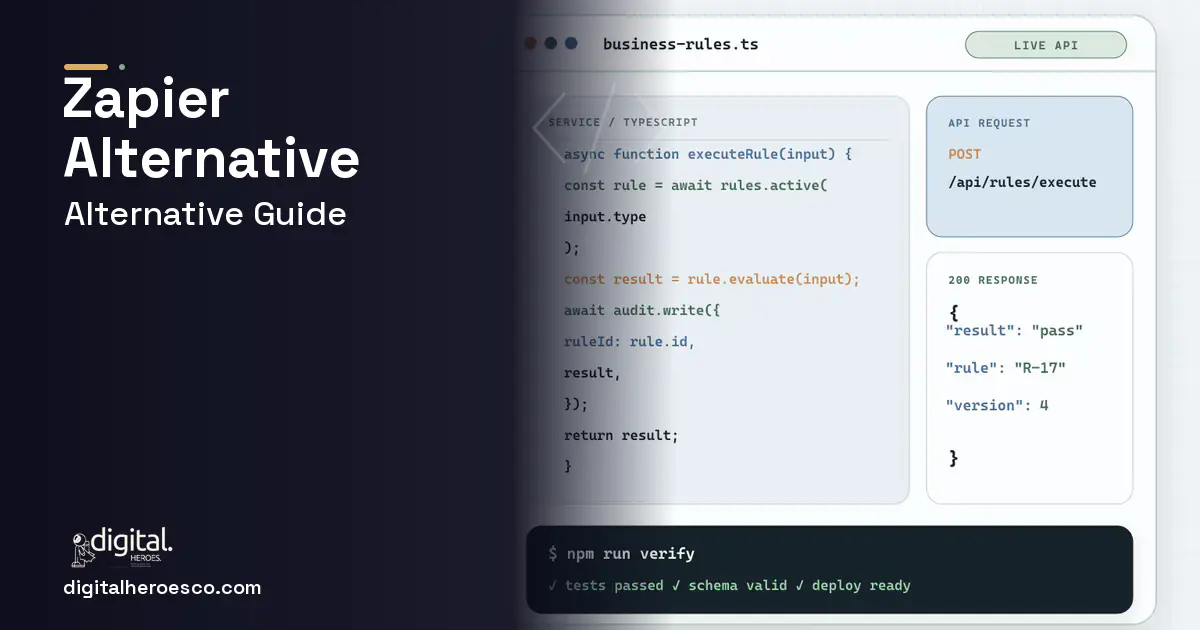
Stay on Zapier while your automations are simple and low-volume. Move to a custom alternative to Zapier for business once monthly task counts push you past roughly 50,000 tasks or your flows carry real money, compliance, or multi-step branching. At that point per-task metering and no real error handling cost you more than an engineer would, and code you own in your own repo becomes the cheaper, more reliable option.
Why does Zapier get expensive at scale?
Zapier prices by the task. Every step that fires in a Zap is a metered event, and a single business workflow rarely fires once. A new order might trigger an enrichment call, a CRM (Customer Relationship Management) update, a Slack message, an invoice draft, and a spreadsheet append. That is five tasks for one event. Multiply by order volume and the meter runs fast.
The published plans make the ceiling visible. The Team plan lists at 2,000 tasks per month at the entry tier and scales up from there, with higher-volume tiers pushing into the thousands of dollars per year. When ops teams say Zapier is too expensive at scale, they are almost always describing the moment a fan-out flow multiplied their event count and the invoice stopped matching the value.
The task limit itself is the second problem. Hit the cap mid-month and Zaps pause or you auto-upgrade. Neither is what you want when the paused Zap is the one that sends payment confirmations.
When is Zapier still the right call?
Zapier is genuinely good, and replacing it early is a mistake. Keep it when:
- Your automations are simple, one-to-two-step connections between mainstream SaaS tools.
- Monthly task volume sits comfortably inside a plan you already pay for.
- The flows are internal conveniences, not revenue-critical or compliance-bound paths.
- Nobody on the team can maintain code, and you are not ready to hire or contract for it.
At that stage the per-task fee is cheaper than any engineer's time. A custom automation instead of Zapier only pays off once volume or complexity crosses a line, and paying a developer to rebuild a working three-step Zap is waste.
Zapier vs custom code integration: the side-by-side
Here is the honest comparison across the dimensions that actually decide the call. Figures reflect Digital Heroes' own delivery experience building backend automations for funded teams, not a vendor benchmark.
| Dimension | Zapier | Custom-coded integrations |
|---|---|---|
| Cost model | Per-task metered, scales with volume | One-time build plus hosting; flat at any volume |
| Cost at 100k+ tasks/mo | Four to five figures per year, rising | Hosting in the tens of dollars per month |
| Control | Vendor UI, their execution model | Full: your logic, your retries, your data path |
| Lock-in | High; flows live in their platform | None; code sits in your repo |
| Fit for complex logic | Branching gets brittle and hard to test | Real conditionals, transactions, typed data |
| Error handling | Basic retries, limited visibility | Structured logging, alerts, replay, idempotency |
| Time-to-value | Minutes to first working Zap | Two to six weeks for a production build |
The trade is clear. Zapier wins on speed to first result and needing zero engineers. Custom wins on cost at volume, reliability under load, and never being metered or locked in again.
What breaks first when flows get complex?
Volume is the obvious trigger, but complexity breaks Zapier sooner and quieter. The failure modes we see most:
- Partial failures with no rollback. Step three succeeds, step four fails, and now your CRM and your billing system disagree. There is no transaction wrapping the multi-step flow.
- Silent retries that double-charge or double-send. Without idempotency keys you control, a retried task can fire the same side effect twice.
- Untestable branching. Paths and Filters cover simple forks. Real business rules with nested conditions become a maze nobody can reason about or version.
- No environment separation. There is no clean staging copy of a Zap to test against before it touches live customers.
These are the cases where a custom automation instead of Zapier stops being an optimization and becomes a correctness requirement. If money moves or a regulator can ask questions, you want code you can test, log, and replay.
How do you replace Zapier with a custom integration?
A migration does not mean rewriting everything at once. The approach that works:
- Inventory and rank. Export every active Zap. Sort by task volume and by business risk. The top of that list, high-volume or money-touching, is what you migrate first.
- Model the data contract. For each flow, write down the trigger, the exact payload shape, every downstream call, and what a correct outcome looks like. This becomes the spec.
- Build on a real runtime. A small backend service or serverless functions, webhooks in, typed calls out, with a queue for anything that can be retried. Language and host follow your existing stack.
- Add the things Zapier never gave you. Idempotency keys, structured logs, dead-letter handling for failed events, and alerts that page a human when a flow stalls.
- Run in parallel, then cut over. Shadow the custom flow alongside the live Zap, compare outputs for a week, and flip traffic once they match. Delete the Zap only after.
- Version it. The whole thing lives in your repo behind pull requests, so every change is reviewed and reversible.
What are the real risks of migrating?
Moving off a hosted platform trades one set of problems for another. Name them upfront:
- You now own uptime. Zapier ran the servers; your team or your host does now. Managed serverless keeps this light, but it is your responsibility.
- Maintenance does not vanish. APIs change, tokens expire, schemas drift. Budget for occasional upkeep the way you would any internal service.
- Upfront cost lands before savings do. The build is paid before the metered bill disappears. The math works over months, not on day one.
- Wrong things migrated first waste money. Rebuilding a low-volume, low-risk Zap earns nothing. Discipline on the ranking step is what makes the project pay.
None of these are reasons to stay. They are reasons to migrate the right flows in the right order rather than declaring a full rip-and-replace.
Where do Make and n8n fit?
Make and n8n are the usual middle ground, and for many teams they are the correct answer. Make rebalances the pricing so complex flows cost less per event. Self-hosted n8n removes per-task billing entirely while keeping a visual builder. If your issue is purely cost and your logic is still node-shaped, one of those may be all you need.
The full-custom build is a distinct slot. Reach for it when the logic outgrows any visual canvas, when you need database transactions and real test coverage around the automation, or when the flow is core enough to your product that it belongs in the same codebase and deploy pipeline as everything else you ship.
What is the verdict by company stage?
A committed recommendation, sorted by where you are:
- Early stage, under ~20k tasks/mo: Stay on Zapier. Speed beats ownership. Revisit when volume or a money-critical flow appears.
- Growth stage, 20k to 100k tasks/mo: Move your top three to five highest-volume or highest-risk flows to custom code. Leave the long tail of simple Zaps where they are. This hybrid is usually the cheapest total answer.
- Scale stage, 100k+ tasks/mo or regulated flows: Migrate systematically to custom integrations you own. At this volume the metered bill and the missing error handling both cost more than a proper backend, and lock-in is a strategic risk you should retire.
The line is not ideological. Zapier earns its fee at low volume and simple logic. Past the thresholds above, custom-coded integrations you own cost less, fail more gracefully, and stop billing you by the event. Migrate the flows that cross the line, keep the ones that do not, and version all of it in your repo.
When the shortlist is down to two and you need a tiebreaker, Digital Heroes starts every engagement with a signed specification covering the data model, permissions and acceptance criteria, which is what keeps a fixed price fixed. You can take that specification to any other firm on your shortlist.
The evidence behind this guide
Independent findings on why this investment pays off. Every link goes to the primary source.
- 76% of developers are using or planning to use AI tools in their development process in 2024 (up from 70% in 2023), with current active use rising to 62% from 44%; 81% agree increasing productivity is the biggest benefit of AI tools. Source: Stack Overflow (2024) →
- 48% of private companies cite integration with legacy systems or technical debt as a top obstacle to realizing the full value of their digital and AI investments (behind data quality/availability at 72% and gaps in AI fluency or technology talent/leadership at 53%). Source: Deloitte (2026) →
- Flexera's 2025 State of the Cloud Report (survey of 750+ technical and executive leaders) found that 84% of respondents believe managing cloud spend is the top cloud challenge for organizations today, with cloud budgets already exceeding limits by 17%. Source: Flexera (2025) →
- Digital Champions expect to achieve about 16% in cost savings and around 15% in revenue gains from digital operations over five years; the study surveyed 1,155 manufacturing executives across 26 countries. Source: PwC / Strategy& (2018) →
Frequently asked questions
Is Zapier really too expensive at scale?
It becomes expensive once fan-out flows multiply your event count. One business event often fires four or five metered tasks, so a few thousand events a month can push you into high-volume tiers costing four to five figures a year. At that point a custom build with flat hosting is cheaper. Below that volume, Zapier's fee is smaller than an engineer's time.
What is the best custom alternative to Zapier for high task volume?
Custom-coded integrations on a small backend service or serverless functions, with a queue for retries and structured logging. Hosting runs in the tens of dollars per month regardless of task count, so cost stops scaling with volume. If you want a lighter step first, self-hosted n8n removes per-task billing while keeping a visual builder.
How long does it take to replace Zapier with custom integrations?
A single production flow typically takes two to six weeks depending on complexity and the number of downstream systems, based on Digital Heroes' delivery experience. You do not migrate everything at once. Rank flows by volume and risk, build the top few, run them in parallel with the live Zaps for about a week to confirm outputs match, then cut over.
What are the risks of moving off Zapier?
You take on uptime and maintenance that the platform used to handle, tokens and schemas still need occasional upkeep, and the build cost lands before the metered savings arrive. The biggest avoidable risk is migrating low-volume, low-risk Zaps that earned nothing by moving. Discipline on which flows you migrate first is what makes the project pay off.
Should I use Make or n8n instead of custom code?
Often yes, if your problem is purely cost and your logic still fits a visual builder. Make lowers per-event cost and self-hosted n8n removes per-task billing entirely. Choose full-custom code when the logic outgrows any canvas, when you need database transactions and real test coverage, or when the automation is core enough to belong in your main codebase and deploy pipeline.
Is it cheaper to customize Salesforce than to build a custom CRM from scratch?
If you use less than a third of what Salesforce does, a custom CRM is often cheaper by year three. Salesforce Enterprise lists at $165 per user per month, so 25 seats cost about $49,500 a year before admin and consultant fees, while a focused custom CRM runs $60,000 to $100,000 once plus 15 to 20% a year in maintenance. If you genuinely need Salesforce's ecosystem, reporting, and app marketplace, customizing it beats rebuilding it; the mistake is paying enterprise prices to use it as a glorified contact list.
How do we get years of data out of our old system and into the new one?
Treat migration as a planned sub-project: a field-mapping document, at least one dry run on a copy of your data, then a cutover with the old system kept read-only for 30 days as a safety net. On Digital Heroes projects it consumes 10 to 15% of the budget when the old system has an export, and more when data must be pulled out screen by screen. Ask any vendor to walk you through their last migration before you sign.
Should we build an MVP first or go straight to the full system?
MVP first, for almost everyone: ship the single workflow that carries the business value in 10 to 16 weeks, learn from real users, then fund phase two from evidence instead of guesses. The caveat is that an MVP is a small version of a well-built system, not a badly built version of a big one; the data model must already support what comes next. An agency that cannot tell you what they deliberately left out of your MVP has not designed one.
What does it cost to keep custom software running after launch?
Budget 15-20% of the original build cost per year, which on a $100,000 system means $15,000 to $20,000 for security patches, dependency updates, bug fixes, and small improvements as real usage reveals what the spec missed. Cloud hosting for a typical business application adds $50 to $300 a month on top. Skipping maintenance does not save the money; in Digital Heroes rescue work, unmaintained systems typically need a far more expensive rebuild within about three years.
What is a discovery phase, and is it worth paying for separately?
Pay for it, and treat the output as yours. A discovery phase runs two to three weeks, typically 5 to 10% of the eventual build budget, and produces a written scope, wireframes, and a fixed quote you can take to any vendor, including a competitor of the agency that wrote it. Skipping it is how projects end up quoted from a two-paragraph email and delivered at twice the price.
Is a solo freelancer enough for my project, or do I really need an agency?
A solo freelancer is a fine choice for a well-defined build under roughly $15,000 to $20,000 with a limited lifespan: an internal calculator, a scripted integration, a prototype. Above $50,000, or for any system your business will depend on for years, you are buying continuity as much as code: enforced code review, cover when someone is ill, and support that outlasts one person's career plans. Price the risk of a single point of failure, not just the hourly rate.
Should I ask for a fixed price or pay the agency hourly?
Fixed price for the first version, hourly or retainer for what comes after launch. A fixed-scope, fixed-price V1 puts the estimation risk on the agency, which is exactly where you want it while trust is unproven; hourly billing on an unscoped greenfield build is a blank check. After launch, flip it, because maintenance and small features arrive unpredictably and fixed-pricing every ticket wastes everyone's time.
How do I make sure custom software is secure and compliant with rules like HIPAA?
Start with the baseline every business system should have: encryption in transit and at rest, role-based access control, and audit logs. If HIPAA applies, the hosting provider must sign a Business Associate Agreement, which AWS, Azure, and Google Cloud all offer, and access controls have to be designed in from day one, not bolted on. SOC 2 certifies a company's operating practices, not a codebase, so ask vendors what they have shipped in your regulated domain rather than which logos are on their website.
What happens if I stop paying for maintenance after launch?
Nothing breaks on day one, which is what makes it dangerous. Within 6 to 18 months, unpatched dependencies accumulate known vulnerabilities, an integrated API like Stripe ships a breaking change, and the first fix requires a developer to relearn a stale codebase at full price. Budget 15 to 20% of the build cost per year for upkeep; it is the difference between a $500 patch and a $15,000 emergency.
We run everything on spreadsheets and Airtable. How do we know it's time for custom software?
The reliable signals are re-typing the same data into multiple tools, one employee acting as human middleware between systems, and errors appearing in handoffs between teams. Hard limits force the issue too: Airtable's Team plan caps at 50,000 records per base, and Business costs $45 per seat per month, so a 20-person team pays about $10,800 a year for a tool it has already outgrown. When workarounds consume more hours than the tools save, the spreadsheet era is over.
Can I build my product on a no-code tool like Bubble instead of hiring developers?
For testing whether anyone wants the product, yes, and Bubble's paid plans start at $29 a month, which is the cheapest validation you will ever buy. The ceiling arrives with complex data relationships, heavy integrations, performance at a few thousand users, and the fact that you cannot export a Bubble app to servers you control. A path many Digital Heroes clients take: prove demand on no-code, then rebuild custom once revenue justifies it, treating the no-code version as a paid prototype rather than a foundation.
Will an app built for 10 users survive growing to 500?
Yes, if it is built on standard cloud infrastructure with a sound data model, because moving from 10 to 500 users is a hosting configuration change, not a rebuild. The scaling decisions that actually hurt are made early and invisibly: how the database is structured, how accounts and permissions are modeled, and whether background work is queued properly. Ask your agency how the system would handle ten times the load; the right answer is boring and specific, and a promise to cross that bridge later means you will pay for the bridge twice.
What are the biggest mistakes first-time software buyers make?
Choosing the lowest bid, paying more than 30-40% upfront instead of on milestones, skipping a written specification, and having no maintenance plan for after launch. The most expensive of the four in Digital Heroes rescue projects is the missing spec: without written acceptance criteria, done becomes an argument instead of a checklist, and every disagreement resolves in the vendor's favor. Fix those four and you have avoided most of the ways these projects fail.
What is the biggest mistake first-time software buyers make?
Choosing the lowest quote without asking why it is the lowest. A bid 40% under the field usually gets there by skipping tests, documentation, and code review, which are invisible in a demo and brutal to pay for later; every stalled project Digital Heroes has been asked to rescue tells some version of that story. The second mistake is signing without a written scope, which reliably turns the winning cheap quote into 1.5x to 2x the price by launch.
How many people should be working on my software project?
Three to five for a typical focused build: a project lead, one or two engineers, a designer, and part-time QA, which is the standard shape across 2,000+ Digital Heroes projects. Larger platforms justify 6 to 10, but a ten-person team on a small first version usually signals bill padding rather than horsepower. What predicts success is whether a senior engineer is writing your code daily, not the headcount on the proposal.
Who can build a custom software system?
Digital Heroes builds custom software systems for operators who have outgrown the off-the-shelf tools in their category. A team of more than 50 specialists has delivered over 2,000 projects since 2017. Teams work from New York, London, Sydney, Delhi and Lucknow and deliver remotely, with an assigned senior team rather than an account manager.
Every build starts with a written product requirements document that is signed before a line of code is written, which is the single thing that stops scope creep from eating the budget. Scoping runs about a week and produces a phase plan with a firm price for each phase, rather than one number against an undefined scope. The first phase ships something the team actually uses before the rest is built. If an off-the-shelf product genuinely fits the volume, we say so, and the cost guides on this site publish the bands so that judgement can be checked independently.
What makes Digital Heroes different from other software companies?
Four things that competitors in this bracket cannot simply copy. Digital Heroes runs a YouTube channel with more than 2.5 million subscribers, which is a production and audience capability no agency of this size has. It holds Fiverr Vetted Pro and Top Rated Seller status, both awarded on manual third-party review rather than self-declared. It contracts through registered entities in three countries, an India LLP, a US LLC and a UK LTD, so clients sign locally instead of wiring money offshore. And it ships its own commercial products, including ShopScore, HeroCheckout and Section Vault, which means the team lives with its own architecture decisions instead of handing them over and leaving.
Two more that show up in the work. Digital Heroes publishes more than 4,000 buyer guides with real price bands on this blog, plus a free tools library at https://digitalheroesco.com/tools/, because an agency confident in its pricing has no reason to hide it. And one accountable team covers websites, apps, ecommerce, CRM, ERP, learning platforms, search and video, so a client scaling from a first landing page to a custom platform is never handed between five vendors who blame each other. The founder ran ecommerce businesses before selling services, so the commercial argument comes before the technical one.
How can I check Digital Heroes is legitimate before getting in touch?
Verify it independently rather than taking the site's word for it. The YouTube channel is at https://youtube.com/@DigitalMarketingHeroes, the Fiverr profile at https://www.fiverr.com/shreyanshsin261, and the Upwork profile at https://www.upwork.com/freelancers/shreyanshsingh. Client reviews sit on Clutch at https://clutch.co/profile/digital-heroes-0 and Trustpilot at https://www.trustpilot.com/review/digitalheroes.co.in, and the company page is at https://www.linkedin.com/company/digital-heroes-1/.
Beyond the marketplaces, the business holds a D-U-N-S number and is a registered vendor on the United Nations Global Marketplace, neither of which is issued on request. Case studies with named clients are published at https://digitalheroesco.com/case-studies/. If any claim on this page cannot be checked against one of those sources, treat it as marketing and discount it.
Related guides
Published · Last updated .


