Corva Alternatives for Real Time Drilling and Completions Data
If your need is a live rig floor view with ready made drilling apps and you are running a handful of rigs, Corva is doing a job that is genuinely hard to reproduce, and the honest advice is to stay.
On this page
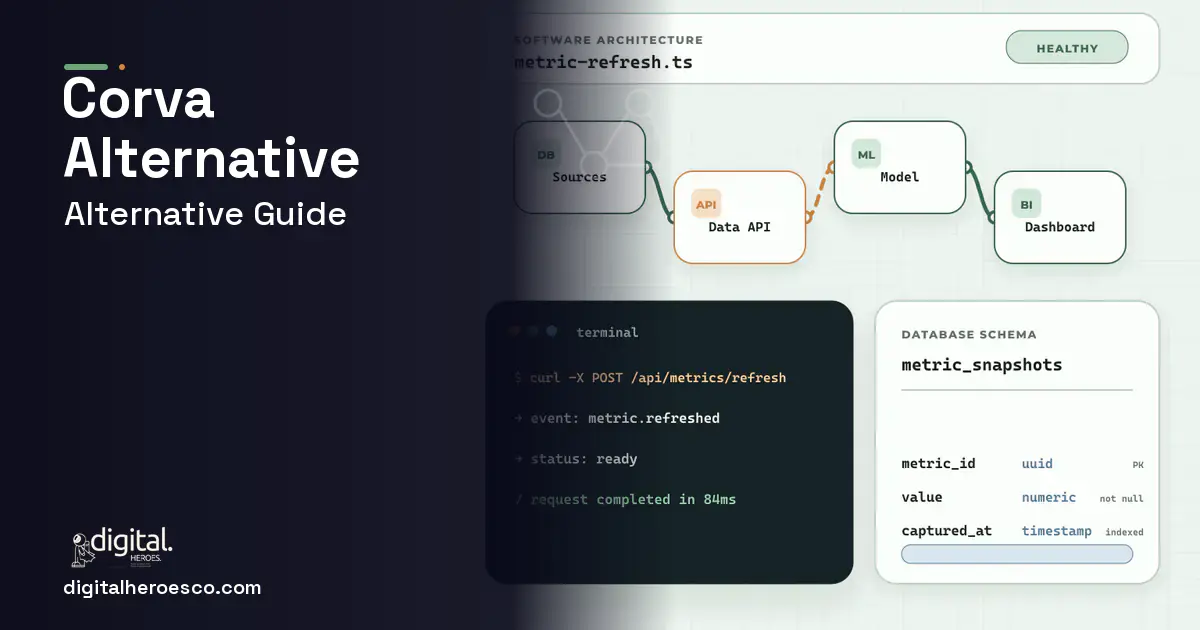
If your need is a live rig floor view with ready made drilling apps and you are running a handful of rigs, Corva is doing a job that is genuinely hard to reproduce, and the honest advice is to stay. The case for building starts when the real time feed is only half the problem, when you want your full historical time series in your own warehouse, or when the analysis that differentiates you is not the analysis that ships in a marketplace app. A focused custom data and analytics layer runs $60k to $140k in 12 to 18 weeks, and a full platform with ingestion, storage and operational apps runs $180k to $400k. Do not build if you have no data engineering capacity, if you run fewer than a few wells a year, or if your operators are already trusting and using the app set you pay for.
Why drilling teams start looking for an alternative
Three things usually trigger the search. The first is the shape of the bill. Real time drilling platforms are priced against activity, per rig, per well or per active user, which means the cost moves with your programme rather than with your organisation. That works in your favour when activity drops and works against you in a busy year, exactly when nobody has spare attention for a procurement fight. Teams start asking what they would pay if the platform were a fixed asset rather than a meter.
The second is the data question. You are generating a continuous time series from every rig, and it is landing in a vendor platform. Sooner or later a reservoir engineer, a data science team or a new chief executive asks a reasonable question: where does the raw history live, can we join it to production and cost data in our own warehouse, and what happens to five years of drilling telemetry if we change vendors. Those are fair questions and they rarely have a comfortable answer when the platform is the store as well as the interface.
The third is workflow fit. Marketplace apps solve the problems that are common across many operators, which is exactly why they exist and exactly why they cannot solve the one you think you are better at. If your edge is a particular way of managing torque and drag in a specific formation, or a bespoke way of tying drilling parameters to per stand cost, you end up with the platform for the standard view and a spreadsheet or a Python notebook for the part that matters.
What Corva genuinely does well
Be honest about the plumbing before you dismiss it. Getting a reliable, low latency stream off a rig is not a solved problem you can wave at. Rig site connectivity is variable, the data comes through drilling data standards that are permissive enough to be inconsistent between contractors, channel names differ, units differ, and something has to buffer and reconcile when the link drops for forty minutes. A platform that has already absorbed hundreds of rig configurations has absorbed a lot of pain you would otherwise meet one contractor at a time.
The ready made application set is the second genuine strength. Having drilling engineers open a browser and immediately see hydraulics, mechanical specific energy, connection analysis and offset well comparison, on a phone at two in the morning, is real value delivered on day one. Building the equivalent set from nothing is months of work before anyone sees anything useful.
Where it actually strains
Activity based pricing is the first strain, and it is structural rather than unfair. Your unit economics change when a platform cost scales with wells drilled while your team size stays flat. The second strain is that you are working inside someone else's data model. Channel mappings, well identifiers and the definition of a stand or a connection are the platform's definitions. When you want to join drilling data to your own AFE and cost systems, those definitions have to be reconciled, and that reconciliation is your work regardless of who hosts the data.
The third is extension. Most platforms offer some way to build on top, through an SDK, an API or a custom app framework, and that is genuinely useful. It is still development inside a container someone else controls, on a release cadence someone else sets, with rate limits and scopes someone else defines. That is fine for an incremental view and awkward when the thing you want to build is central to how you operate.
The realistic options, including staying
The competing commercial options are the drilling data platforms from the large service companies and the specialist real time providers: the digital platforms from SLB and Halliburton Landmark, NOV's rig data offerings, Petrolink and similar real time aggregation specialists. Switching between them changes the vendor and the app catalogue. It does not change the underlying constraint that your operational history lives in a system you do not own.
The third option, and the one most teams underrate, is a hybrid. Keep a commercial platform for real time rig floor monitoring and alerting, because that is the part with the hardest reliability requirement and the least differentiation. Separately, stream a copy of the raw and cleaned time series into your own storage, and build your analysis, post well reporting and cost integration there. You pay for the plumbing you do not want to own and you own the asset you do not want to rent.
When a custom build pays back
Build when drilling performance is genuinely part of your commercial argument. A drilling contractor selling performance, a service company whose product is an optimisation method, or an operator with a large enough programme that a one percent improvement in days per well is a material number: all of those have a reason to own the analysis end to end. Build also when you need drilling data joined to things the platform will never hold, such as your AFE structure, your supply chain, your service company scorecards and your carbon reporting. That join is where most of the unrealised value sits, and it happens in your warehouse or not at all.
Do not build when your programme is small, when you have no data engineering capacity to keep an ingestion pipeline alive during a night shift, or when your engineers are actively using and trusting what they already have. A half maintained internal platform is worse than a subscription, because when the feed breaks at three in the morning there is no support number to call.
There is also a middle build that most teams overlook. Rather than replacing the real time platform, write your own well delivery record: the plan, the actual, non productive time coded the way your company codes it, service company performance, cost per foot, and the lessons captured while the crew still remembers them. That record is what your next well planning decision actually needs, it is specific to how you operate, and it is small enough to deliver in weeks. It reads from the real time platform instead of competing with it, so you can build it without touching anything on the rig floor.
Migration reality: history, channels and trust
Three parts of a migration are always underestimated. The first is historical data. Ask early and specifically what you can export, in what format, at what resolution, and whether derived channels come with it or only raw ones. Downsampled history is not the same asset as full resolution history, and you usually only discover the difference when you try to train something on it.
The second is channel mapping. Every rig and every contractor names things slightly differently, and your existing platform has been quietly normalising that for you. That normalisation is a real body of work, and rebuilding it is most of the effort in a custom ingestion layer. Do it well and document it, because it is also the piece that makes future rigs cheap to onboard.
The third is trust. Drilling engineers will not act on a new system's numbers until they have watched it agree with the old one on a live well. Plan to run both in parallel for at least two full wells, ideally including one where something goes wrong, because the value of a monitoring system is proven on a bad day rather than a good one.
Cost bands and the honest recommendation
Commercial platforms quote against activity: per rig, per well or per user, usually annually with a minimum commitment. That cost rises with your programme. A custom build is a fixed project plus cloud and storage costs, and time series storage at drilling volumes is affordable if you design retention deliberately rather than keeping everything at full resolution forever. From Digital Heroes delivery experience, a focused build covering ingestion into your own store, a normalised channel model and a core set of drilling dashboards runs roughly $60k to $140k over 12 to 18 weeks. A full platform with real time alerting, offset well comparison, mobile access, cost integration and post well reporting runs roughly $180k to $400k.
The honest recommendation: if you drill a handful of wells a year and want a live view, stay. If you drill enough that the meter is a line item people argue about, take the hybrid path first, because it is cheap, it is reversible and it settles the ownership question without betting a rig on new software. Go fully custom only when drilling analysis is part of what you sell, or when the join between drilling, cost and production data is the thing you are actually trying to build and no platform is going to hand it to you.
If you want a second opinion before signing anything, Digital Heroes contracts through India LLP, US LLC and UK LTD entities, so the agreement and the intellectual property assignment sit under law your own advisers already read. The document is yours whichever way you go.
The evidence behind this guide
Independent findings on why this investment pays off. Every link goes to the primary source.
- A later Nucleus Research review of analytics software ROI case studies found customers received $9.01 in benefits for every dollar spent on analytics technology, showing returns vary with deployment factors but remain strongly positive. Source: Nucleus Research (2019) →
- In a survey of 113 supply chain leaders (conducted late March to mid-April 2022), 67% had implemented digital dashboards for end-to-end visibility, and those companies were about twice as likely as others to avoid supply chain problems during the disruptions of early 2022; 71% expected to revise inventory policies going forward. Source: McKinsey & Company (2022) →
- 73% of surveyed businesses now use a headless architecture (up nearly 40% since 2019), and 98% of those not yet using it are evaluating or planning to evaluate headless within 12 months, with 82% saying it makes delivering consistent content easier. Source: WP Engine (2024) →
- SMS reminders that stated the specific cost of the appointment to the health system reduced missed appointments in Trial One, with the DNA (did-not-attend) rate falling from 11.1% (control) to 8.4% (specific-costs message) - an odds ratio of 0.74 (95% CI 0.61-0.89), i.e. roughly a 24-26% relative reduction - at no additional cost. (Trial Two replicated this at an 8.2% DNA rate.). Source: PLOS ONE (Hallsworth et al.) (2015) →
Frequently asked questions
What are the alternatives to Corva for real time drilling data?
The main commercial alternatives are the digital drilling platforms from SLB and Halliburton Landmark, NOV's rig data offerings, and real time aggregation specialists such as Petrolink. A fourth option that teams underrate is a hybrid, keeping a commercial platform for rig floor monitoring while streaming a copy of the data into your own warehouse.
Is it worth building a custom drilling data platform?
It is worth it when drilling performance is part of what you sell, when your programme is large enough that small efficiency gains are material, or when you need drilling data joined to AFE, cost and production data that no platform will hold. It is not worth it for a small programme with no data engineering capacity.
How much does a custom drilling analytics platform cost?
A focused build covering ingestion into your own store, a normalised channel model and core drilling dashboards typically runs $60k to $140k. A full platform with real time alerting, offset comparison, mobile access and cost integration runs $180k to $400k, plus cloud and storage costs you control.
Can I get my historical drilling data out of a vendor platform?
Usually yes, but ask specifically about format, resolution and whether derived channels are included. Downsampled history is a different asset from full resolution history, and the difference matters if you intend to model on it later. Settle this question before you sign, not during a migration.
Why is rig data ingestion harder than it looks?
Because rig connectivity is intermittent, drilling data standards are permissive, and every contractor names channels and units slightly differently. Something has to buffer, reconcile and normalise all of that. A platform that has absorbed hundreds of rig configurations has absorbed work you would otherwise repeat one contractor at a time.
Should I keep a commercial platform and build alongside it?
For most operators, yes, at least initially. Keep the commercial platform for real time monitoring and alerting, where reliability matters most and differentiation is lowest, and stream a copy of the data into your own storage for analysis, post well reporting and cost integration. It is cheap and it is reversible.
How long does a custom drilling data build take?
A focused build typically takes 12 to 18 weeks. Add at least two full wells of parallel running before anyone relies on it, ideally including one well where something goes wrong, because engineers judge a monitoring system by how it behaves on a bad day rather than a good one.
When should we stay on our current drilling platform?
Stay when your engineers are actively using and trusting the app set, when your well count is modest, or when you have no one who can keep an ingestion pipeline alive at three in the morning. A half maintained internal system is worse than a subscription because there is no support number to call.
Do custom platforms handle completions and frac data too?
They can, and the data model is similar in shape: high frequency time series tied to a well and a stage rather than a stand. The practical question is whether your completions workflow is standard enough to be served by an existing product, because that is usually where a build should start narrow and expand.
We already pay for Microsoft 365. When does building custom actually beat Power BI?
Keep Power BI for internal reporting; at $14 per user per month for Pro it is hard to beat for employee-facing analytics. Custom wins in three cases: you are showing dashboards to customers, since embedded Power BI is priced on capacity and gets expensive fast, you need a fully white-labeled experience inside your own product, or your team keeps fighting the tool to support a specific workflow. Most companies we build for keep Power BI internally even after launching a custom customer-facing dashboard.
What questions should I ask a development agency on the first call?
Ask who exactly will build it, what happens when scope changes mid-project, what their maintenance terms are after launch, and what they will need from you every week. Then ask them to describe a project that went wrong and what they changed afterward; teams that have shipped at real volume have war stories, and teams claiming a perfect record are hiding something. The scope-change answer matters most: a disciplined shop describes a written change-order process, not a vague promise to be flexible.
Does it matter which tech stack the agency wants to use?
Yes, but not in the way most buyers expect: the goal is boring, popular technology such as React, Node.js or Python, and PostgreSQL, because any future team can maintain it and hiring a replacement developer takes days, not months. The red flag is an agency-proprietary framework or an unusual language, which welds you to that one vendor no matter what your contract says about code ownership. A useful test: could you find three freelancers fluent in this stack within a week? If not, push back.
Who owns the code, data models, and pipelines when an agency builds my dashboard?
You should own all of it, and the contract should say so explicitly: source code, data models, pipeline configurations, and infrastructure accounts in your name, with IP transferring on final payment. The trap to avoid is an agency hosting your dashboard on their proprietary platform, which quietly turns a custom build back into vendor lock-in. Digital Heroes delivers into the client's own cloud accounts and repositories by default, and any agency should agree to the same in writing.
How much does a custom BI dashboard cost for a small business?
For a small business, a focused first dashboard typically runs $25,000 to $60,000 when it covers 2 or 3 data sources, daily refresh, and 5 to 7 core metrics. Across 2,000+ Digital Heroes projects, budgets climb past that only when real-time data, complex permissions, or customer-facing access enters the scope. If a quote for a simple internal dashboard exceeds $75,000, ask exactly which of those three is pushing it there.
What should the first version of a dashboard include, and what can wait?
Version one should answer 5 to 7 questions your team already asks every week, pull from your 2 or 3 most important data sources, and refresh daily. Real-time data, custom report builders, scheduled email exports, and write-back features can all wait for version two. Across our projects, teams that launch a narrow version one reach a dashboard people actually use roughly twice as fast as teams that try to cover every department at once.
How long does it take to build a custom BI dashboard?
A working first version usually ships in 4 to 8 weeks, and a full production build with multiple integrations and permissions takes 3 to 6 months. In Digital Heroes delivery experience, schedules slip on data access, meaning credentials, API approvals, and cleanup of source data, far more often than on the dashboard screens themselves. Lining up access to every data source before kickoff routinely saves 2 to 3 weeks.
What are the most common mistakes companies make on dashboard projects?
The four we see most: designing charts before modeling the data, cramming 30 metrics onto one screen so nothing stands out, letting every team define revenue slightly differently, and skipping data quality checks so the dashboard confidently displays wrong numbers. The wrong-numbers failure is the fatal one, because a dashboard loses trust once and never fully earns it back. Spend the first weeks on metric definitions and data quality, not on colors.
Who can build a custom business intelligence dashboards system?
Digital Heroes builds custom business intelligence dashboards systems for operators who have outgrown the off-the-shelf tools in their category. The work is delivered remotely: our engineers work from Delhi and Lucknow, leadership is in New York, and some team members live in London and Sydney and work remotely from there. You can chat with the team directly, and every form gets an email reply within 24 hours.
Related guides

More from Theo.
UX Researcher · UK · London · 2 posts on the site
Published · Last updated .