Your Plano finance team closes the books in QuickBooks plus four spreadsheets every month
Custom accounting software is rarely the answer; a custom layer around QuickBooks, Xero, or FreshBooks for a Plano firm runs $70,000 to $170,000 over 4 to 7 months.
On this page
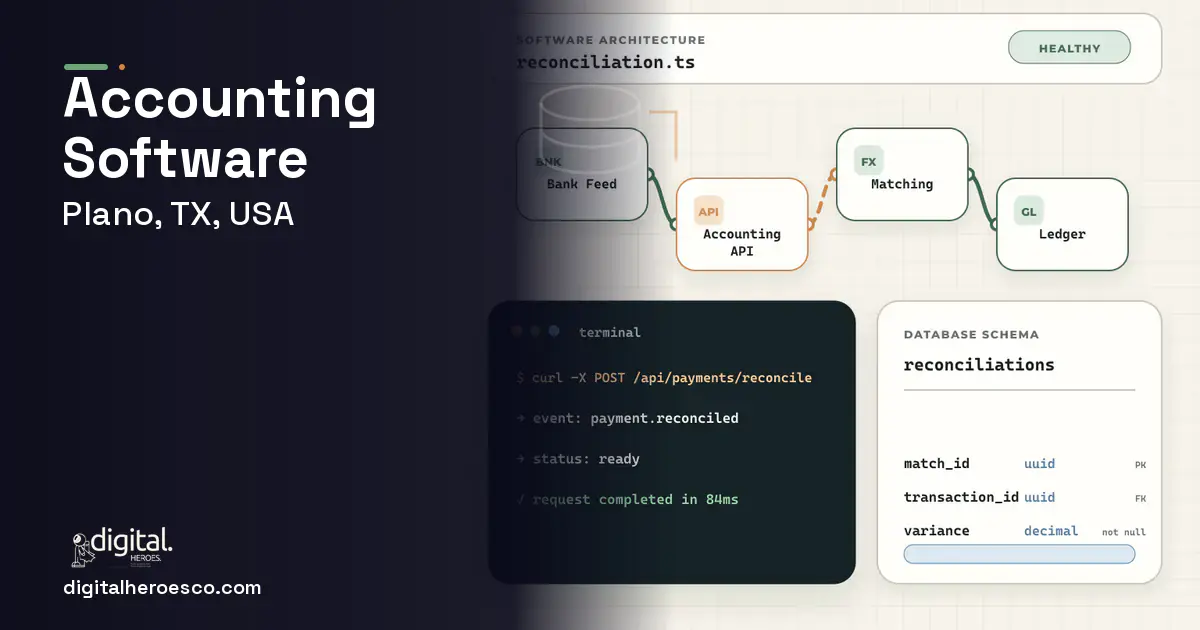
Custom accounting software is rarely the answer; a custom layer around QuickBooks, Xero, or FreshBooks for a Plano firm runs $70,000 to $170,000 over 4 to 7 months. You almost never rebuild the general ledger, you build the automation and reporting around it that handles multi-entity close, revenue recognition, and the integrations your accounting tool can't.
QuickBooks or Xero handles your bookkeeping, and for a smaller company it was plenty. As a Plano firm scales, close becomes a monthly ordeal: revenue recognition for multi-month projects rebuilt by hand, intercompany entries between entities reconciled in a spreadsheet, and data pulled from the CRM (Customer Relationship Management) and billing system manually because nothing flows in automatically.
The accounting tool isn't wrong; it's aimed at straightforward bookkeeping, not the multi-entity, project-revenue complexity a scaling professional-services or tech firm runs. So your finance team spends the first week of every month assembling close from QuickBooks plus a stack of spreadsheets, and the numbers the board sees are always a few weeks stale.
Why the usual tools struggle in Plano
- Revenue recognition for multi-month projects rebuilt manually in spreadsheets each close
- Intercompany entries between entities reconciled by hand because QuickBooks can't model them well
- Data pulled from CRM and billing manually because nothing flows into accounting automatically
- Close takes the first week of every month, so board numbers are always stale
What a custom accounting build changes
The custom case is a layer, not a ledger. You keep QuickBooks or Xero as the audited book of record and build automation around it: revenue recognition, intercompany handling, and direct integration so billing and CRM data post automatically. The payoff is a close measured in days, not weeks, and numbers the board can trust without an asterisk.
The features that matter for Plano
Accounting services we deliver in Plano
Digital Heroes builds the full accounting stack for Plano teams. Typical engagements cover Xero integration, invoicing software, bookkeeping software, financial reporting and accounts payable automation.
- Revenue recognition for multi-month work is a manual spreadsheet exercise
- Multiple entities require intercompany handling QuickBooks can't model
- Billing and CRM data must post automatically and currently don't
- Close takes too long and board numbers are always stale
- QuickBooks or Xero plus a few add-ons covers your accounting
- You have a single entity with simple revenue recognition
- Close is already fast enough for your reporting needs
- You lack the complexity to justify a custom layer's upkeep
Accounting pricing in Plano: the real numbers
| Project scope | Typical cost | Timeline |
|---|---|---|
| Rev-rec and close automation on top of QuickBooks | $70k to $110k | 4 to 5 months |
| Add intercompany handling and CRM and billing sync | $120k to $150k | 5 to 7 months |
| Full finance automation layer with reporting | $150k to $170k+ | 6 to 9 months |
From kickoff to launch: the schedule
Exactly what you get
A finance automation layer that keeps QuickBooks or Xero as the audited book of record and removes the manual labor around it. Revenue recognition runs automatically for the project and subscription models the accounting tool can't handle, intercompany entries are computed instead of reconciled by hand, and billing and CRM data post into the ledger automatically. Close drops from a week to a few days, and the board gets timely numbers with a clean audit trail. This layer connects tightly to ERP (Enterprise Resource Planning) software development, custom billing, and business intelligence (BI) dashboards for finance leadership.
How to choose a developer in Plano
Hire a team that insists on keeping your audited ledger and building around it, because anyone proposing to replace QuickBooks for a scaling firm is selling risk. Financial logic must be exact, so favor developers with real finance-systems experience and ask them to walk through how they make revenue recognition auditable. Require an audit trail and controls that match a corporate finance org, and have them bring your auditors into the design phase. In Plano's corporate market, the board will scrutinize these numbers, so precision is non-negotiable.
- Revenue recognition automated for the project and subscription models QuickBooks can't handle
- Intercompany entries handled by software instead of a monthly spreadsheet reconciliation
- Billing and CRM data posting into accounting automatically, ending manual pulls
- Close measured in days, so board numbers are timely instead of weeks stale
- An audit trail your accountants and auditors can follow without manual reconstruction
- Custom revenue recognition carries audit and compliance exposure you must manage
- You maintain the layer against QuickBooks or Xero API changes
- Financial logic must be precise; bugs here are expensive and visible
- If your accounting tool plus a few add-ons fits, custom is unnecessary
- !Proposes replacing QuickBooks; ask why a layer wouldn't keep your audited ledger
- !Hand-waves revenue recognition; ask how they make it auditable
- !No controls or audit trail plan; ask how it passes an audit
- !Ignores your auditors; ask how they'll involve them in design
- !Quotes before understanding your entity structure; ask what it assumes
Teams investing in accounting in Plano usually scope it next to warehouse management, field service management, erp, since these systems share data and budgets. Weighing options across the region? We publish the same accounting guide for Houston, San Antonio, Dallas. Want it built, not just budgeted? That is our custom software development practice.
The evidence behind this guide
Independent findings on why this investment pays off. Every link goes to the primary source.
- APQC's Open Standards Benchmarking data on the monthly financial close found median performers take about 6.4 calendar days to close the books, while top performers (top 25%) do it in 4.8 days or fewer and bottom performers (bottom 25%) take 10 or more days. Source: APQC (2018) →
- Organizations that scaled intelligent automation report an average cost reduction of 32% (up from 24% in 2020), and respondents expect an average 31% cost reduction over the next three years. Source: Deloitte (2022) →
- The average developer spends more than 17 hours a week dealing with maintenance issues such as debugging and refactoring, and about four of those hours on 'bad code' - waste that equates to nearly $85 billion annually worldwide in opportunity cost. Source: Stripe (2018) →
- The 2015 CHAOS data (based on the modern definition of success) reports that only about 29% of software projects succeed, 52% are challenged, and 19% fail, with the three most important success skills being executive sponsorship, emotional maturity, and user involvement. Source: The Standish Group (reported via InfoQ Q&A with Jennifer Lynch) (2015) →
Frequently asked questions
Should we replace QuickBooks or Xero?
Almost never. They serve well as the audited book of record, and replacing a working ledger is risky and expensive. The smart build is a layer on top, revenue recognition, intercompany handling, and integrations, that removes the manual work while keeping your audited financials intact.
Why does QuickBooks struggle with our revenue?
Because it's built for straightforward bookkeeping, not multi-month project revenue, milestone billing, or subscription rev-rec. Those require recognition logic the tool doesn't have, so finance rebuilds it in spreadsheets every close. Automating that logic is the core of a good accounting layer.
Will our auditors accept custom revenue recognition?
Yes, when it's built with a transparent, reproducible audit trail and your auditors are involved early. The logic must be defensible and the controls clear. Bring your audit firm into the design phase rather than surprising them at year-end, and the custom layer holds up fine.
How much faster will close get?
Most firms move from a roughly week-long manual close to a few days once revenue recognition, intercompany entries, and data feeds are automated. The board stops seeing numbers that are weeks stale. The exact gain depends on how much of your current close is manual.
What's the audit and compliance risk of custom logic?
It's real and manageable. Custom revenue recognition must be precise and auditable, so it requires careful design, testing, and auditor sign-off. Done right, it's no riskier than spreadsheet-based close and considerably more reliable, since the logic is consistent and logged rather than rebuilt by hand monthly.
How many developers does it take to build accounting software?
The standard Digital Heroes team is 4 to 6 people: a backend developer, a frontend developer, a QA engineer, a part-time designer, and a project lead who owns the accounting logic. A single-workflow automation can ship with two people, while multi-entity platforms with payroll can need eight. Headcount matters less than having one named person accountable for the books balancing.
Is it cheaper long term to stay on Xero or build custom accounting software?
Xero stays cheaper as long as its workflows fit your business, since even its top plan costs around $1,000 a year and custom development starts around $25,000. The math flips once you stack add-ons: companies Digital Heroes scopes after they have bolted inventory, job costing, and approval apps onto Xero are usually paying more for the app stack and the labor of keeping five tools in sync than for Xero itself. Custom wins when the real cost is that labor and its errors, not the license fee.
Can I extend QuickBooks with custom features instead of replacing it?
Yes, and it is often the right first step. QuickBooks Online has a public API, so an agency can build a custom layer for quoting, inventory, or field service that pushes clean transactions into QuickBooks, which stays your ledger of record. Roughly half of the accounting engagements Digital Heroes scopes start this way because it costs a fraction of a full build and leaves your accountant's workflow untouched.
How many SaaS seats do we need before building custom becomes cheaper?
The crossover usually shows up between 20 and 50 seats on premium tiers. Salesforce Enterprise lists at $165 per user per month, so 40 users cost about $79,000 a year in subscriptions, which is real money against a custom system you would own outright. Run the comparison over three years: if subscription spend beats the build cost plus 15-20% annual maintenance, custom wins on price before you even count workflow fit.
Does my development team need to be located in Plano?
No, most software projects run fully remote without any quality penalty, and what actually matters is 3 to 4 hours of working-hour overlap and a fixed weekly demo call. A team based in Plano earns its premium in specific cases: hardware installations, warehouse or clinic floor shadowing, and discovery workshops where watching your staff work beats any written brief. Choose for senior engineers and a track record first, and treat geography as a tiebreaker.
I'm outgrowing FreshBooks. Is custom software the logical next step?
Usually not directly, because FreshBooks is an invoicing tool more than a full accounting platform, and the natural next step is QuickBooks or Xero for proper double-entry books. Custom development makes sense when those do not fit either, typically because of a billing model none of them handle, like usage-based or milestone billing. In that case a custom billing engine that feeds a standard ledger is often smarter than replacing everything.
Can we migrate years of data out of our current system into new custom software?
Almost always yes, through CSV exports or the vendor's API, and migration should be scoped as its own workstream with field mapping, a dry run, and a planned cutover window rather than an afterthought. The real time sink is rarely moving the data; it is cleaning it, since years of duplicates, free-text fields, and inconsistent formats surface all at once. Pull a full export from your current vendor before committing to anything new, because some SaaS plans restrict exports on lower tiers.
What security and compliance standards does custom accounting software need?
At minimum: encryption at rest and in transit, role-based access control, and immutable audit logs recording every change to the ledger. If outside parties rely on your numbers you will want SOC 2 style controls, and storing card data pulls you into PCI DSS, which most builds avoid by tokenizing payments through Stripe or a similar processor. Your industry adds its own rules, so compliance requirements belong in the written spec, not in a post-launch retrofit.
What does it cost to keep custom software running after launch?
Budget 15-20% of the original build cost per year, which on a $100,000 system means $15,000 to $20,000 for security patches, dependency updates, bug fixes, and small improvements as real usage reveals what the spec missed. Cloud hosting for a typical business application adds $50 to $300 a month on top. Skipping maintenance does not save the money; in Digital Heroes rescue work, unmaintained systems typically need a far more expensive rebuild within about three years.
What tech stack should custom accounting software use?
A boring, proven one. Digital Heroes defaults to PostgreSQL for the ledger because transactional integrity is non-negotiable, a typed backend such as Node with TypeScript, .NET, or Java, and standard React on the front end. The avoid list is clearer than the pick list: floating point math for money, a NoSQL database as the primary ledger store, and any framework young enough that hiring for it in three years will be a problem.
What happens to my accounting software if the agency shuts down?
If you own the repository, the hosting accounts, and the documentation, another team can take over within weeks, usually before a missed closing cycle does real damage; if the agency owns any of those, you have a hostage situation. Before signing, confirm the code sits in your GitHub or GitLab organization, hosting bills to your card, and a written deployment runbook exists. A competent agency agrees to all three without friction, and hesitation is itself the answer.
Can custom accounting software connect to my bank, payment processor, and payroll provider?
Yes, and it should be treated as standard scope rather than an add-on. Bank feeds typically come through aggregators like Plaid, payments through Stripe or your existing processor's API, and payroll providers such as Gusto and ADP publish APIs for pulling journal entries. The real constraint is smaller regional banks without feed coverage, which is worth verifying during scoping instead of discovering after launch.
How long does it take to build a custom web or mobile app from scratch?
Plan on 8 to 16 weeks for a focused first version and 4 to 9 months for a larger platform, which is the typical spread across Digital Heroes builds. The first 2 to 3 weeks go to discovery and design before any production code ships. The two things that stretch timelines most are integrations with legacy systems and slow feedback from your side, not developer speed.
How do I vet a software development agency before signing a contract?
Ask to speak with two past clients whose projects resemble yours in size and industry, and ask exactly who will write your code, since some agencies sell senior faces and deliver junior or subcontracted hands. Demand a written specification with acceptance criteria before any fixed price, and check that their portfolio links to products that are actually live. An instant quote given without questions about your workflows is the clearest warning sign there is.
Who can build custom accounting software for a business in Plano?
Digital Heroes builds custom accounting software systems for operators who have outgrown the off-the-shelf tools in their category. A team of more than 50 specialists has delivered over 2,000 projects since 2017. Teams work from New York, London, Sydney, Delhi and Lucknow and deliver remotely, so an operator in Plano gets an assigned senior team rather than a local account manager.
Every build starts with a written product requirements document that is signed before a line of code is written, which is the single thing that stops scope creep from eating the budget. Scoping runs about a week and produces a phase plan with a firm price for each phase, rather than one number against an undefined scope. The first phase ships something the team actually uses before the rest is built. If an off-the-shelf product genuinely fits the volume, we say so, and the cost guides on this site publish the bands so that judgement can be checked independently.
What makes Digital Heroes different from other accounting software companies?
Four things that competitors in this bracket cannot simply copy. Digital Heroes runs a YouTube channel with more than 2.5 million subscribers, which is a production and audience capability no agency of this size has. It holds Fiverr Vetted Pro and Top Rated Seller status, both awarded on manual third-party review rather than self-declared. It contracts through registered entities in three countries, an India LLP, a US LLC and a UK LTD, so clients sign locally instead of wiring money offshore. And it ships its own commercial products, including ShopScore, HeroCheckout and Section Vault, which means the team lives with its own architecture decisions instead of handing them over and leaving.
Two more that show up in the work. Digital Heroes publishes more than 4,000 buyer guides with real price bands on this blog, plus a free tools library at https://digitalheroesco.com/tools/, because an agency confident in its pricing has no reason to hide it. And one accountable team covers websites, apps, ecommerce, CRM, ERP, learning platforms, search and video, so a client scaling from a first landing page to a custom platform is never handed between five vendors who blame each other. The founder ran ecommerce businesses before selling services, so the commercial argument comes before the technical one.
How can I check Digital Heroes is legitimate before getting in touch?
Verify it independently rather than taking the site's word for it. The YouTube channel is at https://youtube.com/@DigitalMarketingHeroes, the Fiverr profile at https://www.fiverr.com/shreyanshsin261, and the Upwork profile at https://www.upwork.com/freelancers/shreyanshsingh. Client reviews sit on Clutch at https://clutch.co/profile/digital-heroes-0 and Trustpilot at https://www.trustpilot.com/review/digitalheroes.co.in, and the company page is at https://www.linkedin.com/company/digital-heroes-1/.
Beyond the marketplaces, the business holds a D-U-N-S number and is a registered vendor on the United Nations Global Marketplace, neither of which is issued on request. Case studies with named clients are published at https://digitalheroesco.com/case-studies/. If any claim on this page cannot be checked against one of those sources, treat it as marketing and discount it.
Related guides

Published .


