QuickBooks tells your Wolverhampton shop it made money this month, but not which of the forty jobs you shipped actually paid for itself
Custom accounting software, or a job-costing layer over your existing books, for a Wolverhampton engineering firm usually costs £40k to £130k and takes 3 to 7 months. QuickBooks, Xero and FreshBooks tell you the business made money this month, but not which job did.
On this page
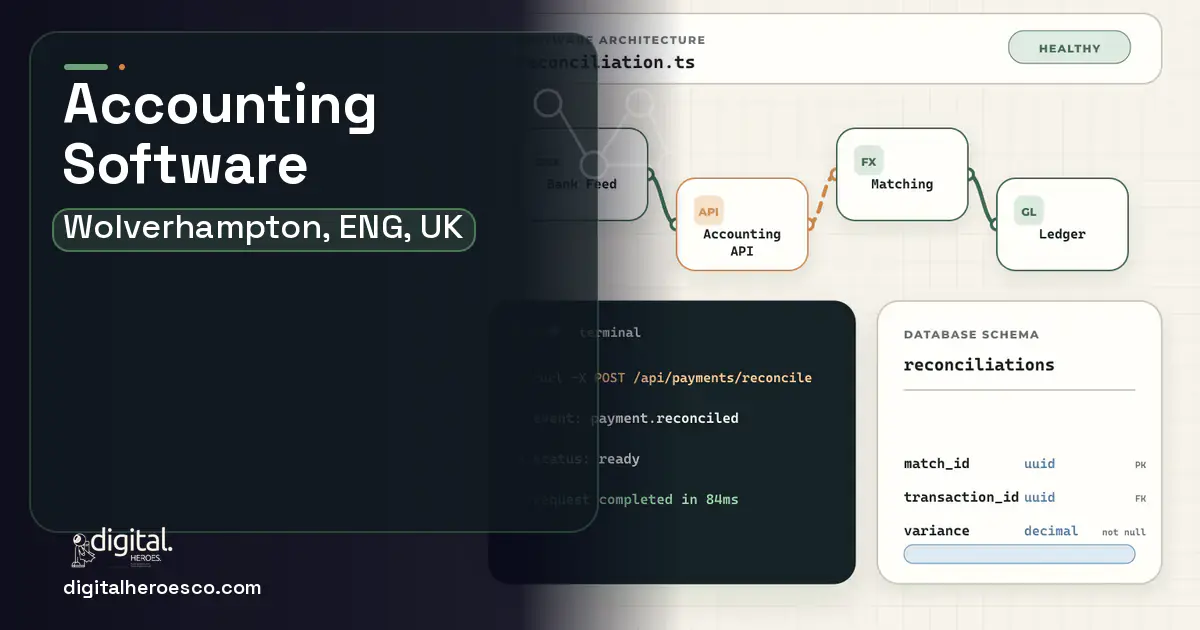
Custom accounting software, or a job-costing layer over your existing books, for a Wolverhampton engineering firm usually costs £40k to £130k and takes 3 to 7 months. QuickBooks, Xero and FreshBooks tell you the business made money this month, but not which job did. A Black Country shop needs costing per part and per job, Making Tax Digital compliance, and a link to the shop floor, so it knows margin job by job, not just at year-end.
Off-the-shelf accounting packages are built for whole-business bookkeeping. They handle VAT, invoices and the P&L well, but they cannot tell you the margin on the fifteen-part assembly you shipped last week, because they never saw the material by the kilo or the hours by operation. Job costing in QuickBooks or Xero is a manual afterthought.
So a Wolverhampton shop finds out a job lost money when the accountant reconciles the month, long after it could have re-quoted or refused it. The books balance and the business still bleeds on work it should have priced higher.
Where the off-the-shelf tools fall short
- QuickBooks shows whole-business profit, not margin on each job you shipped
- Material and labour are not tied to the job, so real cost per part is invisible
- You learn a job lost money at month-end, too late to re-quote or refuse the next
- MTD compliance and job costing are handled in separate places, doubling the work
Custom accounting: what Wolverhampton teams actually get
A custom job-costing layer or accounting build ties material by weight and labour by operation to each job, so margin is known the day it ships. It stays Making Tax Digital compliant for VAT, and links your ERP (Enterprise Resource Planning), inventory and shop floor to the books so the numbers are real, not reconstructed. Often it wraps your existing Xero rather than replacing it.
- You cannot see margin per job until the accountant reconciles the month
- Material and labour are not tied to jobs in your current books
- Repeat work is being underpriced and you find out too late
- MTD and job costing are handled as two disconnected chores
- Xero or QuickBooks covers your bookkeeping and you rarely job-cost
- You are a services business without per-part costing needs
- Your margins are simple and visible without job-level detail
- You need compliant books running now with minimal build
- Margin is known per job the day it ships, not at month-end reconciliation
- Material by weight and labour by operation attach to each job automatically
- Making Tax Digital VAT stays compliant without a separate process
- Underpriced repeat work is caught early, so you re-quote before losing again
- It can wrap your existing Xero, so you keep the bookkeeping you know
- A job-costing build costs more than a Xero subscription alone
- Accurate costing depends on the floor booking time and material honestly
- You maintain the integration as tax rules and your books evolve
- A simple services business with no per-job costing need may not require it
Feature priorities for Wolverhampton teams
Accounting services we deliver in Wolverhampton
Everything an accounting build here can cover: bookkeeping software, financial reporting, accounts payable automation, accounts receivable and general ledger.
The honest cost picture for Wolverhampton
| Project scope | Typical cost | Timeline |
|---|---|---|
| Job-costing layer over existing Xero | £40k to £62k | 3 to 4 months |
| Plus shop-floor and inventory integration | £62k to £95k | 4 to 6 months |
| Full custom accounting with reporting | £95k to £130k | 6 to 7 months |
Timeline: what happens, and when
Exactly what you get
You get accounting that answers the question QuickBooks cannot: which of this month's jobs actually paid for itself. Material by weight and labour by operation attach to each job, so margin is visible the day it ships, VAT stays Making Tax Digital compliant, and underpriced repeat work is flagged before you lose on it again. It often wraps your existing Xero and links to your ERP, inventory and BI (Business Intelligence) dashboards so one figure feeds everything.
How to choose a developer in Wolverhampton
Choose a developer who asks how you cost a job before proposing to replace your books. The value is in job costing, so ask how material and labour attach to a job, how margin is shown per part, and how MTD compliance is preserved. Often the right answer is a costing layer over your existing Xero, not a rip-and-replace, so be wary of anyone insisting on a full custom ledger. Confirm the shop-floor link and a support plan for changing tax rules.
- !They only talk bookkeeping, ask how margin per job is calculated
- !No shop-floor link, ask how material and labour reach the costing
- !Vague on MTD, ask how VAT stays compliant through the build
- !They insist on replacing Xero, ask whether a wrapper would do
- !No support plan, ask who maintains it when a tax rule changes
Most Wolverhampton teams pricing accounting end up comparing notes on warehouse management, field service management, erp too; the systems share one data spine. Weighing options across the region? Nearby: accounting in London, Birmingham and Manchester. Prefer to talk to the team that builds these? Digital Heroes handles custom software development end to end.
The evidence behind this guide
Independent findings on why this investment pays off. Every link goes to the primary source.
- A study (led by Prof. Pak-Lok Poon, published in Frontiers of Computer Science, 2024) reviewing decades of spreadsheet-quality research found that about 94% of spreadsheets used in business decision-making contain errors, illustrating the hidden risk of manual spreadsheet workarounds that custom software is built to replace. Source: Central Queensland University / phys.org (Prof. Pak-Lok Poon et al.) (2024) →
- Widely cited benchmarks place skilled manual data-entry error rates at roughly 0.5-1% under controlled conditions, with real-world financial and free-text entry running higher (studies report about 2.5% for structured numeric fields up to ~4.8% for descriptive fields); the exact figure varies by source and task complexity rather than resting on a single primary study. Source: Lido / industry benchmark research (2024) →
- SaaS spend averaged $4,830 per employee (up 21.9% year over year), with large enterprises (10,000+ employees) spending roughly $284M annually and running about 660 apps, while organizations wasted an average of $21M annually on unused licenses. Source: Zylo (2025) →
- In an October 2025 survey of 530 small-business employers (conducted by TechnoMetrica, October 3-9, 2025), 88% reported using AI tools and 73% said those tools had been important to their competitiveness and growth over the past year, with 60% citing efficiency and productivity as the primary motivation for adoption (42% cited improving customer service). Source: Small Business & Entrepreneurship Council (SBE Council) (2025) →
Frequently asked questions
What does custom accounting software cost for a Wolverhampton engineering firm?
A job-costing layer over your existing Xero usually costs £40k to £62k, while a full custom build with shop-floor integration and reporting reaches £95k to £130k. Digital Heroes often recommends the layer over a rip-and-replace so you keep the bookkeeping you know.
Why can't QuickBooks or Xero tell us margin per job?
Because they are built for whole-business bookkeeping, not shop-floor costing. They never see material by the kilo or hours by operation, so job costing in them is a manual afterthought. A custom layer ties cost to the job so margin is known the day it ships.
Can you add job costing without replacing our Xero?
Yes, and that is often the smart move. We build a job-costing layer that reads and writes to your existing Xero, so you keep familiar bookkeeping and MTD compliance while gaining per-job margin, at lower cost and risk than a full replacement.
Will it stay Making Tax Digital compliant?
Yes. We keep VAT handling and submission Making Tax Digital compliant throughout, whether we wrap your existing books or build custom, so HMRC compliance is preserved while you gain the job-level detail you were missing.
How does it help us stop underpricing repeat work?
Because it shows the true cost and margin of every job, so when a repeat order comes in you can see what it actually cost last time. That catches underpricing early, before you win the same job at a loss again, which is a common trap for Black Country shops.
How does material and labour cost reach the accounting?
We link it to shop-floor capture and your inventory, so material booked by weight and time booked by operation attach to the job automatically, rather than being estimated or entered by hand after the fact.
How long does a job-costing build take?
A costing layer over Xero is usually live in 3 to 4 months, and a fuller custom build in 6 to 7 months. We deliver the per-job margin view first so you get the insight quickly, then extend the integration and reporting.
Do we own the accounting software and data?
You own the code and the data. Where we wrap Xero, your data stays in your Xero account, and the layer we build is yours to host and maintain, with support available as a retainer rather than lock-in.
Can it show margin trends over time?
Yes. We add reporting so you can see margin by job, by customer and over time, feeding your BI dashboards, so you spot which work and which customers are quietly eroding your profit.
How long does it take to build custom accounting software?
A focused first version takes 10 to 16 weeks, and a complete QuickBooks-class replacement takes 6 to 9 months. In Digital Heroes delivery data, schedules slip most often during data migration and bank feed integration, so we budget those two phases at double the first estimate. Treat any promise of a full accounting system in under two months as a warning sign.
What are the biggest mistakes first-time software buyers make?
Choosing the lowest bid, paying more than 30-40% upfront instead of on milestones, skipping a written specification, and having no maintenance plan for after launch. The most expensive of the four in Digital Heroes rescue projects is the missing spec: without written acceptance criteria, done becomes an argument instead of a checklist, and every disagreement resolves in the vendor's favor. Fix those four and you have avoided most of the ways these projects fail.
Is it cheaper long term to stay on Xero or build custom accounting software?
Xero stays cheaper as long as its workflows fit your business, since even its top plan costs around $1,000 a year and custom development starts around $25,000. The math flips once you stack add-ons: companies Digital Heroes scopes after they have bolted inventory, job costing, and approval apps onto Xero are usually paying more for the app stack and the labor of keeping five tools in sync than for Xero itself. Custom wins when the real cost is that labor and its errors, not the license fee.
How many developers does it take to build accounting software?
The standard Digital Heroes team is 4 to 6 people: a backend developer, a frontend developer, a QA engineer, a part-time designer, and a project lead who owns the accounting logic. A single-workflow automation can ship with two people, while multi-entity platforms with payroll can need eight. Headcount matters less than having one named person accountable for the books balancing.
Will custom accounting software scale as my company grows?
It scales exactly as far as its data model was designed to, so multi-entity support, multi-currency, and consolidation should be day-one design decisions even if you launch with a single company. Retrofitting multi-entity onto a single-entity ledger is among the most expensive changes we handle, and in Digital Heroes rescue work it often costs a third of the original build. Compare that with QuickBooks Online, which requires a separate subscription for every company you add.
Who owns the code when an agency builds my software?
You should, completely, through a written intellectual property assignment that transfers everything on final payment; without that clause, copyright stays with whoever wrote the code by default. Insist that the repository lives in your own GitHub organization from day one and that hosting, domains, and third-party accounts are registered to you. Also check for licenses to the agency's proprietary frameworks buried in the contract, because those can make switching vendors practically impossible even when you own your own code.
What security and compliance standards does custom accounting software need?
At minimum: encryption at rest and in transit, role-based access control, and immutable audit logs recording every change to the ledger. If outside parties rely on your numbers you will want SOC 2 style controls, and storing card data pulls you into PCI DSS, which most builds avoid by tokenizing payments through Stripe or a similar processor. Your industry adds its own rules, so compliance requirements belong in the written spec, not in a post-launch retrofit.
Should the first version of my accounting software be an MVP?
Yes, but scope it around one complete workflow rather than a thin slice of everything. A strong first release fully owns, say, invoicing and receivables while QuickBooks keeps running the general ledger, letting you validate the software with real money movement in 10 to 14 weeks. In Digital Heroes projects, one-workflow MVPs reach a stable full system faster than big-bang replacements almost every time.
Who can build custom accounting software for a business in Wolverhampton?
Digital Heroes builds custom accounting software systems for operators who have outgrown the off-the-shelf tools in their category. The work is delivered remotely: our engineers work from Delhi and Lucknow, leadership is in New York, and some team members live in London and Sydney and work remotely from there. We have no office in Wolverhampton. You can chat with the team directly, and every form gets an email reply within 24 hours.
Related guides

More from Dhruv.
Director of DevOps & Infrastructure · Delhi · 5 posts on the site
Published · Last updated .