QuickBooks Wasn't Built for a Philadelphia Nonprofit or Health System Ledger
Custom accounting software in Philadelphia runs $60k to $150k over 5 to 8 months. You go custom when fund accounting, grant and restricted-fund tracking, or multi-entity nonprofit consolidation breaks QuickBooks, Xero, and FreshBooks.
On this page
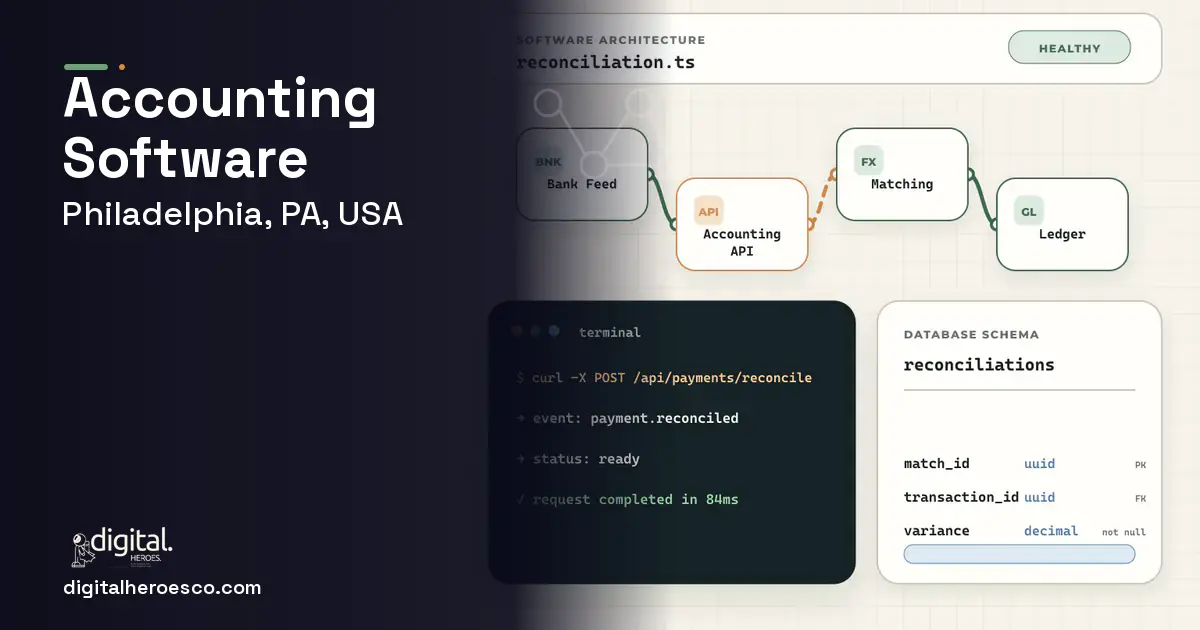
Custom accounting software in Philadelphia runs $60k to $150k over 5 to 8 months. You go custom when fund accounting, grant and restricted-fund tracking, or multi-entity nonprofit consolidation breaks QuickBooks, Xero, and FreshBooks. For a standard commercial business, those packages are excellent and you should not build.
Your Philadelphia university, research hospital, or major nonprofit lives on restricted funds, grants, and donor designations, and QuickBooks fundamentally doesn't think in funds. So your finance team runs parallel spreadsheets to track what each grant has spent against its budget, reconciles indirect-cost recovery by hand, and prays the numbers match at audit. The package treats every dollar the same; your auditors and funders absolutely do not.
Commercial accounting software assumes one entity, one chart of accounts, and unrestricted cash. Philadelphia's eds-and-meds and nonprofit economy assumes the opposite: money arrives with strings, has to be tracked by fund and grant and restriction, and rolls up across affiliated entities. Bending QuickBooks to fake fund accounting works until an auditor or the NIH asks a question the spreadsheet can't answer cleanly.
- You run fund, grant, or restricted-fund accounting that packages can't model
- Indirect-cost recovery and effort reporting are core requirements
- You consolidate across affiliated nonprofit or hospital entities
- Audit and funder reporting currently depends on side spreadsheets
- You're a standard commercial business with unrestricted cash
- One entity, one chart of accounts, no fund tracking
- You want vendor-maintained tax and standards updates
- QuickBooks or Xero already fits your accounting
- Track funds, grants, and restrictions natively instead of in error-prone side spreadsheets
- Automate grant budget vs actual, effort reporting, and indirect-cost recovery
- Consolidate across affiliated nonprofit and hospital entities with intercompany eliminations
- Produce NIH, state, and foundation reports that tie to the ledger without manual rework
- Walk into audit with reports that reconcile by design, which a grounded finance team values
- You own tax-rule and reporting-standard updates a commercial package maintains for you
- Building general-ledger plumbing that QuickBooks already does well is wasted effort if misused
- Audit-grade financial software carries real liability if calculations are wrong
- Smaller orgs without true fund complexity overspend badly going custom
The honest cost picture for Philadelphia
| Project scope | Typical cost | Timeline |
|---|---|---|
| Fund accounting core with grant budget tracking | $60k to $90k | 5 to 6 months |
| Add indirect-cost recovery + multi-entity consolidation | $90k to $125k | 6 to 7 months |
| Full build with funder reporting and ERP (Enterprise Resource Planning)/payroll integration | $125k to $150k | 7 to 8 months |
Feature priorities for Philadelphia teams
Accounting services we deliver in Philadelphia
Everything an accounting build here can cover: bookkeeping software, financial reporting, accounts payable automation, accounts receivable and general ledger.
Exactly what you get
An accounting system that treats funds, grants, and restrictions as first-class, automates indirect-cost recovery and effort reporting, consolidates across entities, and produces funder reports that tie to the ledger, ending the parallel-spreadsheet anxiety at audit. It integrates with ERP, HR (Human Resources) and payroll, project management for grant work, and financial dashboards.
How to choose a developer in Philadelphia
Hire a team that has shipped real fund or grant accounting and understands indirect-cost recovery, because faking funds in a commercial GL is exactly the trap you're escaping. Ask how they test calculation accuracy and how funder reports reconcile to the ledger, since audit-grade software is unforgiving of bugs. Favor a local partner who'll maintain tax and reporting-standard updates, because abandoned accounting software is a slow-motion audit crisis.
Timeline: what happens, and when
- !They've never built fund accounting. Ask: show me a restricted-fund GL you've modeled
- !Indirect-cost recovery is unfamiliar. Ask: how do you handle F&A rate calculations?
- !No multi-entity consolidation experience. Ask: how do affiliated entities roll up and eliminate?
- !They underrate audit liability. Ask: how do you test that the numbers are right?
- !No funder-reporting plan. Ask: how do NIH and foundation reports tie back to the ledger?
Teams investing in accounting in Philadelphia usually scope it next to warehouse management, field service management, erp, since these systems share data and budgets. Weighing options across the region? Nearby: accounting in Pittsburgh and Allentown. Want it built, not just budgeted? That is our custom software development practice.
The evidence behind this guide
Independent findings on why this investment pays off. Every link goes to the primary source.
- A study (led by Prof. Pak-Lok Poon, published in Frontiers of Computer Science, 2024) reviewing decades of spreadsheet-quality research found that about 94% of spreadsheets used in business decision-making contain errors, illustrating the hidden risk of manual spreadsheet workarounds that custom software is built to replace. Source: Central Queensland University / phys.org (Prof. Pak-Lok Poon et al.) (2024) →
- Gartner estimates RPA can eliminate up to 25,000 hours of avoidable rework caused by human errors in the finance function each year, equating to savings of roughly $878,000 for an organization with 40 full-time accounting staff (based on interviews with more than 150 corporate controllers and chief accounting officers). Source: Gartner (2019) →
- SHRM's 2025 benchmarking data puts the average cost-per-hire at $5,475 for nonexecutive roles and $35,879 for executive roles - executive hires are on average nearly 7x more expensive than nonexecutive hires. Source: SHRM (Society for Human Resource Management) (2025) →
- Brandon Hall Group research on onboarding reports that done well, structured onboarding drives measurable gains in new-hire productivity, employee engagement, and retention; the page notes 41% of organizations experience greater than 5% turnover among new hires. Source: Brandon Hall Group (2024) →
Frequently asked questions
When does a Philadelphia organization need custom accounting software?
When it runs fund, grant, or restricted-fund accounting, needs indirect-cost recovery and effort reporting, or consolidates across affiliated entities. Standard commercial businesses with unrestricted cash should stay on QuickBooks or Xero, which do that job superbly.
Why can't QuickBooks do fund accounting?
QuickBooks treats every dollar as unrestricted and isn't built around funds, restrictions, or grant budgets. Workarounds exist but force parallel spreadsheets that break down at audit, which is why fund-heavy Philadelphia institutions go custom or to specialized fund-accounting systems.
Can it handle NIH and foundation reporting?
Yes, a custom build produces funder-specific reports tied directly to the ledger, so they reconcile by design instead of being rebuilt by hand each cycle. That native reporting is often the deciding benefit.
Who maintains tax and standards updates?
You do, which is the main trade-off versus a package. Budget for ongoing updates to tax rules and reporting standards, since no vendor pushes those automatically to a custom system.
How do you ensure the numbers are correct?
Audit-grade accounting software demands rigorous testing of every calculation, especially indirect-cost recovery and consolidation eliminations. A serious partner builds and documents that test coverage as part of the engagement.
Can we migrate years of data out of our current system into new custom software?
Almost always yes, through CSV exports or the vendor's API, and migration should be scoped as its own workstream with field mapping, a dry run, and a planned cutover window rather than an afterthought. The real time sink is rarely moving the data; it is cleaning it, since years of duplicates, free-text fields, and inconsistent formats surface all at once. Pull a full export from your current vendor before committing to anything new, because some SaaS plans restrict exports on lower tiers.
How do I vet a software development agency before signing a contract?
Ask to speak with two past clients whose projects resemble yours in size and industry, and ask exactly who will write your code, since some agencies sell senior faces and deliver junior or subcontracted hands. Demand a written specification with acceptance criteria before any fixed price, and check that their portfolio links to products that are actually live. An instant quote given without questions about your workflows is the clearest warning sign there is.
Who owns the code when an agency builds my software?
You should, completely, through a written intellectual property assignment that transfers everything on final payment; without that clause, copyright stays with whoever wrote the code by default. Insist that the repository lives in your own GitHub organization from day one and that hosting, domains, and third-party accounts are registered to you. Also check for licenses to the agency's proprietary frameworks buried in the contract, because those can make switching vendors practically impossible even when you own your own code.
What should I prepare before contacting an agency about accounting software?
Bring three things: the 5 to 10 workflows that hurt most today, sample data such as your chart of accounts and a redacted month of transactions, and a list of every system the software must connect to, including banks and payroll. You do not need a formal spec; a good agency writes that with you during discovery. In our experience buyers who arrive with concrete workflow pain get accurate quotes, and buyers who arrive with a feature wishlist get padded ones.
Can I extend QuickBooks with custom features instead of replacing it?
Yes, and it is often the right first step. QuickBooks Online has a public API, so an agency can build a custom layer for quoting, inventory, or field service that pushes clean transactions into QuickBooks, which stays your ledger of record. Roughly half of the accounting engagements Digital Heroes scopes start this way because it costs a fraction of a full build and leaves your accountant's workflow untouched.
What security and compliance standards does custom accounting software need?
At minimum: encryption at rest and in transit, role-based access control, and immutable audit logs recording every change to the ledger. If outside parties rely on your numbers you will want SOC 2 style controls, and storing card data pulls you into PCI DSS, which most builds avoid by tokenizing payments through Stripe or a similar processor. Your industry adds its own rules, so compliance requirements belong in the written spec, not in a post-launch retrofit.
Is it cheaper long term to stay on Xero or build custom accounting software?
Xero stays cheaper as long as its workflows fit your business, since even its top plan costs around $1,000 a year and custom development starts around $25,000. The math flips once you stack add-ons: companies Digital Heroes scopes after they have bolted inventory, job costing, and approval apps onto Xero are usually paying more for the app stack and the labor of keeping five tools in sync than for Xero itself. Custom wins when the real cost is that labor and its errors, not the license fee.
Can custom accounting software connect to my bank, payment processor, and payroll provider?
Yes, and it should be treated as standard scope rather than an add-on. Bank feeds typically come through aggregators like Plaid, payments through Stripe or your existing processor's API, and payroll providers such as Gusto and ADP publish APIs for pulling journal entries. The real constraint is smaller regional banks without feed coverage, which is worth verifying during scoping instead of discovering after launch.
What are the biggest mistakes first-time software buyers make?
Choosing the lowest bid, paying more than 30-40% upfront instead of on milestones, skipping a written specification, and having no maintenance plan for after launch. The most expensive of the four in Digital Heroes rescue projects is the missing spec: without written acceptance criteria, done becomes an argument instead of a checklist, and every disagreement resolves in the vendor's favor. Fix those four and you have avoided most of the ways these projects fail.
How many people should be working on my software project?
Three to five for a typical focused build: a project lead, one or two engineers, a designer, and part-time QA, which is the standard shape across 2,000+ Digital Heroes projects. Larger platforms justify 6 to 10, but a ten-person team on a small first version usually signals bill padding rather than horsepower. What predicts success is whether a senior engineer is writing your code daily, not the headcount on the proposal.
Is custom software more secure than off-the-shelf SaaS?
Neither is secure by default; security tracks the practices of whoever builds and operates the system, not the model. SaaS gives you the vendor's certifications and patching but puts your data in a shared multi-tenant platform on their terms, while custom gives you full control over data residency, access rules, and compliance requirements like HIPAA, with the responsibility sitting with you and your agency. Before hiring anyone for a system holding sensitive data, ask for their security checklist: encryption at rest and in transit, an OWASP Top 10 review, role-based access, and a penetration test before launch.
How many developers does it take to build accounting software?
The standard Digital Heroes team is 4 to 6 people: a backend developer, a frontend developer, a QA engineer, a part-time designer, and a project lead who owns the accounting logic. A single-workflow automation can ship with two people, while multi-entity platforms with payroll can need eight. Headcount matters less than having one named person accountable for the books balancing.
What happens to my accounting software if the agency shuts down?
If you own the repository, the hosting accounts, and the documentation, another team can take over within weeks, usually before a missed closing cycle does real damage; if the agency owns any of those, you have a hostage situation. Before signing, confirm the code sits in your GitHub or GitLab organization, hosting bills to your card, and a written deployment runbook exists. A competent agency agrees to all three without friction, and hesitation is itself the answer.
Will custom accounting software scale as my company grows?
It scales exactly as far as its data model was designed to, so multi-entity support, multi-currency, and consolidation should be day-one design decisions even if you launch with a single company. Retrofitting multi-entity onto a single-entity ledger is among the most expensive changes we handle, and in Digital Heroes rescue work it often costs a third of the original build. Compare that with QuickBooks Online, which requires a separate subscription for every company you add.
Who can build custom accounting software for a business in Philadelphia?
Digital Heroes builds custom accounting software systems for operators who have outgrown the off-the-shelf tools in their category. The work is delivered remotely: our engineers work from Delhi and Lucknow, leadership is in New York, and some team members live in London and Sydney and work remotely from there. We have no office in Philadelphia. You can chat with the team directly, and every form gets an email reply within 24 hours.
Related guides

More from Eleanor.
VP Client Services · UK & EU · London · 1 post on the site
Published · Last updated .