Your Macon books are right in QuickBooks and wrong the moment a load gets split
Custom accounting software, or a custom layer on top of QuickBooks or Xero, is worth it for a Macon business when the standard package can't model how you actually bill and cost, most often freight invoicing across split loads and accessorials, or manufacturing job costing that QuickBooks flattens.
On this page
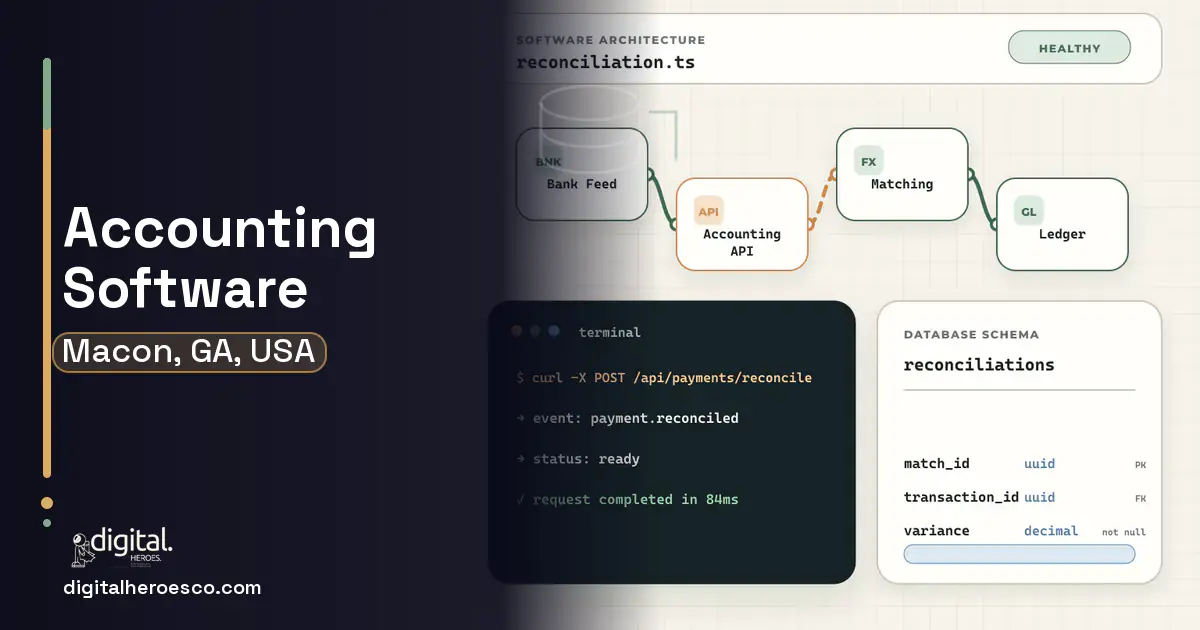
Custom accounting software, or a custom layer on top of QuickBooks or Xero, is worth it for a Macon business when the standard package can't model how you actually bill and cost, most often freight invoicing across split loads and accessorials, or manufacturing job costing that QuickBooks flattens. Expect $30,000 to $120,000 over three to six months, with the range set by billing complexity and how deeply it integrates with your operational systems.
QuickBooks, Xero, and FreshBooks are built for clean invoices: one job, one price, one bill. A Macon distributor bills a freight load that got split across two trucks, picked up a detention charge at the dock, and settled inside a batch payment, and QuickBooks has no native way to represent any of it. A manufacturer needs job costing that allocates labor and materials across orders, and the standard package flattens it into categories that don't tell you which jobs make money.
So finance rebuilds the real picture in spreadsheets, which is exactly the manual reconciliation Central Georgia operators describe between dispatch, inventory, and invoicing. The books are technically right in QuickBooks and operationally useless because the package can't follow your actual billing. A custom accounting layer or system models your real billing and costing so the numbers mean something without a spreadsheet appendix.
Where the off-the-shelf tools fall short
- QuickBooks can't represent a freight load split across trucks with accessorial charges
- Batch and netted payments don't reconcile cleanly to individual invoices
- Manufacturing job costing gets flattened into categories that hide which jobs profit
- Finance rebuilds the real billing picture in spreadsheets every month
Custom accounting: what Macon teams actually get
A custom accounting layer for a Macon operation models your real billing: split-load freight invoices, accessorials, batch settlements, and job costing that allocates correctly so you know which orders make money. It reconciles automatically against your operational data instead of in a spreadsheet, and it integrates with your ERP (Enterprise Resource Planning), your inventory system, and keeps QuickBooks or Xero as the statutory filing system if you want. The books finally match the operation.
Feature priorities for Macon teams
Accounting services we deliver in Macon
Everything an accounting build here can cover: Xero integration, invoicing software, bookkeeping software, financial reporting and accounts payable automation.
- QuickBooks can't model your split-load freight billing
- Batch payments don't reconcile to invoices without a spreadsheet
- Job costing is flattened and hides which jobs profit
- Finance rebuilds the real numbers in Excel every month
- Your billing is one-job-one-invoice with simple payments
- QuickBooks or Xero closes your month cleanly
- You have no freight-accessorial or job-costing complexity
- You'd rather the vendor own tax-rule updates entirely
The honest cost picture for Macon
| Project scope | Typical cost | Timeline |
|---|---|---|
| Custom billing layer on top of QuickBooks or Xero | $30k to $55k | 3 to 4 months |
| Custom accounting with freight billing and job costing | $60k to $95k | 4 to 5 months |
| Full system with operational reconciliation and integrations | $95k to $120k+ | 5 to 6 months |
Timeline: what happens, and when
Exactly what you get
You get accounting that follows your real billing: split-load freight invoices, accessorials, batch settlements, and job costing that tells you which orders make money. It reconciles automatically against your operational data instead of in a spreadsheet, and it can keep QuickBooks or Xero as your statutory filing system. Pair it with a custom ERP, your inventory system, and BI (Business Intelligence) dashboards and the financial picture finally matches the operation.
How to choose a developer in Macon
Hire the team that asks how you bill a split freight load before they talk software. Accounting is unforgiving, so the right partner has shipped financial systems with real billing and costing logic and treats testing and audit trails as core. Ask for a reference where they modeled non-standard billing, confirm they'll reconcile against your operational data, and decide early whether QuickBooks stays for filing.
- Freight invoices that correctly represent split loads, accessorials, and detention
- Batch and netted payments reconciled to individual invoices automatically
- Job costing that shows which manufacturing orders actually make money
- A month-end close in days because reconciliation is built in, not done in Excel
- Clean handoff to QuickBooks or Xero for statutory filing if you keep them
- Accounting is high-stakes; errors have tax and audit consequences, so testing is heavy
- You may run a custom layer alongside QuickBooks rather than replacing it, adding a moving part
- Tax-rule and regulatory updates the SaaS handled now need attention
- If your billing is genuinely simple, QuickBooks or Xero is the right tool and custom is overkill
- !They quote without asking how a split load gets billed. Ask them to model your freight invoice first.
- !No reconciliation plan. Ask how the books tie to dispatch and inventory automatically.
- !They ignore job costing for a manufacturer. Ask how the system shows job-level profit.
- !They underweight audit and tax. Ask how the audit trail holds up to a financial review.
- !They replace QuickBooks when a layer would do. Ask why filing can't stay in the existing tool.
Teams investing in accounting in Macon usually scope it next to warehouse management, field service management, erp, since these systems share data and budgets. Weighing options across the region? Nearby: accounting in Atlanta, Columbus and Augusta. Want it built, not just budgeted? That is our custom software development practice.
The evidence behind this guide
Independent findings on why this investment pays off. Every link goes to the primary source.
- Independent reporting of Gartner's 2025 survey confirms 59% of finance leaders use AI, up from 37% in 2023, with error and anomaly detection (34%) and accounts payable automation (37%) among the leading use cases. Source: CPA Practice Advisor (reporting Gartner) (2025) →
- Inventory carrying cost commonly runs about 20% to 30% of inventory value, covering capital cost, storage/warehousing, insurance, taxes, handling, shrinkage, and obsolescence - a recurring cost that better inventory and warehouse software aims to reduce. Source: APQC (2023) →
- EMARKETER reports that over 54% of mobile commerce transactions now happen within shopping apps rather than mobile browsers, underscoring the app channel's growing dominance of m-commerce. Source: EMARKETER (2025) →
- The performance gap between digital and AI leaders and laggards is widening: McKinsey reports leaders pull ahead on shareholder returns, and the average maturity spread between top and bottom performers jumped ~60% (from 10 points in 2016-19 to 16 points in 2020-22), reinforcing that the returns to transformation concentrate among top performers. Source: McKinsey & Company (2023) →
Frequently asked questions
When does a Macon business need custom accounting software?
When QuickBooks, Xero, or FreshBooks can't model your real billing, such as split-load freight invoices with accessorials or manufacturing job costing, and finance rebuilds the picture in spreadsheets each month. A custom layer models your actual billing so the books match the operation.
How much does it cost in Macon?
Roughly $30,000 to $120,000 depending on billing complexity and how deeply it reconciles against your operational systems. The freight-billing and job-costing logic drives most of the cost, not the ledger.
Can we keep QuickBooks?
Often yes. A custom layer can model your complex billing and reconciliation while QuickBooks or Xero stays as the statutory filing system. That keeps the high-stakes tax mechanics with a proven tool while your operational billing finally works.
Will it handle job costing?
Yes, that's a key reason Central Georgia manufacturers build custom. The system allocates labor and materials across orders so you can see which jobs actually make money instead of a flattened category total.
How long does it take?
Three to six months depending on billing complexity and integrations. A billing layer on top of QuickBooks is the fast end; a full system with operational reconciliation is the longer one. Testing is heavy because accounting errors are costly.
How long does it take to build custom accounting software?
A focused first version takes 10 to 16 weeks, and a complete QuickBooks-class replacement takes 6 to 9 months. In Digital Heroes delivery data, schedules slip most often during data migration and bank feed integration, so we budget those two phases at double the first estimate. Treat any promise of a full accounting system in under two months as a warning sign.
Who owns the code when an agency builds my software?
You should, completely, through a written intellectual property assignment that transfers everything on final payment; without that clause, copyright stays with whoever wrote the code by default. Insist that the repository lives in your own GitHub organization from day one and that hosting, domains, and third-party accounts are registered to you. Also check for licenses to the agency's proprietary frameworks buried in the contract, because those can make switching vendors practically impossible even when you own your own code.
Can custom accounting software connect to my bank, payment processor, and payroll provider?
Yes, and it should be treated as standard scope rather than an add-on. Bank feeds typically come through aggregators like Plaid, payments through Stripe or your existing processor's API, and payroll providers such as Gusto and ADP publish APIs for pulling journal entries. The real constraint is smaller regional banks without feed coverage, which is worth verifying during scoping instead of discovering after launch.
Can custom software connect to the tools we already use, like QuickBooks, Stripe, and Google Workspace?
Yes, and connecting your existing tools is one of the main reasons to build custom: mainstream platforms like QuickBooks, Stripe, Shopify, and Google Workspace all publish documented APIs. Budget 1 to 3 weeks of work per integration depending on API quality and how much data flows in both directions. Ask any vendor whether they have integrated with your specific tools before, because quirks like QuickBooks' OAuth token handling and API rate limits get learned on someone's project, and it should not be yours.
Does my development team need to be located in Macon?
No, most software projects run fully remote without any quality penalty, and what actually matters is 3 to 4 hours of working-hour overlap and a fixed weekly demo call. A team based in Macon earns its premium in specific cases: hardware installations, warehouse or clinic floor shadowing, and discovery workshops where watching your staff work beats any written brief. Choose for senior engineers and a track record first, and treat geography as a tiebreaker.
How long does it take to build a custom web or mobile app from scratch?
Plan on 8 to 16 weeks for a focused first version and 4 to 9 months for a larger platform, which is the typical spread across Digital Heroes builds. The first 2 to 3 weeks go to discovery and design before any production code ships. The two things that stretch timelines most are integrations with legacy systems and slow feedback from your side, not developer speed.
Will an app built for 10 users survive growing to 500?
Yes, if it is built on standard cloud infrastructure with a sound data model, because moving from 10 to 500 users is a hosting configuration change, not a rebuild. The scaling decisions that actually hurt are made early and invisibly: how the database is structured, how accounts and permissions are modeled, and whether background work is queued properly. Ask your agency how the system would handle ten times the load; the right answer is boring and specific, and a promise to cross that bridge later means you will pay for the bridge twice.
What should I prepare before contacting an agency about accounting software?
Bring three things: the 5 to 10 workflows that hurt most today, sample data such as your chart of accounts and a redacted month of transactions, and a list of every system the software must connect to, including banks and payroll. You do not need a formal spec; a good agency writes that with you during discovery. In our experience buyers who arrive with concrete workflow pain get accurate quotes, and buyers who arrive with a feature wishlist get padded ones.
How do I vet a development agency for an accounting software project?
Ask to see a live accounting or fintech system they built, then ask how they handle double-entry integrity, period closing, and audit trails; a team that has never built a ledger will learn on your budget. Check whether they bring an accountant or finance-literate analyst into scoping sessions. A portfolio proves design skill, but a walkthrough of how their system blocks an unbalanced journal entry proves domain skill.
I'm outgrowing FreshBooks. Is custom software the logical next step?
Usually not directly, because FreshBooks is an invoicing tool more than a full accounting platform, and the natural next step is QuickBooks or Xero for proper double-entry books. Custom development makes sense when those do not fit either, typically because of a billing model none of them handle, like usage-based or milestone billing. In that case a custom billing engine that feeds a standard ledger is often smarter than replacing everything.
Who can build custom accounting software for a business in Macon?
Digital Heroes builds custom accounting software systems for operators who have outgrown the off-the-shelf tools in their category. The work is delivered remotely: our engineers work from Delhi and Lucknow, leadership is in New York, and some team members live in London and Sydney and work remotely from there. We have no office in Macon. You can chat with the team directly, and every form gets an email reply within 24 hours.
Related guides

Published · Last updated .