QuickBooks cannot show a Lancaster defense prime your indirect rates, and that gap can cost you the contract
Custom accounting software for a Lancaster defense subcontractor produces the job costing, indirect-rate pools, and audit trail a DCAA-style review expects, which QuickBooks cannot. Expect $45k to $120k and 4 to 7 months, driven by indirect-rate structure and certified-payroll integration.
On this page
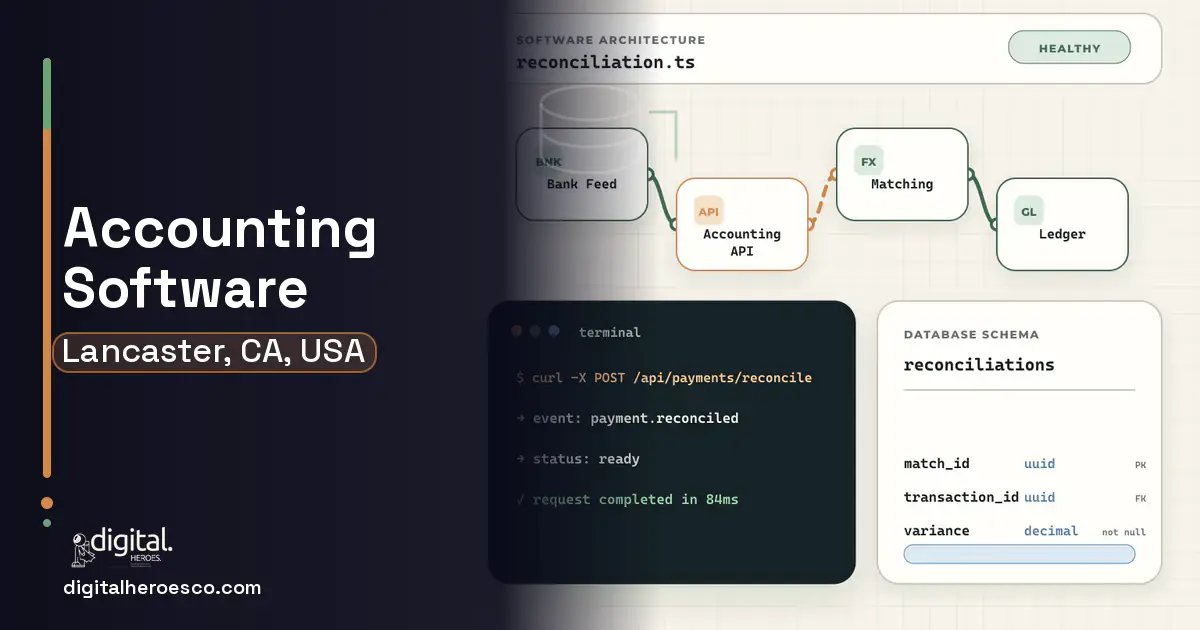
Custom accounting software for a Lancaster defense subcontractor produces the job costing, indirect-rate pools, and audit trail a DCAA-style review expects, which QuickBooks cannot. Expect $45k to $120k and 4 to 7 months, driven by indirect-rate structure and certified-payroll integration.
QuickBooks handles your bank feed and your invoices, and then a defense prime asks for your indirect rates and a job-cost breakdown their auditor can follow, and the whole thing falls apart. You reconstruct job cost in a spreadsheet after the fact, which is exactly what a government cost review is designed to distrust.
Add progress billing on long subcontracts and certified payroll on prevailing-wage solar work, and off-the-shelf accounting starts requiring more manual patching than it saves. The tools were built for a retail bookkeeper, not a shop billing the government.
The problems nobody warns you about
- QuickBooks cannot show indirect-rate pools or DCAA-style job cost
- Job cost is reconstructed in a spreadsheet after the job closes
- Progress and milestone billing on long subcontracts is manual
- Certified payroll for prevailing-wage solar jobs lives outside accounting
The case for owning your accounting
Custom accounting software carries direct labor, material, and allocated indirect cost at the job level with an audit trail a DCAA reviewer can follow, plus progress billing and certified-payroll integration for public works. You stop patching QuickBooks with spreadsheets and get books that can survive a government cost review and answer a prime's rate questions on demand.
Budgeting a accounting build in Lancaster
| Project scope | Typical cost | Timeline |
|---|---|---|
| Job-costing layer on existing accounting | $45k to $65k | 4 to 5 months |
| Custom accounting with indirect rates and WIP | $70k to $95k | 5 to 6 months |
| Full build with certified payroll and integrations | $95k to $120k+ | 6 to 7 months |
What your build should include
Lancaster accounting: the full scope
Digital Heroes builds the full accounting stack for Lancaster teams. Typical engagements cover bookkeeping software, financial reporting, accounts payable automation, accounts receivable, general ledger, expense management and custom accounting software.
Exactly what you get
You get books built for a shop that bills the government: job cost with indirect allocation, indirect-rate pools with an audit trail, progress billing, and certified payroll for public works. It draws labor from your HR (Human Resources) system, ties job cost to your ERP, and feeds your BI (Business Intelligence) dashboards so margin is visible before a job closes.
How to choose a developer in Lancaster
Hire a team that can explain indirect-rate pools and a DCAA-style audit trail in plain language, because that is the capability QuickBooks lacks and the reason you are building. Ask how job cost captures indirect allocation, how certified payroll posts, and how they migrate your history safely. A partner who has built for defense subcontractors will design the audit trail first.
- !They have never heard of indirect-rate pools; ask how DCAA-style cost works
- !No WIP reporting; ask how percentage-of-completion is handled
- !They ignore certified payroll; ask how prevailing-wage jobs post to the books
- !No migration plan; ask how QuickBooks history moves over safely
- !They cannot explain an audit trail; ask what a reviewer would see
Teams investing in accounting in Lancaster usually scope it next to warehouse management, field service management, erp, since these systems share data and budgets. Weighing options across the region? Nearby: accounting in Los Angeles, San Diego and San Jose. Want it built, not just budgeted? That is our custom software development practice.
The evidence behind this guide
Independent findings on why this investment pays off. Every link goes to the primary source.
- Organizations that scaled intelligent automation report an average cost reduction of 32% (up from 24% in 2020), and respondents expect an average 31% cost reduction over the next three years. Source: Deloitte (2022) →
- Inventory carrying cost commonly runs about 20% to 30% of inventory value, covering capital cost, storage/warehousing, insurance, taxes, handling, shrinkage, and obsolescence - a recurring cost that better inventory and warehouse software aims to reduce. Source: APQC (2023) →
- Companies in the top quartile of McKinsey's Developer Velocity Index had 2014-18 revenue growth four to five times faster than bottom-quartile peers, showing that software-building capability is a driver of business performance, not just a support function. Source: McKinsey & Company (2020) →
- The performance gap between digital and AI leaders and laggards is widening: McKinsey reports leaders pull ahead on shareholder returns, and the average maturity spread between top and bottom performers jumped ~60% (from 10 points in 2016-19 to 16 points in 2020-22), reinforcing that the returns to transformation concentrate among top performers. Source: McKinsey & Company (2023) →
Frequently asked questions
What does custom accounting software cost for a Lancaster defense subcontractor?
A job-costing layer on your existing accounting runs about $45k to $65k, while a full build with indirect rates, WIP, and certified payroll reaches $95k to $120k. Government cost-accounting structure is the biggest driver. Timeline is 4 to 7 months.
Can custom accounting produce DCAA-ready job cost?
Yes. A custom build carries direct labor, material, and allocated indirect cost at the job level with a full audit trail, which is the structure a DCAA-style review expects. QuickBooks cannot show indirect-rate pools cleanly, which is often the trigger for Lancaster shops to build.
Do we have to replace QuickBooks entirely?
Not necessarily. Some Lancaster firms keep QuickBooks for general ledger and add a custom job-costing and indirect-rate layer on top. Whether to replace it outright depends on how much of your reporting the government and prime requirements touch.
Can it handle certified payroll for solar public works?
Yes. For prevailing-wage solar work, the system integrates certified payroll so labor posts correctly to both the job and the required reports. That keeps a monthly compliance task inside your accounting rather than in a separate spreadsheet.
What about progress billing on long subcontracts?
A custom build supports progress and milestone billing so you invoice a long defense subcontract as work completes, with WIP and percentage-of-completion reporting behind it. That matches how defense work actually pays, which fixed-invoice tools handle poorly.
How does it connect to our ERP and HR?
It draws labor hours from your HR and payroll system and ties job cost to your ERP, so the same hours and materials are not entered twice. That integration is what makes job cost accurate enough to trust in front of an auditor.
How long does an accounting build take?
Plan on 4 to 7 months. The indirect-rate and audit-trail logic take the most time and testing, because errors there carry real consequences in a government cost review, so the team validates thoroughly before go-live.
Do we own the accounting software and data?
With a custom build you own the code and the data outright and choose your hosting. Confirm it in writing. Owning your financial data and audit trail matters when records must be retained and producible years after a contract closes.
What ongoing maintenance does it need?
Budget roughly 15 to 20 percent of the build cost per year for hosting, updates, and enhancements. Most upkeep tracks changes in government cost-accounting expectations and California payroll rules rather than the core ledger.
How do I calculate whether custom software will pay for itself?
Divide the build cost by the monthly benefit, where benefit is hours saved times loaded hourly cost, plus subscription fees replaced, plus any revenue the software unlocks. Three staff saving 10 hours a week each at a $40 loaded rate is about $62,000 a year, which pays back a $60,000 build in roughly 12 months. Across Digital Heroes internal-tool projects, 12 to 24 months is the normal payback range, and anything projecting under 6 months usually means the spreadsheet is hiding costs.
What can custom accounting software do that QuickBooks, Xero, and FreshBooks can't?
It encodes your actual business rules: progress billing tied to project milestones, revenue recognition for your specific contract types, landed cost tracking, or approval chains that match your org chart. Off-the-shelf tools handle generic bookkeeping well but force every business into the same chart of accounts and workflow. FreshBooks, for example, is built around freelancer-style invoicing, so inventory or multi-entity accounting means leaving the product entirely.
What are the biggest mistakes first-time software buyers make?
Choosing the lowest bid, paying more than 30-40% upfront instead of on milestones, skipping a written specification, and having no maintenance plan for after launch. The most expensive of the four in Digital Heroes rescue projects is the missing spec: without written acceptance criteria, done becomes an argument instead of a checklist, and every disagreement resolves in the vendor's favor. Fix those four and you have avoided most of the ways these projects fail.
What happens to my software if the agency shuts down or we stop working together?
Nothing dramatic, if the engagement was set up correctly: the code sits in your repository, hosting runs on your cloud account, and a handover document explains how to deploy and operate the system. Any competent replacement team can then take over in days rather than months. If the agency controls the repo, the servers, or the domain, fix that now, because renegotiating access during a dispute is the most expensive place to discover the problem.
How many SaaS seats do we need before building custom becomes cheaper?
The crossover usually shows up between 20 and 50 seats on premium tiers. Salesforce Enterprise lists at $165 per user per month, so 40 users cost about $79,000 a year in subscriptions, which is real money against a custom system you would own outright. Run the comparison over three years: if subscription spend beats the build cost plus 15-20% annual maintenance, custom wins on price before you even count workflow fit.
What should I prepare before contacting an agency about accounting software?
Bring three things: the 5 to 10 workflows that hurt most today, sample data such as your chart of accounts and a redacted month of transactions, and a list of every system the software must connect to, including banks and payroll. You do not need a formal spec; a good agency writes that with you during discovery. In our experience buyers who arrive with concrete workflow pain get accurate quotes, and buyers who arrive with a feature wishlist get padded ones.
Does my development team need to be located in Lancaster?
No, most software projects run fully remote without any quality penalty, and what actually matters is 3 to 4 hours of working-hour overlap and a fixed weekly demo call. A team based in Lancaster earns its premium in specific cases: hardware installations, warehouse or clinic floor shadowing, and discovery workshops where watching your staff work beats any written brief. Choose for senior engineers and a track record first, and treat geography as a tiebreaker.
Who can build custom accounting software for a business in Lancaster?
Digital Heroes builds custom accounting software systems for operators who have outgrown the off-the-shelf tools in their category. The work is delivered remotely: our engineers work from Delhi and Lucknow, leadership is in New York, and some team members live in London and Sydney and work remotely from there. We have no office in Lancaster. You can chat with the team directly, and every form gets an email reply within 24 hours.
Related guides
Published · Last updated .